

In the high-stakes environment of the 2026 Florida real estate market, the primary impediment to institutional-grade portfolio expansion is frequently not a scarcity of viable assets, but rather the structural rigidity of traditional banking institutions. You’ve likely encountered the significant friction caused by onerous credit mandates and protracted underwriting cycles; it’s these delays that often force sophisticated investors to seek alternative solutions from specialized hard money lenders Orlando. Speed is often the deciding factor in capital preservation. Securing reliable capital requires moving beyond the bureaucratic constraints of conventional finance to embrace a more disciplined, asset-centric approach that prioritizes property fundamentals.
This strategic guide provides a disciplined analysis of how private capital serves as a collaborative ally in the preservation and generation of worth. We’ll examine the sophisticated mechanics of capital allocation for new construction and multi-family assets, focusing on the rapid deployment of funds based on property intrinsic value rather than borrower credit history. You’ll gain a comprehensive understanding of the 2026 lending environment, including current interest rate benchmarks and the customized structures required to scale a high-value real estate portfolio with precision and stability.
Key Takeaways
- Understand why private capital functions as a tactical alternative to traditional debt; it’s the agility provided that allows investors to navigate the inherent volatility of high-stakes real estate markets.
- Analyze the structural anatomy of asset-backed financing, specifically the critical application of Loan-to-Value and Loan-to-Cost ratios within the 2026 fiscal landscape.
- Evaluate the competitive advantages of partnering with hard money lenders Orlando, prioritizing certainty of closing and speed of capital deployment over the nominal interest rate deltas of conventional banking.
- Learn the essential components of an institutional-grade loan package; don’t overlook the vital roles of feasibility studies and appraisals in securing private capital for complex commercial projects.
- Discover how a disciplined approach to transitional capital, grounded in thirty years of analytical expertise, supports the long-term preservation of portfolio value.
The Role of Private Capital in Strategic Real Estate Acquisition
In the sophisticated environment of Central Florida, private capital has transitioned from a niche alternative to a fundamental component of the institutional capital stack. Sophisticated investors recognize that relying solely on traditional depository institutions often introduces unacceptable levels of execution risk, particularly when acquisition timelines are compressed. By engaging with specialized hard money lenders Orlando, principals can bypass the bureaucratic inertia that characterizes modern banking. This shift represents a tactical move toward capital that values the underlying asset’s intrinsic worth over the borrower’s personal credit history.
Addressing Market Volatility through Agile Financing
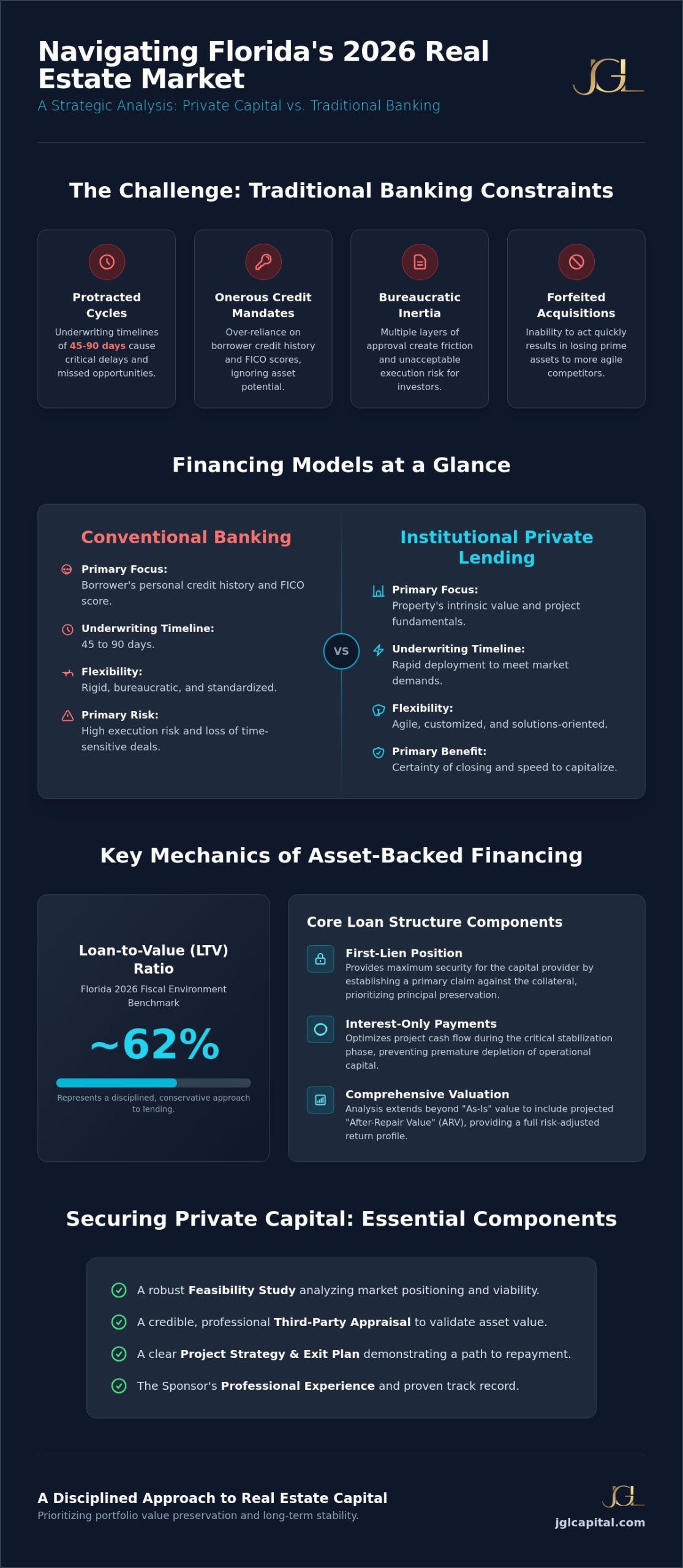
Traditional banking cycles, often spanning 45 to 90 days for commercial assets, rarely align with the rapid-response requirements of the current market. When a high-stakes opportunity arises, the delay inherent in conventional underwriting can result in the forfeiture of significant equity positions. Strategic investors utilize private funds to bridge these gaps, ensuring they don’t lose prime acquisitions while waiting for institutional approvals. Private capital serves as a vital tool for strategic transitional management. This non-dilutive capital allows for the preservation of investor liquidity, ensuring that principal remains available for operational scaling rather than being locked in protracted equity requirements.
The Evolution of Asset-Based Underwriting
The evolution of underwriting in the private sector has replaced the simplistic reliance on FICO scores with a rigorous analysis of collateral quality. Modern hard money loan structures focus analytical efforts on the property’s performance metrics and market positioning. This disciplined approach considers the “As-Is” valuation alongside the projected “After-Repair” value, providing a more comprehensive view of the risk-adjusted return. It’s a fundamental departure from the credit-centric models of the past decade. By focusing on the asset, hard money lenders Orlando provide a level of certainty that traditional lenders, burdened by regulatory overreach, simply cannot match.
Institutional private lending prioritizes project feasibility and the sponsor’s professional experience over static financial metrics. A seasoned partner evaluates the strategic viability of a commercial project, recognizing that the strength of the asset often mitigates traditional credit concerns. It’s a matter of certainty. This analytical rigor ensures that every funding decision is grounded in the preservation of value and the long-term stability of the investment portfolio. This commitment to discipline distinguishes institutional-grade capital from more transactional, short-term funding sources.
Structural Mechanics of Asset-Backed Financing and Bridge Loans
The architecture of asset-backed debt requires a meticulous understanding of risk distribution and capital priority. In most private debt structures, the lender occupies a first-lien position, which establishes a primary claim against the collateral and provides a foundation of security for the capital provider. This structural preference is a hallmark of sophisticated hard money lenders Orlando, who prioritize the preservation of principal through rigorous collateral evaluation. By utilizing interest-only payment structures, investors can optimize project cash flow during the critical stabilization phase, ensuring that operational capital isn’t prematurely depleted by principal amortization.
In the 2026 fiscal environment, capital allocation is governed by highly disciplined ratios. The Private credit market has seen a distinct return to conservative fundamentals following periods of market recalibration. Data from the first quarter of 2026 indicates that average Loan-to-Value (LTV) ratios in Florida have settled at approximately 62%. While certain opportunistic structures may allow for Loan-to-Cost (LTC) ratios up to 90% for high-yield development, the standard maximum LTV for a purchase typically remains capped at 70%. These metrics aren’t arbitrary; they serve as essential safeguards that align the interests of the lender and the sponsor.
Bridge Financing as Transitional Capital
A bridge loan functions as a tactical instrument for transitional management. It’s designed to stabilize assets, such as multi-family complexes or commercial centers, before they qualify for permanent institutional refinancing. Success in these ventures depends entirely on a clear, documented exit strategy. Whether the objective is a property sale or a long-term DSCR refinance, the bridge phase provides the necessary window to achieve pro-forma occupancy and maximize asset value. Those seeking to align their portfolio with these rigorous standards can partner with an expert advisor to evaluate specific asset viability.
New Construction and Development Funding
The complexities of new construction loans demand a higher level of institutional oversight than standard bridge financing. Draw schedules are the heartbeat of project continuity, requiring disciplined management to ensure that capital deployment matches physical construction milestones. Hard money lenders Orlando utilize these structured draws, coupled with regular site inspections, to mitigate the risks inherent in ground-up development. This methodical approach ensures that project timelines are maintained and that the generation of worth remains the central focus of the development lifecycle. It’s a system built on transparency and analytical rigor.
Institutional Private Lending vs. Conventional Banking
The divergence between traditional depository institutions and private capital providers has never been more pronounced than in the current fiscal landscape. While conventional banks operate within highly regulated, rigid frameworks that prioritize standardized risk mitigation, hard money lenders Orlando utilize a more analytical, asset-centric approach that aligns with the objectives of entrepreneurial developers. This distinction isn’t merely operational; it’s a fundamental difference in how value is perceived and how capital is deployed. Sophisticated investors often find that the documentation requirements of traditional banks, which focus heavily on global cash flow and historical tax returns, create unnecessary friction that can jeopardize complex commercial transactions.
Evaluating the total cost of capital requires looking beyond nominal interest rate deltas. While an Orlando hard money loan might carry an average interest rate of 11.10% in 2026, the strategic value of this capital is found in its certainty of closing. In contrast, the opportunity cost of a delayed or denied bank loan, which can span 60 days or more, often results in the loss of significant equity or the forfeiture of earnest money deposits. By prioritizing execution over a lower headline rate, principals ensure that their portfolio scaling remains uninterrupted by the bureaucratic cycles of institutional debt.
The Strategic Premium of Speed and Certainty
In the Orlando market, where high-value assets are frequently placed under contract within 24 hours, the ability to close in as few as 7 to 10 days provides a definitive competitive advantage. Traditional bank “red tape” often introduces variables that are incompatible with such rapid acquisition timelines. By providing rapid capital deployment and asset-centric underwriting, hard money lenders in Florida act as tactical partners who prioritize the successful acquisition of time-sensitive assets over the rigid fulfillment of standardized credit checklists. This agility allows sponsors to secure opportunistic buys that would otherwise be inaccessible through conventional channels.
Customization vs. Standardized Lending Products
Standardized mortgage products often fail to address the nuances of mixed-use developments, land acquisitions, or transitional multi-family assets. These “cookie-cutter” solutions lack the flexibility required for specialized underwriting, particularly when a property’s value is tied to future stabilization rather than current performance. Private brokers excel in structuring bespoke solutions that account for unique project variables, such as complex draw schedules for new construction or specific release clauses for land development. This high-level strategic alliance ensures that the financing structure supports the project’s long-term viability rather than imposing restrictive covenants that stifle growth. It’s a disciplined approach to capital that values the preservation of worth through highly customized, individual solutions.
Strategic Implementation: Navigating the Deployment of Private Funds
Successful capital allocation begins with the preparation of an institutional-grade loan package that articulates the strategic value of the underlying asset. Unlike the cursory reviews often found in residential lending, the scrutiny applied by professional hard money lenders Orlando involves a deep-seated analysis of feasibility studies and third-party appraisals. These documents serve as the evidentiary basis for asset-backed financing, ensuring that every dollar deployed is grounded in measurable marketability. By synchronizing capital draws with specific renovation or construction milestones, investors maintain project momentum while providing the lender with a disciplined oversight of the development lifecycle.
Repeated private capital cycles offer a proven methodology for scaling a real estate investing portfolio with precision. Rather than viewing each loan as an isolated event, sophisticated principals treat these arrangements as strategic alliances that facilitate rapid acquisition and stabilization. This cumulative approach allows for the preservation of equity while maximizing the velocity of capital across multiple high-stakes projects. To begin this process with a seasoned partner, you may submit your executive summary for institutional review.
Due Diligence and Risk Mitigation
The internal processes for evaluating property marketability focus heavily on liquidation value and downside protection. Transparency in borrower-broker communications isn’t merely a courtesy; it’s a structural requirement for ensuring that risk is accurately priced and mitigated. Adherence to national standards for non-owner occupied commercial debt ensures that the financing remains compliant with the evolving regulatory expectations of 2026. This disciplined due diligence protects the integrity of the capital stack and reinforces the brand’s position as a quiet expert in high-stakes management.
Exit Strategy Optimization
The bridge phase of any project is defined by its transition to long-term commercial real estate loans. Planning for this exit begins before the initial private funds are even disbursed. For rental portfolios, Debt Service Coverage Ratio (DSCR) loans function as a stable, long-term solution that replaces transitional debt once pro-forma occupancy is achieved. Coordinating with permanent lenders during the stabilization period ensures a seamless handoff, preventing the friction of bridge extensions and maintaining the steady rhythm of long-term growth. This foresight is what distinguishes a disciplined steward from a transactional participant.
JGL Capital LLC: A Disciplined Approach to Real Estate Capital Solutions
The selection of a capital partner requires a level of scrutiny that matches the complexity of the underlying asset. JGL Capital LLC serves as a private money broker with over thirty years of industry expertise, prioritizing the alignment of institutional objectives with the specific requirements of high-stakes real estate projects. By focusing on property value rather than personal credit scores, the firm provides a stable foundation for investors seeking to scale their portfolios through asset-backed financing. As a recognized leader among hard money lenders Orlando, the firm’s philosophy is rooted in the timeless principles of integrity and the preservation of value, ensuring that every strategic alliance is built on a foundation of analytical rigor. It’s this commitment to stability that distinguishes JGL Capital LLC from more transactional entities in the Central Florida corridor.
This organization provides a comprehensive suite of customized solutions, including new construction loans and multi-family debt, tailored to the unique variables of each development. This disciplined approach rejects the speculative trends often found in the broader market, favoring instead a serious and steady approach to the generation of worth. By framing its activities as a form of high-level strategic alliance rather than a simple service provision, JGL Capital LLC distinguishes itself from competitors who prioritize volume over project viability. Every claim is qualified by decades of experience, reinforcing the position of JGL Capital LLC as a leader in the field of transitional capital.
National Reach with Institutional Precision
While the firm maintains a deep-seated expertise in the Central Florida market, its national service scope allows it to support developers and investors across the United States, ensuring that capital deployment is managed with institutional precision regardless of the property’s geographic location. A partner-led approach to loan origination provides a sense of security for high-net-worth stakeholders, as every transaction is overseen by seasoned experts who understand the gravity of high-stakes management. Streamlined processing cycles at JGL Capital LLC are meticulously designed to meet the demands of sophisticated partners, ensuring that acquisition timelines are met without sacrificing the thorough analysis required for long-term stability. This deliberate pace suggests a firm that takes the time to conduct thorough analysis and values precision over speed.
Securing Your Next Strategic Acquisition
Initiating a collaborative relationship with JGL Capital LLC begins with a mutual assessment of project feasibility and long-term objectives. The role of professional stewardship in private capital brokerage is to serve as a quiet expert, relying on intellectual capital and an established history to guide partners through complex financing structures. It’s a matter of responsibility. By valuing long-term growth and the building of lasting legacies, the firm ensures that its partners are positioned for success in the 2026 real estate landscape. We invite you to consult with JGL Capital LLC for bespoke capital allocation that aligns with your institutional-grade investment strategy.
Advancing Your Portfolio Through Strategic Capital Allocation
The successful navigation of the 2026 real estate landscape requires a transition from transactional borrowing to the establishment of high-level strategic alliances. As explored, the primary advantages of utilizing asset-backed financing lie in the agility of capital deployment and the analytical focus on property intrinsic value. By prioritizing the certainty of closing over the bureaucratic constraints of traditional institutions, sophisticated investors can secure opportunistic acquisitions that define a lasting legacy. It’s this commitment to stability that ensures your projects are supported by a partner who values the preservation of worth; engaging with experienced hard money lenders Orlando provides that essential baseline of security.
With over 30 years of industry leadership and a disciplined approach to asset-based underwriting, JGL Capital LLC provides the stability and expertise required for complex commercial and residential ventures. Our national brokerage capabilities allow for the delivery of highly customized solutions that align with your long-term growth objectives. We invite you to Consult with JGL Capital LLC for Professional Real Estate Financing Solutions to discuss how our tailored capital allocation can support your next acquisition. Your commitment to disciplined investment deserves a partner with the intellectual capital to match your ambition.
Frequently Asked Questions
What distinguishes hard money from traditional commercial financing?
Hard money is distinguished by its focus on collateral value and speed of execution rather than the borrower’s personal creditworthiness. This approach allows for a level of agility that traditional institutions cannot match due to their structural rigidity and protracted underwriting cycles. It’s a tactical alternative for investors who require certain execution in volatile markets where property fundamentals are the primary driver of the loan’s approval.
How is the Debt-Service Coverage Ratio (DSCR) utilized in private lending?
The Debt-Service Coverage Ratio (DSCR) is a metric used to evaluate the property’s ability to cover its debt obligations through net operating income. In the private lending sector, this ratio is critical for assessing the viability of rental property loans. A ratio above 1.0 ensures that the asset generates sufficient cash flow to service the interest payments without relying on the sponsor’s personal income, which provides a layer of security for the capital provider.
Can private money be used for ground-up new construction projects?
Yes, private capital is an essential tool for ground-up development through structured new construction loans. These loans are designed to fund the entire development lifecycle, utilizing disciplined draw schedules that align with physical construction milestones. This structure ensures project continuity and allows developers to maintain momentum without the bureaucratic delays often associated with traditional construction financing, ensuring that the generation of worth remains the project’s central focus.
What are the typical timelines for closing an asset-backed bridge loan?
Typical closing timelines for an asset-backed bridge loan range from 7 to 14 business days. This expedited process is a core competency of professional hard money lenders Orlando, who prioritize rapid capital deployment to support time-sensitive acquisitions. By streamlining the due diligence phase and focusing on property intrinsic value, these lenders provide a definitive competitive advantage in markets where high-value assets are under contract quickly.
Why do lenders prioritize property value over personal credit scores?
Lenders prioritize property value because the asset serves as the primary security for the capital in a non-recourse or limited-recourse structure. This asset-centric approach reflects a disciplined focus on the preservation of value and the property’s liquidation potential. It allows for a more objective analysis of risk, grounded in property fundamentals and market positioning rather than the borrower’s historical credit behavior or personal financial fluctuations.
Are hard money loans available for multi-family property acquisitions?
Yes, multi-family property acquisitions are a primary use case for private capital, particularly for assets requiring stabilization or renovation. These loans provide the necessary liquidity to execute value-add strategies, allowing sponsors to increase the property’s net operating income. Once the asset reaches pro-forma occupancy, it can be transitioned into long-term institutional debt or permanent commercial financing, fulfilling its role as a transitional capital instrument.
What documentation is required for an institutional-grade hard money application?
Institutional-grade applications require a comprehensive executive summary, detailed property financials, and a documented exit strategy. Professional hard money lenders Orlando also require third-party appraisals and feasibility studies to confirm the asset’s intrinsic worth and marketability. This level of documentation ensures that the loan structure is grounded in analytical rigor and aligns with the strategic objectives of both the sponsor and the lender, fostering a collaborative relationship.
How does a bridge loan function as a transitional capital tool?
A bridge loan functions as transitional capital by providing a temporary funding solution until a property qualifies for long-term financing or is sold. It’s an instrument designed to facilitate the “bridge” between acquisition and stabilization. This allows investors to secure properties that don’t currently meet the strict occupancy or condition requirements of traditional banking institutions, providing the time needed to execute a strategy that preserves and enhances the asset’s value.