

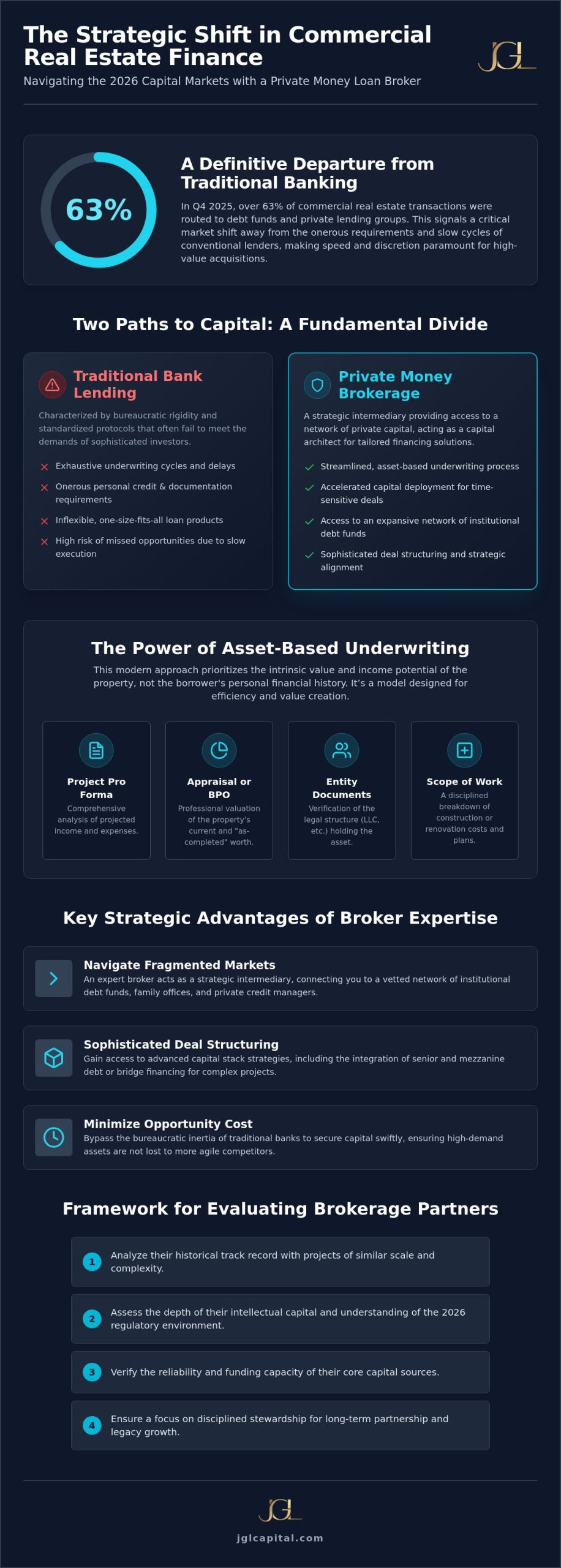
In the final quarter of 2025, over 63% of commercial real estate transactions were routed to debt funds and private lending groups, signaling a definitive departure from traditional banking reliance. This shift underscores a reality you likely face: the onerous credit requirements and exhaustive underwriting cycles of conventional lenders are increasingly incompatible with the precision required for high-value acquisitions. When speed and discretion are paramount, the role of a sophisticated private money loan broker becomes the cornerstone of a successful capital strategy.
You recognize that securing reliable bridge or construction financing requires more than a simple transaction; it demands a deep alignment of strategic objectives. We will demonstrate how an expert private money loan broker navigates today’s intricate capital markets to secure institutional-grade financing while utilizing asset-based underwriting to minimize your personal liability. This analysis provides a comprehensive overview of the 2026 regulatory environment, including new FinCEN compliance standards, and outlines a disciplined framework for establishing a long-term partnership focused on the preservation and growth of your real estate legacy.
Key Takeaways
- Understand the evolving role of the private money loan broker as a strategic intermediary capable of navigating the increasingly fragmented capital markets of 2026.
- Learn how to minimize the high cost of missed opportunities through streamlined, asset-based underwriting that bypasses the rigid constraints of traditional retail banking.
- Gain insights into sophisticated deal structuring, including the strategic application of bridge financing and the integration of senior and mezzanine debt within the capital stack.
- Establish a rigorous framework for conducting due diligence on potential brokerage partners, focusing on their historical track record and the depth of their intellectual capital.
- Discover the principles of disciplined stewardship required to secure reliable financing for high-stakes projects, including new construction and multi-family developments.
Defining the Private Money Loan Brokerage Model
The professional private money loan broker operates as a sophisticated strategic intermediary, meticulously bridging the gap between ambitious real estate investors and specialized private capital sources. This role is fundamentally distinct from traditional retail mortgage banking, which is often characterized by bureaucratic rigidity and a reliance on standardized, government-backed protocols. By assuming the position of a capital architect, the broker identifies and captures non-traditional funds from institutional debt funds, family offices, and private credit managers to construct a tailored financial solution. At the heart of this model lies a commitment to asset-based underwriting, a discipline that prioritizes the intrinsic value and income potential of the property over the personal financial history of the borrower. The Private money investment industry has evolved into a complex network where the broker’s primary responsibility is the alignment of risk and reward through analytical rigor.
The Distinction Between Brokers and Direct Lenders
While a direct lender is confined by the limitations of its own balance sheet and specific risk appetite, a private money loan broker provides access to an expansive network of institutional and private funds. This diversity is vital. It ensures that a project’s viability isn’t contingent on the fluctuating liquidity or shifting credit appetite of a single lending entity, which can often lead to unexpected funding gaps during critical project phases. A seasoned broker acts as a disciplined steward, vetting capital sources for reliability and verifying that their funding capacity aligns with the specific requirements of complex real estate developments. This strategic oversight mitigates the risk of capital exhaustion and provides a level of stability that a single-lender approach simply can’t match.
Asset-Backed Lending vs. Credit-Based Financing
Traditional financing relies heavily on debt-to-income ratios and FICO scores, metrics that frequently fail to capture the actual potential of a commercial or residential investment. In contrast, asset-based models focus on property equity and the project’s projected performance. This shift is particularly advantageous during rapid market cycles where the speed of execution is a competitive necessity. By centering the underwriting process on the asset, brokers can facilitate capital deployment with a precision that traditional institutions lack. The documentation required for such requests is typically focused on the project’s fundamentals rather than the borrower’s personal lifestyle. Key requirements often include:
- Detailed Project Pro Forma: A comprehensive analysis of projected income and expenses.
- Appraisal or BPO: A professional valuation of the property’s current and “as-completed” worth.
- Entity Formation Documents: Verification of the legal structure holding the asset.
- Scope of Work: A disciplined breakdown of construction or renovation costs.
This streamlined approach allows investors to focus on value creation rather than navigating the exhaustive personal disclosures required by conventional banks. It’s a model designed for the sophisticated developer who values efficiency and strategic alignment over the generic offerings of the retail market.
The Strategic Advantages of Institutional Brokerage Expertise
The strategic advantage of engaging a professional private money loan broker lies in the deliberate acceleration of capital deployment through a refined, institutional-grade underwriting framework. In an environment where traditional institutions are frequently encumbered by bureaucratic inertia, the ability to bypass exhaustive credit cycles and focus on the intrinsic worth of the collateral is a critical differentiator. This administrative efficiency serves to mitigate the substantial opportunity costs that arise when high-demand assets are lost to more agile competitors. A seasoned broker ensures that the capital stack is not merely a collection of generic products but a customized solution engineered to align with the specific risk profile and long-term objectives of the investor. It’s a level of sophistication that transforms financing from a hurdle into a competitive asset.
Navigating the regulatory landscape is another area where a specialized broker provides essential stewardship. The implementation of the FinCEN residential real estate rule on March 1, 2026, has introduced rigorous Anti-Money Laundering (AML) and Know Your Customer (KYC) requirements that demand precise compliance management. By adhering to established frameworks like the California Financing Law, a broker protects the integrity of the transaction and shields the borrower from the legal complexities of private credit. This level of oversight is a prerequisite for any developer seeking to maintain a professional standing within the capital markets while focusing on the preservation of value.
Speed of Execution and Market Agility
The administrative efficiency inherent in the process for asset-backed loans allows for a level of responsiveness that traditional banking cannot replicate. This agility is particularly vital when securing distressed assets or competing in markets where the window for acquisition is exceedingly narrow. Within the private credit sector, speed of capital is defined as the temporal efficiency with which debt is originated, underwritten, and deployed to capitalize on transient market inefficiencies. By reducing the time from term sheet to closing, investors can secure favorable positions and maximize their return on equity without the delays of conventional underwriting. It’s this rapid deployment that often determines the success of a high-stakes real estate acquisition.
Access to Diverse Funding Programs
A sophisticated private money loan broker provides access to a broad spectrum of capital allocation strategies, ranging from Fix and Flip and New Construction to large-scale Multi-family developments. The integration of commercial real estate loans into a diversified portfolio requires a broker who can identify the specific lender whose current risk appetite and liquidity profile match the unique demands of the project. This matching process ensures that the financing is both reliable and cost-effective, even as market conditions fluctuate. For those seeking to optimize their capital structure through disciplined planning, engaging with a seasoned advisor can provide the clarity needed to navigate these diverse funding avenues.
Navigating the Capital Stack: How Brokers Structure Complex Deals
The structural integrity of a real estate investment is fundamentally dependent on the composition of its capital stack. A proficient private money loan broker does not merely facilitate a loan; they engineer a capital structure that maximizes leverage while mitigating systemic risk. This process involves the meticulous layering of senior debt and mezzanine capital to optimize the internal rate of return for the developer. By balancing loan-to-value (LTV) and loan-to-cost (LTC) ratios, a broker ensures that the equity requirement remains manageable without compromising the institutional safety margins required by sophisticated capital partners. For national developers, the strategic application of new construction loans serves as a primary vehicle for value creation, requiring a broker who understands the nuances of horizontal and vertical development cycles.
The Mechanics of Bridge and Transitional Financing
Transitional real estate phases require a high degree of financial flexibility. The strategic use of a bridge loan allows an investor to secure a property quickly, providing the necessary window to execute a value-add strategy or stabilize an asset before seeking long-term permanent financing. A disciplined private money loan broker insists on a clearly defined exit strategy, which is a prerequisite for institutional-grade transitional debt. These structures often incorporate interest reserves, which are funds set aside from the loan proceeds to cover debt service during the initial months of the project. This mechanism protects the developer’s cash flow while ensuring the lender’s yield remains consistent throughout the renovation or stabilization period.
Funding Multi-Family and Large-Scale Commercial Projects
Underwriting multi-family assets requires a specialized analytical rigor that differs significantly from single-family residential lending. The focus shifts toward Debt Service Coverage Ratios (DSCR) and the historical performance of the property’s income stream. Brokers managing these institutional-scale projects must oversee a comprehensive due diligence process that includes environmental assessments, structural engineering reports, and detailed rent roll audits. This level of complexity necessitates a collaborative strategic alliance between the broker, the developer, and the capital source. It is through this disciplined approach that large-scale commercial projects receive the capital allocation they require, moving from speculative concepts to stabilized, cash-flowing legacies. Precision is mandatory in these high-stakes environments, and a seasoned broker provides the stability needed to see such projects through to completion.
Evaluating Brokerage Partners: A Framework for Due Diligence
Selecting a private money loan broker requires a rigorous evaluation of the firm’s intellectual capital and fiduciary responsibility. Sophisticated investors understand that a partner who lacks deep-seated expertise may fail to anticipate market shifts, potentially jeopardizing the project’s stability. A disciplined approach to due diligence ensures that the chosen intermediary operates as a strategic steward rather than a mere transactional agent. This distinction is vital for maintaining the integrity of a real estate portfolio and ensuring the preservation of value across volatile economic cycles. Every claim must be qualified by a demonstrable history of success and a commitment to transparency.
Assessing Industry Expertise and Intellectual Capital
Over thirty years of experience provides a repository of historical data and strategic foresight, which is essential for navigating the complexities of non-bank credit markets. A broker’s ability to conduct thorough property-level analysis is the bedrock of effective risk assessment. It requires an analytical rigor that goes beyond surface-level appraisals to understand the intrinsic value and income potential of an asset. This disciplined methodology distinguishes a quiet expert from those who rely on aggressive self-promotion or speculative trends. A seasoned firm prioritizes the alignment of objectives, ensuring that the capital structure supports the project’s specific operational strengths and long-term goals.
Transparency in Fee Structures and Closing Costs
Transparency is the foundation of trust in private credit. A professional private money loan broker provides a clear breakdown of “points,” which are origination fees calculated as a percentage of the total loan amount, along with all administrative and processing costs. A comprehensive closing statement is essential for verifying that all charges align with the initial term sheet, leaving little room for ambiguity. The lifecycle of a loan, from the initial origination and underwriting through the servicing phase to the final payoff, must be clearly articulated. For investors seeking a partner with a proven history of disciplined capital allocation, engaging a seasoned brokerage firm ensures that every transaction is grounded in transparency and long-term value creation. This clarity allows for precise performance metrics and more accurate financial forecasting.
Red flags often include high-pressure tactics or a lack of clarity regarding capital sources and licensing compliance. These behaviors signal a transactional mindset that prioritizes short-term commission over the generation of lasting worth. A true strategic partner values exclusivity and long-term growth, rejecting the fleeting industry buzzwords that often mask a lack of fundamental knowledge. By focusing on a collaborative relationship rather than a simple service provision, a broker becomes a deeply invested ally in the creation of your real estate legacy. This methodical presentation of principles serves to build a persuasive case for a firm’s competence and integrity.
JGL Capital LLC: Disciplined Execution in Private Capital Allocation
JGL Capital LLC stands as a seasoned entity in the private credit market, offering a level of stability and deep-seated expertise that’s increasingly rare in a fragmented industry. As a premier private money loan broker, the firm prioritizes the preservation and creation of value through a serious and disciplined approach to capital allocation. This commitment ensures that every strategic alliance is grounded in analytical rigor rather than marketing hyperbole, providing sophisticated partners with the security they require for high-stakes real estate management. By focusing on the intrinsic worth of the asset, JGL Capital LLC bypasses the bureaucratic delays that define traditional banking, allowing for a more precise articulation of a developer’s core philosophies and long-term objectives.
The JGL Capital LLC Advantage: A Legacy of Strategic Stewardship
The firm’s identity is defined by a sense of exclusivity and a focus on building lasting legacies through careful, deliberate action. With over thirty years of industry expertise, JGL Capital LLC serves as a disciplined steward for national investors seeking specialized funding for New Construction Loans, Multi-Family Loans, and Land Loans. These individual solutions are highly customized, reflecting an understanding that each project possesses unique operational strengths and specific risk profiles. By rejecting speculative trends and remaining rooted in timeless business principles, JGL Capital LLC delivers worth through collaborative relationships that extend far beyond a simple service provision. It’s a philosophy that values integrity and the meticulous generation of value above all else.
Initiating Your Capital Strategy
Engaging with JGL Capital LLC begins with a methodical presentation of your project’s objectives and a thorough evaluation of the underlying asset’s potential. This initial consultation serves as the foundation for a long-term strategic relationship where capital expertise is aligned with your specific investment goals. Stakeholders are invited to present their national projects, including those requiring Rental Property Loans or Bridge Loans, for a rigorous analysis of property value and income potential. The process is steady and cumulative, moving from high-level mission alignment to specific operational strengths without the rushed pace of transactional competitors.
It’s time to establish a partnership with a private money loan broker that values integrity and long-term growth as the primary metrics of success. You’re encouraged to reach out to our firm to begin the deliberate process of securing the institutional-grade financing your real estate legacy demands. By choosing a partner that relies on intellectual capital and an established history of success, you ensure that your projects are supported by a disciplined and deeply invested ally.
Advancing Your Capital Strategy through Disciplined Partnership
The evolution of the private credit market in 2026 demands a definitive departure from transactional lending toward a model of strategic stewardship. As traditional institutions continue to retreat from complex real estate projects, the expertise of a sophisticated private money loan broker becomes the primary factor in securing institutional-grade financing. By prioritizing asset-backed underwriting and streamlined execution, investors can navigate the capital markets with a level of agility that ensures the preservation of value across national markets. This transition allows for the optimization of the capital stack, moving beyond simple debt procurement toward the creation of lasting legacies.
JGL Capital LLC brings over 30 years of industry-leading expertise to every partnership, providing a stable foundation for your most ambitious acquisitions and developments. Our national reach across the United States allows for a disciplined approach to asset-backed lending, ensuring that your objectives are met with analytical rigor and integrity. We invite you to Consult with JGL Capital LLC for Your Next Strategic Capital Allocation to begin the process of aligning your investment goals with our specialized expertise. It’s time to secure the future of your portfolio through a partnership that values the deliberate generation of worth. We look forward to supporting your long-term success.
Frequently Asked Questions
What is the primary difference between a private money loan broker and a bank?
The fundamental distinction lies in the source of capital and the underwriting methodology employed. While traditional banks rely on depository funds and stringent federal regulations that prioritize personal credit history, a private money loan broker accesses a diversified network of non-bank institutional and private funds. This model emphasizes the intrinsic value of the real estate asset, providing a level of flexibility and speed that conventional banking structures cannot replicate.
How are private money loan brokers typically compensated for their services?
Compensation for a broker is typically structured through origination fees, commonly referred to as “points,” which are calculated as a percentage of the total loan amount. These fees are generally disbursed at the time of closing and are clearly articulated on the settlement statement to ensure full transparency. This performance-based model ensures that the broker’s interests remain aligned with the successful execution and funding of the transaction for their partners.
Is a private money loan broker necessary for a simple fix and flip project?
While an investor may engage a direct lender for a singular project, a private money loan broker provides the strategic oversight necessary for scaling a portfolio. Brokers optimize the capital stack by identifying lenders with the most favorable terms for specific asset types, such as Fix and Flip Loans. This approach mitigates the risk of capital exhaustion and allows developers to focus on project execution rather than the administrative burdens of capital sourcing.
What documents are required by a broker to begin the underwriting process?
The underwriting process for asset-based lending requires a disciplined set of documents focused on the project’s viability. Essential items typically include a detailed project pro forma, a professional appraisal or broker price opinion, and a comprehensive scope of work for any planned renovations. Additionally, brokers require legal entity formation documents to verify the ownership structure of the asset, ensuring a transparent and secure transaction for all involved stakeholders.
Can a private money loan broker help with multi-family or commercial developments?
Professional brokers are instrumental in structuring capital for large-scale Multi-Family Loans and commercial developments. These projects often require a sophisticated layering of senior debt and mezzanine capital, which a broker coordinates through an extensive network of institutional partners. By managing the due diligence for these complex assets, the broker serves as a strategic ally in the creation of high-value, income-producing real estate legacies that require significant capital allocation.
How do I verify the legitimacy of a private money loan broker in 2026?
Verification of a broker’s legitimacy requires a rigorous review of their licensing status and compliance with current regulatory standards. In 2026, this includes confirming adherence to FinCEN’s Anti-Money Laundering (AML) and Know Your Customer (KYC) requirements, which became effective on March 1, 2026. Investors should also evaluate the firm’s historical track record and established history of successful capital allocation within the private credit sector to ensure a disciplined and professional partnership.
What are the typical interest rates for loans sourced through a private broker?
Interest rates for loans sourced through private channels are determined by the project’s risk profile and current market liquidity. As of July 2026, rates for bridge financing typically start near 8.75%, while new construction and fix and flip projects may range between 8.50% and 12.5%. These rates reflect the premium for the speed and flexibility provided by private capital, which is essential for capturing high-demand real estate opportunities in a competitive environment.
Does a private money broker check personal credit scores during underwriting?
While a private money loan broker may review personal credit as a component of the character assessment, the primary focus remains on the equity and income potential of the asset. This asset-based approach allows for the funding of projects that traditional banks might reject due to rigid personal debt-to-income requirements. The emphasis is on the project’s ability to support the debt service, ensuring that the capital allocation is grounded in analytical rigor rather than individual credit metrics.