

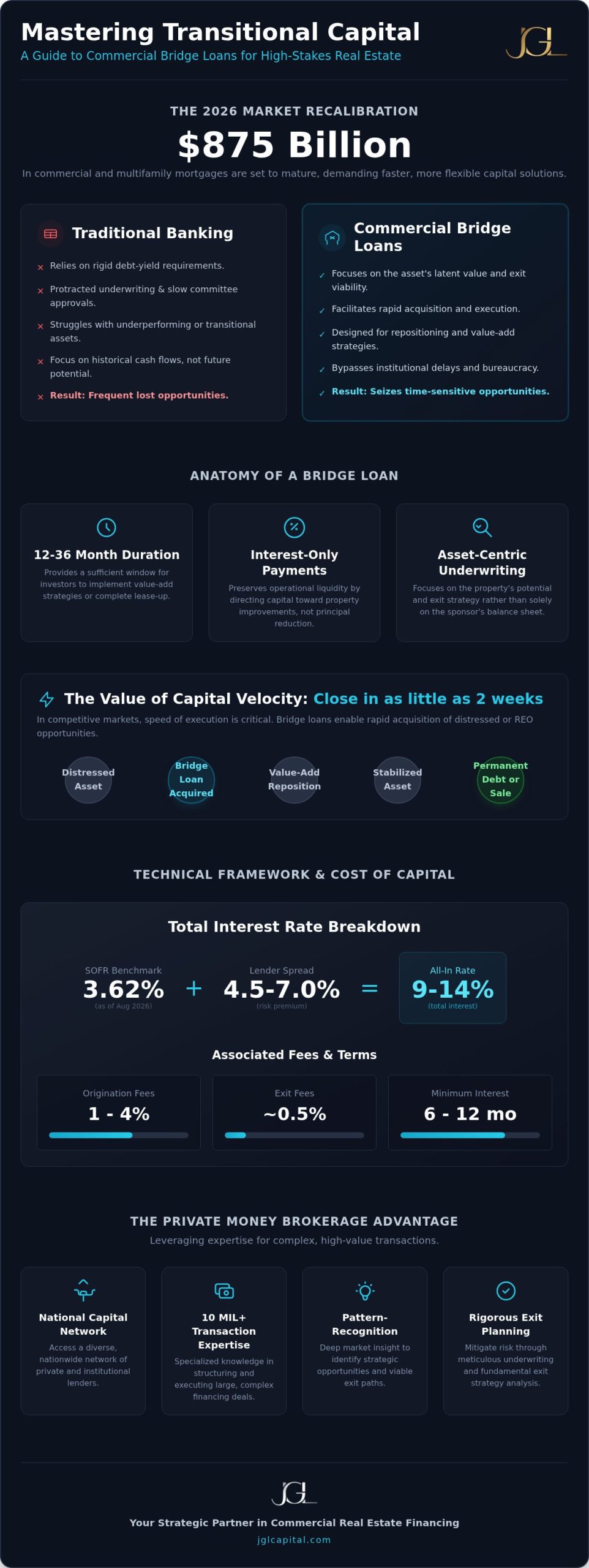
With an estimated $875 billion in commercial and multifamily mortgages reaching maturity in 2026, the capital markets are facing a period of significant recalibration that demands a more disciplined approach to the commercial bridge loan. You understand that the traditional banking sector’s increasing reliance on rigid debt-yield requirements often creates a friction that stifles the acquisition of transitional or underperforming assets. These institutional delays don’t just hinder growth; they frequently result in lost opportunities for those who require immediate, decisive action and sophisticated capital structures.
This guide serves as a strategic blueprint for mastering transitional capital, offering the analytical rigor and institutional precision necessary to navigate high-stakes real estate strategies. By the conclusion of this analysis, you’ll possess a comprehensive understanding of how to leverage private capital to stabilize distressed properties or qualify for agency debt. We will explore the technical complexities of transitional financing, including the implications of current SOFR benchmarks and the meticulous structuring of exit strategies, ensuring your capital deployment remains aligned with the long-term preservation of value.
Key Takeaways
- Understand the critical role of the commercial bridge loan in navigating the 2026 refinancing wave and securing time-sensitive transitional assets.
- Analyze current SOFR-based pricing structures and leverage parameters to ensure capital alignment with institutional-grade property stabilization goals.
- Identify strategic opportunities for property repositioning and rehabilitation, addressing lease-up gaps to prepare assets for permanent agency financing.
- Prioritize rigorous exit strategy planning as the fundamental pillar of underwriting to mitigate risk in a fluctuating interest rate environment.
- Leverage the pattern-recognition expertise of a private money brokerage to access a national network of capital for complex, 10 MIL+ transactions.
The Strategic Role of Commercial Bridge Loans in Real Estate Portfolios
The deployment of a bridge loan within a sophisticated real estate portfolio represents a calculated maneuver designed to bridge the gap between acquisition and long-term stabilization. Unlike permanent financing, which prioritizes historical cash flows and borrower creditworthiness, this transitional capital instrument focuses on the latent value of the underlying asset. In an environment where $875 billion in commercial mortgages are set to mature in 2026, the ability to secure immediate liquidity is paramount. This specialized financing allows investors to bypass the protracted underwriting cycles of depository banks, which often struggle with underperforming assets or complex repositioning narratives. By prioritizing the property’s eventual exit viability over its current performance, the commercial bridge loan provides the necessary runway for execution without the constraints of traditional debt-yield requirements.
Core Characteristics of Transitional Capital
Institutional bridge financing is defined by its temporary nature and structural flexibility. These facilities typically feature durations of 12 to 36 months, providing a sufficient window for investors to implement value-add strategies or complete a necessary lease-up. To preserve operational liquidity during the stabilization phase, these loans almost exclusively utilize interest-only payment structures. This approach ensures that capital is directed toward property improvements rather than principal reduction. The underwriting process remains inherently asset-centric, allowing for a more nuanced evaluation of the property’s potential rather than relying solely on the sponsor’s balance sheet. It’s a strategic distinction. This focus is critical for high-stakes management where the asset’s future worth is the primary driver of the investment thesis.
The Value of Capital Velocity
In competitive markets, the speed of execution is often as vital as the cost of capital. A commercial bridge loan facilitates rapid acquisition, enabling sponsors to capitalize on distressed or REO opportunities that require closing timelines as short as two weeks. This velocity is particularly advantageous in 2026 as lending from depository banks remains subject to heavy regulatory scrutiny and slow committee approvals. By utilizing private money brokerage services, investors can access a national network of capital that values the strategic objective over bureaucratic process. This agility serves as a catalyst for value-add repositioning, allowing for the swift transition of a property from a distressed state to a stabilized asset that qualifies for permanent agency debt or a strategic sale. It’s about seizing the window of opportunity before it closes.
Technical Framework: Rates, Terms, and Structural Components
The technical architecture of a contemporary commercial bridge loan is fundamentally anchored by the Secured Overnight Financing Rate (SOFR), which has replaced LIBOR as the primary benchmark for floating-rate debt. As of August 2026, the SOFR overnight index rate stands at 3.62%, serving as the baseline for institutional capital pricing. Most bridge facilities are structured with a spread over this index, typically ranging from 4.50% to 7.00% for institutional-grade debt funds. When accounting for the broader private lending market, total interest rates generally fluctuate between 9.00% and 14.00%. This pricing reflects the inherent risk of transitional assets and the premium placed on the lender’s ability to execute with speed and flexibility. It’s a precise calculation where the cost of capital is balanced against the speed of asset stabilization.
Understanding the Cost of Capital
Beyond the headline interest rate, the total cost of bridge financing includes origination fees that typically range from 1 to 4 points. Institutional lenders often reside at the lower end of this spectrum, while more aggressive private sources may charge higher upfront fees to compensate for increased leverage or asset complexity. Exit fees, which frequently hover around 0.5%, are another common structural component. Minimum interest periods, often six to twelve months, ensure that the lender achieves a baseline yield even if the sponsor executes a bridge-to-sale strategy faster than anticipated. For those managing complex, 10 MIL+ transactions, engaging with private money broker services can provide the necessary pattern-recognition expertise to optimize these structural nuances and ensure alignment with the long-term investment thesis.
Leverage and Equity Requirements
Underwriting thresholds in 2026 remain disciplined, with lenders generally requiring a down payment or equity contribution between 25% and 40%. Loan-to-Value (LTV) and Loan-to-Cost (LTC) ratios are meticulously calibrated based on the asset class and the specific repositioning strategy. While multifamily assets may occasionally qualify for higher leverage, retail and industrial properties often face more conservative constraints. The “as-stabilized” value serves as the critical metric for future funding; it dictates the viability of earnouts as the property reaches performance milestones. To manage the debt service during the transition, lenders often mandate the creation of an interest reserve. This reserve ensures that monthly obligations are met even when the property’s current cash flow falls below the standard 1.25x debt service coverage ratio. This structural safeguard protects both the lender and the sponsor’s equity position during the critical lease-up or rehabilitation phase.
Strategic Applications for Commercial Real Estate Financing
The strategic deployment of a commercial bridge loan extends far beyond simple liquidity; it serves as a sophisticated instrument for asset recalibration. While many market participants emphasize speed in a vacuum, the true utility of this capital lies in the analytical rigor used to navigate complex ownership transitions or property repositioning. In a landscape where traditional institutions remain hesitant to fund assets with temporary cash-flow voids, private capital provides the necessary flexibility to address operational hurdles. This is particularly relevant for retail and industrial assets where “lease-up” gaps or tenant improvements require a patient yet disciplined funding partner. By utilizing a bridge facility, sponsors can consolidate short-term debt and execute value-add strategies that would otherwise be constrained by the rigid debt-yield requirements of conventional lenders.
Stabilization and Value-Add Strategies
For investors focused on property rehabilitation, the ability to fund significant capital expenditures (CapEx) through structured bridge draws is essential. This approach is frequently utilized in “change of use” projects, such as the conversion of underutilized office space into mixed-use or residential developments, a trend that continues to gain momentum in 2026. These complex redevelopments require a deep understanding of commercial real estate loans and the specific milestones required to reach stabilization. Unlike depository banks that often shy away from construction-to-stabilization gaps, private money brokerage services facilitate access to capital that recognizes the long-term worth generated through meticulous physical and operational improvements. It’s a method of aligning capital with the asset’s eventual highest and best use.
The Bridge-to-Permanent Pipeline
The ultimate objective of most transitional financing is to prepare an asset for a seamless transition into the permanent debt markets. This process involves stabilizing the property’s Net Operating Income (NOI) to a level that meets the stringent Debt Service Coverage Ratio (DSCR) requirements of agency or CMBS lenders. In the current environment, timing the refinance is a critical exercise in risk management. Sponsors must evaluate the viability of “take-out” loans as they move from private capital to institutional debt, ensuring that the asset’s improved performance justifies the new leverage. This strategic timing allows for the preservation of equity while locking in long-term, lower-cost financing once the initial risk of the transition has been successfully mitigated. It represents the final stage of a disciplined investment lifecycle, moving from high-stakes management to long-term value preservation.
Mitigating Risk through Rigorous Exit Strategy Planning
The underwriting of a commercial bridge loan is, at its core, an exhaustive evaluation of the exit strategy. While traditional lenders focus on historical debt coverage, institutional bridge providers prioritize the mechanics of capital return. In a 2026 market characterized by a Bank Prime Loan Rate of 6.75% and a significant volume of maturing debt, the viability of a “take-out” loan is no longer a peripheral concern; it’s the primary pillar of risk mitigation. Sponsors must demonstrate that the projected Net Operating Income (NOI) will support a permanent refinance or a strategic sale within the 12 to 36-month term. This requires a granular analysis of cap rate trends and the specific liquidity of the target asset class, ensuring that the transition from private capital to permanent debt is grounded in reality rather than speculation.
Secondary and Tertiary Exit Paths
A disciplined approach to transitional capital requires the formulation of multiple contingency layers to hedge against market volatility. Lenders scrutinize pro-forma feasibility with a focus on downside protection, often requiring sponsors to demonstrate how the asset maintains value if stabilization timelines extend beyond the initial projections. This stress-testing is vital when evaluating distressed acquisitions or complex redevelopments that may face unforeseen operational delays. Exit Viability serves as the definitive metric that determines the strategic alignment between transitional capital and long-term asset performance. By establishing secondary exit paths, such as a bridge-to-sale execution or a structured recapitalization, sponsors preserve their equity and maintain the integrity of the investment lifecycle even when the primary refinance path encounters friction.
Market Timing and Maturity Risk
Aligning the loan term with the projected asset lifecycle is a fundamental requirement for avoiding the “bridge to nowhere.” This scenario occurs when the financing expires before the property reaches the performance milestones necessary for permanent debt. To mitigate this maturity risk, sophisticated sponsors negotiate extension options that provide a critical hedge against shifting interest rate environments or slower-than-anticipated lease-ups. These extensions, often structured as six-month increments, allow for continued stabilization without the pressure of an immediate maturity default. Sponsors seeking to validate their repositioning narratives should leverage private money broker services to ensure their exit pathways are stress-tested against current market benchmarks and national capital trends. This analytical rigor ensures that the bridge serves as a stable platform for growth rather than a source of terminal risk.
Engaging JGL Capital: The Private Money Brokerage Advantage
The efficacy of a commercial bridge loan is intrinsically linked to the caliber of the capital partner overseeing the transaction. JGL Capital operates through a sophisticated private money brokerage model, a distinction that allows for the navigation of a vast national network of alternative capital sources. While balance-sheet lenders are often constrained by their own internal credit appetites and liquidity cycles, JGL leverages over 30 years of combined industry expertise to identify the most competitive capital for a specific asset profile. This broker-first approach ensures that sophisticated sponsors aren’t limited to a single source of funding; instead, they benefit from a marketplace of institutional debt that recognizes the latent worth of transitional assets.
High-stakes management requires a partner capable of executing complex, 10 MIL+ transactions with absolute precision. JGL Capital specializes in these institutional-scale deals, where the intricacies of asset-based underwriting and exit viability demand a disciplined, analytical approach. This pattern-recognition expertise allows the firm to anticipate potential friction points in the capital stack before they manifest as delays. By functioning as a strategic ally rather than a mere service provider, JGL ensures that every deployment of capital remains aligned with the sponsor’s broader objective of long-term value preservation and asset stabilization.
Customized Solutions for Sophisticated Sponsors
Every transitional asset possesses a unique set of operational challenges that require a tailored capital structure. JGL Capital provides strategic guidance from the initial inquiry through to the successful execution of the exit strategy, ensuring that the terms of the facility accommodate the property’s specific stabilization timeline. This individualization is essential for sponsors who need to move beyond generic financing products to secure a commercial bridge loan that respects the nuances of the asset’s repositioning narrative. Whether managing a lease-up gap in a retail development or consolidating debt during a complex ownership transition, the firm’s focus remains on providing a highly customized solution that delivers institutional precision.
The JGL Execution Process
The JGL process is characterized by administrative rigor and a steady, logical flow of information. This methodical approach prioritizes certainty of execution, a critical factor for time-sensitive acquisitions or distressed debt consolidations where speed is paramount. By conducting a thorough analysis of the property’s value and the viability of the proposed exit, JGL builds a persuasive case for capital deployment that instills confidence in all stakeholders.
- National service footprint for business-purpose lending on retail, industrial, and multifamily assets.
- Specialization in 10 MIL+ institutional transactions requiring complex capital structuring.
- A broker-first model that leverages a broad capital network for maximum competitiveness.
- Asset-centric underwriting that prioritizes property value and exit viability over personal credit.
For sponsors seeking a disciplined steward for their next capital requirement, the firm invites a formal engagement. Consult with JGL Capital for your next commercial transaction to leverage our intellectual capital and national network for your strategic real estate objectives.
Securing Capital Alignment for Long-Term Asset Worth
The successful execution of a commercial bridge loan requires more than just speed; it demands a meticulous alignment of capital with the asset’s specific stabilization lifecycle. You’ve seen how technical benchmarks like SOFR and disciplined exit planning form the bedrock of institutional-grade financing. By prioritizing asset-based underwriting and recognizing the nuances of transitional cash flows, sophisticated sponsors can navigate the 2026 market with heightened precision. It’s a process that rewards those who value analytical rigor over speculative trends.
Achieving certainty of execution in complex, 10 MIL+ transactions necessitates a partner with deep-seated intellectual capital and a vast national capital network. JGL Capital provides over 30 years of private money expertise, ensuring your strategies are supported by a disciplined, broker-first model that values long-term integrity. As the commercial landscape continues to recalibrate, your commitment to careful, deliberate action will remain your greatest competitive advantage. Partner with JGL Capital for Strategic Commercial Financing
Frequently Asked Questions
What is the typical interest rate for a commercial bridge loan in 2026?
Interest rates for a commercial bridge loan in 2026 generally range from 9.00% to 14.00%, depending on the risk profile and asset class. Institutional-grade transactions are frequently priced as a floating spread over the Secured Overnight Financing Rate, which currently sits at 3.62%. These spreads typically fluctuate between 4.50% and 6.50%. The final pricing is determined by the property’s stabilization potential and the strength of the proposed exit strategy.
How long does it take to fund a commercial bridge loan through JGL Capital?
The funding timeline for a commercial bridge loan through a private money brokerage varies based on deal complexity, but typically ranges from two to four weeks. Unlike traditional depository banks that require months of committee review, the asset-centric approach prioritizes property value and exit viability. This administrative rigor ensures that time-sensitive acquisitions or distressed debt consolidations are executed with the speed required to capitalize on fleeting market opportunities.
What property types are eligible for commercial bridge financing?
Eligible property types for this transitional financing primarily include multifamily, industrial, and retail assets. While traditional institutions may hesitate on assets with lease-up gaps or deferred maintenance, bridge capital is specifically designed for these scenarios. This includes mixed-use redevelopments and properties undergoing a change of use strategy. The focus remains on business-purpose lending for income-producing assets that demonstrate a clear path toward long-term stabilization and permanent debt.
Can I get a commercial bridge loan with a low credit score?
It’s possible to secure a commercial bridge loan with a lower credit score because underwriting focuses on the asset’s value and the viability of the exit strategy. Private money brokers prioritize the property’s current and stabilized worth rather than the sponsor’s personal credit history. While a strong financial background is beneficial, the analytical rigor is directed toward the property’s ability to generate value and support a future refinance or sale.
How much equity is required for a commercial bridge loan?
Lenders typically require an equity contribution or down payment ranging from 25% to 40% of the property’s value. This “skin in the game” ensures that the sponsor’s objectives are aligned with the preservation of capital. Loan-to-Value and Loan-to-Cost parameters are calibrated based on the specific asset class and the risk associated with the stabilization plan. Higher leverage may be available for institutional-grade multifamily assets with strong cash-flow projections.
What is the difference between a bridge loan and a hard money loan?
A bridge loan is generally considered an institutional-grade product with lower rates and longer terms than hard money. While both are asset-backed, bridge financing often involves more rigorous underwriting and is used to stabilize properties for permanent agency debt. Hard money is typically a pure asset-only play with higher costs and shorter durations, often utilized when the speed of execution is the only primary consideration for the sponsor.
Are commercial bridge loans typically recourse or non-recourse?
Commercial bridge loans are frequently structured as non-recourse debt, particularly in institutional transactions exceeding $10 million. This means the lender’s primary security is the property itself rather than the sponsor’s personal assets. However, these agreements typically include “bad boy” carve-outs, which trigger personal liability in the event of fraud, gross negligence, or bankruptcy filings. This structure balances the sponsor’s risk with the lender’s need for institutional security and accountability.
What happens if I cannot refinance my bridge loan before maturity?
If an asset cannot be refinanced before maturity, sponsors often negotiate extension options to hedge against market shifts. These extensions provide additional time to reach stabilization milestones or wait for more favorable interest rate environments. If a viable exit isn’t achieved, the lender may require a capital pay-down or, in extreme cases, initiate a workout process. Meticulous contingency planning is essential to avoid these terminal risks during the investment lifecycle.