

In the high-stakes environment of 2026 real estate, the distinction between a profitable exit and terminal capital erosion often rests on a single basis point of miscalculation. You likely recognize that while the national market shows modest growth, the margin for error has narrowed significantly as mortgage rates stabilize in the mid-6% range. Mastering the precision of calculating return on investment for a flip requires a departure from speculative optimism in favor of rigorous, analytical frameworks that account for every nuance of the capital stack.
This article provides the institutional-grade methodologies necessary to preserve your equity and ensure that every bridge loan point or interest accrual is meticulously factored into your net yield. We’ll examine the standardized models used by sophisticated partners to compare disparate opportunities and mitigate the risks of unforeseen cost overruns. By the end of this analysis, you’ll possess a disciplined framework designed to transform raw data into a strategic roadmap for long-term value preservation and disciplined growth.
Key Takeaways
- Distinguish between superficial gross margins and the comprehensive analytical rigor required for calculating return on investment for a flip to ensure capital preservation.
- Identify the critical variables of After Repair Value and total carrying costs to refine performance forecasting and eliminate speculative error in your projections.
- Quantify the cumulative impact of private capital costs, including loan origination points and bridge interest, to understand how project duration affects your net yield.
- Implement advanced performance benchmarks, such as the 70% Rule and break-even analysis, to establish a disciplined baseline for property acquisition and risk mitigation.
- Align your investment objectives with sophisticated financing solutions that utilize property-based underwriting to secure long-term value in a competitive 2026 market.
The Strategic Significance of ROI in Real Estate Capital Allocation
In the context of institutional real estate management, capital is a finite resource that requires precise deployment. While many novice participants focus on the nominal dollar value of a profit check, seasoned professionals recognize that Return on Investment (ROI) serves as the ultimate barometer for operational efficiency. Calculating return on investment for a flip isn’t merely a retrospective accounting exercise; it’s a prospective strategic framework that allows an organization to weigh the opportunity cost of one project against another, ensuring that every dollar is working at its highest possible capacity.
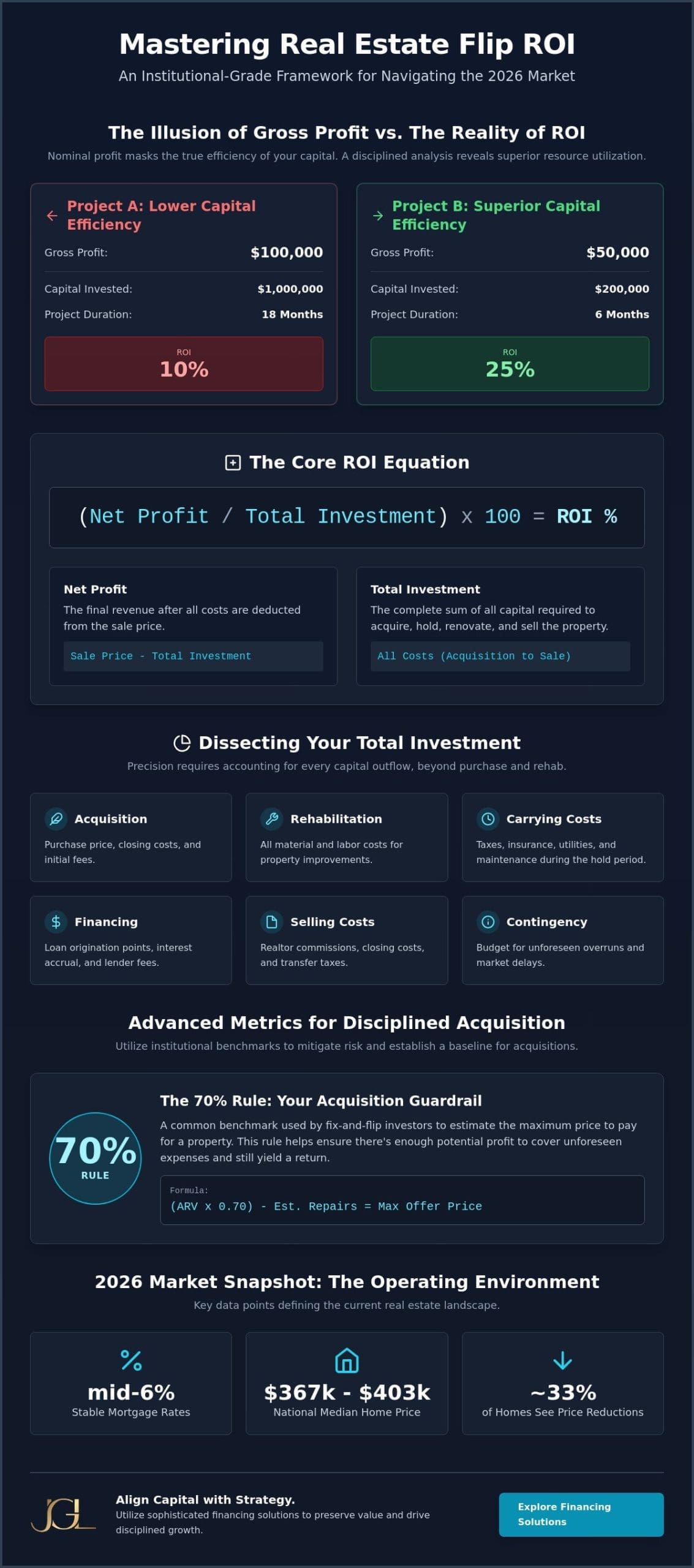
Gross profit margins often mask the underlying erosion caused by time and capital intensity. A project yielding $100,000 may appear successful until one realizes it required $1,000,000 in liquidity and eighteen months to execute. By contrast, a project with a $50,000 yield on $200,000 of capital over six months represents a vastly superior utilization of resources. For 2026, where the national median home sale price sits between $366,667 and $403,200, the margin for error is thin. Benchmarking success requires a focus on the percentage yield relative to the total capital at risk, prioritizing portfolio scalability over individual project size.
The Philosophy of Capital Preservation
Establishing a disciplined approach to property acquisition necessitates a rejection of emotional bias. We view every transaction as a strategic alliance between the availability of capital and the precision of execution. Rigorous ROI modeling serves as a defensive barrier against the allure of vanity projects. It ensures that investment decisions are grounded in analytical rigor, which is the cornerstone of maintaining long-term trust with high-net-worth stakeholders. When the math dictates a withdrawal, the disciplined steward complies without hesitation.
ROI vs. Cash-on-Cash Return
The narrative of a project shifts dramatically when leverage is introduced. While ROI measures the total efficiency of the project capital, Cash-on-Cash (CoC) return measures the performance of the investor’s specific equity. In an era where private lending and bridge loans are standard for sophisticated portfolios, understanding this distinction is vital. High leverage can amplify CoC returns significantly, yet it increases sensitivity to carrying costs. Calculating return on investment for a flip across both metrics provides a dual-lens view of risk, allowing you to align financing structures with your specific long-term objectives.
The Core Components of the ROI Equation
Precision in calculating return on investment for a flip requires an exhaustive cataloging of every capital outflow, moving beyond simple purchase and sale prices to include the granular details of project execution. The standard formula, which involves dividing net profit by the total investment base and multiplying by 100, only yields a reliable metric if the investor accounts for the quiet erosion of capital. Beyond the initial acquisition, you must integrate recurring obligations such as property taxes, insurance premiums, and utility maintenance into your financial model. These carrying costs are often underestimated; however, they represent a significant portion of the total investment base, especially in extended project timelines where every month of possession reduces the final yield.
Determining the After Repair Value (ARV)
Projecting the eventual sale price demands a conservative approach, particularly in a cycle where approximately one-third of homes undergo price reductions before a successful closing. Relying on a comparative market analysis that prioritizes recent sales over aspirational list prices is the only way to ground your projections in reality. While aesthetic updates are necessary, you should carefully weigh design’s impact on ROI against the risk of over-improvement. Investing beyond the established standards of a neighborhood can paradoxically diminish returns by narrowing the pool of qualified buyers who can secure financing at that price point.
Calculating Total Project Costs
Institutional-grade forecasting categorizes expenses into hard and soft costs to ensure total transparency. Hard costs encompass the physical renovation, where the national average for a whole-house transformation sits near $52,275. Kitchen updates typically require between $14,550 and $40,400, while bathroom renovations can range from $6,600 to $28,000. Soft costs, including architectural fees, permits, and legal oversight, must be similarly scrutinized. A disciplined steward always maintains a contingency reserve to absorb the impact of unforeseen structural requirements. Utilizing professional Fix and Flip Loans allows for a more structured approach to budgeting, as professional lenders provide an additional layer of scrutiny during the property-based underwriting process, ensuring your cost projections remain realistic and your capital remains protected.
Analyzing the Impact of Private Capital and Financing Costs
The inclusion of debt financing introduces a layer of complexity that demands rigorous quantitative analysis. When calculating return on investment for a flip, you must recognize that loan origination points and brokerage fees represent immediate capital requirements, not merely backend deductions from gross profit. In the current 2026 fiscal cycle, hard money interest rates typically range from 9.5% to 12.5% for first position loans, while origination fees generally fall between 1.5 and 3 points. These figures aren’t static variables; they’re the primary drivers of your effective cost of capital. Failure to integrate these costs into the initial investment base leads to an artificial inflation of projected yields, which compromises the integrity of your capital allocation strategy.
Strategic utilization of fix and flip loans provides the necessary leverage for disciplined portfolio expansion. While all-cash acquisitions offer the security of lower carrying costs, they often result in an inefficient concentration of equity that limits your ability to capitalize on concurrent opportunities. Bridge financing serves as a sophisticated tool for rapid acquisition, allowing you to secure assets in competitive refuge markets where speed of execution is a prerequisite for value capture. The cumulative effect of interest payments on project duration is a critical metric; every thirty days of possession requires a corresponding increase in the final sale price to maintain your targeted net yield.
The Role of Points and Underwriting Fees
You should treat loan points as an upfront capital requirement to ensure a realistic assessment of your liquidity position. Calculating the effective interest rate, which accounts for both the stated coupon rate and the amortized cost of points over the project duration, reveals the true burden on your profitability. Professional-grade underwriting serves as a vital safeguard in this process. It provides a secondary, objective evaluation of the asset’s viability, ensuring that the financing structure aligns with the intrinsic value of the property rather than speculative projections.
Leverage: The ROI Multiplier
Mitigating Risk Through Advanced Performance Metrics
Risk mitigation in the 2026 real estate cycle requires a shift from static projections to dynamic sensitivity analysis. While calculating return on investment for a flip provides a necessary baseline, the sophisticated steward must understand how minor market fluctuations impact the net position. For instance, given that approximately one-third of homes currently undergo price reductions before a successful sale, modeling a 5% or 10% downward shift in your projected After Repair Value (ARV) is no longer optional; it’s a prerequisite for capital preservation. This analytical rigor allows you to identify the specific threshold where a project ceases to be a viable investment and becomes a liability to your broader portfolio, ensuring that your capital remains deployed only in the most resilient assets.
The 70% Rule in Modern Context
Historically, the 70% rule served as a blunt instrument for property acquisition, dictating that an investor should pay no more than 70% of the ARV minus repair costs. In high-value markets where median sale prices exceed $400,000, investors often find themselves adjusting this baseline to account for premium inventory and compressed margins. However, the rule remains a fundamental guardrail for new construction and extensive renovations. It forces a disciplined evaluation of the purchase price relative to the total capital at risk. When a potential acquisition violates these core metrics, the most strategic action is often the decision to walk away, prioritizing the integrity of your capital stack over the desire for deal volume. Maintaining this discipline is what distinguishes institutional-grade management from speculative participation.
Time as a Variable in ROI
Time is the most persistent erosive force in any fix-and-flip project. Quantifying your “Daily Burn Rate”, which is the cumulative cost of interest, taxes, insurance, and utilities, reveals the true price of project delays. Rapid execution isn’t merely an operational goal; it’s the primary driver of a superior internal rate of return. Utilizing specialized bridge loans allows for the transitional capital needed to accelerate timelines and optimize liquidity during the renovation phase. By compressing the holding period, you reduce exposure to market volatility and increase the velocity of your capital, effectively shortening the window in which external economic factors can negatively influence your yield. Maintaining exit strategy diversification, such as preparing for a long-term rental hold if market liquidity stalls, ensures that your capital remains protected regardless of shifts in the macroeconomic environment. If you’re prepared to optimize your project timelines with disciplined capital, consult with our team regarding property-based underwriting for your next acquisition.
Aligning Capital Solutions with Investment Objectives
The final stage of any institutional-grade framework involves the selection of a financing partner that mirrors the investor’s commitment to analytical rigor. While calculating return on investment for a flip provides the necessary quantitative foundation, the actualization of those yields depends entirely on the stability and reliability of the capital source. JGL Capital LLC serves as a disciplined steward of your investment vision, offering a level of stability grounded in 30 years of industry expertise. We don’t view financing as a mere transaction; instead, we frame our involvement as a high-level strategic alliance designed to facilitate the creation and preservation of value through meticulous capital allocation and professional oversight.
Customized hard money solutions are essential for navigating the complexities of the 2026 real estate cycle, where project execution must be both rapid and precise to maintain targeted yields. By integrating professional underwriting into your strategic planning, you move beyond the limitations of transactional flipping toward a legacy-focused investment strategy. This transition requires a partner who understands that the generation of worth is a cumulative process, necessitating a patient and steady approach to long-term objectives. Our role is to provide the intellectual capital and liquidity that transform a single successful exit into a sustainable engine for wealth preservation and portfolio growth.
The JGL Capital LLC Advantage
Our methodology prioritizes property value and strategic potential over the restrictive credit metrics often utilized by traditional institutions. This property-based underwriting allows for a more nuanced assessment of an asset’s intrinsic worth, providing national developers with the flexibility required for sophisticated capital structures. We offer a streamlined alternative to the bureaucratic delays inherent in conventional banking, ensuring that your acquisition timelines remain uncompromised by administrative inertia. This focus on highly customized, individual solutions ensures that the alignment of objectives remains at the forefront of every collaborative relationship we cultivate, reflecting our position as a quiet expert in the field of private capital.
Next Steps for Strategic Investors
The path toward a disciplined and profitable portfolio begins with a meticulous evaluation of current opportunities. Our expert team is prepared to conduct a preliminary project analysis that integrates the rigorous ROI frameworks discussed throughout this guide. By securing fast, asset-backed funding, you ensure that your next high-stakes acquisition is supported by a foundation of operational strength and strategic foresight. We invite you to Consult with JGL Capital LLC for your strategic financing needs and discover the value of a partner dedicated to your long-term growth and the preservation of your capital through every market cycle.
Securing Your Legacy Through Disciplined Capital Management
The evolution of the 2026 real estate market demands a transition from speculative maneuvers to a methodology rooted in analytical precision. By prioritizing the integration of carrying costs and private capital fees into your financial models, you ensure that calculating return on investment for a flip remains a tool for wealth preservation rather than a hollow exercise in optimism. Success in this high-stakes environment requires a steadfast commitment to performance metrics that account for market sensitivity and project velocity. You must view every acquisition through the lens of risk-adjusted returns to maintain the integrity of your broader portfolio.
To achieve these objectives, you require a partner whose history of excellence matches the scale of your ambitions. JGL Capital LLC provides national reach and institutional-grade capital solutions, backed by over 30 years of industry expertise. Our streamlined asset-backed underwriting process is designed to align with your strategic goals, providing the stability necessary for complex project execution. We invite you to Partner with JGL Capital LLC for Professional Real Estate Financing and secure the support of a disciplined steward for your next acquisition. It’s this commitment to rigorous analysis, paired with our sophisticated capital structures, that creates a powerful alliance for the generation of lasting worth.
Frequently Asked Questions
What is considered a good ROI for a fix and flip project in 2026?
A target ROI of 15% to 25% on the total investment base is generally considered a hallmark of a successful project in the current market cycle. While nominal profit figures may fluctuate based on regional median home prices, this percentage range provides a necessary buffer against the modest growth and inventory constraints observed in 2026. Sophisticated investors prioritize these risk-adjusted returns to ensure that the capital deployed justifies the operational intensity of the renovation.
How do I account for private money loan points in my ROI calculation?
Loan origination points must be integrated into the total investment base as an upfront capital requirement rather than a deferred expense. When calculating return on investment for a flip, failing to include these 1.5 to 3 point fees at the start of the project leads to an inaccurate assessment of your liquidity. Treating these as immediate outflows ensures your performance forecasting reflects the true cost of the capital utilized for the acquisition.
What is the difference between ROI and ROE in real estate investing?
ROI measures the efficiency of the total capital deployed in a project, whereas Return on Equity (ROE) focuses exclusively on the performance of your specific out-of-pocket cash. In a leveraged transaction involving bridge or fix-and-flip loans, your ROE will often be significantly higher than the project’s total ROI. This distinction is vital for strategic investors who use leverage to amplify their personal wealth while maintaining a disciplined approach to project-level profitability.
How does the 70% rule help in calculating the return on a flip?
The 70% rule serves as a fundamental acquisition guardrail by ensuring that the combined purchase price and renovation costs do not exceed a safe threshold of the After Repair Value. This baseline provides a structural margin for profit, financing costs, and market volatility. While high-value markets may necessitate slight adjustments to this ratio, the rule remains a primary tool for maintaining the analytical rigor required for long-term capital preservation.
Can I calculate ROI if I am using a bridge loan for acquisition?
Calculating ROI is essential when utilizing a bridge loan to ensure that the cost of transitional capital doesn’t eclipse the project’s net yield. Your formula must incorporate the specific interest accrual and origination points associated with the bridge financing over the projected holding period. This allows you to determine if the rapid execution facilitated by the loan effectively optimizes your internal rate of return compared to more traditional funding sources.
How do unexpected renovation costs impact my final return on investment?
Unexpected costs act as a direct deduction from your net profit, which inversely affects the final ROI unless there’s a corresponding increase in the property’s sale price. With full gut renovations often reaching $150 per square foot in 2026, even minor structural surprises can erode your projected margins. This is why disciplined stewards always include a robust contingency reserve within the total investment base when calculating return on investment for a flip.
Why is the After Repair Value (ARV) the most critical number in the ROI equation?
The ARV serves as the terminal value of the investment and dictates the maximum allowable expenditure for both acquisition and renovation. Because ROI is a derivative of the eventual sale price, any inaccuracy in this projection compromises the entire strategic framework. In a market where one-third of homes see price reductions before closing, a conservative and data-driven ARV is the most important safeguard against capital erosion.
How do I calculate the holding costs for a property during the rehab phase?
Holding costs are calculated by aggregating the daily expenses of property ownership, including loan interest, property taxes, insurance premiums, and utility maintenance. These recurring outflows are often quantified as a “Daily Burn Rate” to illustrate how project delays impact the final yield. Accurately forecasting these costs is a prerequisite for calculating return on investment for a flip, as they represent a significant portion of the capital at risk during the possession period.