

The retention of high-cost bridge debt for a single day beyond its strategic utility is not merely an operational oversight; it’s a deliberate concession of investment margin that sophisticated stewards of capital can’t afford to ignore. You likely recognize that while private capital provides the essential agility for rapid acquisition, the persistent burn of daily interest requires a rigorous exit strategy to protect the project’s overall worth. This guide establishes a professional framework for how to pay off a hard money loan early, ensuring that you can navigate the technical complexities of prepayment penalties and the evolving regulatory environment of 2026 with confidence.
We will examine the specific impact of the new FinCEN Real Estate Rule on redemption timelines, the nuances of yield maintenance calculations, and the precise operational coordination required to transition from bridge financing to long-term capital structures. By aligning your liquidation schedule with a detailed analysis of contractual obligations, you can minimize interest expense and secure a seamless transition that preserves your investment’s integrity. Our analysis moves beyond simple repayment to address the alignment of objectives between all stakeholders, providing the disciplined approach necessary for the preservation of value in a high-stakes environment.
Key Takeaways
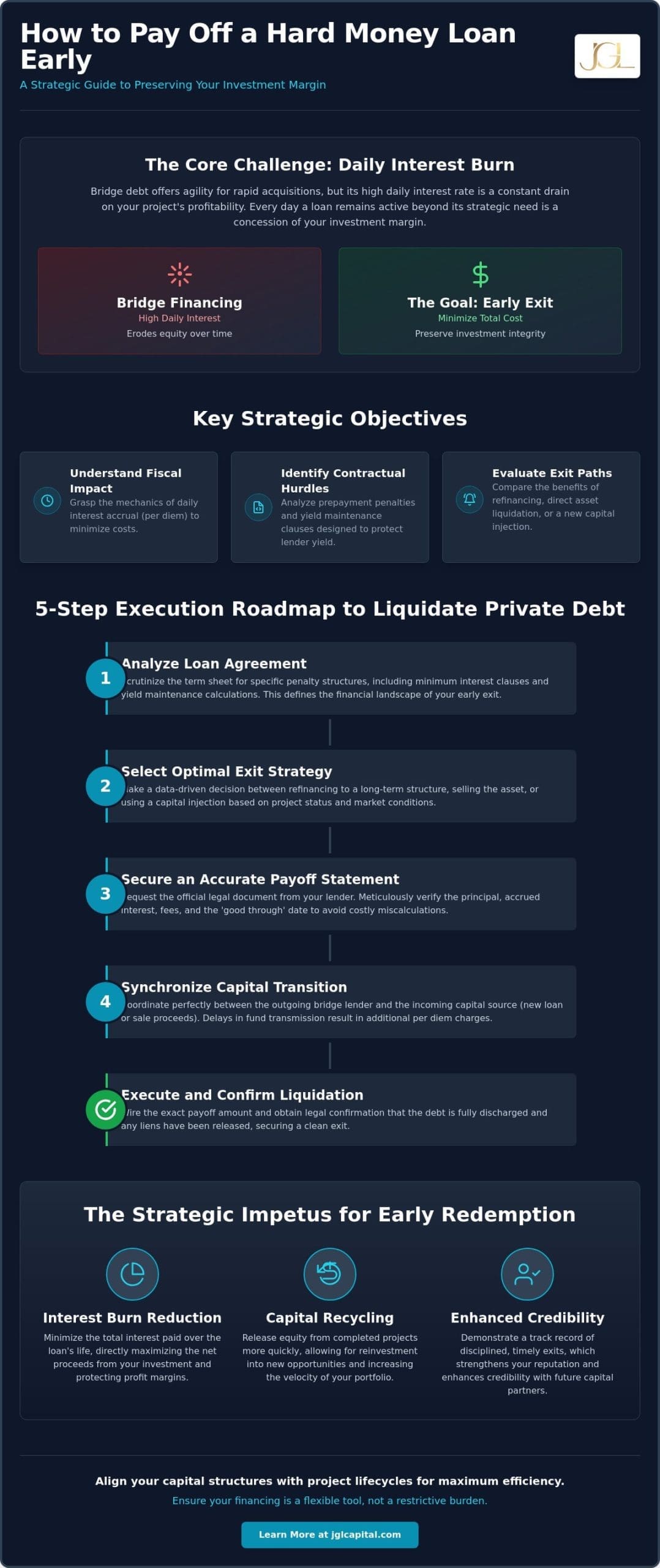
- Understand the fiscal impact of daily interest accrual and the structural mechanics of liquidating private debt before its established contractual maturity date.
- Identify the specific contractual hurdles, including minimum interest clauses and yield maintenance, that are designed to protect a lender’s anticipated yield.
- Evaluate the optimal strategic path for how to pay off a hard money loan early by analyzing the comparative benefits of refinancing versus direct asset liquidation.
- Master the administrative roadmap for securing an accurate payoff statement, ensuring that all ‘good through’ dates and associated legal costs are meticulously verified.
- Discover the importance of aligning capital structures with project lifecycles to ensure that your financing remains a flexible tool rather than a restrictive burden.
The Mechanics of Early Redemption in Private Capital Markets
Early redemption in the context of private debt is formally defined as the total liquidation of an outstanding obligation before the contractually mandated maturity date. This process is a common objective for institutional investors who utilize bridge capital to facilitate rapid acquisitions or property rehabilitations. Because a Hard Money Loan is typically structured as an interest-only instrument, the principal balance remains static throughout the term while interest accrues on a daily basis. Investors who possess a disciplined understanding of how to pay off a hard money loan early recognize that the payoff statement serves as the definitive legal document in this transition. This document provides a comprehensive breakdown of the principal balance, accrued interest, and any applicable administrative fees, establishing the exact capital requirement for a clean exit. The strategic liquidation of these assets isn’t merely about debt removal; it’s about the deliberate preservation of investment worth through the reduction of interest burn.
Understanding Interest Accrual and Per Diem Charges
The precision of your exit strategy depends on a granular understanding of how interest is calculated. Lenders generally employ either a 360-day or a 365-day year model to determine the daily cost of capital. This distinction, while seemingly minor, can result in significant variance in the final liquidation figure when managing large-scale commercial assets. The final payoff figure is also influenced by the temporal gap between the initial funding date and the commencement of the first payment cycle, as interest typically begins to accrue the moment funds are escrowed. Per diem interest represents the daily cost of capital that dictates the timing of an exit.
The Strategic Impetus for Early Liquidation
The motivation for early redemption is frequently grounded in the optimization of the Internal Rate of Return (IRR). By accelerating the project lifecycle, sponsors can recycle capital into new opportunities more frequently, thereby increasing the velocity of their portfolio. Reducing the total cost of capital protects net profit margins, particularly in fix-and-flip projects where high daily interest expenses can erode equity over time. Additionally, clearing the capital stack ahead of schedule facilitates a transition toward more complex institutional acquisitions. A disciplined approach to debt management ensures that capital remains an active tool for growth rather than a passive weight on the balance sheet.
- Interest Burn Reduction: Minimizing the total number of days interest is paid to maximize net proceeds.
- Capital Recycling: Releasing equity from completed projects to fund subsequent acquisitions.
- Operational Efficiency: Demonstrating a track record of timely exits to enhance credibility with future capital partners.
Execution requires a methodical approach to documentation. When you’re determining how to pay off a hard money loan early, you’ve got to ensure that the transition between the current bridge lender and the incoming take-out financing is perfectly synchronized. Any delay in the transmission of the payoff statement or the wiring of funds can result in additional per diem charges that diminish the financial benefits of the early exit.
Navigating Contractual Hurdles: Prepayment Penalties and Yield Maintenance
While the reduction of interest burn is a primary objective, the contractual reality of private debt often involves mechanisms designed to protect the lender’s anticipated yield. From the perspective of institutional capital, an early redemption represents a disruption in the projected cash flow and necessitates the immediate redeployment of funds, which incurs its own set of operational costs. When evaluating how to pay off a hard money loan early, sophisticated investors must first dissect the specific penalty structures embedded within their term sheets. These clauses aren’t merely administrative; they’re financial hedges against the reinvestment risk that lenders face in a fluctuating market.
The best hard money lenders often utilize ‘Minimum Interest’ clauses, which guarantee a specific duration of yield, typically ranging from four to six months. If a borrower liquidates the debt in month three, they’re still obligated to pay the remaining interest for the guaranteed period. Alternatively, many commercial contracts employ ‘Step-Down’ structures, such as a 3-2-1 penalty, where the fee decreases by one percentage point for each year or period the loan remains outstanding. Yield maintenance represents the most institutional approach, utilizing a complex formula to ensure the lender receives a return equivalent to the original interest rate spread over a benchmark like the Treasury rate.
Minimum Interest vs. Hard Prepayment Penalties
Investors must distinguish between ‘soft’ penalties, which expire after a set duration, and ‘hard’ penalties that apply throughout the entire loan term. A six-month interest guarantee may be more favorable for a rapid fix-and-flip than a flat 2% penalty on the total loan balance, depending on the projected exit date. Negotiating these terms during the initial origination phase is critical for preserving future flexibility. At JGL Capital, we emphasize the importance of aligning these contractual structures with the actual operational timeline of the asset to ensure that the capital remains an asset rather than a liability.
Calculating the Break-Even Point for Early Redemption
A rigorous mathematical framework is required to determine the financial viability of a premature exit. You must weigh the immediate cost of the prepayment penalty against the cumulative savings of the remaining interest payments that would have been due. This analysis should also account for the opportunity cost of the capital; if the equity released can be redeployed into a higher-yielding asset, the penalty may be a secondary concern. An early payoff is only strategic if the penalty is less than the projected interest burn. Successfully managing how to pay off a hard money loan early requires this precise alignment of contractual obligations and capital efficiency to maintain the integrity of your investment margins.
Strategic Exit Frameworks: Refinance, Sale, or Capital Injection
The transition from high-velocity bridge capital to permanent financing or asset disposition requires a rigorous evaluation of the project’s current maturity and the prevailing market conditions. Selecting the appropriate vehicle for liquidation is a strategic decision that directly impacts the preservation of equity. Investors analyzing Hard Money Loan Exit Strategies generally identify three primary pathways: the sale of the asset, a refinance into long-term debt, or a direct capital injection using internal reserves. Each path presents distinct operational requirements and financial implications that must be meticulously managed to achieve a successful redemption. For those pursuing a hold strategy, transitioning from high-cost bridge debt to institutional rental property loans represents the most common method for how to pay off a hard money loan early.
This “take-out” process involves replacing short-term private capital with debt structures that favor long-term cash flow stability. Whether you’re liquidating to move into a new acquisition or simply to lower your cost of capital, the timing must be synchronized with the operational completion of the asset.
Transitioning to Long-Term DSCR Financing
Debt Service Coverage Ratio (DSCR) loans are frequently the preferred instrument for rental investors seeking to retire bridge financing. These institutional products focus on the asset’s ability to generate sufficient income to cover debt obligations rather than the borrower’s personal income. A critical component of this transition is managing the seasoning requirements that many traditional lenders impose; these rules often dictate how soon a property can be refinanced based on its appraised value rather than its purchase price. Aligning the appraisal process between the outgoing bridge lender and the incoming permanent lender is essential to avoid valuation discrepancies that could stall the redemption. This alignment ensures that the transition occurs without a gap in coverage or an unexpected capital call.
The Disposition Strategy: Selling the Asset
When the investment objective is a fix-and-flip or a value-add project, the sale of the property serves as the primary mechanism for debt retirement. This disposition strategy requires precise timing to ensure the market listing coincides with the expiration of any prepayment penalties identified in the loan agreement. Utilizing a bridge-to-sale model allows investors to maximize the property’s value through renovations before initiating the liquidation process. Coordination between the bridge lender, the title company, and escrow is paramount. A formal payoff letter must be integrated into the closing statement to ensure a clean transfer of title and to prevent the accrual of unnecessary double-interest during the transition. Successfully executing this coordination is a hallmark of a professional approach to how to pay off a hard money loan early.
While less common in high-leverage environments, cash liquidation remains a viable option for sponsors with significant internal capital reserves. Retiring the debt via a direct capital injection eliminates the interest burn immediately, though it requires a thorough analysis of the opportunity cost of that capital. In every scenario, the objective remains the same: a disciplined execution that protects the project’s net worth and establishes a foundation for future growth.
Execution Roadmap: 5 Steps to Liquidate Your Private Debt
The transition from strategic planning to the technical liquidation of debt requires a disciplined adherence to administrative protocol. While the decision-making process for how to pay off a hard money loan early is grounded in rigorous financial analysis, the execution itself is a matter of precise coordination between the borrower, the lender, and the title agent. A failure to manage these operational details can lead to unexpected per diem charges or delays in title clearance that jeopardize subsequent acquisitions. To ensure a seamless redemption, investors must move through a structured roadmap that prioritizes transparency and contractual accuracy.
The execution process begins with a formal request for a Payoff Statement, a document that serves as the legal baseline for the transaction. This statement must include a “Good Through” date, which establishes the temporal boundary for the final figure and dictates the exact timing of the capital movement. Following the request, the roadmap includes:
- Requesting the Formal Payoff Statement: Securing the document at least ten days prior to the anticipated exit to allow for a thorough review.
- Verifying Figure Accuracy: Auditing the statement for any administrative charges or legal costs that were not previously disclosed in the original note.
- Coordination with Title and Escrow: Ensuring that the escrow officer has received the payoff instructions and that the release of the mortgage lien is scheduled.
- Executing the Wire Transfer: Utilizing secure, high-limit wire protocols to move capital, ensuring funds arrive before the daily cutoff to avoid additional interest.
- Post-Closing Verification: Confirming that the “Satisfaction of Mortgage” has been recorded with the appropriate county authority.
The Payoff Statement Audit
Examine the statement for administrative charges or “junk fees” that deviate from the terms established in the original promissory note. It is essential to confirm that credits for any unused repair draws or escrowed interest are accurately applied to the principal balance before the wire is initiated. The per diem calculation should be cross-referenced against the contractual interest rate to ensure mathematical integrity. Mastering the mechanics of how to pay off a hard money loan early requires this level of granular scrutiny, as even minor discrepancies in interest accrual can impact the net profit of a large-scale commercial project.
Lien Release and Title Clearance
The final stage of the redemption process is the public recording of the “Satisfaction of Mortgage” or “Release of Lien.” This document serves as the formal evidence that the property is no longer encumbered by the bridge debt, which is a prerequisite for securing title insurance on future financing or facilitating a clean sale. Investors must proactively follow up with the county recorder’s office to ensure this filing is completed; an unreleased lien can stall the closing of future institutional deals. For investors seeking a partner who prioritizes transparency in these terminal phases, JGL Capital provides the clarity and institutional support necessary for a seamless exit.
The JGL Capital Perspective: Aligning Capital with Project Lifecycles
At JGL Capital LLC, we recognize that the strategic liquidation of debt constitutes a fundamental pillar of value preservation within any sophisticated investment framework. We believe that private capital should function as a tactical instrument of growth rather than a static financial burden. Our institutional approach to structuring bridge loans ensures that investors possess a clear, transparent pathway for how to pay off a hard money loan early without encountering the opaque contractual hurdles often found in more transactional lending environments. By prioritizing transparency in our term sheets, we allow our partners to model their exit strategies with mathematical precision, ensuring that the cost of early redemption is always outweighed by the resulting increase in investment velocity.
Leveraging over 30 years of industry expertise, our firm specializes in the creation of customized capital solutions that respect the unique temporal requirements of each asset. We understand that the preservation of worth requires a disciplined alignment between the duration of the debt and the underlying operational milestones of the project. This perspective allows our clients to view private money as a high-leverage tool that can be deployed and retired with surgical efficiency as market conditions or project phases evolve.
Customized Solutions for Sophisticated Investors
Generic, one-size-fits-all loan products frequently fail to address the nuanced requirements of complex commercial real estate loans, where stabilization timelines can be fluid. JGL Capital meticulously aligns debt terms with the projected stabilization of an asset, ensuring that the borrower isn’t trapped in a high-cost structure longer than is operationally necessary. A collaborative relationship between the borrower and a seasoned broker is essential when navigating early exits, as it facilitates a proactive dialogue regarding payoff timing and future capital needs. This level of individual attention ensures that every strategic move is grounded in analytical rigor rather than administrative convenience.
Finalizing Your Exit Strategy
Investors who have reached the appropriate stage of their project lifecycle must transition their capital stack to reflect their new objectives. Whether you are seeking to move from a completed rehabilitation into a new construction loan or simply wish to secure a bridge exit that maximizes your net proceeds, the timing of your redemption remains paramount. Understanding how to pay off a hard money loan early is the first step toward reclaiming your equity for the next phase of growth. We invite you to engage with our team to conduct a thorough analysis of your current debt obligations and future capital requirements.
Contact the strategic advisors at JGL Capital LLC to optimize your capital stack.
Optimizing Your Capital Stack for Long-Term Value Preservation
Achieving a successful redemption requires a disciplined approach to both contractual analysis and operational timing. By mastering the nuances of prepayment structures and maintaining a rigorous execution roadmap, you can effectively minimize interest burn and protect your project’s net worth. Understanding how to pay off a hard money loan early isn’t just a cost-saving measure; it’s a strategic maneuver that increases your annualized internal rate of return and facilitates the rapid recycling of capital into new opportunities.
As you navigate these complexities, aligning yourself with a seasoned, strategic partner ensures that your financing remains a flexible asset rather than a restrictive liability. JGL Capital LLC leverages over 30 years of industry expertise to provide asset-backed lending nationwide, specializing in the delivery of highly customized bridge, new construction, and multi-family loans. We’re committed to the generation of worth through collaborative relationships and the alignment of strategic objectives. Partner with JGL Capital LLC for strategic private money solutions tailored to your investment lifecycle. Your disciplined approach to debt management today builds the foundation for a lasting legacy of institutional growth.
Frequently Asked Questions
Is there a penalty for paying off a hard money loan early?
Many private capital contracts include prepayment penalties or minimum interest clauses designed to protect the lender’s anticipated yield. These structures vary significantly across the industry, but common iterations include a fixed percentage of the outstanding loan balance or a step-down fee that decreases over the duration of the term. You must conduct a thorough review of your specific promissory note to identify the exact financial implications of a premature liquidation.
What is a ‘minimum interest’ clause in a private money contract?
A minimum interest clause serves as a contractual guarantee that the lender will receive a specified amount of yield regardless of when the debt is retired. If a sponsor liquidates the obligation within three months on a loan that carries a six-month minimum interest requirement, they’re responsible for the interest due for the remaining three months. This mechanism ensures the lender achieves a baseline return on the capital deployment despite the shortened duration.
How do I request a payoff letter from my hard money lender?
You should submit a formal written request to the lender’s servicing department or your primary point of contact at least ten business days prior to your anticipated closing date. This request must specify the desired “Good Through” date to ensure the per diem interest is calculated with precision for the final wire transfer. A formal payoff letter is the only definitive document that establishes the total capital requirement for a clean exit.
Can I refinance a hard money loan into a traditional mortgage?
Transitioning from bridge debt to traditional financing is a primary exit strategy, provided the asset meets the stabilization and seasoning requirements of the institutional lender. Investors frequently explore how to pay off a hard money loan early by securing a Debt Service Coverage Ratio (DSCR) loan once the property generates sufficient rental income. This transition allows for the replacement of high-velocity capital with long-term, lower-cost debt structures that favor cash flow stability.
What happens to my escrowed repair funds when I pay off the loan early?
Any unused capital held in a rehabilitation or repair escrow account should be credited back to the principal balance upon the final liquidation of the debt. It’s your responsibility to audit the final payoff statement to ensure these credits are applied correctly, as these funds represent your equity in the project. Accurate accounting of these reserves is essential for calculating the true net proceeds of your investment upon redemption.
How long does it take to get a lien release after paying off a loan?
The timeframe for recording a “Satisfaction of Mortgage” or “Release of Lien” varies by jurisdiction, but lenders typically initiate the process within 30 days of receiving the final payoff funds. You’re encouraged to proactively follow up with the county recorder’s office to confirm the public record reflects the discharge of the lien. A clear title is a prerequisite for securing institutional financing or facilitating a clean sale in the future.
Does paying off a hard money loan early improve my credit score?
What is yield maintenance and how does it affect my exit strategy?
Yield maintenance is a prepayment premium designed to provide the lender with the same return they would’ve earned had the loan been held to its contractual maturity. When determining how to pay off a hard money loan early, you must calculate if the projected interest savings exceed the cost of this institutional formula. This calculation is vital for ensuring that the redemption remains a strategic move that protects your overall investment margins.