

A property can look profitable on paper yet leave little cash after the bills are paid. Learning how to analyze a rental property for cash flow means looking beyond gross rent to vacancy, repairs, operating expenses, capital costs, and debt service. A useful estimate depends on testing assumptions, not simply subtracting the mortgage payment from expected rent.
This guide walks through a practical way to estimate rental income and expenses, include financing, and test less favorable scenarios before deciding whether a property fits your business plan. It also explains how property cash flow relates to, but differs from, a lender’s underwriting decision. JGL Capital LLC is a private money broker and capital advisor, not a direct lender. For business-purpose rental transactions, JGL Capital helps borrowers identify potential private and institutional capital sources and organize financing requests. Each lender sets its own requirements and makes its own decisions. The goal is a clearer view of the numbers and the assumptions that could change your decision.
Key Takeaways
- Separate gross rent, net operating income, and cash flow after debt service to see what the property may generate under your assumptions.
- Use a consistent sequence: estimate income, account for vacancy, itemize expenses, then subtract financing costs.
- To learn how to analyze a rental property for cash flow, compare a documented base case with cautious scenarios for rent, vacancy, repairs, and recurring costs.
- Treat your cash-flow model as a decision tool, not a forecast of lender approval. A lender’s DSCR review may also consider borrower, property, and transaction factors.
What Rental Property Cash Flow Really Measures
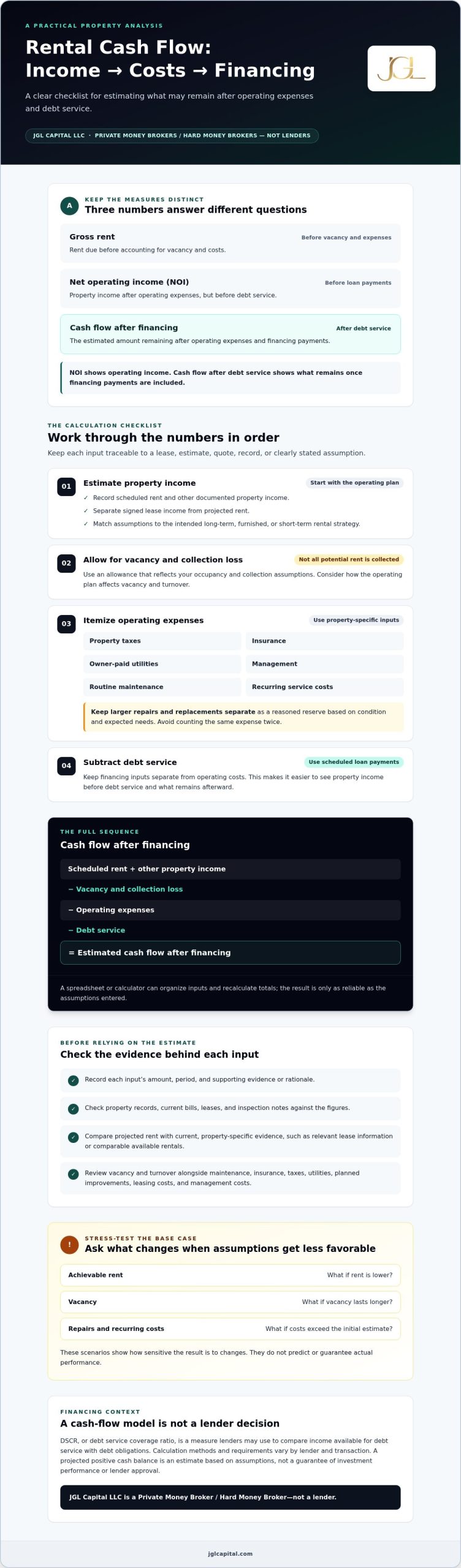
Rental cash flow is the income remaining after operating expenses and debt service are paid. Gross rent is the rent due before vacancy and expenses. Net operating income (NOI) is property income after operating expenses but before loan payments. Cash flow after financing subtracts debt service from NOI, showing what remains from operations before tax and other investment-level considerations.
NOI measures the property’s operating income; cash flow after debt service measures what remains once financing payments are included. A projected positive balance is an estimate based on assumptions, not a guarantee of investment performance. The analysis is only as useful as its inputs, so match income, costs, and financing to the property’s intended use.
How cash flow differs from NOI and investment return
Cash flow is a dollar amount measured over a defined period, commonly monthly or annually. NOI excludes debt service. The capitalization rate compares NOI with a property’s purchase price or value, offering a property-level yield measure before financing. Cash-on-cash return compares annual pre-tax cash flow with the cash invested. These measures answer different questions, so don’t treat them as interchangeable. Tax treatment is specific to each situation; this analysis isn’t tax advice.
Which rental strategy belongs in the analysis?
Start with the operating plan you actually intend to use. A long-term lease, furnished rental, or short-term rental can have different lease structures, turnover patterns, and occupancy assumptions. Those choices affect both the rent you expect to collect and when the property may be vacant. Use assumptions that match your plan. Don’t combine the highest income expectations from one strategy with the lowest operating demands of another. There’s no universally superior rental model. The question is whether the projected cash flow aligns with your objectives and tolerance for uncertainty.
That distinction is central to how to analyze a rental property for cash flow: model the property’s operations and financing together, while keeping each performance measure clear.
How to Calculate Rental Property Cash Flow Step by Step
Use the same sequence for each property and keep every input traceable to a lease, estimate, quote, record, or clearly stated assumption. A rental property cash flow analysis follows the same basic progression: income, costs, then financing.
- Estimate income. Record scheduled rent and other documented property income under your intended operating plan. Separate signed lease income from projected rent.
- Subtract vacancy and collection loss. Apply an allowance that reflects your occupancy and collection assumptions. Don’t treat all potential rent as collected.
- Itemize operating expenses. Include applicable property taxes, insurance, owner-paid utilities, management, routine maintenance, and recurring service costs.
- Subtract debt service. Use the scheduled loan payments to estimate cash flow after financing.
Cash flow after financing = scheduled rent and other property income, minus vacancy and collection loss, minus operating expenses, minus debt service.
Build a complete income and expense schedule
Set up a worksheet before entering assumptions. For each input, record the amount, period, and supporting evidence or rationale. Check whether property records, current bills, leases, and inspection notes support the figures. Keep routine maintenance among operating expenses. Show larger repairs and replacements separately as a reasoned reserve based on the property’s condition and expected needs. This makes recurring costs easier to distinguish and helps avoid counting the same expense twice.
- Scheduled rent and other documented income: _____
- Vacancy and collection loss: _____
- Operating expenses by category: _____
- Separate repair and replacement allowance: _____
- Debt service: _____
- Estimated cash flow after financing: _____
Add financing and interpret the result
A spreadsheet or calculator can organize inputs and recalculate totals, but its output is only as reliable as the assumptions entered. Keep financing inputs separate from operating costs so you can see what the property generates before debt service and what remains afterward. DSCR, or debt service coverage ratio, is a measure lenders may use to compare income available for debt service with debt obligations. Calculation methods and requirements vary by lender and transaction.
Learning how to analyze a rental property for cash flow also means preparing financing assumptions carefully. For business-purpose rental transactions, JGL Capital LLC is a private money broker and capital advisor, not a direct lender. JGL Capital helps borrowers identify potential lender programs and organize financing requests through its business-purpose rental financing process.
How to Stress-Test Rental Cash Flow Assumptions
A base case is useful only when its assumptions have support. Stress-testing asks what happens when a key input is less favorable: achievable rent is lower, vacancy lasts longer, or repairs and recurring costs exceed the initial estimate. These scenarios show how sensitive the result is to changes. They don’t predict or guarantee actual performance.
Which assumptions can change the result most?
Compare projected rent with current, property-specific evidence, such as relevant lease information or comparable available rentals. Review vacancy and turnover alongside maintenance, insurance, taxes, utilities, planned improvements, leasing costs, and management costs. Check whether each expense reflects the property’s condition and operating plan. If an input lacks evidence, label it as an assumption rather than presenting it as established.
Use a working table to make the basis of each assumption visible. Enter your own documented inputs rather than substituting generic market percentages.
| Assumption | Evidence | Base case | Downside case |
|---|---|---|---|
| Achievable rent | Property-specific rent evidence: _____ | _____ | Lower supported estimate: _____ |
| Vacancy and turnover | Lease-up or occupancy rationale: _____ | _____ | More time vacant: _____ |
| Repairs and replacements | Inspection or condition notes: _____ | _____ | Higher allowance: _____ |
| Recurring costs | Current bills or other records: _____ | _____ | Higher supported costs: _____ |
When does a projected positive result deserve caution?
Be cautious if the result depends on full occupancy, unusually low expenses, or rent that hasn’t been substantiated. Consider whether available cash reserves could cover interruptions and unexpected property needs without disrupting the plan. A useful stress test shows which assumptions have the greatest effect and whether the deal still fits your objectives under less favorable conditions. Tax, legal, and accounting questions call for advice from qualified professionals.
If you’re assessing financing alongside these scenarios, JGL Capital LLC can help organize a financing-fit review around the transaction details, timeline, and intended exit. JGL Capital is a private money broker and capital advisor, not a direct lender.
Use the Analysis to Assess the Deal and Its Financing Path
Your cash-flow model is a decision tool, not a promise of profitability or future property performance. Use it to identify which assumptions support the purchase, where the downside could fall, and whether the transaction remains aligned with your business plan if conditions differ from expectations. The broader real estate investing guide offers additional acquisition context.
What cash flow can and cannot tell you about financing
A projected cash-flow figure helps you assess the property under your assumptions. It doesn’t determine how a lender will evaluate the transaction. A lender’s DSCR review is separate, and calculation methods and thresholds vary. The lender may also consider borrower, property, and transaction factors. JGL Capital LLC is a private money broker and capital advisor, not a direct lender. It helps business-purpose rental-property borrowers identify potential lender programs and organize financing requests. Each lender independently sets its requirements, conducts underwriting, determines terms, and makes the final approval decision.
Prepare a concise rental-property financing summary
Before discussing financing, assemble a clear summary that presents the property and request together. Include:
- Property details and purchase price or current value
- Documented rental income, operating expenses, and your cash-flow assumptions
- Requested proceeds and the transaction timeline
- Your intended exit strategy
Keep supporting records and downside assumptions close at hand. This helps distinguish documented information from estimates and explain how the proposed financing fits the investment plan. You can also review JGL Capital LLC’s background to understand its broker and capital-advisory role.
If you’re evaluating a business-purpose rental transaction, request an initial financing-fit review to discuss its details, timeline, and exit. The review can help organize the financing conversation, while the lender retains control of its requirements and decisions.
Put Your Rental Analysis to Work
A cash-flow model is most useful as a working decision document, not a figure you calculate once and set aside. As property-specific information improves, revise the assumptions and note what changed. That process can help you decide whether to proceed, adjust the plan, or pause before committing capital.
If you’re considering how to analyze a rental property for cash flow alongside a financing request, bring the transaction details, timeline, and intended exit into the same conversation. JGL CAPITAL is a private money broker and capital advisor, not a direct lender. Its stated 5 Star Service reflects its service approach, not a promise of financing results. Lenders make their own decisions under their requirements.
Discuss your business-purpose rental transaction with JGL CAPITAL and take a considered next step with your analysis in hand. A clear model gives you a stronger basis for evaluating the opportunity and aligning the financing discussion with your investment plan.
Frequently Asked Questions
How do you calculate cash flow on a rental property?
Subtract vacancy and collection loss, operating expenses, and scheduled debt payments from expected rental income. To learn how to analyze a rental property for cash flow, keep the calculation period consistent: compare monthly income with monthly expenses and payments, or use annual figures throughout. Use amounts supported by leases, property records, or stated assumptions, and note where each input came from.
What expenses should be included when analyzing a rental property?
Include recurring costs the property or its operating plan is expected to bear, such as taxes, insurance, owner-paid utilities, management, routine maintenance, and service contracts. Account separately for larger repairs and replacements so they aren’t lost among routine costs. If you’ll self-manage, consider whether the plan still works if management responsibilities or associated costs change. Avoid counting a cost twice under different labels.
Is net operating income the same as rental cash flow?
No. NOI reflects property operations before debt payments, while rental cash flow after financing accounts for scheduled debt service. For example, a property may show positive NOI but leave less cash after its loan payment is deducted. NOI can help compare operating performance without financing; cash flow shows how the selected financing affects the amount remaining. Neither measure alone captures every aspect of investment return.
What is a good cash flow for a rental property?
There’s no single cash-flow amount that’s right for every property or investor. A useful result depends on the purchase plan, financing structure, operating strategy, reserve needs, and the investor’s objectives. Rather than rely on a generic benchmark, assess whether the projected amount remains acceptable under cautious assumptions and whether available reserves can address interruptions or property needs. A positive estimate isn’t a guarantee of future performance.
How is DSCR different from rental property cash flow?
Rental cash flow is an estimated dollar amount remaining after selected costs and debt service; DSCR is a ratio used to assess income relative to debt obligations. A lender may calculate the ratio differently from an investor’s own model and may consider other borrower, property, or transaction factors. Requirements vary by lender, so an investor’s cash-flow estimate shouldn’t be treated as a lender decision or approval.