

With national gross ROI for house flipping reaching a seventeen-year low of 23.1 percent in late 2025, the margin for error in residential redevelopment has effectively vanished. You likely recognize that the era of speculative “rules of thumb” and casual property evaluation has been superseded by a need for rigorous, analytical precision. The current landscape presents a complex array of challenges, from compressed margins to the tightening requirements of asset-backed lenders who now prioritize comprehensive data over optimistic projections. Analyzing a fix and flip deal 2026 requires a transition from simple estimation to a disciplined, institutional-grade capital allocation strategy that preserves value in a volatile environment.
This article serves as a strategic framework to help you master the analytical techniques necessary to evaluate property profitability and secure private capital with confidence. We’ll provide the methodology for constructing a bulletproof proforma that withstands the scrutiny of sophisticated partners while identifying the specific fundability criteria required for modern Fix-and-Flip Loans. By refining your approach to rehab estimates and holding cost mitigation, you’ll establish a foundation for long-term growth and professional integrity in your investment portfolio. We’ll move from high-level strategic objectives to the granular operational strengths that define a successful deal in today’s market.
Key Takeaways
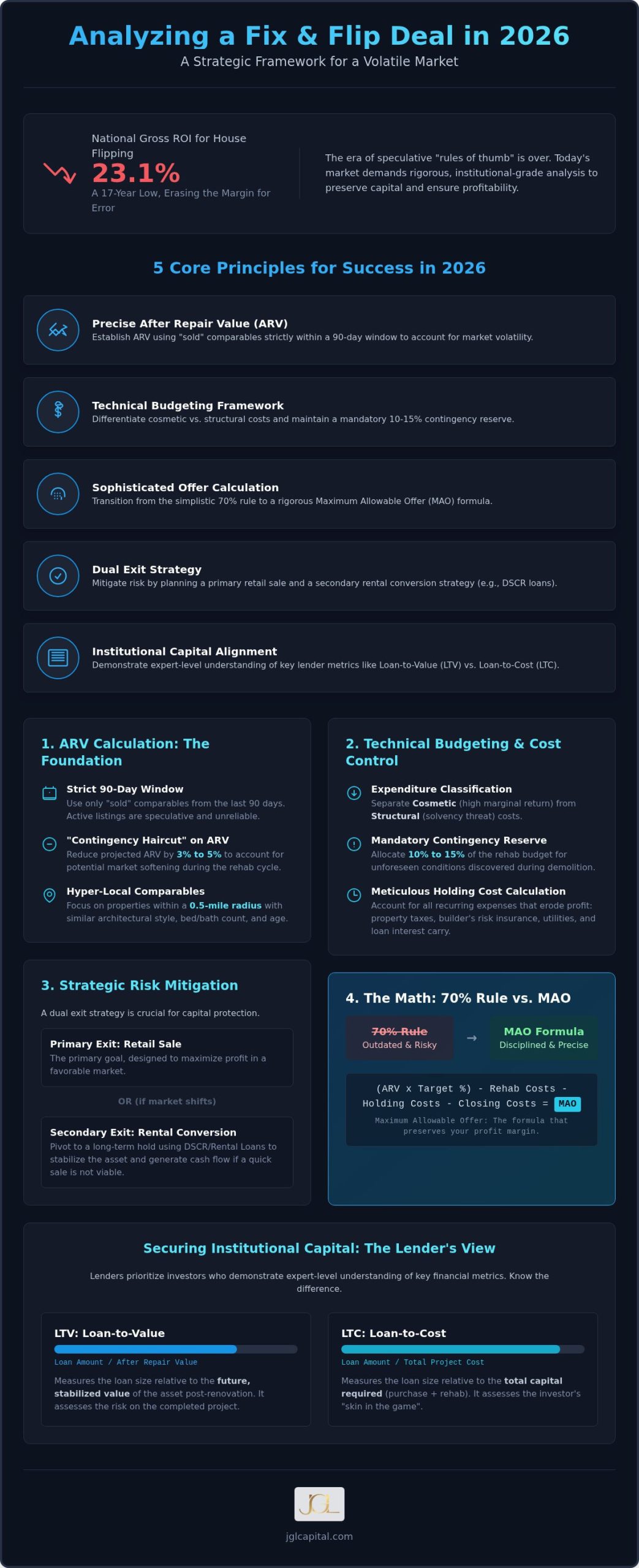
- Establish a precise After Repair Value by utilizing “sold” comparables within a strict 90-day window to accurately account for contemporary market volatility.
- Implement a technical budgeting framework that differentiates between cosmetic and structural expenditures while maintaining a mandatory 10-15% contingency reserve for unforeseen conditions.
- Transition from the 70% rule to a sophisticated Maximum Allowable Offer (MAO) formula when analyzing a fix and flip deal 2026 to ensure rigorous margin preservation.
- Mitigate capital risk by establishing both a primary retail exit and a secondary rental conversion strategy, utilizing DSCR / Rental Loans for long-term asset stabilization.
- Align with institutional lender requirements by demonstrating an expert-level understanding of the distinction between Loan-to-Value (LTV) and Loan-to-Cost (LTC) metrics.
The Foundation of Analysis: Establishing After Repair Value (ARV) in 2026
Within the disciplined practice of real estate redevelopment, the After Repair Value (ARV) serves as the definitive terminal value an asset is projected to achieve upon the conclusion of a comprehensive renovation program. It’s not merely an optimistic estimate; it’s a calculated projection of an asset’s worth in its most optimized state. Analyzing a fix and flip deal 2026 demands a departure from historical averages in favor of immediate, localized data. This rigorous approach ensures that capital is deployed only where the exit valuation is supported by empirical evidence rather than speculative hope.
To reflect current market volatility, analysts must restrict their evaluation to “sold” comparables settled within a strict 90-day window. Reliance on active listings or stale data from the previous quarter introduces unacceptable risk, as these figures don’t reflect the actual closing prices in a shifting economy. High inventory levels often exert downward pressure on terminal pricing. This reality necessitates a “contingency haircut” of 3 to 5 percent to the projected ARV. Such a reduction accounts for potential market softening during the typical six-month rehab cycle, providing a necessary buffer for the preservation of equity.
Filtering and Adjusting Sales Comparables
Precision in selection is paramount for accurate valuation. You should focus on properties within a 0.5-mile radius that share similar architectural utility, bedroom counts, and vintage. Quantitative adjustments must be applied for variances in square footage and lot size to ensure a normalized comparison across the data set. Prioritizing recent cash transactions provides a clearer benchmark for investor activity. These transactions often represent the floor of the market, offering a conservative baseline for your projections. This methodology ensures that analyzing a fix and flip deal 2026 remains a grounded exercise in value preservation rather than a speculative gamble.
Accounting for 2026 Market Sentiment
The psychological state of the end-buyer pool significantly influences the velocity of a capital exit. Evaluating the “Days on Market” (DOM) for recently renovated properties in the subject class reveals the actual absorption rate of the local sub-market. If prevailing mortgage rates remain elevated, the pool of qualified owner-occupants may shrink, extending holding periods and increasing costs. In such instances, a prudent steward must determine if the “highest and best use” has shifted toward a rental model. This shift might necessitate a pivot toward DSCR / Rental Loans for long-term stabilization, ensuring that the asset generates worth even if a retail sale is deferred.
Technical Budgeting: Estimating Rehab and Holding Expenses
Precision in fiscal modeling is the hallmark of a disciplined investor. Once the After Repair Value has been established with the rigor described previously, the analytical focus must pivot toward the preservation of margins through technical budgeting. Analyzing a fix and flip deal 2026 requires a binary classification of capital expenditures: cosmetic enhancements designed to drive emotional engagement and structural remediations necessary for asset integrity. While cosmetic upgrades often yield the highest marginal return, structural deficiencies represent the greatest threat to a project’s solvency. A seasoned steward maintains a mandatory 10-15% contingency reserve to absorb the impact of unforeseen site conditions, ensuring that the original proforma remains viable even when skeletal issues emerge during the demolition phase.
Holding costs, frequently relegated to a secondary status in amateur projections, demand meticulous calculation. These recurring expenses, including property taxes, specialized builder’s risk insurance, and essential utilities, erode profitability with every day the asset remains in inventory. Central to this erosion is the cost of capital, specifically the interest carry associated with Fix-and-Flip Loans. Modeling these interest-only payments over a conservative six-to-nine-month timeline provides a realistic view of the net cash flow requirements, allowing for better alignment with the firm’s liquidity objectives.
Vetting Contractor Bids for Accuracy
Institutional-grade analysis rejects “per square foot” estimates in favor of line-itemized transparency. You must require contractors to provide granular bids that isolate labor and material costs for every phase of the renovation. This level of detail allows for a direct comparison against industry benchmarks and prevents the common pitfall of over-improvement. Verifying contractor licensure and reviewing a portfolio of similar historical completions is non-negotiable. It’s essential to align the proposed scope of work with the target ARV, ensuring that every dollar deployed contributes to the ultimate generation of worth.
The Impact of Interest Carry and Draw Schedules
The management of liquidity is as critical as the management of construction. Strategic alignment of draw schedules with verifiable project milestones ensures that capital is deployed in a manner that mirrors value creation. Each draw request typically triggers a third-party inspection, and the administrative fees for these site visits must be factored into the total project cost. By modeling the cash flow impact of these disbursements alongside interest carry, an investor can maintain a clear understanding of their leverage position. For those seeking to optimize their capital structure, engaging with a private money broker can offer the flexibility needed for rapid execution.
The Math of the Deal: 70% Rule vs. Maximum Allowable Offer (MAO)
The 70 percent rule, while historically serving as a reliable heuristic for rapid deal filtering, often lacks the precision required for high-stakes capital allocation in the current economic climate. This guideline suggests that an investor should pay no more than 70 percent of the After Repair Value minus the estimated cost of renovations. While it remains a useful preliminary screening tool, analyzing a fix and flip deal 2026 requires a transition toward the more granular Maximum Allowable Offer (MAO) formula. This institutional-grade calculation incorporates every facet of the project’s financial lifecycle, defined as: (ARV x Target Margin) minus Rehab, Holding Costs, and Closing Costs. By utilizing this formula, a disciplined steward ensures that the purchase price is anchored in actual projected performance rather than a generalized industry average.
The prevailing interest rates of 2026, which typically range from 8.00 to 14.00 percent for asset-backed financing, have necessitated a fundamental shift in target profit margins. High capital costs exert immediate pressure on the bottom line, requiring a more conservative entry point to preserve the original proforma. You must also account for the initial capital outlay, specifically the acquisition fees and brokerage points associated with securing leverage. With origination points for new investors often reaching 2.5 percent, these upfront expenses must be integrated into the MAO calculation to avoid the erosion of liquidity before the renovation even commences.
When the 70% Rule Fails the Modern Investor
In high-demand markets where inventory remains exceptionally tight, a strict adherence to the 70 percent rule may result in a complete lack of acquisition volume. In such competitive environments, a 75 or 80 percent threshold may be acceptable, provided the asset sits in a low-volatility area with high absorption rates. Conversely, a “thin” deal in a tertiary market presents an unacceptable risk profile. You must determine a minimum net profit floor, often benchmarked against the median gross profit of approximately $60,000 seen in recent quarters, to justify the deployment of firm capital and the assumption of operational risk.
Reverse Engineering Your Target Profit
A sophisticated approach to analyzing a fix and flip deal 2026 involves starting with the desired Return on Equity (ROE) and working backward to establish the purchase price. This method forces an evaluation of the “opportunity cost” of the capital deployed, comparing the projected flip returns against more passive institutional benchmarks. Given that profit margins hit a 17-year low in late 2025, it’s vital to ensure the profit margin provides a sufficient buffer against ARV compression. This disciplined reverse-engineering ensures that every acquisition aligns with the broader objective of long-term value preservation and capital growth.
Strategic Risk Mitigation and Exit Planning
Risk management isn’t merely a defensive posture; it’s a strategic imperative that separates institutional stewards from speculative amateurs. When analyzing a fix and flip deal 2026, a disciplined investor must establish a primary exit through a retail sale while simultaneously underwriting a secondary exit via rental conversion. This dual-path approach ensures that capital remains protected even if market absorption rates decelerate or buyer sentiment shifts unexpectedly. A robust stress test should always include a “worst-case” scenario analysis, specifically modeling the impact of a 10 percent reduction in the projected After Repair Value. If the proforma remains solvent under these compressed conditions, the deal demonstrates the structural integrity required for a serious commitment of capital.
For properties requiring immediate stabilization or those with complex acquisition timelines, the strategic use of Bridge Loans offers the necessary transitional capital to reach a fundable state. Should the retail market soften during the renovation phase, evaluating the viability of DSCR / Rental Loans as a long-term stabilization tool becomes paramount. This pivot allows the firm to transition from a capital appreciation model to a yield-generating one, preserving equity through market cycles rather than forcing a sale in a downmarket. It’s about maintaining the flexibility to hold an asset until the optimal exit window reappears.
The Bridge-to-Perm Contingency
The transition from a short-term flip to a long-term hold requires a precise calculation of the Debt Service Coverage Ratio (DSCR). A ratio of 1.20 or higher is typically the benchmark to ensure the property can comfortably carry its debt obligations as a rental asset. You must identify the specific “pivot point” where a flip should be converted to a hold to avoid equity erosion from mounting holding costs. Additionally, it’s vital to assess the impact of prepayment penalties on your short-term financing, as these fees can significantly alter the net proceeds of a mid-project refinance. Analyzing a fix and flip deal 2026 involves anticipating these friction points before they impact liquidity.
Mitigating External Market Risks
Beyond the asset level, a steward must monitor local economic indicators such as employment data and net migration patterns. These macro factors dictate the depth of the end-buyer pool and the long-term demand for housing in the sub-market. Assessing the risk of sudden regulatory changes or new property tax assessments is equally critical to the preservation of value. Maintaining a dedicated liquidity reserve is essential to manage extended holding periods, ensuring the firm is never forced into a distressed liquidation. To secure the flexible financing necessary for these sophisticated risk-mitigation strategies, you should consult with a private money broker who understands the nuances of capital allocation in the current landscape.
Securing Institutional Capital: The Lender’s Evaluation Criteria
The successful deployment of capital relies on an alignment of interests between the investor and the institution. Analyzing a fix and flip deal 2026 involves viewing the transaction through the lens of asset-based underwriting. Unlike traditional mortgage lending, Hard Money Lenders prioritize the intrinsic value of the property and the viability of the exit strategy over personal credit history. This “pattern recognition” allows for the rapid execution of deals that would otherwise be rejected by conventional banks. A comprehensive deal package, including a detailed scope of work and a professional experience resume, serves as the primary instrument for establishing this institutional trust. Speed of execution remains a critical competitive advantage, and asset-based private capital provides the agility required to secure distressed assets before they reach the broader market.
Understanding LTC and LTV Requirements
Institutional lenders typically utilize two primary metrics to assess risk: Loan-to-Cost (LTC) and Loan-to-Value (LTV). While LTC represents the percentage of the total project costs the lender is willing to finance, LTV focuses on the terminal value established by the ARV. Most institutions cap LTC at 85 to 90 percent, ensuring the sponsor maintains significant “skin in the game” to mitigate the risk of project abandonment. If a sponsor seeks higher leverage, cross-collateralization of other equity-rich assets can be employed as a strategic tool to secure more favorable terms. This approach allows for the preservation of firm liquidity while maximizing the impact of the initial capital outlay. It’s essential to understand that while a lender may finance up to 95 percent of costs in exceptional cases, the baseline requirements remain rooted in the disciplined preservation of equity.
The Importance of Sponsor Capacity
Beyond the asset’s metrics, the lender evaluates the operational capacity and professional history of the sponsor. Documenting a consistent track record of successful completions is essential to securing the most competitive interest rates, which for highly qualified borrowers can range from 7.25 to 7.75 percent. You must demonstrate sufficient liquidity to fund the initial phases of the renovation before the first draw is disbursed. This financial readiness positions the transaction not as a simple service provision, but as a collaborative alliance. By framing the relationship as a strategic partnership, you ensure that the capital source remains invested in the long-term generation of worth. Analyzing a fix and flip deal 2026 from this perspective transforms the loan application into a high-level strategic proposal, emphasizing a serious and disciplined approach to the creation of value.
Advancing Toward Institutional-Grade Capital Allocation
The transition from speculative heuristics to institutional-grade analysis isn’t merely a preference; it’s a requirement for the preservation of capital in a high-stakes environment. Success in the current market hinges on the rigorous establishment of After Repair Value and the implementation of technical budgeting that accounts for both structural contingencies and interest carry. By moving beyond the 70 percent rule to a comprehensive Maximum Allowable Offer framework, you ensure that every acquisition is grounded in empirical data. Analyzing a fix and flip deal 2026 necessitates this level of discipline to navigate margin compression and secure the trust of sophisticated capital partners who value analytical precision.
As you refine your strategic exit planning and risk mitigation protocols, the alignment with a knowledgeable financial ally becomes paramount. JGL Capital LLC provides the stability and expertise required to execute complex redevelopment programs through national asset-based lending programs. With 30 plus years of combined industry expertise, our firm offers strategic guidance from private capital experts who prioritize property worth and long-term viability. We invite you to Secure Strategic Capital for Your Next Fix and Flip Deal and leverage our institutional resources for your portfolio. Your dedication to a disciplined investment philosophy ensures a path toward the consistent generation of worth.
Frequently Asked Questions
What is the 70% rule in real estate and is it still valid in 2026?
The 70 percent rule is a heuristic suggesting an acquisition price no higher than 70 percent of the After Repair Value minus renovation costs. While it serves as a functional baseline, its validity when analyzing a fix and flip deal 2026 is often challenged by tight inventory and compressed margins. Sophisticated stewards now favor the Maximum Allowable Offer formula, which incorporates granular holding and closing costs to ensure the preservation of net profitability.
How do I calculate the After Repair Value (ARV) for a fix and flip deal?
Calculating the After Repair Value requires a meticulous evaluation of “sold” comparables within a 0.5-mile radius and a strict 90-day window. This terminal value represents the anticipated market price of the asset following a comprehensive renovation program. You must apply quantitative adjustments for square footage and lot size variances to ensure data normalization. A conservative approach often includes a contingency haircut to account for potential market softening during the project lifecycle.
What are the typical holding costs for a residential flip?
Typical holding costs encompass every recurring expense incurred during the lifecycle of the project, including property taxes, builder’s risk insurance, and essential utilities. The most significant component is often the interest carry associated with Fix-and-Flip Loans. These expenses erode the firm’s equity with every day the asset remains in inventory. Precise modeling of these costs is essential for maintaining the integrity of the original proforma and ensuring sufficient liquidity for the firm.
Can I use a bridge loan for a fix and flip project?
Bridge Loans are an effective tool for properties requiring immediate stabilization or transitional capital before they reach a fundable state for long-term programs. These short-term instruments provide the agility required for rapid execution in competitive markets. While they often carry higher interest rates, their flexibility allows an investor to secure an asset and initiate the renovation process while a more permanent capital structure is finalized or the project moves toward completion.
What is the difference between LTC and LTV in property financing?
Loan-to-Cost (LTC) measures the percentage of the total project costs financed by the lender, whereas Loan-to-Value (LTV) is based on the property’s projected After Repair Value. Lenders typically cap LTC at 85 to 90 percent to ensure the sponsor maintains sufficient “skin in the game.” Understanding this distinction is critical when analyzing a fix and flip deal 2026, as it dictates the initial capital outlay required to initiate the project and manage firm equity.
How much cash reserve should I maintain for a fix and flip?
A disciplined investor should maintain a mandatory 10 to 15 percent contingency reserve specifically for unforeseen site conditions discovered during the renovation. Beyond construction contingencies, it’s vital to hold a liquidity reserve sufficient to cover at least six months of holding costs and interest carry. This capital buffer protects the firm from forced liquidations and allows for a patient approach to achieving the optimal exit valuation even in volatile market conditions.
What happens if I cannot sell the property within the loan term?
If a retail sale is not achieved within the original loan term, the most common strategic pivot involves a “bridge-to-perm” refinance into DSCR / Rental Loans. This transition allows the investor to stabilize the asset as a yield-generating rental property while preserving equity. It requires a Debt Service Coverage Ratio of at least 1.20 to ensure the property can carry its own debt. This secondary exit strategy is a hallmark of professional risk mitigation.
Why do private money lenders focus on property value rather than credit?
Private money lenders utilize asset-based underwriting because the property’s equity and the viability of the exit strategy provide the primary security for the capital. This institutional focus on “pattern recognition” and property worth allows for greater flexibility than traditional credit-based lending. By prioritizing the asset’s intrinsic value, these lenders can facilitate rapid execution for sophisticated partners who demonstrate a serious and disciplined approach to the creation and preservation of value.