

What if a deal that looks strong on paper still misses the mark with a private lender? The common reasons private lenders reject deals often have less to do with one obvious flaw than with gaps across the whole request: collateral, borrower capacity, documentation, or a credible exit. A decline or pause can feel frustrating, especially when the feedback is brief, but it may point to a mismatch between the deal’s risk profile and a lender’s criteria.
This article explains what lenders may scrutinize and how to address weaknesses before making another submission. You’ll see how property value, borrower liquidity and experience, supporting documents, and the business plan work together, and why a clear exit strategy matters. JGL Capital LLC is a private money broker, not a lender. We help organize business-purpose real estate requests and match them with prospective capital sources, while each lender makes its own underwriting and approval decisions. The goal is a concise, credible deal package and a better-informed comparison of financing paths.
Key Takeaways
- The common reasons private lenders reject deals often involve a mismatch between the request and a lender’s criteria, not a single weakness in the property or borrower.
- Assess collateral alongside borrower capacity, project execution, documentation, and exit. A strong asset alone may not resolve gaps in the overall request.
- Before another submission, reconcile requested proceeds with the use of funds, project budget, and available equity so the financing request is clear and internally consistent.
- After a decline, separate fixable gaps from lender-specific limits. A private money broker can help organize the request and identify prospective capital sources, but each lender makes its own decision.
Common reasons private lenders reject real estate deals
A decline isn’t necessarily a judgment of the borrower or the property’s overall merit. It may mean the request doesn’t align with a particular lender’s criteria, which vary by property, program, borrower, and transaction. Common reasons private lenders reject deals include concerns about collateral or valuation, project feasibility, borrower capacity, documentation, requested structure, and the credibility of the exit. These are possible considerations, not universal rules.
JGL Capital LLC is a private money broker, not a lender, and does not make underwriting or approval decisions. Its role is to help organize a business-purpose financing request and identify prospective capital sources whose criteria may fit the transaction. The phrase private mortgage can refer broadly to real estate financing from private sources. The label alone doesn’t determine how a particular lender evaluates a deal.
When the collateral or project does not support the request
A property’s apparent value may differ from the value a lender is prepared to recognize as eligible collateral. The purchase basis, current condition, and projected completed value are distinct figures, especially when the request depends on renovation or construction. Unresolved title concerns, limited marketability, or a project scope that appears difficult to execute may also raise questions. The lender determines accepted value and eligible collateral. A borrower’s estimate isn’t necessarily the figure used in the review.
For example, a property may have a compelling projected value after renovation, but the request can still be difficult to assess if the scope of work, budget, or support for that projection is unclear. Present the current asset and the planned outcome as separate parts of the transaction, and show how the budget and schedule connect them.
When the business plan or exit appears uncertain
Short-term financing depends on a plausible path to repayment. A lender may scrutinize resale assumptions, a refinance plan, lease-up projections, stabilization milestones, or construction timing if they lack support or seem inconsistent with the project. A credible exit should identify the intended repayment source and the steps required to reach it. Include a timeline that accounts for execution risks, such as construction delays or slower-than-expected leasing. No exit strategy or loan structure guarantees acceptance; the lender evaluates the complete request against its own criteria.
Why property value alone may not prevent a private lender rejection
A valuable property can still be part of a request that is difficult to evaluate. The proposed loan amount, intended use of funds, borrower’s capacity, project execution plan, and documentation all need to make sense together. Lenders may evaluate the whole transaction, not collateral in isolation. That is why common reasons private lenders reject deals can extend beyond the asset itself, even when its value appears compelling.
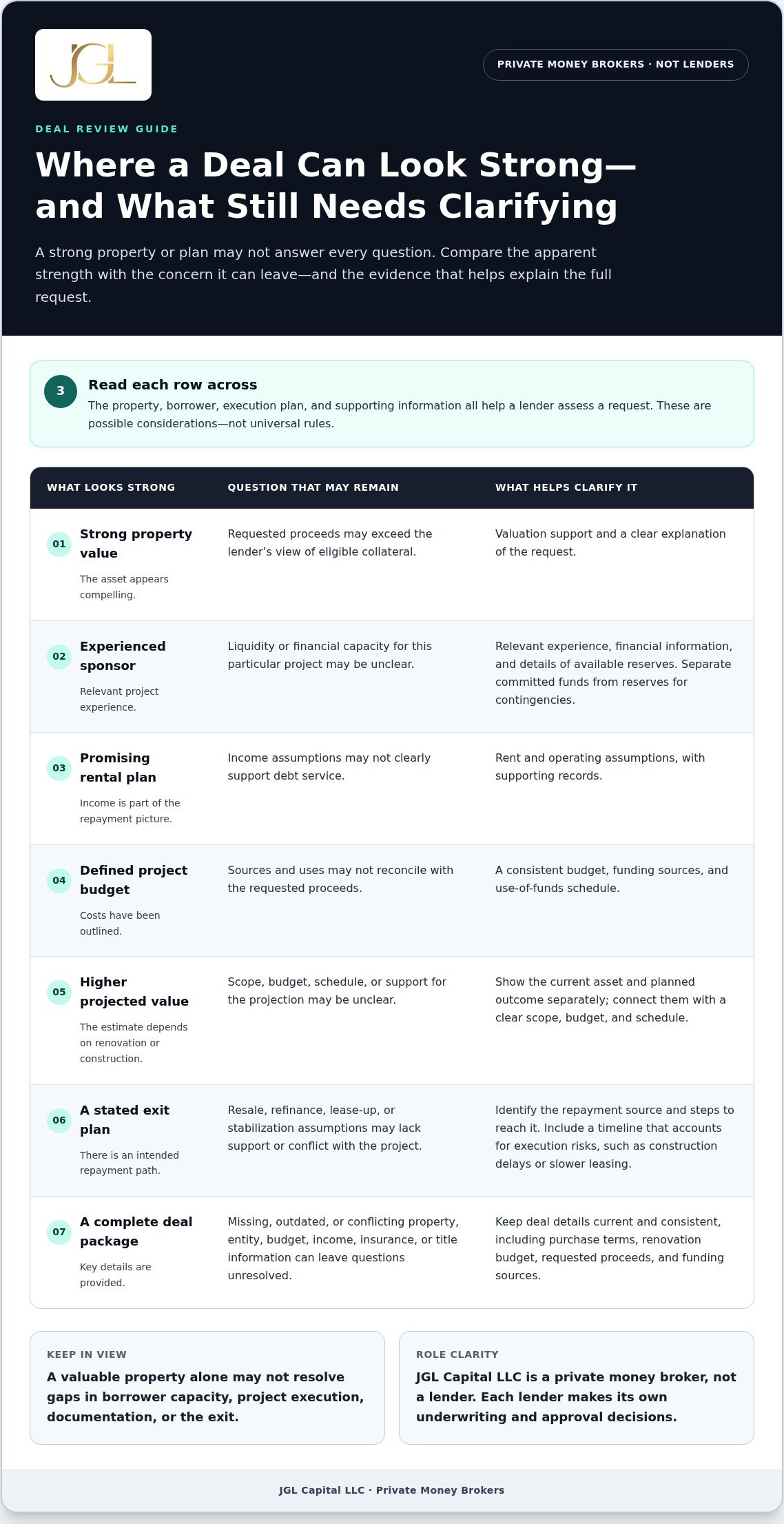
The distinctions are useful when diagnosing a decline: collateral concerns relate to the property; borrower and capital concerns relate to repayment capacity and available resources; execution concerns relate to the plan; and documentation concerns relate to whether the facts are clear and consistent.
| Apparent strength | Possible lender concern | Clarifying evidence |
|---|---|---|
| Strong property value | Requested proceeds exceed the lender’s view of eligible collateral | Valuation support and a clear explanation of the request |
| Experienced sponsor | Limited liquidity or unclear financial capacity for this project | Relevant experience, financial information, and available-reserve details |
| Promising rental plan | Income assumptions don’t clearly support debt service | Rent and operating assumptions with supporting records |
| Defined project budget | Sources and uses don’t reconcile | Consistent budget, funding sources, and use-of-funds schedule |
Borrower capacity, experience, and available liquidity
A lender’s review may consider relevant project experience, financial capacity, reserves, credit, and guarantor information. The weight assigned to each factor varies by program, transaction, and risk profile. Private financing doesn’t mean borrower finances are irrelevant. Present experience in context, and distinguish funds committed to the project from reserves available for contingencies. If a reserve amount is already allocated to another cost, don’t present it as available for unexpected expenses.
Documentation gaps and inconsistent deal details
Missing or outdated property, entity, budget, income, insurance, or title information can leave basic questions unresolved. Conflicting figures create another problem: if the purchase terms, renovation budget, requested proceeds, and sources of funds don’t reconcile, it becomes harder to assess the request. DSCR, or debt service coverage ratio, helps describe how property income relates to debt service. Loan-to-value and loan-to-cost can show how a request compares with property value or project cost when those measures are relevant to the lender’s criteria.
JGL Capital LLC is a private money broker that helps borrowers organize business-purpose requests and compare prospective capital sources. A deal package review can help surface inconsistencies and present the transaction more clearly, without guaranteeing a lender’s decision.
How to diagnose and strengthen a deal before another submission
Before sending a revised request, treat it as one transaction to reconcile, not a stack of separate documents. The common reasons private lenders reject deals are easier to diagnose when you review the request across six connected areas:
- Transaction: State what is being purchased, refinanced, built, or repositioned.
- Capital: Reconcile requested proceeds and use of funds with the full project budget and available equity.
- Collateral: Summarize property type, address, condition, and relevant value assumptions.
- Sponsor: Explain relevant experience, capital invested, and capacity to execute the plan.
- Timing: Set out key deadlines and dependencies, including valuation, title, insurance, entity records, and lender due diligence.
- Exit: Describe the expected repayment path and the steps required to reach it.
Build a clear deal summary and supporting package
Lead with a concise summary of the property, transaction, requested amount, use of funds, condition, and deadline. Add the sponsor’s relevant experience, invested capital, business plan, and proposed exit. Then organize current supporting documents around the transaction. Requirements vary by lender, so don’t assume one package fits every program. Keep the narrative consistent across the summary, budget, entity records, and financial materials. If the requested amount changes, update the use-of-funds schedule and every document that relies on it.
Stress-test the timeline, budget, and exit
Check whether the schedule allows for due diligence and project dependencies, and whether the budget accounts for construction contingencies, carrying costs, and reserves where applicable. If a delay would change the exit or require more capital, explain how the plan responds. The guide What Is a Bridge Loan? A Strategic Guide to Transitional Real Estate Capital can help frame questions about transitional financing. A construction financing guide can help you consider project-specific planning.
Before sharing the revised request, confirm that the amount, uses, budget, and equity agree; documents are current; assumptions are stated; and the exit has a realistic sequence. JGL Capital LLC is a private money broker, not a lender. Review your deal package with JGL Capital LLC to organize the request and consider transaction-specific capital sources. A review cannot assure approval.
What to do after a private lender declines a deal
Start by identifying which concerns drove the decision. Then separate gaps you can address, such as missing records or an unclear budget, from lender-specific limits that may remain even after the package is improved. A different structure, additional documentation, a revised request, or a later submission may be worth considering, but none guarantees a different outcome. Understand the decision before making another submission, so you can address the actual issue rather than simply resending the same materials.
How JGL Capital LLC supports a clearer financing review
JGL Capital LLC is a private money broker and capital advisor, not a direct lender. We help borrowers review financing fit, organize the deal package, identify prospective private or institutional capital sources, and coordinate communication. Each lender independently determines its underwriting requirements, approval, terms, proceeds, and closing timeline. A clear presentation can help a lender assess the request, but it cannot determine the lender’s decision.
Prepare for a realistic next conversation
Bring the transaction into one concise summary: property and condition, intended use, requested structure, supporting documents, key dates, and proposed exit. Include the reason for the prior decline and what has changed, if anything. This makes it easier to distinguish an unresolved weakness from a request that may simply be a poor fit for that lender. The guide Hard Money Lenders: A Strategic Guide to Private Capital Allocation in 2026 offers additional context on private capital.
The common reasons private lenders reject deals can inform the next review, but the right path depends on the transaction and lender criteria. JGL Capital LLC works with borrowers on business-purpose real estate financing requests, not consumer or owner-occupied mortgages. If you’re preparing a revised request or assessing another financing path, you can discuss the transaction with our team.
Make the Next Financing Step More Deliberate
Understanding the common reasons private lenders reject deals matters most when it helps you make a considered next move. Before approaching another capital source, decide what the previous response tells you: is there a specific issue to resolve, a request to restructure, or a lender-specific limit that calls for a different fit? A clear answer can prevent the same unresolved questions from following the deal into another review.
JGL Capital is a private money broker, not a lender. Its broker-first approach provides access to private and institutional capital sources, with transaction packaging and lender-program comparisons shaped around the property, borrower, business plan, and exit. Each lender makes its own decision. An initial financing-fit review is an opportunity to present the request clearly and assess potential alignment, not a promise of approval.
If you’re ready to take that step, submit a concise business-purpose deal summary for an initial financing-fit review. A thoughtful, well-aligned request gives you a clearer basis for deciding what to do next.
Frequently Asked Questions
Can a private lender reject a deal after issuing a term sheet?
Yes. A term sheet doesn’t by itself guarantee funding. It typically summarizes proposed terms subject to the lender’s underwriting, due diligence, documentation, approvals, and closing conditions. A lender may revise or decline the request if its review uncovers material issues or facts change. Before relying on a term sheet for a purchase or project schedule, distinguish preliminary terms from final approval and clarify which conditions remain outstanding.
Does a private lender rejection affect my credit?
A rejection itself isn’t the same as a credit inquiry or new debt. Whether an application affects a personal credit file depends on whether the lender requested a credit check, what type of inquiry it used, and whose credit was reviewed. Review any authorization and lender disclosures, then clarify which checks were performed. Don’t assume every private financing request is handled identically.
Should I submit the same deal to several private lenders at once?
Not necessarily. The common reasons private lenders reject deals can include fit and presentation issues, and sending the same unrefined package broadly may not address either. Before another round, align the request with likely program criteria and keep one accurate package. Maintain a submission log with each recipient, date, package version, questions, and status. This helps prevent conflicting figures or outdated documents from circulating.
What should I do if a lender says the exit strategy is not strong enough?
Identify the repayment source and support each assumption with evidence, such as current lease information for a rental or a documented sequence for completing and selling a project. Set out key milestones and explain what could delay them. If repayment depends on refinancing, show how the property is expected to meet a future lender’s criteria, while recognizing that the future lender makes its own decision.