

A polished pro forma can weaken a financing request if its assumptions can’t be defended. It’s reasonable to ask what lenders look for in a real estate pro forma, especially when projected rents, vacancy, or expenses are uncertain. Prospective lenders read the forecast as a testable account of the deal: they look at the evidence behind its assumptions and whether projected property cash flow fits the requested financing.
This article explains which income and expense assumptions commonly draw scrutiny, what records can support them, and how reserves, loan sizing, downside scenarios, and an exit plan fit together. A forecast grounded in property records and relevant market information is easier to assess than one that relies on optimistic growth alone. JGL Capital LLC is a private money broker and capital advisor, not a lender. It helps organize business-purpose financing requests and compare potential capital structures; prospective lenders make their own underwriting decisions. The goal is to present the opportunity, its assumptions, and its risks clearly.
Key Takeaways
- Understand what lenders look for in a real estate pro forma: a credible connection between property performance, repayment capacity, and the financing request.
- Projections support a financing request, but they don’t replace lender due diligence or final underwriting.
- Reconcile operating records with your forecast, document key assumptions, and test how downside scenarios could affect the deal.
- Present the transaction, capital request, collateral, sponsor resources, timing, and exit as one coherent financing narrative.
What a Real Estate Pro Forma Tells Lenders About the Deal
A real estate pro forma is a forward-looking estimate of a property’s income, expenses, and financial performance. It translates a business plan into projections, such as expected rental income, operating costs, and net operating income (NOI), which is income remaining after operating expenses and before debt service. For general context, see What is a Pro Forma? In a financing request, the forecast helps prospective lenders assess the plan’s feasibility, the potential contribution of property income toward repayment, and whether the requested structure fits the transaction.
A pro forma is a forecast to test, not a promise of future performance. Projected figures are assumptions to evaluate, not proof that income or repayment capacity is certain.
Why projected performance is only one part of lender review
What lenders look for in a real estate pro forma depends on how the forecast fits the full transaction. Property condition and value, borrower qualifications, the business plan, requested financing structure, and intended exit all matter. For example, a plan to renovate and lease vacant space depends on the work being completed, the cost and timing being credible, and the path to occupancy being explained. Lender requirements vary by program, property, borrower, and transaction, so no single forecast format or set of assumptions suits every request.
How a pro forma differs from actual operating history
Keep historical results distinct from projections. Trailing operating statements show recorded income and expenses over a past period; current leases document existing rental obligations and terms. A stabilization forecast estimates performance after planned changes, such as leasing vacant units or completing improvements. Label each clearly, state the period covered, and avoid presenting a projection as if it were an operating result.
Explain gaps between actual results and projections. If the forecast assumes higher rents or lower expenses than the records show, identify the support, such as signed lease terms, documented improvements, or a specific operating plan. Without that connection, a prospective lender has little basis to distinguish a reasoned projection from an unsupported assumption and may ask for more detail.
Why a Strong Pro Forma Does Not Guarantee Financing
A persuasive forecast is one part of a financing request, not a substitute for lender due diligence or final underwriting. Projected cash flow may support the financing case, but it doesn’t determine a lender’s decision. A prospective lender may also assess property value, purchase basis, physical condition, title, and the borrower’s liquidity, experience, documentation, and repayment or exit plan. The weight given to each factor depends on the program and transaction.
That broader review is why what lenders look for in a real estate pro forma goes beyond an attractive bottom line. Rent growth without support, unusually low expenses, or a rapid path to stabilization can weaken the forecast’s credibility if the assumptions conflict with property records or the business plan. The SEC’s guidance on pro forma financial information addresses a separate disclosure context, not lender underwriting, but it underscores the importance of explaining the basis for projections.
Which assumptions commonly require stronger support?
Pay particular attention to rent, occupancy, concessions, operating expenses, capital needs, and the timing of stabilization. Connect projected income to current leases, a rent roll, relevant market evidence, or another clearly stated basis. If projected rents exceed current lease levels, explain what supports the increase. If occupancy is expected to improve, describe the operating steps and timeline behind that projection rather than simply entering a higher occupancy figure.
Check that expenses reflect the property and its plan, including recurring operating costs and anticipated repairs or improvements. If the forecast assumes a cost will fall or a unit will become rent-ready, note the reason and timing. Leaving out a cost or treating a planned improvement as already complete can make the projected cash flow harder to evaluate.
How the exit strategy changes the lender’s perspective
A sale, refinance, or stabilization plan should fit the requested financing structure and the forecast. Identify what must happen before the exit is feasible, and disclose uncertainties such as construction delays, lease-up pace, or changing market conditions. Explain how the borrower might respond if the original timing or assumptions don’t hold. A fallback plan doesn’t remove risk, but it makes the plan’s dependencies easier to understand.
JGL CAPITAL LLC is a private money broker and capital advisor, not a lender or underwriting decision-maker. For a business-purpose transaction, organizing a financing request around its assumptions, evidence, and exit can help prospective lenders assess the opportunity and identify open questions.
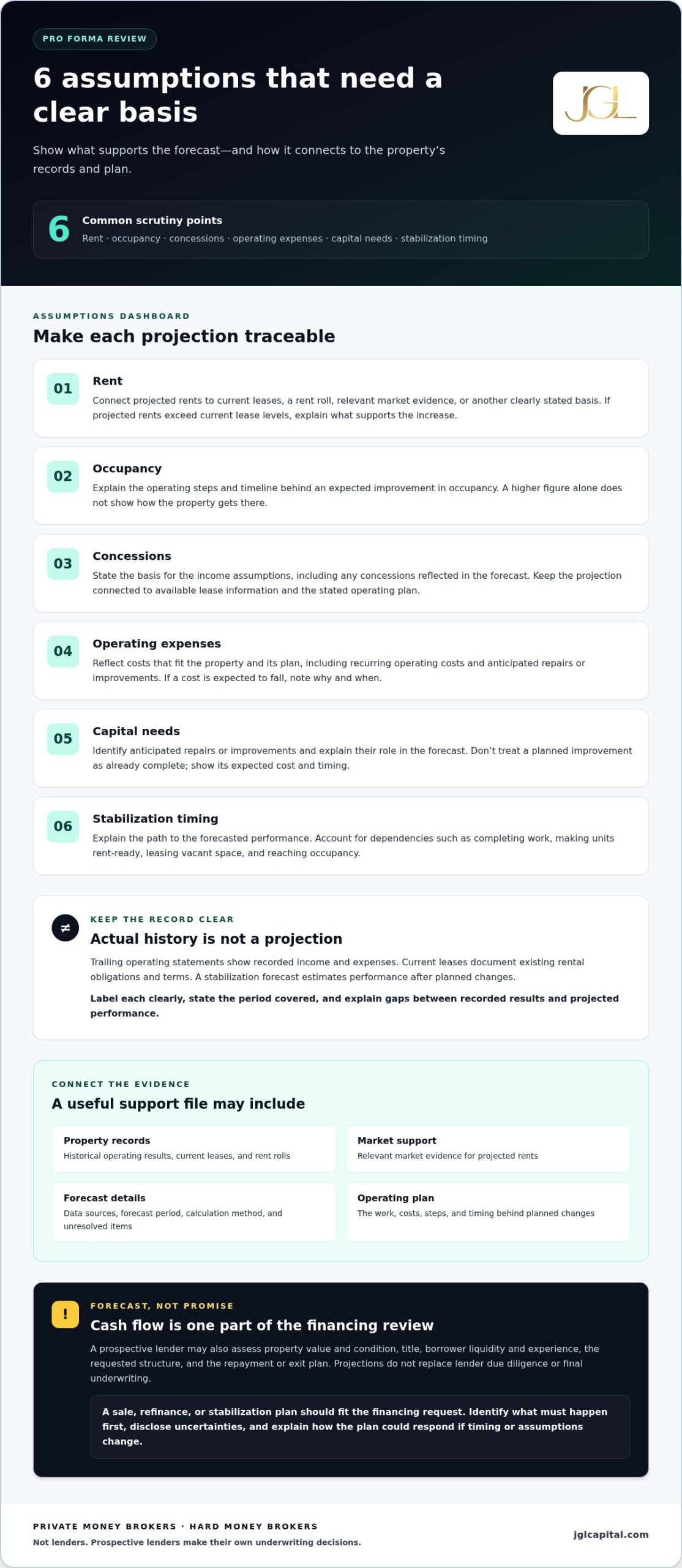
A Lender-Ready Real Estate Pro Forma Checklist
A useful checklist makes each projection easier to trace, evaluate, and compare with the financing request. What lenders look for in a real estate pro forma includes not only projected results, but also the evidence and calculations behind them. For every material assumption, provide supporting evidence or label it clearly as an estimate and explain the reasoning.
- Reconcile actuals. Compare historical operating results with current leases and rent rolls. Identify differences between recorded performance and the forecast rather than blending the two.
- Document assumptions. Label each data source, forecast period, calculation method, and unresolved item. Support rent and occupancy assumptions with available lease information and relevant market evidence.
- Test downside cases. Model how slower leasing, delayed completion, higher operating costs, repairs, or schedule changes could affect property cash flow. State the assumptions behind the base case and each downside scenario.
- Align the exit. Show how the forecast connects to the intended sale, refinance, or stabilization plan, including the conditions the project must meet before that exit is plausible.
Test income, expenses, and debt-service capacity
Include property-specific vacancy, concessions, operating costs, repairs, capital needs, and reserves. Keep operating assumptions separate from financing costs and sponsor-level resources, such as available liquidity. Debt service coverage ratio (DSCR) compares net operating income with required debt service. Lenders may calculate it differently and set their own requirements. The OCC’s commercial real estate lending guidance provides further context on lender review.
Check that projected income and expenses use the same period and that subtotals reconcile. For example, don’t compare annual NOI with monthly debt service without making the periods consistent. If an expense or reserve is excluded, state why so the reviewer can understand the calculation.
Stress-test timing, costs, and the exit
For development budgets, compare the forecast with project cost assumptions and the schedule. Include the major work, expected timing, and the relationship between completion and projected occupancy or income. The published guide New Construction Loans: A Strategic Guide for Real Estate Developers (2026) offers related context. Make revisions visible, and don’t present a downside case as though it were the base forecast.
JGL CAPITAL LLC is a private money broker and capital advisor, not a lender. Discuss a business-purpose financing request to organize its assumptions, supporting materials, and proposed structure for prospective lenders.
How to Present Your Pro Forma and Financing Request
A clear financing request lets prospective lenders see how the transaction, forecast, collateral, sponsor, timing, and exit fit together. Reconcile the pro forma with the property summary, available operating records, project budget, and requested financing. If documents use different assumptions or describe different plans, explain the difference and identify which figures are current. For context on allocating capital across a commercial real estate transaction, the guide Commercial Real Estate Loans: A Strategic Guide to Capital Allocation in 2026 is also relevant.
What to include in a concise deal summary
Give the reader a concise account of the transaction and the evidence behind it. Include:
- Property and transaction: property type, acquisition or project plan, current condition, and intended use.
- Capital request: requested proceeds and how the funds will be used.
- Operating picture: current income and the records available to support it.
- Sponsor and timing: relevant experience, capital invested, key documents, and anticipated schedule.
- Exit: the intended sale, refinance, or other repayment plan and the assumptions it depends on.
Keep the summary consistent with the detailed forecast. The answer to what lenders look for in a real estate pro forma should be apparent from the alignment between assumptions, supporting records, and the financing request, not buried across conflicting documents.
How a broker can help frame the request
JGL CAPITAL LLC is a private money broker and capital advisor, not a lender or approval authority. JGL CAPITAL helps organize business-purpose financing requests, identify potential private and institutional capital sources, compare possible structures, and coordinate communication. The About page describes this role and approach. Prospective lenders independently determine their programs, documentation requirements, underwriting decisions, terms, proceeds, and timing.
If you’re preparing a business-purpose real estate transaction, you can discuss the opportunity or submit a concise deal summary for an initial review. A well-organized request gives prospective lenders a coherent account of the property, capital need, and repayment plan without presenting projections as a promise of approval.
Prepare for a More Informed Financing Conversation
Use what lenders look for in a real estate pro forma as a standard for reviewing the transaction before presenting it. A forecast can also help you assess whether the proposed capital structure, business plan, and exit still fit together, or whether an assumption needs more support before you proceed.
JGL CAPITAL LLC is a private money broker and capital advisor, not a lender. It organizes business-purpose financing requests and helps identify appropriate private and institutional capital sources, with clear communication about a transaction’s strengths, gaps, documentation, and the discretion lenders retain over their decisions. A well-prepared request can make the opportunity easier to assess, but the lender makes its own decision.
Bring the deal forward with a clear account of its purpose and current position. Discuss your business-purpose real estate transaction with JGL CAPITAL to explore potential capital sources and request an initial financing-fit review.
Frequently Asked Questions
What do lenders look for in a real estate pro forma?
Lenders look for projections grounded in property information and consistent with the financing request. In a real estate pro forma, clarity matters: identify the period covered, distinguish leased income from projected income, and show how major figures were calculated. A forecast that connects assumptions to records gives the reviewer a clearer basis for assessing the request and identifying questions.
Do lenders rely only on the pro forma when reviewing a real estate deal?
No. A pro forma is one element of the review. A prospective lender may also examine an appraisal, title information, property condition, sponsor liquidity and experience, and documents supporting the transaction. For example, if a purchase agreement, project budget, and requested proceeds describe different uses of funds, the lender may seek clarification even if projected cash flow appears adequate. Underwriting and final decisions rest with the lender.
How should a borrower support projected rental income in a pro forma?
Show how the rent forecast relates to the property’s actual leasing position. A unit-level rent roll can distinguish occupied units from vacancies, while leases can support contracted rent and show lease start and expiration dates. If the forecast assumes rents above signed lease amounts, identify the market information or other basis for that projection. Keep asking rents separate from rents supported by executed leases.
Should a real estate pro forma include downside scenarios?
Yes. Include plausible cases that reflect risks specific to the plan, such as slower leasing, delayed completion, or higher operating costs. State the assumptions for each case rather than applying arbitrary changes, then show how the outcome could affect cash flow, reserve needs, and the timing of the planned exit. This helps readers understand how setbacks could affect the transaction.
Does a strong pro forma guarantee loan approval?
No. A well-supported forecast can clarify a business-purpose request, but it can’t guarantee approval or financing. JGL CAPITAL LLC is a private money broker and capital advisor, not a lender or approval authority. It helps organize requests and identify potential capital sources; each prospective lender independently determines its underwriting, terms, and decision based on the full transaction and its requirements.