

A polished presentation isn’t the same as a credible deal. If you’re working out how to pitch a real estate deal to investors, start by showing that the opportunity, assumptions, risks, and repayment plan hold together under scrutiny. Make it easy to see what is known, what is projected, and what still needs to be verified.
A financing request also differs from an equity-investor pitch. For business-purpose real estate financing, prospective lenders need a clear account of the property, borrower, requested structure, use of funds, and exit strategy. They may also evaluate the project budget, borrower experience, liquidity, documentation, and other deal-specific factors.
This article explains how to build a concise, evidence-supported deal narrative without overstating the opportunity. You’ll learn what to prepare, how to present metrics such as NOI, LTV, and DSCR, and how to tailor the request to the type of capital sought. JGL Capital LLC is a private money broker and capital advisor, not a direct lender. It helps organize financing requests and present them to prospective capital sources, while each lender independently determines its requirements, terms, and approval.
Key Takeaways
- Learn how to pitch a real estate deal to investors by stating the decision you’re seeking and separating verified property facts from estimates.
- Support projections with clear sources, dated assumptions, and a candid discussion of risks that could affect the plan.
- Bring the essential materials together in a concise package, and flag figures that still need validation.
- Tailor the request to the capital source: equity investors and lenders evaluate different structures, decisions, and diligence.
Pitching Real Estate: Start With the Decision
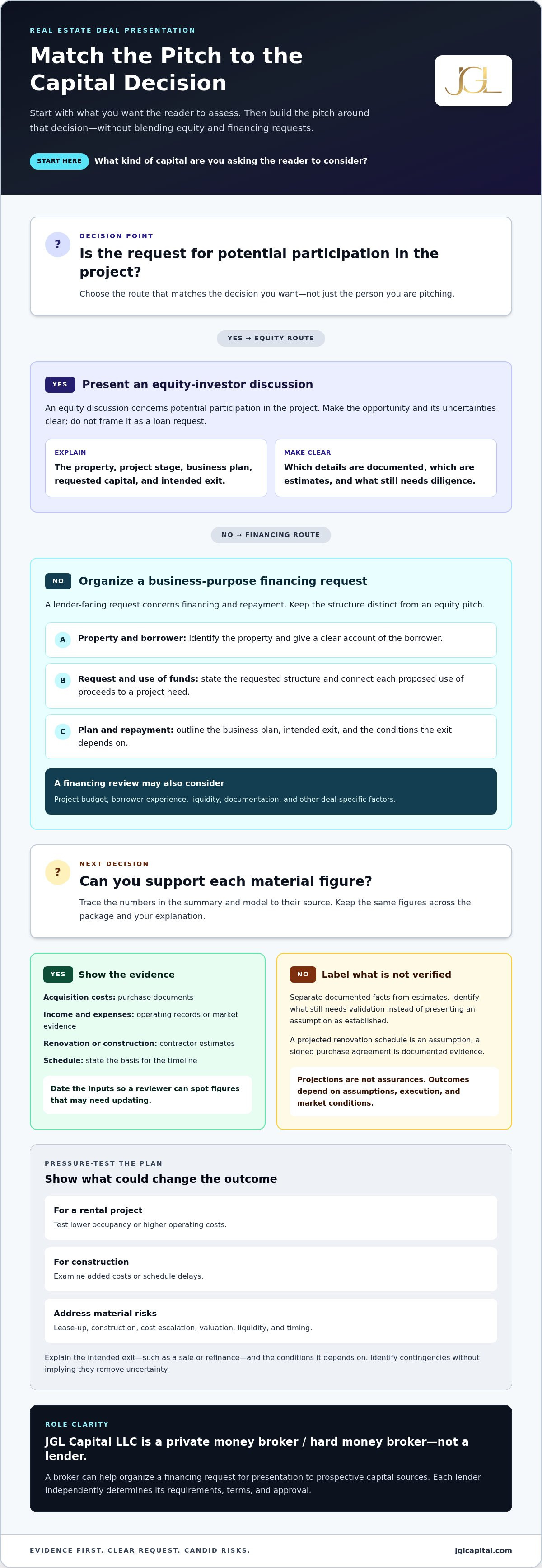
Before presenting projections, explain the request in a few sentences. Identify the property and project stage, describe the business plan and intended use of proceeds, say what type of capital you’re seeking, and state what decision you want from the reader. Are you asking an equity investor to consider participating, a lender to evaluate business-purpose financing, or a capital contact to review the opportunity and discuss possible fit?
A useful principle is simple: A real estate pitch is a decision brief supported by evidence, not a promise of results. State the investment thesis in plain language, then separate documented facts from estimates. A signed purchase agreement is documented evidence; a projected renovation schedule is an assumption. Label both clearly so the reader can distinguish what is established from what still requires diligence. A general overview of real estate investing also underscores why financing, investment structure, and risk belong in the same conversation.
What should the opening deal summary tell investors?
Give the audience a concise account of the property, transaction, business plan, requested capital, timeline assumptions, and intended exit. Name the project stage, such as acquisition, renovation, or construction, and connect each proposed use of proceeds to a specific project need. Include the next major milestones and explain how the plan is expected to reach its exit. Make clear that timing and outcomes are projections, not assurances.
Who is receiving the pitch, and what decision are you requesting?
Equity investors and lenders evaluate different arrangements. An equity discussion concerns potential participation in the project; a lender-facing request concerns financing and repayment. Don’t blur the two. For a financing request, organize the property, borrower, business plan, requested structure, and exit so a private money broker can present the transaction to prospective capital sources. When learning how to pitch a real estate deal to investors, clarity about the audience is as important as the property thesis: it tells the reader what to assess and what response you’re seeking.
Build a Real Estate Investor Pitch Around Supportable Numbers and Risks
A persuasive model makes its assumptions visible. Show where each material figure comes from: purchase documents for acquisition costs, operating records or market evidence for income and expenses, contractor estimates for renovation or construction, and a stated basis for the project schedule. Separate verified information from estimates, and date the inputs so a reviewer can identify figures that may need updating.
How should you present a pro forma and capital structure?
Show expected revenue and operating expenses separately, then calculate net operating income (NOI), the property’s income after operating expenses and before debt service. List project costs, the amount requested, and how the proceeds would be allocated. If relevant, define loan-to-cost (LTC) as the loan amount, or applicable portion, compared with eligible project cost. Define loan-to-value (LTV) as the loan amount compared with the value used for the analysis. The relevant cost and value definitions can vary by lender and program. For broader context, connect the model to real estate investing principles such as clearly identifying the assumptions behind projected income and expenses.
Use base, downside, and sensitivity cases to show how changes in key assumptions affect the plan. For a rental project, test lower occupancy or higher operating costs. For construction, examine added costs or schedule delays. Label each scenario as illustrative and state which assumptions changed. Projected outcomes depend on assumptions, execution, and market conditions, and none should be presented as assured.
Which risks and exit assumptions belong in the pitch?
Address risks material to the property and plan, including lease-up, construction, cost escalation, valuation, liquidity, and timing. Explain the intended exit, such as a sale or refinance, and the conditions it depends on. Identify contingencies and backup considerations without suggesting they remove uncertainty. A disciplined pitch shows not only what could work, but what could put the plan under pressure.
For a business-purpose financing request, a private money broker can help organize information about the property, borrower, business plan, requested structure, and exit for presentation to prospective capital sources. JGL Capital LLC’s private money broker services support this process. Prospective lenders independently determine their underwriting requirements, terms, and approval.
Prepare the Investor Pitch Materials and Presentation
A well-organized package lets a prospective investor or lender assess the opportunity without having to reconcile conflicting versions of the deal. Keep the presentation concise, make supporting records easy to locate, and check that the figures in the summary, financial model, and verbal explanation match. Make the request straightforward to evaluate by labeling assumptions and linking important figures to their supporting documents.
A transparent deal pitch includes a summary, property facts, business plan, financial model, supporting records, risks, capital request, and intended exit.
- Start with the deal summary, property details, and project stage.
- Provide the business plan, budget, income evidence, and financial model.
- Include relevant purchase or project documents and supporting market evidence.
- State the capital request, proposed use of proceeds, key risks, and exit plan.
What materials help investors evaluate the opportunity?
Choose records that substantiate the specific deal: property information, purchase or project details, available income documentation, and a budget supported by estimates or bids where applicable. Label preliminary materials as preliminary, identify figures that still need validation, and distinguish information for an initial review from items that may be subject to further diligence or lender review. A term sheet may outline proposed terms, but it does not guarantee funding or final terms.
How should you handle questions and follow-up?
Answer directly. If you don’t know something, identify the open item instead of filling the gap with an assumption. Track requested documents and questions about liquidity, sponsor experience, contingencies, supporting records, or the exit. Update the package when material facts change, and use the same source dates and assumptions throughout. If a budget or schedule changes, reflect it in the model and presentation rather than introducing it only in conversation.
JGL CAPITAL LLC is a private money broker, not a lender, and helps organize business-purpose financing requests for presentation to prospective capital sources. Discuss your real estate financing request with the team.
Match the Deal Pitch to the Capital Source and Choose a Practical Next Step
The right pitch depends on what the recipient is being asked to decide. An equity investor considers whether to participate under a proposed structure. A lender evaluates a financing request, including the proposed repayment plan and the property or other collateral involved. These are different conversations with different diligence questions. Identify the intended audience so the request doesn’t confuse equity participation with debt financing.
How does a lender-facing financing request differ from an equity pitch?
An equity pitch explains the proposed participation and how project results may be shared. A financing request sets out the amount and intended use of proceeds, collateral, borrower profile, business plan, and anticipated exit or repayment source. If the plan depends on a bridge loan, explain the transition the project is intended to make and the assumptions behind that exit. Understanding how transitional real estate capital works can help you describe the financing context clearly.
For borrowers learning how to pitch a real estate deal to investors, the distinction is practical: don’t present an equity opportunity as though it were a lender program, or describe a loan request as a promise of investor participation. JGL CAPITAL LLC is a private-money broker and capital advisor, not a direct lender. It helps organize business-purpose financing requests and coordinate their presentation to prospective private and institutional capital sources. Those lenders make their own underwriting, approval, and term decisions.
What is a practical next step after presenting the deal?
Prepare a concise summary covering the property, borrower, capital request, intended use, project timeline, business plan, and exit. For ground-up development, include the project stage, budget, and construction plan. Prospective lenders independently determine their requirements and whether to proceed.
If you’re considering business-purpose financing, start a conversation with JGL CAPITAL about organizing the request and exploring its fit for presentation to prospective capital sources. No pitch can assure approval or terms, but a well-aligned request makes the decision being considered clear.
Move Your Financing Request Toward a Clear First Review
The next step isn’t to eliminate every uncertainty. It’s to decide whether your request is organized enough for an initial review, with open questions identified rather than hidden. That keeps the financing conversation grounded as the project develops.
For business-purpose real estate transactions, JGL CAPITAL LLC is a private-money broker and capital advisor, not a direct lender. It provides access to private and institutional capital sources and helps organize financing requests and compare lender programs based on the property, borrower, business plan, requested structure, and exit. Any selected lender independently determines its requirements, underwriting, approval, and terms.
As you apply what you’ve learned about how to pitch a real estate deal to investors, keep the next move straightforward: present the request clearly, be candid about what is still being established, and seek a capital conversation suited to the transaction. Discuss a business-purpose real estate transaction with JGL CAPITAL. A disciplined first step can make the request easier to understand and review.
Frequently Asked Questions
What should a real estate investor pitch include?
Include enough detail for the recipient to understand the transaction and evaluate its logic. Along with the property, plan, request, risks, and exit, clarify what is already in place and what remains conditional. For a rental acquisition, distinguish current lease information from rent assumptions for future occupancy. This is central to pitching a real estate deal without presenting projections as established facts.
How detailed should financial projections be in a real estate deal pitch?
Make each important projection traceable to its inputs. A reviewer should be able to follow how expected income, operating costs, project expenses, and timing produce the figures in your model. Keep units and periods consistent, such as monthly rent alongside monthly expenses, and label estimates clearly. The appropriate depth depends on the deal and audience, but a forecast should never imply that projected results are certain.
How do you discuss risk when pitching a real estate deal?
Name the risks that could change the project’s economics or timing, then explain the assumptions behind your response. Connect each material risk with its possible effect and the contingency you’re considering. For instance, a construction delay may affect carrying costs and the planned exit. Be candid about what remains uncertain: disclosure helps the recipient assess the plan, but it doesn’t eliminate risk.
Is a term sheet a guarantee that a real estate deal will receive financing?
No. A term sheet generally outlines proposed financing terms; it isn’t a guarantee of funding or final approval. Treat it as a preliminary document, note its date and stated conditions, and identify unresolved items so it isn’t confused with a completed financing decision. The selected lender independently sets its underwriting requirements and determines approval and final terms, subject to due diligence. Consider qualified professional advice when interpreting transaction documents.
Should I pitch a real estate deal to an investor or a lender?
Choose the audience based on the capital structure you’re seeking. An equity investor considers possible participation in the project, while a lender evaluates a financing request under its own program requirements. State whether you’re proposing participation or seeking debt, and explain how the capital relates to the project’s needs and planned exit. JGL CAPITAL is a private-money broker, not a lender, and can help organize business-purpose financing requests for presentation to prospective capital sources.