

A construction budget is only useful if its funding plan matches the schedule for spending it. If you’re considering a hard money construction loan for a ground-up project, the key question is not just how much capital you need. It’s whether the project scope, budget, draw plan, sponsor capacity, and exit strategy fit together. If contractor payments come due before a lender can review and release a draw, the project may face a cash-flow gap. A headline rate alone won’t show whether the full financing structure fits your plan.
Preparation helps make those details visible. This guide explains how business-purpose construction financing differs from other private financing, what prospective lenders may review, and how budgets, draw schedules, borrower experience, liquidity, and repayment plans fit into a request. JGL CAPITAL LLC is a private-money broker and capital advisor, not a lender. It helps borrowers organize financing requests, identify potential capital sources, and compare structures. Each lender sets its own requirements and terms. Use the guidance below to prepare a clear project package and assess financing in the context of your construction plan and exit.
Key Takeaways
- A hard money construction loan is business-purpose financing for an eligible project, and lender criteria vary.
- Understand how lender review, closing conditions, construction draws, and repayment fit together before relying on projected cash flow.
- Separate confirmed project facts from estimates, and make the assumptions behind your budget and schedule clear.
- JGL CAPITAL LLC is a private-money broker that helps organize requests and compare potential financing structures. It does not make lending decisions.
What Is a Hard Money Construction Loan and When to Use It?
A hard money construction loan is business-purpose financing for an eligible ground-up real estate project. Unlike financing focused on buying a completed property, construction financing must account for the work required to turn a site or existing asset into the planned project. “Hard money” commonly refers to non-bank private capital with an asset-focused approach. That does not mean collateral alone determines whether a lender will consider a request. Lenders may also review the borrower’s experience, liquidity, documentation, project feasibility, and repayment plan.
For background, What is a Hard Money Loan? outlines the broader category and its distinction from traditional lending. In practice, a private-money broker such as JGL CAPITAL LLC helps organize a financing request and identify prospective capital sources. The selected lender makes underwriting decisions and determines any approval, proceeds, and terms.
Which projects may use construction financing?
Potential project categories include ground-up residential, multifamily, commercial, industrial, and mixed-use real estate. A request, for example, might involve building a multifamily property or constructing a commercial building on a site intended for that use. These categories do not guarantee eligibility. A lender considers the property, project plan, borrower, and transaction against its own requirements.
How is construction financing different from acquisition financing?
An acquisition request centers on purchasing an existing asset. A ground-up project also needs a clear account of what will be built, how the work will proceed, and when project costs will arise. A financing review may therefore include the construction scope, itemized budget, schedule, and expected stages of spending. A project with land secured but incomplete plans raises different questions from one with a defined scope and documented cost assumptions. These details help shape the request, but they do not make construction financing inherently faster, cheaper, or easier to obtain.
How Do Hard Money Construction Loans Work During a Project?
A hard money construction loan may involve several connected stages. The lender reviews the request, sets any conditions for closing, and outlines how funds may be released as work progresses. After closing, the borrower completes project work and submits draw requests under the lender’s process. Repayment may come from a sale, a refinance, or another planned source, depending on the financing terms and project outcome.
The details vary by lender and transaction. Inspections, supporting documents, draw timing, and any holdbacks are determined by the selected lender. A budget may look sound on paper but still create pressure if contractor payments are due before a draw is reviewed or released. Compare the expected payment dates with the lender’s draw process before construction begins. This can help reveal timing gaps that need to be addressed in the project’s capital plan.
What does a construction draw schedule mean?
A draw is a lender-controlled release of funds tied to project progress and applicable conditions. A draw schedule describes when the borrower may request funds, which work or costs support each request, and what verification or documents the lender requires. For example, a request for reimbursement of completed site work may be reviewed differently from a request for costs associated with work not yet performed. Requirements and timing depend on the lender and transaction.
Why plan the exit before construction begins?
Construction financing and permanent financing serve different stages of a project. Construction capital supports the work while it is underway. After completion, the borrower may consider permanent financing, or may plan to sell the property. Neither a refinance nor a sale is assured, so test repayment assumptions against possible schedule changes, market conditions, and the time available to repay.
Collateral matters, but it is not the only consideration. Lenders may also assess project feasibility, borrower liquidity and experience, supporting documents, and the proposed exit. JGL CAPITAL LLC is a private-money broker, not a lender. It helps organize financing requests and coordinate communication with prospective capital sources. A clear account of the budget, draws, and repayment plan gives lenders a more coherent request to review. Explore construction financing guidance as you refine your project plan.
What Should You Prepare Before Requesting a Hard Money Construction Loan?
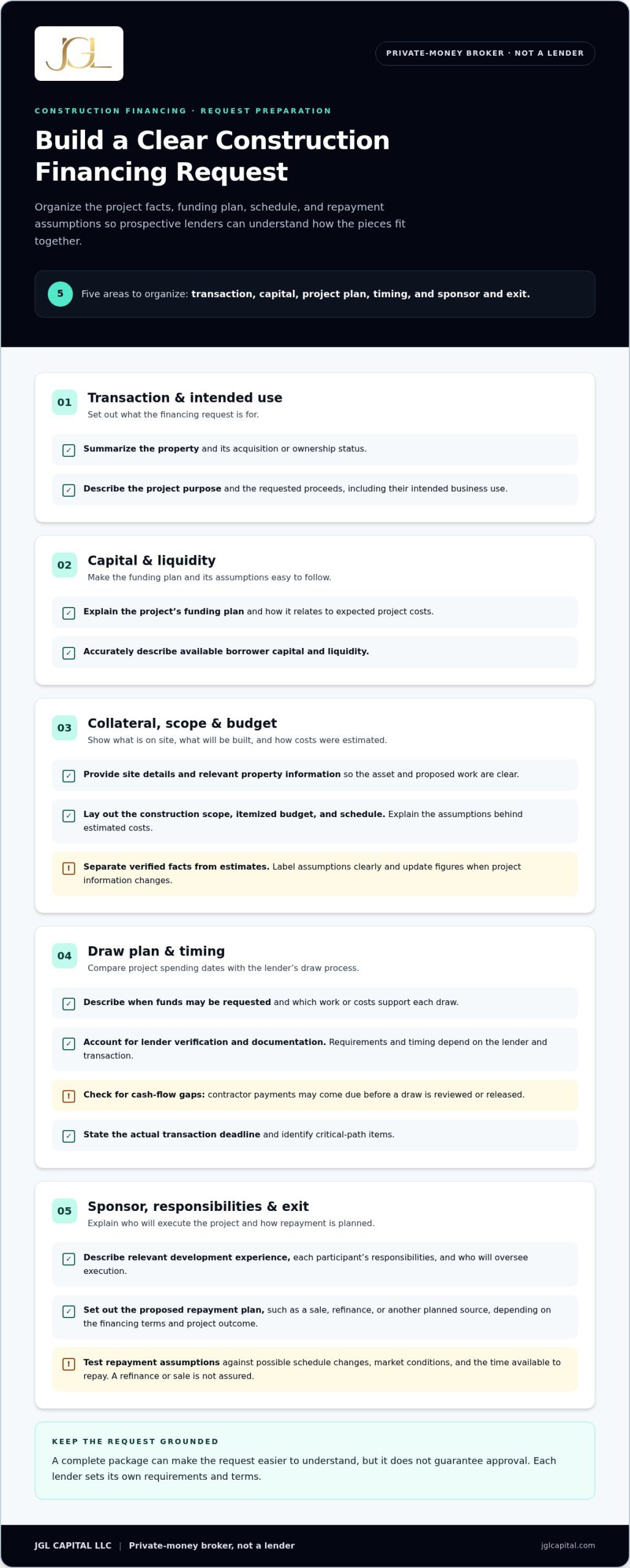
A well-organized request helps a prospective lender understand the transaction, the capital plan, and the assumptions behind the project. A complete package makes those details easier to follow, but it does not guarantee approval. Separate verified facts from estimates, label assumptions clearly, and update figures when project information changes.
Use this readiness sequence to shape the request:
- Transaction: Summarize the property, acquisition or ownership status, project purpose, and requested proceeds, including their intended business use.
- Capital: Explain the project’s funding plan and accurately describe available borrower capital and liquidity.
- Collateral: Provide site details and relevant property information so the asset and proposed work are clear.
- Sponsor: Describe relevant development experience, each participant’s responsibilities, and who will oversee execution.
- Timing: State the actual transaction deadline and identify critical-path items, such as plans or other project milestones. Don’t assume a particular closing date.
- Exit: Describe the intended repayment path, such as a sale or refinance, and the assumptions it depends on.
Which project documents help explain the request?
Depending on the project, assemble a project description, site information, plans, construction budget, schedule, and available market support. Show how the requested proceeds relate to project costs and when those costs are expected. Label estimates as estimates, distinguish them from known figures, and explain material assumptions. Lender-specific documentation requirements vary, so no universal checklist establishes qualification.
How should sponsors present capital, experience, and timing?
Be precise about liquidity, relevant experience, and project responsibilities. Don’t overstate what is available or already complete. For a hard money construction loan, consistency matters: the budget, schedule, capital plan, and exit should all describe the same project. A useful companion is New Construction Loans: A Strategic Guide for Real Estate Developers (2026), which offers broader context for organizing a development request.
JGL CAPITAL LLC is a private-money broker, not a lender. It helps borrowers organize financing requests and compare potential capital sources. Discuss your construction financing request with a broker who can help present the project clearly.
How Can a Private-Money Broker Help Structure a Construction Financing Request?
A construction financing request may have more than one potential capital source, but comparing options starts with a clear account of the project and its constraints. JGL Capital LLC is a private-money broker and capital advisor, not a lender. It helps organize requests, identify prospective lenders, compare programs, and coordinate communication. It does not lend its own funds or make underwriting or approval decisions.
Look beyond the headline rate when comparing proposed structures. Review how costs, leverage, recourse, reserve requirements, draw procedures, and exit assumptions fit the project’s budget and timeline. The goal is to understand the financing as a whole, rather than treating any single term as a measure of suitability. Each prospective lender sets its own requirements and terms.
What does an initial financing-fit review cover?
An initial review can clarify the property, requested proceeds, project scope, sponsor experience, available capital, timing constraints, and intended exit. It can also surface questions or gaps, such as a budget assumption that needs explanation or a deadline tied to an unresolved project milestone. This is preparation for a financing discussion, not a determination of approval or qualification.
How does JGL Capital LLC coordinate the lender process?
JGL Capital LLC helps package project information, identify potential capital sources, compare relevant structures, and coordinate communication as the request is presented. A coherent package helps prospective lenders review the same core facts, with assumptions and open questions made visible. Final underwriting, approval decisions, proceeds, terms, and timelines remain with the selected lender.
If you’re considering a hard money construction loan, bring the project facts, budget, timing, and proposed exit into one concise deal summary. Review construction financing information as you prepare to discuss business-purpose financing options.
Put the Project Plan to Work
Turn your financing assumptions into a concise project summary. Bring the proposed scope, budget, funding needs, timing constraints, and repayment plan together, and identify which details are established and which remain estimates. This gives financing conversations a clear starting point and makes gaps easier to spot.
Assess a hard money construction loan in the context of the project it is meant to support, not as a rate or proceeds figure in isolation. JGL CAPITAL LLC works as a private-money broker and capital advisor, helping borrowers organize project information, identify prospective lenders, compare structures, and coordinate communication. Lenders retain authority over their own requirements, underwriting, and decisions.
To discuss a business-purpose construction project, submit a concise project summary to JGL CAPITAL, including the project’s current stage, budget, timing, and proposed exit. Financing remains subject to the selected lender’s review and final approval.
Frequently Asked Questions
Can a first-time builder seek a hard money construction loan?
Yes. A first-time builder can seek a hard money construction loan, though a lender may consider limited building history when reviewing the request. Explain who will manage construction, document the contractor’s relevant experience, and show how the project plan accounts for potential cost changes or delays. These details help describe the execution plan, but they do not replace lender review or ensure approval.
Does a construction loan term sheet guarantee funding?
No. A term sheet generally outlines proposed terms that may remain subject to underwriting, due diligence, documentation, approvals, and closing conditions. A lender may still need to review property information or resolve a condition before closing. Treat the document as a preliminary expression of proposed terms, not confirmation that proceeds will be available.
Can construction financing include an interest reserve?
Possibly. Some construction or transitional financing structures may include an interest reserve, which is a portion of proceeds set aside for interest payments during a defined period. Whether a reserve is considered, how it is calculated, and how it affects the financing structure depend on the lender and transaction. Include anticipated carrying costs in your project planning rather than assuming a reserve will be available.
Can a hard money construction loan be used for a mixed-use project?
An eligible mixed-use project may be considered when the financing serves a business purpose. A lender’s review may account for the property’s uses, project scope, borrower profile, and repayment plan. Eligibility is not automatic. If a property combines residential units with commercial space, explain the intended uses and how the completed project fits the financing request.
Can this financing be used for an owner-occupied home?
No. JGL CAPITAL LLC arranges business-purpose real estate financing and does not arrange owner-occupied residential mortgages. A property intended as the borrower’s home does not fit that business-purpose scope. The distinction is the property’s intended use, not simply whether it is residential. JGL CAPITAL is a private-money broker and capital advisor, not a lender; prospective lenders determine the requirements for transactions they consider.