

Institutional capital allocation requires a level of agility and pattern-recognition that traditional lending institutions simply cannot provide in the current 2026 fiscal environment. You’ve likely encountered the friction of onerous documentation requirements and rigid approval timelines that threaten the viability of time-sensitive acquisitions. It’s a common frustration to find that your project’s potential is constrained by a single lender’s limited appetite or a fundamental misalignment between loan terms and your specific exit strategy.
Engaging a specialized private money broker for real estate transforms these obstacles into a strategic advantage by providing the institutional-grade liquidity and sophisticated architecture necessary for complex transactions. This guide examines how JGL Capital leverages thirty years of industry expertise to structure bespoke financing solutions that prioritize asset value over personal credit metrics. We’ll explore the mechanics of diversified capital networks and the disciplined stewardship required to execute $10 million plus deals with absolute precision.
Key Takeaways
- Learn why a private money broker for real estate acts as a strategic steward, providing access to a diversified network of capital rather than the limited constraints of a single lending source.
- Gain insight into the structural components of the capital stack and how sophisticated LTV and LTC calculations influence overall project liquidity and leverage.
- Identify the operational advantages of broker-led capital allocation over the protracted timelines and rigid criteria typical of traditional financial institutions.
- Master the underwriting sequence from initial asset feasibility to strategic exit planning to ensure reliable execution for complex transactions exceeding $10 million.
Defining the Role of a Private Money Broker in Institutional Real Estate Finance
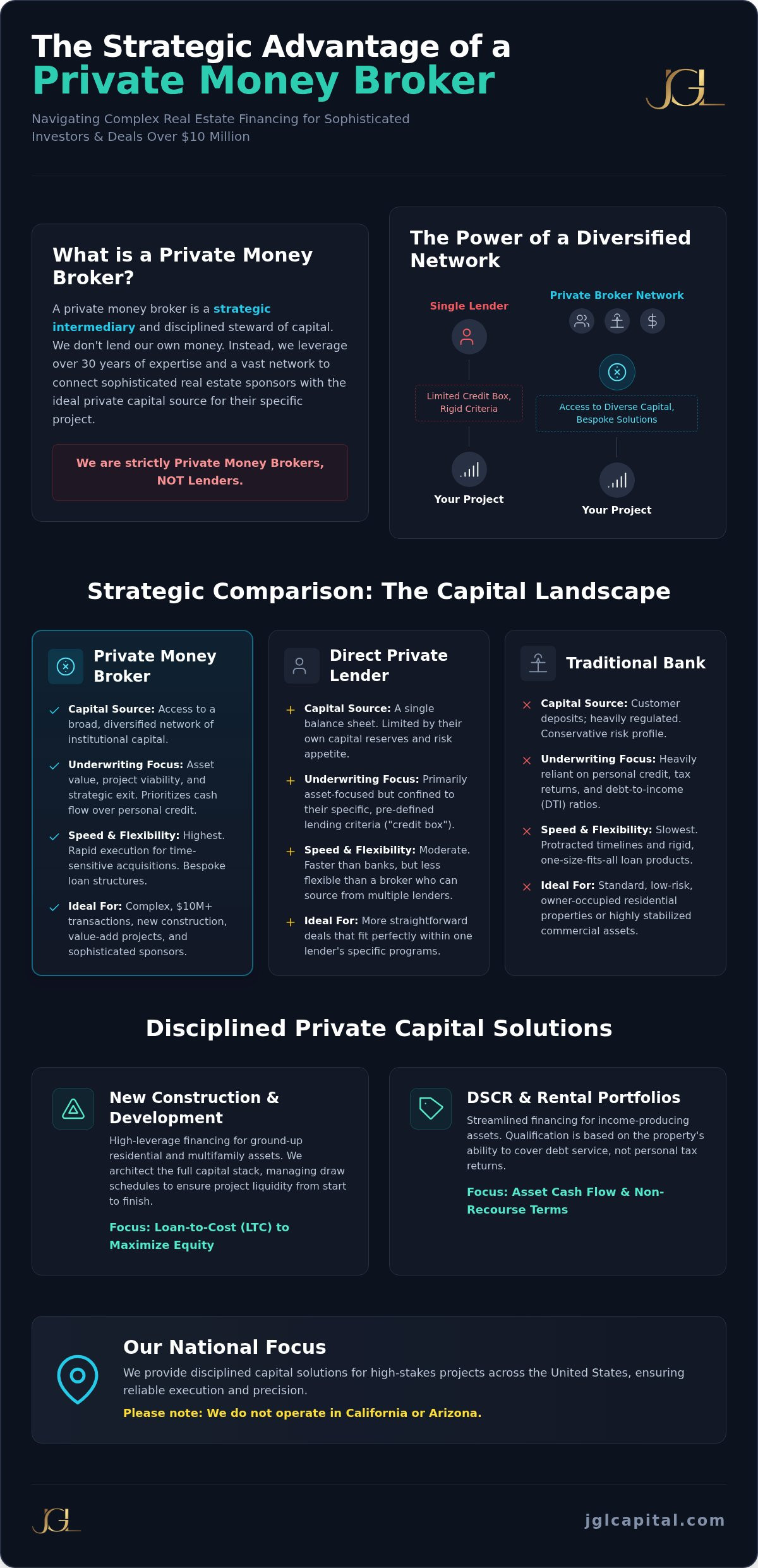
A private money broker for real estate functions as a strategic intermediary, connecting sophisticated sponsors with diverse alternative capital sources. Unlike direct lenders who operate from a single balance sheet, a broker provides access to a broad network of institutional liquidity. This distinction is vital for optimal capital allocation. JGL Capital utilizes pattern-recognition expertise developed over three decades to identify the precise lender for complex asset classes. It’s a model that institutional investors value because it transcends the limitations of a single firm’s credit box. It ensures that specific project requirements aren’t sacrificed for rigid lending criteria. By acting as a disciplined steward, the broker secures bespoke financing that aligns with long-term investment legacies.
The Strategic Architecture of Private Capital
Bespoke capital structuring requires moving beyond simple transactional lending. A broker’s responsibility involves aligning a sponsor’s operational capacity with a lender’s specific risk appetite. This alignment ensures that the financial architecture supports the long-term preservation of value. By managing the entire capital stack, a broker mitigates the risk of project stalls caused by a single lender reaching its concentration limits or internal shifts in underwriting priorities.
Asset-Backed Lending vs. Traditional Credit Standards
The shift toward asset-backed solutions prioritizes property-level cash flow over traditional borrower income verification. This methodology is central to Private Money Investing, where real estate serves as the primary security. It allows a private money broker for real estate to bypass conventional debt-to-income constraints. JGL Capital maintains this disciplined focus for national transactions, excluding California and Arizona, ensuring reliable execution for high-stakes projects that demand speed and precision.
The Mechanics of Asset-Backed Private Capital: Speed, Leverage, and Liquidity
Execution speed in high-demand markets is a competitive necessity. A private money broker for real estate doesn’t just find money; they architect the capital stack. They source liquidity from sophisticated pools like family offices and private equity. This is different from regulated real estate investments which have different liquidity profiles. Professional brokerage allows for senior debt and mezzanine financing to be layered precisely, ensuring the project remains capitalized through various phases of development.
High-Leverage Solutions for New Construction and Development
Developers require capital that respects the project’s lifecycle. JGL Capital specializes in new construction loans for ground-up residential and multifamily assets. We manage draw schedules and budget contingencies to ensure liquidity is available when milestones are met. Utilizing Loan-to-Cost (LTC) instead of just LTV allows developers to maximize equity retention, which is critical for scaling large-scale developments.
DSCR and Rental Portfolio Financing
For income-producing assets, Debt Service Coverage Ratio (DSCR) loans provide a streamlined path to growth. These products focus on the asset’s ability to cover debt obligations rather than the sponsor’s personal tax returns. Financing options extend to 2-4 unit properties and large multifamily portfolios. Many of these solutions offer non-recourse terms, protecting the sponsor’s personal balance sheet. As a dedicated private money broker for real estate, JGL Capital ensures these terms are negotiated to favor the project’s long-term viability. If you’re managing a complex portfolio, consulting with an experienced broker can help align your debt with your long-term exit strategy.
Strategic Comparison: Private Money Brokers vs. Direct Lenders and Traditional Institutions
Institutional banks offer low-cost capital, yet their rigid criteria and protracted timelines often stifle time-sensitive acquisitions. Conversely, direct private lenders provide speed but frequently operate within narrow product boxes. A private money broker for real estate serves as a strategic ally, offering market-wide access and the deal-structuring expertise necessary to foster multi-lender competition. JGL Capital operates strictly as a professional brokerage firm, not a direct lender. This distinction ensures our partners benefit from a multi-source capital network rather than the limitations of a single balance sheet. Relying on one lender creates a significant opportunity cost if they decline a project late in the process.
When to Choose a Broker Over a Traditional Mortgage
Transitional assets require an analytical understanding of the “cost of speed.” When timing is the primary risk factor, securing bridge loans through a broker allows sponsors to bypass the personal credit scrutiny typical of traditional mortgages. This model prioritizes the asset’s potential over the borrower’s personal balance sheet. It’s particularly effective for business-purpose loans where traditional debt-to-income ratios don’t reflect the project’s true value.
The Value of Market-Wide Capital Access
Market-wide access is about more than just finding a rate. It’s about leveraging deep industry relationships to secure favorable points and terms. JGL Capital frequently acts as a disciplined steward for $10M+ commercial real estate loans, often “rescuing” deals that traditional institutions have declined due to internal policy shifts. By maintaining a national focus, excluding California and Arizona, we ensure our partners receive the most reliable strategic positioning available. This commitment to integrity and long-term growth distinguishes a professional private money broker for real estate from simple transactional finders.
Navigating the Underwriting Process: From Asset Valuation to Strategic Exit Planning
Institutional underwriting demands a level of analytical rigor that casual investors often underestimate. A private money broker for real estate begins this sequence with a comprehensive feasibility analysis, ensuring the project aligns with specific institutional risk appetites before a single document is submitted. This disciplined approach moves from preliminary valuation to the meticulous structuring of the loan package, where the broker shapes the narrative to meet lender expectations. Navigating appraisal and environmental reviews requires a steady hand in document preparation to satisfy high-level compliance standards. Every project must conclude with a definitive exit strategy, whether through refinancing into a permanent hold or a strategic resale.
The Critical Importance of Exit Planning
Defining a bridge-to-permanent strategy is essential for sustaining long-term rental holds. For those focused on residential redevelopment, structuring fix and flip loans requires precise resale timelines to preserve equity and avoid costly extensions. JGL Capital assists sponsors in preparing for this next phase, ensuring the transition from short-term debt to long-term stability is seamless. It’s about more than just the current loan; it’s about the entire lifecycle of the investment legacy.
Underwriting for Commercial and Multifamily Assets
Large-scale developments necessitate a deep evaluation of sponsor capacity and historical property performance. When structuring commercial real estate loans, factors like property management efficiency and stabilized occupancy are scrutinized with institutional precision. This disciplined underwriting mitigates risk and ensures that high-stakes transactions, particularly those exceeding $10 million, remain viable through market fluctuations. We prioritize analytical rigor over speculative trends to protect our partners’ interests. If you’re ready to align your project with institutional-grade capital, apply for a strategic consultation to begin the underwriting process.
JGL Capital: Delivering Disciplined Private Capital Solutions for Sophisticated Investors
JGL Capital operates with a legacy of stability, leveraging over 30 years of expertise in private real estate finance to guide sophisticated partners through complex market cycles. As a specialized private money broker for real estate, we don’t just facilitate transactions; we provide the strategic architecture required for long-term value preservation. Our model is built on professional integrity and transparency, ensuring that every allocation of capital is backed by analytical rigor rather than speculative trends. By maintaining a disciplined brokerage approach, we empower developers and institutional sponsors to execute large-scale projects with absolute confidence.
Institutional Standards, National Reach
Our firm serves real estate professionals across the United States, focusing strictly on business-purpose loans that require institutional-grade execution. JGL Capital provides access to uncapped capital for projects ranging from $1 million to over $100 million, specializing in those high-stakes transactions that exceed the $10 million threshold. We embrace a “Quiet Expert” philosophy, prioritizing intellectual capital and proven results over aggressive self-promotion or marketing hyperbole. While our reach is national, we deliberately omit California and Arizona from our service offerings to maintain focus on regions where we provide the most stable and reliable execution.
Your Strategic Partner in Capital Allocation
JGL Capital has become the preferred private money broker for real estate among attorneys, CPAs, and high-net-worth investors who value discretion and precision in their financial partnerships. We view our engagements as high-level strategic alliances rather than simple service provisions, aligning our objectives with the creation of lasting legacies through careful, deliberate action. This commitment to disciplined financing decisions ensures that every project starts with a foundation of institutional strength and professional stewardship. If you’re ready to secure the strategic architecture your next project demands, consult with our team to explore a collaborative partnership focused on sustainable growth and the preservation of capital.
Securing the Future of Institutional Real Estate Acquisitions
Institutional real estate success in 2026 relies on the ability to navigate complex liquidity pools with precision. As explored, the strategic architecture provided by a professional private money broker for real estate ensures that high-stakes projects aren’t restricted by the narrow credit boxes of single lenders. By prioritizing asset-level performance and definitive exit strategies, sponsors can secure the leverage needed for growth while preserving their personal balance sheets. JGL Capital brings over 30 years of industry-leading expertise to every transaction, acting as a disciplined steward for national business-purpose assets. We specialize in complex, high-balance deals exceeding $10 million, providing the institutional-grade guidance required for high-stakes management. Our brokerage model is built on stability and professional integrity, ensuring your project receives the analytical rigor it deserves. It’s time to align your objectives with a partner who values long-term excellence. Engage with JGL Capital for a Strategic Capital Consultation and begin building your investment legacy today.
Frequently Asked Questions
What is the primary difference between a private money broker and a hard money lender?
A private money broker for real estate identifies and organizes capital from a network of sources, whereas a hard money lender funds deals directly from their own balance sheet. JGL Capital serves as a strategic advisor, matching business-purpose opportunities with institutional or private lenders. This broker-first model provides access to diverse programs rather than a single lender’s rigid criteria, ensuring a more tailored fit for complex transactions.
How does a private money broker earn their fee, and is it worth the cost?
Brokers typically earn a percentage-based fee, known as points, which is paid at the time of closing as part of the settlement costs. This fee covers the strategic deal packaging and market-wide sourcing required to secure optimal terms. For sophisticated investors, the value lies in the pattern-recognition expertise that prevents deal failure and ensures reliable execution for high-stakes projects that traditional banks often decline.
Can a private money broker help with non-owner-occupied residential properties?
Yes, a private money broker for real estate specializes in financing for non-owner-occupied investment properties, including single-family rentals and 2-4 unit assets. JGL Capital focuses exclusively on business-purpose transactions, such as DSCR loans and fix-and-flip financing. We don’t arrange consumer mortgages or owner-occupied residential loans, as our mission is to support the growth of professional real estate portfolios and development projects.
What are the typical interest rates and points for a private money loan in 2026?
In 2026, market observations indicate that bridge loan interest rates generally range from 9.0% to 14.5%, with 30-year fixed DSCR rates typically falling between 6.125% and 8.0%. Origination fees often span 1.5 to 2.5 points depending on the lender and loan complexity. These figures are subject to current benchmark rates like the 10-Year Treasury yield and are established independently by the selected capital source during underwriting.
How fast can a private money broker fund a new construction or bridge loan?
The timeline for funding depends on the complexity of the deal and the completeness of the borrower’s documentation package. While asset-backed loans offer superior speed compared to traditional institutions, specific closing dates aren’t guaranteed. A bridge loan might close within a few weeks if appraisal, title, and insurance requirements are met promptly. New construction financing follows a similar path but involves more detailed draw schedule reviews.
Do private money brokers require a minimum credit score for real estate loans?
While private capital focuses primarily on property value, lenders still evaluate credit as a measure of sponsor reliability. Minimum scores for bridge loans often range from 650 to 680, while DSCR programs may require 620 to 660. However, these requirements vary significantly between capital sources. A broker’s role is to match the project with a lender whose specific appetite aligns with the sponsor’s credit profile and industry experience.
What types of properties are eligible for private money financing through a broker?
Eligible collateral includes multifamily assets, mixed-use buildings, retail spaces, industrial properties, and hospitality sites. We also facilitate financing for land development and ground-up new construction projects. JGL Capital coordinates capital for a broad range of business-purpose real estate, excluding California and Arizona. Eligibility is determined by the property’s income potential, the sponsor’s basis in the asset, and the clarity of the proposed exit strategy.
How do I transition from a private bridge loan to permanent financing?
Transitioning from a bridge loan to permanent financing requires a disciplined approach to stabilization and lease-up. Once the property meets the specific cash-flow requirements of a long-term lender, such as a DSCR threshold, the broker facilitates the refinance process. This bridge-to-permanent planning is integral to the initial capital structuring, ensuring that the short-term debt serves as a practical path toward the creation of lasting legacy value.