

In the high-stakes environment of institutional real estate investment, the primary threat to capital preservation is rarely market volatility, but rather the failure of operational execution. Most sophisticated investors recognize that finding contractors for a fix and flip represents the critical pivot point upon which an entire project’s profitability turns. You’ve likely experienced the frustration of inconsistent workmanship devaluing a prime asset or project delays that inflate carrying costs until they erode your projected margins. These operational inefficiencies don’t just delay timelines; they compromise the integrity of your investment strategy and create friction with your capital partners.
This guide provides a disciplined, institutional-grade methodology for identifying, vetting, and managing renovation partners to ensure the preservation of capital and the optimization of asset value. By establishing a repeatable procurement process, you can mitigate operational risk through rigorous vetting and align contractor performance with the technical requirements of professional Fix-and-Flip Loans and Bridge Loans. We’ll explore a strategic framework designed to transform contractor management from a source of tactical uncertainty into a predictable, strategic alliance that supports long-term wealth creation and professionalized asset management.
Key Takeaways
- Adopt a strategic alliance model that redefines the contractor relationship as a critical component in the preservation of capital and the generation of asset worth.
- Implement a disciplined methodology for finding contractors for a fix and flip by utilizing professional networks and the performance insights of experienced private money brokers.
- Execute rigorous analytical due diligence through the verification of regulatory standing and a comprehensive audit of insurance coverage to mitigate institutional risk.
- Utilize fixed-price agreements and “Time is of the Essence” clauses to prevent budget inflation and ensure project velocity remains aligned with strategic objectives.
- Synchronize operational milestones with the technical draw requirements of Fix-and-Flip Loans to maintain liquidity and satisfy the performance metrics of capital partners.
Establishing a Strategic Framework for Contractor Procurement
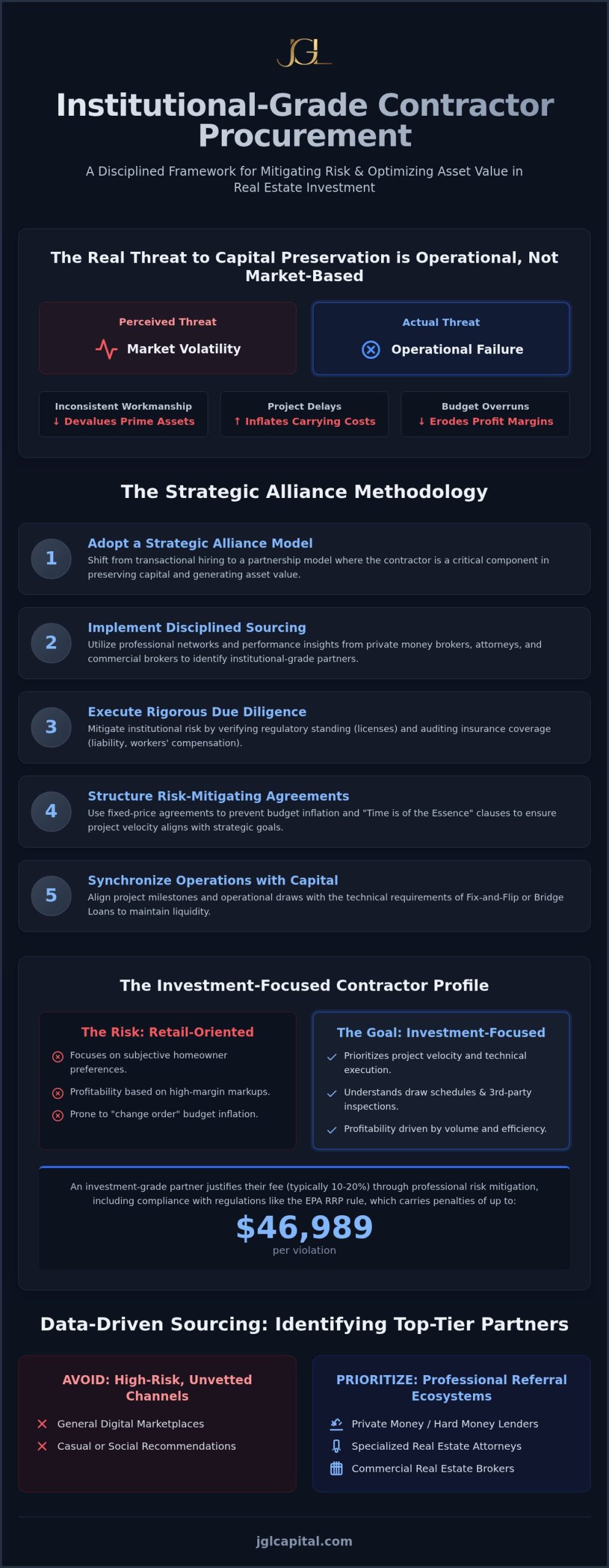
Investment success in the redevelopment sector is predicated on the transition from transactional hiring to a formalized procurement strategy. When finding contractors for a fix and flip, the objective is to secure a strategic ally whose operational priorities align with the preservation and generation of asset worth. While retail-oriented contractors focus on the subjective preferences of homeowners, an investment-focused redevelopment partner prioritizes project velocity and the technical execution of the value-add plan. This distinction is critical; a disciplined approach to vendor selection reduces the soft costs associated with capital carrying and ensures that the asset’s exit strategy remains viable.
The Investment-Focused Contractor Profile
The methodology for finding contractors for a fix and flip must prioritize partners who operate with a “wholesale” mindset, recognizing that their profitability is derived from volume and repeatable processes rather than high-margin retail markups. This profile requires a deep understanding of General Contractor Responsibilities as they pertain to institutional standards, specifically regarding the mechanics of draw schedules and third-party inspections. Professional general contractors typically command fees between 10% and 20% of the total project cost; however, an investment-grade partner justifies this expense through the mitigation of regulatory risks, such as compliance with the 2026 EPA RRP rule which carries penalties up to $46,989 per violation. It’s essential that these entities operate as independent professional organizations, maintaining their own comprehensive liability coverage and workers’ compensation to insulate the investor from operational risk.
Defining Project Objectives for Vendor Alignment
Strategic alignment begins with the articulation of a comprehensive Scope of Work (SOW) before the procurement process commences. This document serves as the analytical foundation for the partnership, defining clear performance metrics centered on milestone completion and quality control. Objectives must be meticulously synchronized with the maturity dates and performance requirements of fix and flip loans. By establishing these parameters early, the investor ensures that the contractor is committed to a timeline that optimizes the cost of capital. Key alignment factors include:
- Milestone Precision: Establishing specific dates for structural, mechanical, and finish phases to maintain project velocity.
- Budget Adherence: Utilizing fixed-price structures to eliminate the risk of “change order” inflation that erodes margins.
- Regulatory Compliance: Ensuring all activities meet current 2026 building codes and safety standards to prevent costly enforcement delays.
This disciplined framework transforms the renovation phase from a period of high risk into a controlled execution of the investment thesis. A contractor who cannot demonstrate this level of institutional readiness is a liability to the portfolio’s stability.
Identifying Institutional-Grade Renovation Partners
Identifying institutional-grade partners requires a departure from informal networking in favor of a data-driven sourcing model. High-net-worth investors shouldn’t rely on digital marketplaces or casual recommendations that lack a basis in analytical performance. Instead, the process of finding contractors for a fix and flip should begin within professional referral ecosystems that possess a vested interest in project success. Specialized real estate attorneys and commercial brokers often maintain proprietary lists of vendors who’ve successfully navigated complex redevelopments. These professionals understand that a contractor’s ability to manage legal and regulatory hurdles is as vital as their technical proficiency.
One of the most underutilized resources in this procurement phase is the perspective of private hard money lenders. These institutions observe contractor performance across diverse portfolios; they track which teams consistently meet draw requirements and pass third-party inspections without significant remediation. By engaging with a seasoned partner for private money broker services, an investor gains access to this institutional memory, effectively leveraging the lender’s risk management data to inform their own selection process. Additionally, engaging with specialized material suppliers can reveal which contractors maintain consistent credit accounts and high-volume purchasing history. A contractor who maintains liquidity with suppliers is better positioned to weather the 8.5% year-over-year increase in construction material costs observed in August 2026.
Professional Referral Ecosystems
Property managers serve as a critical link in this ecosystem, as they frequently oversee the maintenance and renovation crews responsible for preserving asset value post-redevelopment. Their insights into a crew’s long-term workmanship quality are invaluable. Similarly, collaborating with other high-net-worth stakeholders allows for the exchange of vetted vendor lists, ensuring that only those with a proven history of integrity are considered. Title professionals who handle frequent investor transactions can also provide data on which contractors are prone to filing mechanics’ liens, offering a preemptive look at potential financial instability.
Direct Observation and Field Research
Analytical due diligence must extend into the field through unannounced site visits to assess ongoing work standards in real-time. Observing a contractor’s existing crew provides immediate evidence of their operational discipline and adherence to safety protocols. With 65% of remodelers reporting labor shortages in 2026, it’s essential to monitor the velocity of current projects to gauge a contractor’s actual bandwidth. A disorganized site or a lack of personnel suggests that a contractor may be overextended, which can add 4 to 8 weeks to your project timeline and significantly increase carrying costs. Evaluating these factors ensures that your renovation partner possesses the resource allocation necessary to meet the rigorous demands of professional Fix-and-Flip Loans.
Executing Analytical Due Diligence and Performance Vetting
Transitioning from identification to engagement requires an exhaustive analytical audit of the candidate’s operational and financial health. Finding contractors for a fix and flip is a process that necessitates the same level of scrutiny applied to the underwriting of a complex real estate transaction. Investors must verify licensure and standing with both national and regional regulatory bodies. This ensures the entity is authorized to perform the specific scope of work required by modern building codes. A comprehensive insurance audit is equally vital; ensuring that General Liability and Workers’ Compensation limits are sufficient for the project scope protects the stakeholder from catastrophic loss. Financial vetting should confirm that the contractor possesses the liquidity to manage initial labor costs before the first draw is disbursed. This financial stability is essential to maintain project momentum during the critical early phases of redevelopment.
The Three-Tiered Reference Check
Relying on curated portfolios or digital reviews is insufficient for high-stakes management. A disciplined procurement process utilizes a three-tiered reference check to evaluate performance across different temporal and situational contexts. First, interview a past client whose project was completed over 24 months ago to assess long-term workmanship quality and the durability of the materials utilized. Second, consult a current client to evaluate real-time communication and the contractor’s ability to adhere to scheduling precision amidst the 2026 labor shortages affecting 65% of the industry. Finally, request a reference from a project that encountered significant structural or regulatory challenges. Observing how a contractor navigates adversity provides the most accurate insight into their problem-solving capabilities. It reveals their true commitment to preserving the investor’s interests.
Legal and Financial Stability Assessment
A contractor’s history in the public record often serves as a leading indicator of future performance. Utilizing public records to identify a history of litigation or mechanic’s liens is a non-negotiable step in mitigating operational risk. It’s also prudent to confirm the contractor’s standing with major sub-trades and material providers. Since construction materials saw an 8.5% year-over-year increase in August 2026, a contractor with strained supplier relationships may face procurement delays that jeopardize the project’s velocity. Due diligence is not optional. To ensure full tax compliance and reinforce the independent nature of the relationship, the execution of a W-9 and a formal independent contractor agreement is required before any capital is deployed. This level of due diligence ensures that the chosen partner is not just a service provider but a stable component of a professionalized investment strategy.
Structuring Agreements for Risk Mitigation and Strategic Alignment
The transition from analytical vetting to contractual formalization marks the point where strategic intent becomes a legally binding obligation. Finding contractors for a fix and flip requires a shift in focus from historical performance to future accountability. A robust agreement doesn’t merely outline the work; it serves as a risk management tool that protects the investor’s equity from the dual threats of budget creep and project stagnation. Given that the Construction Materials Cost Index rose 8.5% year-over-year as of August 2026, a detailed, fixed-price contract is a non-negotiable requirement. This structure shifts the risk of inflationary pressure onto the contractor, preventing the “change order” culture that often erodes project margins. To ensure your capital is deployed effectively, you should consult with a strategic capital partner who understands how to align these agreements with institutional funding requirements.
Project velocity is maintained through the inclusion of a rigorous “Time is of the Essence” clause. This provision transforms a target completion date into a firm contractual deadline, allowing the investor to pursue liquidated damages if unexcused delays occur. Furthermore, the payment schedule must be meticulously synchronized with the draw requirements of a bridge loan or other asset-backed financing. By establishing milestone-based payments, the investor ensures that capital is only released upon the verified completion of specific phases, such as rough-in inspections or the installation of finish materials.
Essential Contractual Clauses
Institutional-grade protection requires specific clauses that go beyond standard residential templates. A Termination for Convenience clause is vital; it allows the investor to pivot and replace a failing vendor without the necessity of proving a material breach, which can often lead to protracted litigation. Retainage provisions, which typically involve withholding 10% of each payment until the final project close-out and the submission of all lien waivers, provide a critical financial incentive for the contractor to complete the “punch list” items. Finally, comprehensive indemnification and hold-harmless agreements are required to insulate the investor from third-party liabilities arising from site accidents or regulatory non-compliance.
The Scope of Work as a Legal Document
A vague Scope of Work (SOW) is the primary cause of budget disputes. A professional SOW translates architectural plans into a granular, line-item budget that specifies material grades and finishes. For instance, rather than stating “install flooring,” the document should specify the exact brand, thickness, and wear layer of the luxury vinyl plank required. This level of detail eliminates ambiguity and prevents the contractor from substituting inferior materials to preserve their own margin. Integrating this granular SOW with the lender’s approved budget ensures a seamless flow of capital and minimizes friction during third-party inspections.
Synchronizing Contractor Performance with Private Capital Draw Schedules
The final phase of a professionalized procurement strategy involves the seamless integration of operational milestones with the financial mechanics of the lender’s funding cycle. Finding contractors for a fix and flip is a process that only reaches full utility when the selected partner understands the rigorous nuances of asset-backed financing. Unlike retail residential projects where a homeowner might provide substantial upfront deposits, institutional redevelopments rely on a reimbursement model predicated on verified completion. Educating a contractor on these mechanics is essential to prevent operational friction; they must recognize that capital is a reward for performance rather than a prerequisite for mobilization. This alignment ensures that the project’s liquidity remains stable throughout the renovation lifecycle.
The Mechanics of the Draw Request
Efficiency in capital deployment depends on a standardized protocol for “Draw Readiness” that leaves no room for ambiguity. This protocol requires the contractor to provide comprehensive documentation, including time-stamped photographs and executed lien waivers, for every line item in the budget before a request is submitted. The third-party inspector serves as the objective validator for the lender, ensuring that the work meets the required standards and matches the percentage of completion claimed. Coordinating the timing of contractor invoices with the lender’s funding cycle is a critical management task that prevents liquidity gaps. When the contractor’s billing cycle is synchronized with the lender’s inspection window, the project maintains a steady velocity without the interruptions caused by capital delays.
Mitigating Financial Delays
Successful investors anticipate the inherent lag between work completion and fund disbursement by selecting partners with sufficient operational liquidity. Managing contractor cash flow during the inspection and funding window requires a partner who possesses the financial stability established during the vetting phase. It’s also vital to maintain a contingency fund to handle the unforeseen site conditions that frequently impact the profitability of professional flips. In an environment defined by persistent material price increases and labor scarcity, these funds are essential for absorbing unexpected costs without stalling the project. This proactive approach to liquidity management, combined with professionalized contractor oversight, significantly increases an investor’s credibility with hard money lenders.
The transition from acquisition bridge financing to the construction draw phase represents a critical shift in the project’s financial lifecycle. JGL Capital LLC serves as a strategic ally in this transition, facilitating efficient capital allocation through expert brokerage and a deep understanding of operational requirements. By framing contractor management as a high-level strategic alliance, investors can ensure that their renovation partners are fully aligned with the technical and financial demands of the project. This disciplined focus on synchronization preserves capital and ensures that the asset’s value is optimized for a successful exit.
Strategic Execution and Capital Optimization
Strategic excellence in real estate redevelopment is defined by the transition from tactical hiring to institutional-grade procurement. By adopting a disciplined framework for finding contractors for a fix and flip, investors transform potential operational vulnerabilities into predictable strategic alliances. This methodology ensures that renovation milestones are meticulously aligned with the performance requirements of Fix-and-Flip Loans, preserving equity and optimizing the asset’s eventual exit value. It’s through this rigorous alignment of operational and financial objectives that sophisticated stakeholders secure their margins against volatility. The preservation of capital requires a partner who understands the gravity of high-stakes portfolio management. With over 30 years of combined industry experience and a national reach that provides deep pattern recognition, JGL Capital LLC specializes in structuring complex real estate loans, including those exceeding $10 million. Our analytical approach to private money brokerage ensures that your capital structure is as robust as your operational execution. Secure Strategic Capital for Your Next Project with JGL Capital LLC and establish the foundation for a lasting investment legacy.
Frequently Asked Questions
How do I determine if a contractor is truly “investor-friendly”?
An investor-friendly contractor is distinguished by their prioritization of project velocity and their adherence to a wholesale pricing model rather than high-margin retail rates. These professionals possess a deep understanding of institutional requirements, specifically regarding the technical documentation needed for lender inspections. They recognize that their role is to facilitate the investor’s exit strategy. A true partner in finding contractors for a fix and flip will demonstrate a history of meeting milestone deadlines consistently.
What is the standard payment structure for a fix and flip renovation?
The institutional standard for payment is a milestone-based reimbursement structure that aligns with the lender’s draw schedule. Investors should avoid significant upfront deposits, as professional redevelopment partners typically possess the liquidity to fund initial labor and mobilization costs. Payments are traditionally released upon the third-party verification of completed work phases. This structure ensures that capital deployment remains commensurate with the actual value added to the asset, protecting the investor’s equity throughout the renovation.
Should I use a General Contractor or manage sub-contractors myself?
Utilizing a licensed General Contractor is generally advisable for sophisticated investors seeking to mitigate operational risk and ensure professionalized oversight. While managing sub-contractors directly may appear to offer cost savings, it often results in increased soft costs due to scheduling inefficiencies and regulatory oversights. A General Contractor assumes responsibility for site safety, permit compliance, and the synchronization of trades. This allows the investor to focus on strategic capital allocation and portfolio growth rather than tactical site management.
What insurance coverage is mandatory for contractors on a fix and flip project?
Mandatory coverage includes comprehensive General Liability and Workers’ Compensation insurance with limits appropriate for the project’s total replacement value. Investors must ensure they’re named as an additionally insured party on the contractor’s policy to insulate themselves from third-party claims. In 2026, stricter enforcement of safety protocols necessitates that all sub-contractors also maintain verifiable coverage. Failure to confirm these policies can lead to catastrophic financial exposure if an on-site accident or structural failure occurs during the redevelopment phase.
How do I handle change orders without compromising my profit margins?
Change orders are managed through the implementation of a rigorous, line-item Scope of Work that defines every material specification and finish grade. By utilizing fixed-price contracts, the investor shifts the burden of inflationary pressure onto the contractor. Any deviations from the original agreement must require a formal, written change order that includes a detailed cost-benefit analysis. This disciplined approach prevents budget creep and ensures that any necessary adjustments are justified by a corresponding increase in the asset’s after-repair value.
What are the red flags to watch for during the initial interview process?
Primary red flags include a contractor’s inability to provide verifiable institutional references or a history of mechanic’s liens in public records. Requests for substantial upfront capital before mobilization suggest financial instability and a lack of the liquidity required for professional redevelopment. Additionally, a lack of familiarity with lead-safe practices required by the 2026 EPA RRP rule indicates a regulatory risk. Poor communication during the initial vetting phase is a reliable indicator of future scheduling delays and operational friction.
Can I use fix and flip loan funds to pay for the initial contractor deposit?
Most Fix-and-Flip Loans are structured as reimbursement facilities, meaning lenders typically don’t advance funds for initial contractor deposits. Capital is disbursed in arrears following a third-party inspection that validates the completion of specific milestones. Investors must be prepared to fund initial mobilization costs from their own liquidity or seek contractors with the financial capacity to carry labor costs. This requirement reinforces the necessity of finding contractors for a fix and flip who possess institutional-grade financial stability.
How does the draw schedule impact my choice of contractor?
The draw schedule dictates the contractor’s cash flow requirements and their administrative capacity to provide necessary documentation. A contractor who can’t navigate the complexities of third-party inspections or provide time-stamped photos and lien waivers will cause significant funding delays. This impact necessitates selecting a partner who’s prepared for the 4 to 8-week timelines often associated with labor shortages and inspection windows. Alignment between the contractor’s billing cycle and the lender’s funding cycle is essential for maintaining project velocity.