

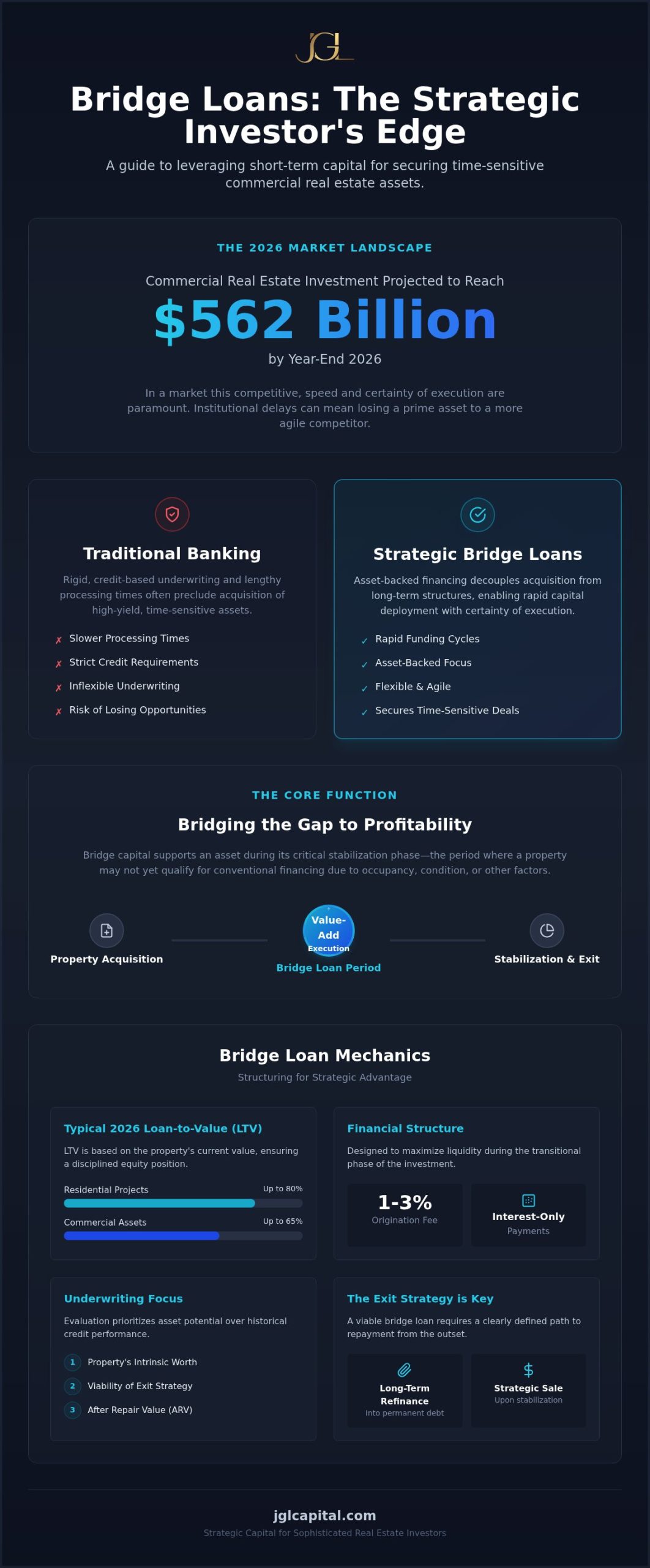
The traditional reliance on conventional banking institutions often represents a strategic liability in a market where commercial real estate investment is projected to reach $562 billion by the end of 2026. While the “new normal” of the current fiscal year offers stabilized opportunities, the inherent rigidity of institutional underwriting frequently precludes the acquisition of high-yield, time-sensitive assets. Utilizing a bridge loan for investment property is no longer merely a tactical necessity for distressed scenarios; it’s a sophisticated instrument for capital allocation that allows disciplined investors to decouple immediate acquisition from long-term financing structures.
You likely recognize that the window for securing transitional assets or executing value-add projects is often narrower than the processing time required by a standard mortgage department. This guide provides a comprehensive analysis of how private, asset-backed financing enables the rapid stabilization of portfolios while navigating new regulatory landscapes like the 2026 FinCEN reporting requirements. We’ll examine the mechanics of permanent 100% bonus depreciation, the implications of the 21st Century ROAD to Housing Act, and the strategic deployment of capital to ensure your legacy remains resilient against institutional delays.
Key Takeaways
- Master the strategic deployment of a bridge loan for investment property to circumvent institutional delays and secure high-yield, time-sensitive assets.
- Analyze the specific 2026 loan-to-value and loan-to-cost ratios required to maintain an optimal capital structure during the stabilization of transitional real estate.
- Evaluate the integration of new federal legislation and tax incentives, such as permanent 100% bonus depreciation, into your long-term portfolio growth strategy.
- Streamline the underwriting process by aligning pro-forma financials and exit strategies with the rigorous requirements of sophisticated private capital providers.
- Leverage the expertise of a seasoned strategic partner to navigate volatile markets and secure bespoke financing for complex, high-stakes commercial projects.
Defining the Bridge Loan for Investment Property: A Strategic Necessity
A bridge loan for investment property is a specialized, short-term debt instrument secured by real estate collateral, specifically designed for non-owner-occupied assets. It functions as an interim financing solution, providing the necessary liquidity to secure a property until a more permanent capital structure can be established. Unlike consumer-oriented bridge loans, which primarily facilitate the purchase of a primary residence, investment-purpose bridge financing is a professional tool for business entities and sophisticated individuals. It represents a strategic alliance between the borrower and a capital provider, focusing on the generation of worth through deliberate action.
In the current 2026 market cycle, where commercial real estate investment activity is projected to reach $562 billion, the ability to deploy capital with precision is a distinct competitive advantage. Sophisticated investors don’t prioritize the nominal cost of capital during transitional phases. They prioritize the certainty of execution. The institutional delays inherent in traditional banking can result in the loss of a prime asset to a more agile competitor. By utilizing a bridge loan for investment property, an investor decouples the immediate need for acquisition from the lengthy process of securing permanent debt.
The Core Function of Transitional Capital
The primary utility of this financing lies in its ability to support an asset during the stabilization phase. This is the critical period where a property may not yet qualify for conventional financing due to occupancy levels, physical condition, or recent changes in management. Bridge capital allows investors to execute non-contingent bids, which is essential in the high-stakes bidding environments of 2026. It effectively bridges the gap between the initial purchase and the completion of a value-add strategy, ensuring that the project remains capitalized throughout its most volatile stage.
Asset-Backed vs. Credit-Based Underwriting
Traditional institutional lenders typically rely on a credit-based underwriting model that emphasizes personal debt-to-income ratios and historical credit performance. In contrast, private bridge financing utilizes an asset-backed approach. This methodology prioritizes the intrinsic worth of the real estate and the viability of the exit strategy. A critical component of this process is the evaluation of the property’s After Repair Value (ARV), which allows the lender to structure the loan based on the future potential of the asset rather than its current distressed state. This disciplined focus on the asset itself bypasses the strict requirements that often stall traditional bank approvals, providing a streamlined path to funding for experienced developers.
The Mechanics of Bridge Financing: Structuring for Strategic Advantage
The structural integrity of a bridge loan for investment property relies on the precise alignment of leverage with the asset’s specific risk profile. In the 2026 fiscal year, residential projects typically see loan-to-value (LTV) ratios capped at 80%, whereas commercial assets generally require a more conservative 65% LTV. These metrics ensure that both the investor and the capital provider maintain a disciplined equity position. When renovation is a core component of the project, lenders often utilize a loan-to-cost (LTC) metric to determine the total capital commitment. This approach ensures that the funding remains commensurate with the actual capital expenditures required to enhance the property’s worth.
Interest-only structures are a hallmark of this financing model. By eliminating principal amortization during the interim phase, investors preserve critical liquidity for operational needs or value-add improvements. This focus on short-term cash flow management is essential for projects that haven’t yet reached their full income-generating potential. Additionally, origination fees, typically ranging from 1 to 3 points, must be integrated into the initial underwriting. A bridge loan for investment property is only as viable as its exit strategy. Whether the plan involves a long-term refinance into a permanent debt structure or a strategic sale upon stabilization, the path to repayment must be clearly defined from the outset.
Loan Terms and Repayment Structures
Typical durations for these facilities range from 6 to 24 months. This window provides sufficient time for property acquisition, renovation, and the eventual transition to permanent financing. Many sophisticated investors seek structures that omit pre-payment penalties, allowing for maximum flexibility if the asset stabilizes ahead of schedule. For renovation-intensive projects, capital is often disbursed through a series of structured draws. These draws are released upon the completion of specific milestones, ensuring that the project stays on budget and the collateral’s value increases in lockstep with the debt.
The Role of Private Capital in High-Stakes Management
Private capital markets offer a level of customization that is rarely found in the rigid frameworks of traditional banking. Navigating these complexities requires a private money broker who understands the nuances of diverse capital pools and can tailor a solution to a project’s unique scope. This broker-first model facilitates access to highly specialized lenders who prioritize the property’s potential over standardized credit scores. Bridge financing serves as a tactical tool for portfolio expansion in 2026. By aligning the financing structure with the specific operational objectives of the project, investors can execute their growth strategies with confidence and precision.
Core Strategic Use Cases for Bridge Loans in 2026
The strategic deployment of a bridge loan for investment property is often the deciding factor in securing high-value assets within the competitive 2026 landscape. While traditional lending institutions remain tethered to historical performance metrics, sophisticated bridge financing models prioritize the projected intrinsic worth of the stabilized asset. This approach is particularly effective when acquiring distressed properties that fail to meet the immediate, rigid underwriting standards of conventional banks. By utilizing transitional capital, investors can bypass institutional inertia and secure assets that offer significant upside potential once the initial phase of repositioning is complete.
Integrating a DSCR loan for rental properties as a long-term exit strategy is a common practice among seasoned portfolio managers. The bridge facility provides the necessary liquidity to acquire and improve the asset, while the subsequent debt service coverage ratio loan offers a stable, permanent financing solution based on the property’s newly established cash flow. Similarly, new construction loans frequently rely on bridge structures to fund the critical gap between land acquisition and the commencement of vertical development. In these scenarios, the speed of execution provided by a bridge loan for investment property ensures that project timelines remain intact, even when traditional construction financing faces bureaucratic delays.
Repositioning a complex portfolio often requires the consolidation of multiple smaller assets into a single, unified bridge facility. This maneuver simplifies the capital stack and provides a cohesive foundation for large-scale renovations or rebranding efforts. By aggregating these assets, investors can leverage their collective worth to secure more favorable terms during the eventual transition to permanent debt, thereby maximizing the overall efficiency of their capital allocation strategy.
Stabilization and Repositioning
Stabilization remains the cornerstone of the “bridge-to-permanent” pathway. Investors utilize bridge capital to drive occupancy through targeted capital improvements or to navigate the “timing gaps” inherent in 1031 exchanges. In a 1031 scenario, preserving tax advantages often requires the immediate acquisition of a replacement property before the sale of the relinquished asset is finalized. Bridge financing provides the bridge of liquidity necessary to maintain the tax-deferred status of the exchange, ensuring that the investor’s long-term wealth preservation strategy remains uninterrupted.
Fix-and-Flip and Rapid Turnaround Projects
For projects requiring a rapid turnaround, fix and flip loans serve as a specialized application of bridge financing. Speed is the primary metric of success in these transactions. Securing off-market deals requires the ability to present non-contingent offers that traditional lenders simply cannot support. This agility facilitates the B.R.R.R. method (Buy, Rehab, Rent, Refinance, Repeat), allowing disciplined investors to recycle their equity across multiple projects with a level of precision that mirrors institutional-grade management.
Navigating the Underwriting Process: From Application to Funding
The underwriting phase of a bridge loan for investment property represents a rigorous analytical exercise designed to validate the alignment of capital with a project’s strategic objectives. Unlike the automated systems utilized by retail banks, private capital underwriting is a deliberate process that prioritizes the intrinsic worth of the collateral and the feasibility of the proposed transition. This process begins with an initial deal screening, where lenders apply sophisticated pattern recognition to evaluate both the property’s potential and the borrower’s historical performance in similar asset classes. It’s a method grounded in empirical data rather than speculative trends.
Precision in document preparation is non-negotiable for investors seeking rapid execution. Lenders require comprehensive pro-forma financials, meticulously detailed renovation budgets, and a clearly articulated exit plan. These documents serve as the intellectual foundation of the transaction, providing the transparency necessary to secure a favorable term sheet. During the valuation phase, private capital providers may utilize Broker Price Opinions (BPOs) alongside traditional appraisals to expedite the assessment of a property’s current and future worth. This flexibility is essential for coordinating with title companies and legal counsel within the tight windows required for non-contingent acquisitions. To ensure your project meets these institutional standards, you may submit your deal for a professional screening.
Criteria for Successful Asset-Backed Approval
Successful approval hinges on the lender’s ability to recognize a disciplined approach to value creation. While the asset serves as the primary security, a robust exit strategy remains the most critical component of the application. Lenders must be certain that a clear path to liquidity exists, whether through a strategic sale or a transition to permanent debt. Additionally, sophisticated borrowers must demonstrate sufficient liquidity to cover interest reserves and closing costs, reinforcing their position as a stable partner in the transaction. This ensures that the alignment of objectives remains intact throughout the loan’s duration.
The Timeline of a Private Money Transaction
The velocity of private money transactions is a primary driver for their use in high-stakes management. An initial inquiry often results in a formal term sheet within a 24-to-48 hour window, allowing investors to move with confidence. This is followed by a focused due diligence phase where property condition and title clarity are verified with surgical precision. It is within this framework that hard money lenders prioritize the asset over the borrower’s personal history. This methodical approach ensures that funding occurs with the speed necessary to capitalize on fleeting market opportunities without compromising on analytical rigor.
Securing Private Capital Through Strategic Brokerage
In an environment characterized by fluctuating liquidity and specific regulatory shifts, the broker-first model provides a distinct advantage over single-source lenders. Direct lenders are inherently limited by their own internal underwriting committees and balance sheet constraints. When an investor seeks a bridge loan for investment property, they require access to a diverse array of capital pools that can accommodate the specific nuances of their asset. A strategic broker acts as an intermediary who understands the risk appetite of various private funding sources, ensuring that the project is matched with the most compatible capital provider.
JGL Capital utilizes over 30 years of combined industry experience to navigate these complexities. This tenure allows for the precise structuring of commercial real estate loans that might otherwise be rejected by traditional institutions. By leveraging an established network of private capital, the firm provides access to alternative funding sources that aren’t available to the general public. This strategic guidance is essential for investors looking to capitalize on the 16% projected increase in commercial investment activity throughout 2026.
Customized Solutions for Sophisticated Partners
The firm functions as a disciplined steward of the borrower’s objectives, tailoring every facility to the specific sponsor capacity and project scope. This isn’t a transactional relationship but a high-level strategic alliance. By aligning financing structures with long-term goals, investors can build a lasting legacy through reliable and repeatable access to capital. This approach ensures that every bridge loan for investment property serves as a foundational step toward a stabilized, high-performing portfolio rather than a temporary fix.
Initiating the Strategic Alliance
Engaging with a seasoned partner for a preliminary deal review is the first step in ensuring professional execution. This process involves a rigorous vetting of exit strategies to ensure that the transition from bridge capital to permanent debt is seamless. JGL Capital provides the analytical rigor necessary to identify potential hurdles before they manifest, preserving the integrity of the project’s timeline. To secure a partner invested in your long-term worth, you should initiate a consultation to align your next acquisition with a capital structure designed for growth and stability.
Advancing Your Real Estate Legacy through Strategic Capital Alignment
The 2026 real estate landscape requires more than just capital; it demands a disciplined approach to transitional financing that prioritizes speed and asset worth. By utilizing a bridge loan for investment property, sophisticated investors successfully navigate the complexities of stabilization and repositioning while bypassing the inherent delays of traditional banking institutions. This strategic decoupling of acquisition and permanent financing allows for the preservation of value and the execution of high-stakes projects with surgical precision. Success in this environment is predicated on the alignment of your operational objectives with a capital structure that reflects the true potential of your real estate assets.
JGL Capital offers a broker-first model that provides access to diverse private capital sources, leveraging over 30 years of pattern-recognition expertise to prioritize your property’s intrinsic value over personal credit history. This institutional approach ensures that every transaction is treated as a strategic alliance rather than a simple service provision. We invite you to Secure Strategic Capital for Your Next Investment Property and align your portfolio with a partner dedicated to your long-term growth. Your vision for value creation deserves a capital structure that’s as disciplined and ambitious as your strategy.
Frequently Asked Questions
What is a bridge loan for an investment property?
A bridge loan for investment property is a short term, asset backed debt instrument designed to facilitate the acquisition or stabilization of non owner occupied real estate. These facilities serve as interim capital, allowing sophisticated investors to secure time sensitive assets before transitioning to long term financing. Unlike consumer mortgages, these loans prioritize the intrinsic worth of the collateral and the viability of the project’s exit strategy rather than the borrower’s personal debt to income ratio.
How do bridge loan interest rates compare to traditional mortgages in 2026?
In the 2026 fiscal year, bridge loan interest rates typically range from 9.00% to 14.00%, reflecting the increased risk and speed associated with transitional capital. This is higher than the national average 30 year fixed mortgage rate, which stood at 6.76% in August 2026. Investors accept this higher cost of capital in exchange for the certainty of execution and the ability to secure distressed or non stabilized assets that traditional banks often reject.
Can I get a bridge loan for an investment property with poor credit?
Yes, because bridge financing utilizes an asset backed underwriting model that prioritizes the property’s value and the investor’s exit strategy over personal credit scores. While traditional institutions require high credit thresholds, private capital providers focus on the collateral’s After Repair Value and the project’s feasibility. This approach allows disciplined investors with transitional credit profiles to access the liquidity needed for high stakes acquisitions and value add projects that generate significant worth.
What are the typical fees associated with a real estate bridge loan?
Borrowers should anticipate origination fees typically ranging from 1 to 3 points, which are calculated as a percentage of the total loan amount. Additional project costs include appraisal fees, title insurance, legal counsel, and document preparation. It’s essential to integrate these metrics into your initial underwriting to ensure the project remains capitalized. These fees reflect the specialized nature of private capital and the administrative rigor required for rapid, customized funding solutions.
How fast can a bridge loan for investment property be funded?
The execution of a bridge loan for investment property is significantly faster than traditional banking channels, with funding often occurring within days. A professional inquiry typically results in a formal term sheet within a 24 to 48 hour window. This velocity allows investors to present non contingent offers in competitive bidding environments. The streamlined due diligence process focuses on title clarity and property condition, ensuring that time sensitive opportunities are secured without institutional delay.
What happens if I cannot refinance my bridge loan before it expires?
Failing to refinance or sell the asset before the loan’s maturity date results in a maturity default, which may trigger penalty interest rates or legal action. To mitigate this risk, sophisticated investors maintain a disciplined exit plan and often negotiate extension options during the initial structuring phase. A seasoned strategic partner can assist in vetting these exit strategies early, providing the necessary guidance to ensure the capital stack remains stable as the project matures.
Are bridge loans available for new construction projects?
Bridge financing is a vital instrument for new construction projects, particularly during the critical phase between land acquisition and the commencement of vertical development. These facilities provide the liquidity needed to secure a site and complete pre development requirements before a permanent construction loan is finalized. By utilizing a bridge structure, developers maintain project momentum and preserve equity, ensuring that the alignment of objectives remains intact throughout the entire lifecycle of the development.
What is the minimum loan amount for a JGL Capital bridge loan?
JGL Capital specializes in complex, high stakes transactions, with a primary focus on loan amounts exceeding $10 million. This threshold reflects our commitment to serving institutional partners and high net worth stakeholders who require sophisticated capital structures for large scale commercial and multi family assets. By concentrating on significant capital allocations, we provide the deep seated expertise and analytical rigor necessary to ensure the successful stabilization and long term growth of substantial real estate portfolios.