

The After Repair Value of a property is not a speculative target; it’s a rigorous financial anchor that determines the viability of an entire capital structure. For the sophisticated investor, understanding how to estimate after repair value (ARV) represents the difference between a disciplined acquisition and a catastrophic funding gap. In a climate where national home prices grew by a modest 1.2 percent year-over-year as of June 2026, the margin for error in underwriting has narrowed significantly. Precise valuation is the primary mechanism through which you align your strategic objectives with the requirements of private capital partners.
You likely recognize that inaccurate projections often stem from a failure to account for localized market shifts or the complexities of multi-unit assets. This guide provides the analytical framework necessary to master the rigor of property valuation, ensuring your exit strategies are grounded in empirical evidence rather than market hyperbole. We’ll examine the repeatable formulas used to project future worth, the nuances of the 70 percent rule in competitive environments, and the specific metrics that institutional lenders prioritize when evaluating your next transition. By the end of this analysis, you’ll possess the tools to project worth with a level of certainty that commands institutional trust.
Key Takeaways
- Establish ARV as the fundamental metric for asset-backed financing, moving beyond speculation toward disciplined risk management.
- Learn the precise methodology for how to estimate after repair value (ARV) through meticulous market analysis and the quantification of high-impact renovations.
- Navigate quantitative frameworks such as the 70 percent rule and Loan-to-Value ratios to ensure your project underwriting aligns with institutional requirements.
- Execute advanced valuation strategies for commercial and multi-family assets by transitioning from residential sales comparisons to sophisticated income-based modeling.
- Enhance your credibility with private capital partners by delivering defensible projections that facilitate optimal bridge and fix-and-flip financing.
The Strategic Significance of After Repair Value (ARV) in Real Estate Finance
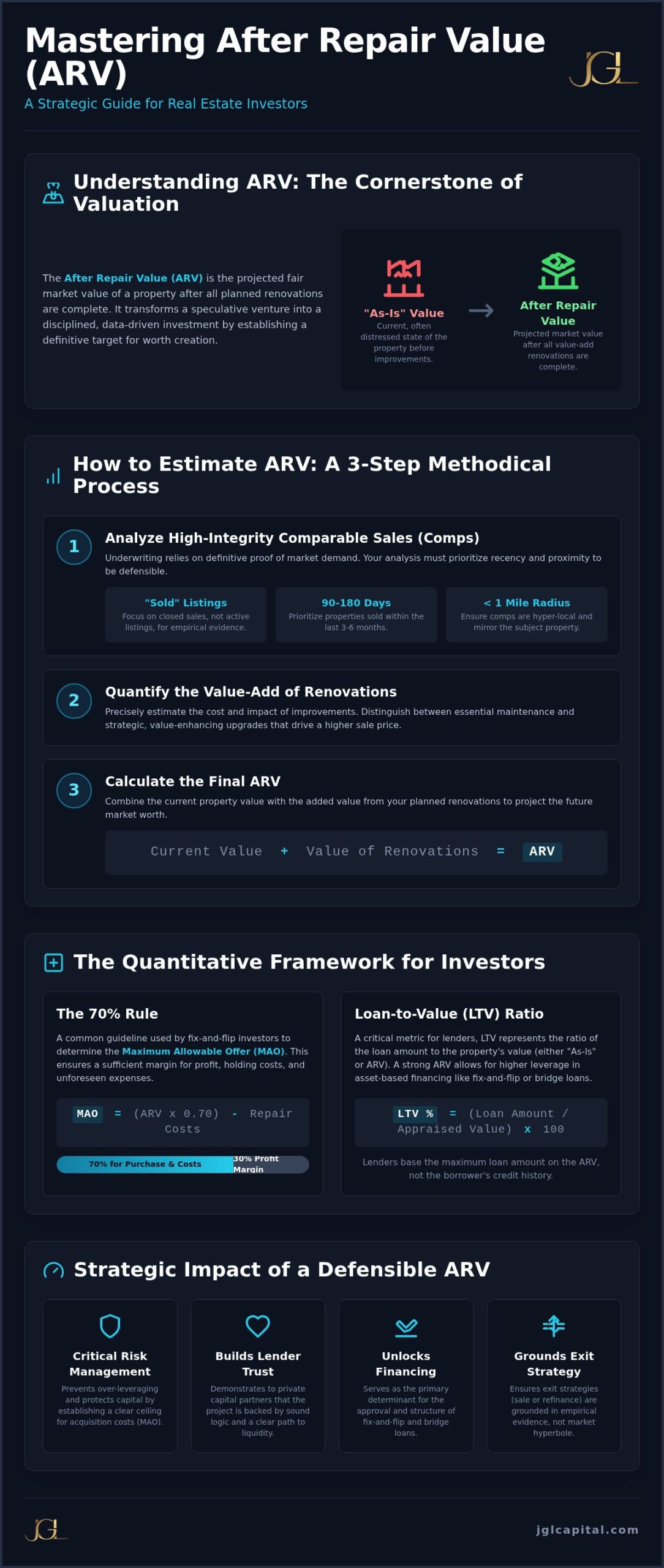
The After Repair Value (ARV) represents the projected fair market value of a real estate asset once all planned capital improvements and renovations have been successfully executed. It’s a stabilized valuation that serves as the cornerstone of institutional underwriting. While the “As-Is” value reflects the property’s current, often distressed state, the ARV looks toward the future utility and marketability of the asset. For private money brokers and sophisticated investors, mastering how to estimate after repair value (ARV) is the primary mechanism for ensuring the preservation of capital. It transforms a speculative venture into a disciplined investment by establishing a definitive target for the creation of worth. This distinction is vital.
ARV as a Risk Management Tool
Precise ARV calculations function as a critical risk management tool by preventing the common pitfall of over-leveraging during the transitional phase of a project. By establishing a defensible future value, an investor can derive the Maximum Allowable Offer (MAO). This figure represents the ceiling for acquisition costs that still permits a sufficient margin for profit and unforeseen contingencies. This process aligns investor projections with the rigorous standards found in a professional real estate appraisal. Without this analytical rigor, an investor risks a funding gap where the total cost of the project exceeds the eventual market demand, compromising the entire capital stack. Success requires precision.
The Impact of ARV on Financing Options
In the context of transitional finance, the ARV is the primary determinant for the approval and structure of fix and flip loans. Because asset-based lenders prioritize the collateral’s future worth over the borrower’s personal credit history, the ARV dictates the maximum loan amount and the resulting leverage. This focus on future value also influences the terms of a bridge loan, where the lender seeks assurance that the property’s eventual stabilization will support a successful exit, whether through a sale or a long-term refinance. Investors who master how to estimate after repair value (ARV) demonstrate to capital partners that the loan is secured by a viable, high-value asset. A disciplined approach to valuation signals that the project is backed by sound logic and a clear path to liquidity. It builds institutional trust.
A Methodical Process: How to Estimate ARV Step-by-Step
The transition from speculative intuition to a disciplined, data-driven methodology is what separates the casual investor from the seasoned professional. To maintain the integrity of a capital stack, one must adopt a repeatable framework that accounts for both quantitative data and qualitative market shifts. Understanding how to estimate after repair value (ARV) requires a meticulous examination of the local ecosystem, ensuring that every projected dollar of worth is supported by empirical evidence. This process serves as the foundation for securing private money broker services that align with your long-term strategic objectives.
Selecting High-Integrity Comparable Sales (Comps)
Institutional-grade underwriting relies heavily on the selection of high-integrity comparable sales. While “active” listings provide insight into current sentiment and competition, “sold” listings remain the only definitive proof of market demand. In a year where national home prices have shown a modest 1.2 percent growth, your analysis must prioritize recency and proximity. Focus on assets sold within the last 90 to 180 days, ideally located within a one-mile radius of the subject property. These comps must mirror the target asset in vintage, utility, and architectural style to ensure the data remains normalized and defensible during a professional appraisal.
Calculating the Value-Add of Renovations
Renovations must be categorized with precision, distinguishing between essential deferred maintenance and strategic, value-enhancing improvements. While a new roof preserves value, it rarely increases it; conversely, modernized kitchens and high-yield floor plan reconfigurations directly impact the price-per-square-foot. It’s vital to recognize neighborhood “ceilings” to avoid the risk of over-improvement, which occurs when the cost of renovations exceeds the market’s willingness to pay for premium finishes. By analyzing the delta between distressed and renovated comps, you can quantify the specific value-add of your proposed scope of work.
Applying the ARV Formula
The core calculation is straightforward: ARV equals the current purchase price plus the specific value added by planned renovations. However, the sophistication lies in accounting for the “Appraisal Gap,” which is the variance between an investor’s optimistic projection and a conservative institutional valuation. When you finalize how to estimate after repair value (ARV), it’s prudent to run both conservative and aggressive models to stress-test the project’s viability. This dual-model approach ensures that your exit strategy remains robust even if market absorption rates fluctuate during the construction phase. A disciplined estimate is your best defense against unforeseen market volatility.
The Quantitative Framework: Formulas, the 70% Rule, and LTV
Once a methodical baseline is established, the investor must apply a rigorous quantitative framework to evaluate the financial feasibility of the transition. Mastery of how to estimate after repair value (ARV) isn’t an end in itself; rather, it’s the critical input for the heuristics that govern capital allocation. These formulas serve as a primary filter, allowing a disciplined steward of capital to distinguish between a viable strategic alliance and a speculative risk that threatens the preservation of worth. By translating property potential into hard percentages, you align your deal structure with institutional expectations.
Deep Dive into the 70% Rule
The 70 percent rule remains a foundational heuristic for high-velocity flipping, stipulating that an acquisition shouldn’t exceed 70 percent of the projected ARV minus renovation costs. This 30 percent margin is essential because it must absorb all ancillary expenses, including marketing commissions, property taxes, and the cost of capital. In the current national market, where mortgage rates for investment properties range from 7.2 to 7.8 percent, these holding costs can erode equity if the initial margin is too thin. While some investors adjust this threshold to 75 or 80 percent in low-inventory markets, such a shift demands an even higher degree of precision in your underlying valuation to avoid over-leveraging.
Institutional Loan-to-Value (LTV) Implications
Asset-backed lenders utilize the ARV to define the maximum exposure within a capital stack, typically capping the loan amount at 70 to 75 percent of the future stabilized value. This is a distinct metric from the “As-Is” LTV, which only considers the property’s current distressed state. Organizations like JGL Capital utilize these future-facing valuations to structure hard money loans that facilitate rapid acquisition and renovation. By demonstrating a sophisticated understanding of how to estimate after repair value (ARV), you provide the lender with the security required to offer higher leverage, such as financing up to 90 percent of the purchase price and 100 percent of the construction costs, provided the total remains within the ARV-based LTV ceiling.
A disciplined ROI analysis must also include a sensitivity test to account for market volatility. If the realized ARV falls five percent below the initial projection, the impact on the return on equity is often magnified. A ten percent decline could potentially eliminate the profit margin entirely or necessitate a capital call to cover the funding gap. Incorporating these conservative stress tests into your underwriting ensures that your project remains solvent even if absorption rates slow or buyer leverage increases during the stabilization period. Precision in the formula is the only path to predictable growth.
Advanced Valuation: ARV for Multifamily and Commercial Assets
The transition from residential single-family assets to multi-family and commercial properties necessitates a fundamental shift in valuation philosophy. While residential analysis relies heavily on the sales comparison approach, commercial valuation is primarily a function of the asset’s capacity to generate predictable cash flow. Mastering how to estimate after repair value (ARV) for these complex assets requires a deep understanding of the income capitalization approach, where value is derived from the net income the property produces post-stabilization. This disciplined perspective ensures that capital is allocated toward projects with the highest potential for long-term worth preservation.
The Income Capitalization Approach
In the commercial sector, the ARV is determined by dividing the projected Net Operating Income (NOI) by the market-appropriate capitalization rate. To achieve a defensible valuation, an investor must project stabilized rents based on current market demand while accounting for realistic vacancy rates and operational expenses. Operational efficiencies, such as reducing utility costs or streamlining property management, directly impact the NOI and, consequently, the property’s total value. Commercial lenders prioritize the Debt Service Coverage Ratio (DSCR), seeking assurance that the stabilized income will comfortably exceed the debt obligations. This focus on performance metrics over simple sales data provides a more stable foundation for high-stakes management.
ARV in New Construction and Development
Projecting future worth for ground-up development involves a unique set of variables, including entitlement risk and fluctuating delivery timelines. For those utilizing new construction loans, the ARV must be supported by a detailed cost analysis and a clear understanding of the market’s absorption capacity upon completion. This process requires close coordination with architects and contractors to ensure that the proposed scope of work aligns with institutional appraisal standards. When seeking commercial real estate loans, the precision of your ARV projection serves as a linguistic signature of your expertise, distinguishing your proposal from more speculative ventures. A well-documented ARV accounts for the time-value of money and the risks inherent in the construction phase.
Successful execution in the commercial space depends on your ability to present a deal that is mathematically sound and strategically viable. If you’re ready to leverage institutional-grade capital for your next multi-family or commercial acquisition, you can consult with our strategic partners to align your valuation with our asset-backed lending requirements. Precision in your initial underwriting is the most effective way to secure the leverage necessary for large-scale value creation.
Strategic Execution: Leveraging ARV for Optimal Financing
The culmination of a disciplined valuation process is the successful procurement of capital. While the technical process of how to estimate after repair value (ARV) provides the mathematical foundation, strategic execution requires the translation of that data into a persuasive narrative for institutional partners. JGL Capital prioritizes the underlying asset’s worth, allowing sophisticated investors to bypass the rigid constraints often associated with traditional credit-based lending. By aligning your deal structure with these asset-backed principles, you position your project for rapid funding and long-term viability. This alignment is the linguistic signature of a professional operator.
Preparing a Professional Underwriting Package
A high-integrity underwriting package, often referred to as a “Deal Book,” serves as the primary instrument through which an investor communicates their strategic vision to private capital partners. This document must present a granular renovation budget alongside a rigorous ARV analysis, supported by the high-integrity comparable sales established in the earlier stages of your due diligence. When you demonstrate a command of how to estimate after repair value (ARV), you signal to private money broker services that the project is managed with institutional-grade precision. JGL Capital leverages over 30 years of industry expertise to offer strategic guidance on deal structuring, ensuring that your capital stack is optimized for both the acquisition and the intensive renovation phase.
Exit Strategy and Long-Term Value Creation
The ARV is not merely a target for a single transaction; it’s the catalyst for sustained real estate investing success. A precise future valuation allows for a seamless transition from bridge financing to permanent solutions, such as DSCR rental loans, which prioritize property performance over personal income. This “Bridge-to-Perm” strategy is essential for investors seeking to build lasting legacies through the deliberate accumulation of high-value portfolios. By planning the refinance at the point of acquisition, you ensure that the stabilized asset will meet the debt service requirements of long-term institutional lenders. To begin this process and secure the leverage required for your next transition, you should engage with JGL Capital for asset-backed financing solutions that prioritize the generated worth of your property. Precision in your exit planning is the final step in the creation and preservation of value.
Advancing Your Investment Strategy Through Disciplined Valuation
Mastering the methodology behind how to estimate after repair value (ARV) is the definitive step in transitioning from a transactional participant to a strategic steward of capital. By implementing a rigorous framework that accounts for market absorption, renovation value-add, and institutional LTV requirements, you ensure that every acquisition is backed by empirical logic rather than speculative trends. This analytical precision is what distinguishes sophisticated partners in a geographic rebalancing market, where national home price growth remains steady but highly localized.
JGL Capital stands ready to support your strategic objectives with over 30 years of industry expertise and a streamlined, asset-based underwriting process that prioritizes property worth over personal credit history. Whether you’re navigating the complexities of multi-family assets or ground-up development, our national brokerage access provides the private capital necessary for rapid execution and certain project ROI. Success in transitional real estate is a function of alignment between your vision and a disciplined capital partner. You’re invited to Secure Fast, Asset-Backed Financing with JGL Capital today. Your commitment to precise valuation is the foundation upon which lasting legacies are built.
Frequently Asked Questions
What is the difference between market value and after repair value?
Current market value reflects an asset’s worth in its existing, often distressed state, whereas the After Repair Value represents the stabilized worth following the completion of a defined renovation scope. While as-is value is used to determine acquisition feasibility, the ARV is the primary metric for asset-backed lending. It serves as the foundation for the entire capital stack. Understanding how to estimate after repair value (ARV) accurately is essential to bridge the gap between distressed acquisition and future market demand.
Can I use active listings as comps when estimating ARV?
Active listings serve as indicators of current market sentiment and competition, but they shouldn’t be the primary basis for a professional valuation. Definitive underwriting requires a reliance on “sold” comparables that have closed within the last 90 to 180 days. Because active listings represent asking prices rather than realized demand, they lack the evidentiary weight required by institutional lenders. You should utilize them only to gauge the absorption rate and current inventory levels in a specific submarket.
How do I account for rising material costs in my ARV calculation?
Rising material costs must be meticulously accounted for within the renovation budget rather than the ARV itself, as construction inflation directly impacts the net profit margin. In 2026, nonresidential construction costs are expected to increase by 4 to 6 percent. This inflation necessitates a more conservative approach to your Maximum Allowable Offer. Since ARV is a reflection of future market demand for a finished product, cost increases typically compress the investor’s margin unless the broader market prices adjust accordingly.
What happens if the professional appraisal is lower than my estimated ARV?
An appraisal that falls below your estimated ARV creates a funding gap that often necessitates a capital call or a restructuring of the loan terms. Institutional lenders typically base their Loan-to-Value ratios on the independent appraiser’s valuation rather than the investor’s internal projections. To mitigate this risk, you should adopt a conservative approach to your initial underwriting. If a discrepancy occurs, you must either provide additional high-integrity comps to the appraiser or adjust your exit strategy to protect the project’s solvency.
Is the 70% rule still relevant for high-end luxury flips?
The 70 percent rule is frequently less applicable to high-end luxury transitions, where the absolute dollar profit is more significant than the percentage margin. In these premium markets, holding costs and specialized craftsmanship often require a more customized financial model. Investors may choose to operate at a 75 or 80 percent threshold if the projected profit justifies the increased exposure. However, this adjustment requires an even more disciplined approach to how to estimate after repair value (ARV) to ensure the capital remains secure.
How often should I update my ARV estimate during a long-term construction project?
You should re-evaluate your ARV estimate at least quarterly or whenever a significant macroeconomic shift occurs, such as a localized inventory surge or a change in mortgage rates. Regular monitoring ensures that your exit strategy remains aligned with current market demand. Given that active housing inventory rose by 3.2 percent annually as of August 2026, a stagnant valuation could lead to an overestimation of the asset’s liquidity. A disciplined operator treats valuation as a dynamic component of risk management.
Does a private money lender require a formal appraisal to verify ARV?
Most private money lenders require a formal, third-party appraisal to validate the ARV before finalizing the capital allocation. This external verification ensures that the loan is secured by an objective market valuation rather than the investor’s optimistic projection. While asset-based lenders prioritize property value over personal credit, they rely on the analytical rigor of professional appraisers to mitigate institutional risk. This standard practice protects both the lender and the investor by ensuring the project is fundamentally sound from the outset.
Can I calculate ARV for a property with existing tenants?
Calculating ARV for a tenanted property requires a dual analysis that accounts for both the physical renovation potential and the legal obligations of existing lease agreements. If the tenants remain post-renovation, the ARV is heavily influenced by the income capitalization approach and projected rent increases. Conversely, if the strategy requires a vacant delivery for a full-scale renovation, you must factor in the timelines and costs associated with lease terminations. The stabilized value is ultimately a reflection of the property’s highest and best future use.