

In the current 2026 fiscal environment, the traditional reliance on conventional banking institutions for ground-up development has transitioned from a standard procedure into a significant strategic liability. You’ve likely experienced the frustration of watching a prime development opportunity vanish because a traditional lender’s rigid requirements or bureaucratic delays couldn’t match the pace of the market. This phenomenon represents a pervasive obstacle for sophisticated developers who require immediate capital to secure a property before transitioning to a permanent construction loan. Understanding the utility of a bridge loan for new construction is no longer just an option for those managing complex capital stacks; it’s a fundamental necessity for maintaining project momentum in an increasingly competitive landscape.
This comprehensive guide, informed by the decades of institutional expertise held by John E. Litton, explores how to leverage bridge financing as a tactical instrument for opportunity capture. You’ll discover how to navigate the 2026 regulatory landscape, including new guidance on streamlined permitting and environmental reviews, to accelerate your project’s timeline. We’ll examine the strategic alignment of transitional funding with long-term objectives, providing a roadmap to manage the capital stack with precision and discipline. By the end of this analysis, you’ll have the insights required to utilize asset-backed lending to secure high-leverage projects without the constraints of personal credit hurdles.
Key Takeaways
- Leverage bridge financing as a strategic instrument for immediate land acquisition, allowing developers to secure prime sites before the completion of the entitlement process.
- Navigate the technical transition from a bridge loan for new construction to a permanent ground-up facility, ensuring continuous capital flow during the critical pre-development phase.
- Contrast the efficiency of private capital brokerage with the bureaucratic constraints of institutional lenders to prioritize speed of execution in high-stakes markets.
- Establish a rigorous framework for exit strategies that align with long-term project stabilization and institutional refinancing requirements.
- Access sophisticated, asset-backed funding solutions for projects exceeding $10 million by partnering with a seasoned, national private money broker.
The Strategic Role of Bridge Financing in New Construction
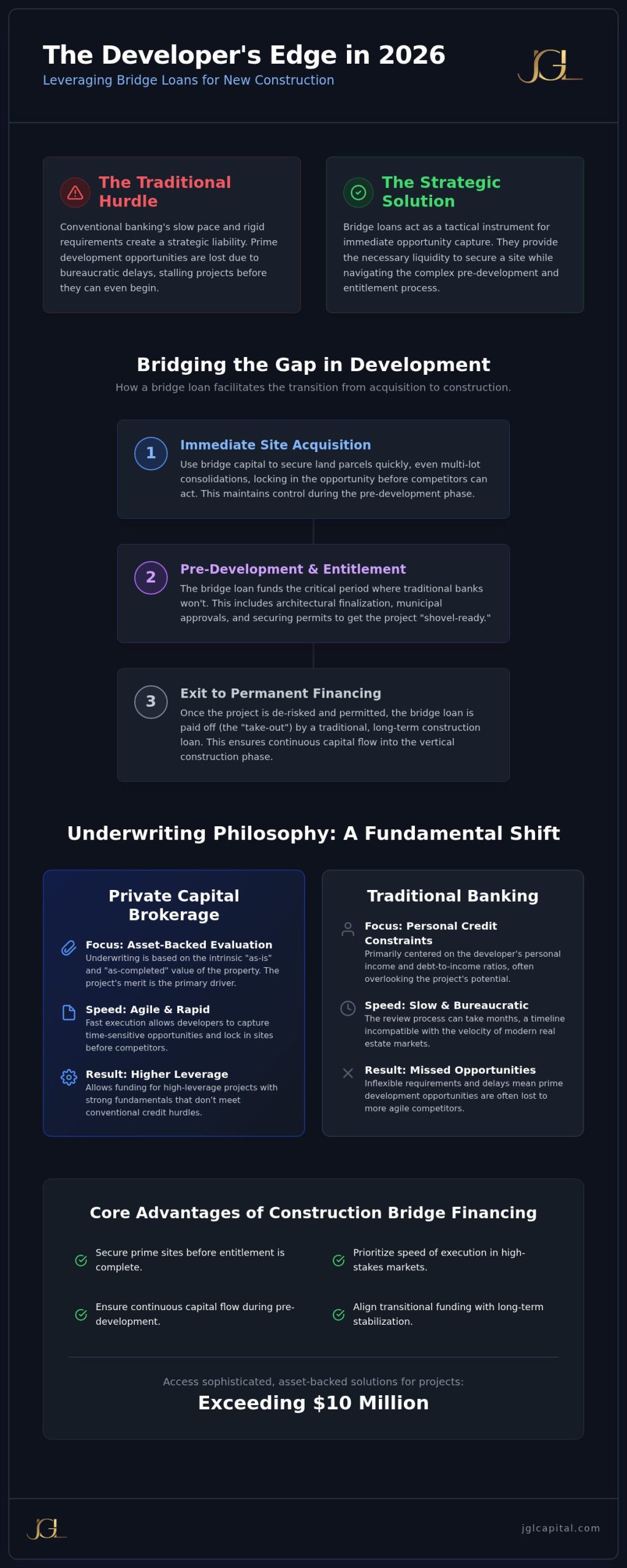
The utilization of a bridge loan for new construction serves as a sophisticated mechanism for developers to manage the temporal disconnect between opportunity identification and the formalization of long-term debt. While retail definitions often simplify these instruments as mere gap funding for residential movers, a professional perspective on understanding bridge loans reveals their critical function within the commercial capital stack. These facilities act as transitional placeholders; they provide the liquidity necessary to secure a site while the developer completes the complex process of obtaining entitlements, architectural finalization, and municipal approvals. By positioning this capital as a temporary instrument, developers can maintain a disciplined approach to project inception without the immediate pressure of permanent financing constraints.
Traditional banking institutions typically operate on a chronological framework that’s fundamentally incompatible with the velocity of 2026 real estate markets. Where an institutional bank might require months to review a ground-up proposal, private capital brokerage offers an agile alternative. This speed allows for “opportunity capture,” ensuring that a developer can lock in a project’s site before a competitor intervenes. The bridge loan isn’t merely a debt obligation. It is a strategic tool that facilitates the preservation of value at the earliest, most volatile stages of development.
Site Acquisition and Pre-Development Bridging
Securing the subject property is the most critical phase of any development lifecycle. Bridge capital allows for the immediate acquisition of land parcels, which is particularly vital for large-scale multi-family developments requiring the consolidation of multiple adjacent lots. By utilizing a bridge loan for new construction, developers can maintain control over a site while simultaneously finalizing the intricate details of their pre-development phase. In competitive national markets, the ability to close a transaction with certainty often dictates whether a project moves forward or remains stalled at the letter of intent stage. This transitional funding ensures project momentum is preserved during the lengthy permitting process.
Asset-Backed Evaluation vs. Personal Credit Constraints
The underwriting philosophy of private capital differs significantly from the rigid, personal-income-centered approach of traditional lenders. Sophisticated developers prioritize property-level metrics, focusing on the intrinsic value of the asset rather than personal debt-to-income ratios. Under the guidance of seasoned experts like John E. Litton, private money brokers employ pattern-recognition expertise to evaluate the “as-is” value of the land alongside the projected “as-completed” value of the stabilized project. This disciplined approach to underwriting allows for higher leverage on projects that possess strong fundamentals but don’t meet the conventional credit hurdles of a retail bank. It ensures that the project’s merit remains the primary driver of the funding decision.
The Mechanics of Bridging Ground-Up Development Phases
The transition from initial site control to vertical construction requires a disciplined orchestration of various debt instruments. While institutional lenders often demand that a project be “shovel-ready” before extending a traditional facility, a bridge loan for new construction provides the necessary liquidity to navigate the entitlement phase. This period, which encompasses architectural finalization and municipal approvals, represents a significant capital gap that traditional banks are typically unwilling to bridge. The primary function of this transitional debt is to facilitate the eventual take-out financing, where a permanent construction loan replaces the bridge facility once the project has been sufficiently de-risked through the acquisition of permits.
Managing the capital stack involves a meticulous balance of senior debt, mezzanine layers, and bridge components to optimize the developer’s equity position. By utilizing bridge financing during the pre-development stage, developers can maintain project momentum without depleting their own reserves or compromising their personal credit profiles. This strategic approach ensures that the project remains capitalized throughout its most vulnerable phases, allowing the developer to focus on operational execution rather than immediate capital shortfalls.
Bridging the Entitlement Gap
The entitlement gap remains one of the most volatile periods in the development lifecycle. During this time, the developer has committed to the land but cannot yet access the construction draws provided by traditional lenders. Bridge financing mitigates the risk of project stagnation by providing flexible, short-term debt that isn’t contingent on immediate vertical progress. This allows for a steady progression of pre-construction activities, ensuring that the project remains viable and attractive to eventual take-out lenders. It’s a method of maintaining forward motion when traditional institutions require absolute certainty.
Bridge-to-Construction Transition Strategies
Successful execution depends on a clearly articulated exit strategy, which is the cornerstone of professional private money brokerage. Structuring the bridge loan to align precisely with the anticipated construction start date is essential for minimizing carry costs and ensuring a seamless transition to long-term debt. John E. Litton emphasizes that the viability of the take-out loan is evaluated at the inception of the bridge facility, reflecting a strategic approach to capital management. Developers who require this level of precision often engage private money broker services to align their transitional funding with their long-term development objectives and ensure a smooth progression into the vertical phase.
Asset-Based Bridge Loans vs. Traditional Construction Financing
The fundamental divergence between institutional banking and private brokerage lies in the prioritization of compliance versus the prioritization of value. While traditional banks offer lower nominal interest rates, their rigid adherence to debt-to-income ratios and extensive documentation requirements often results in a prohibitive “box” that excludes many high-leverage projects. A bridge loan for new construction sourced through a private broker provides a more nuanced evaluation of risk. This model focuses on the strategic alignment of the project’s fundamentals rather than the individual sponsor’s personal balance sheet, allowing for a more sophisticated deployment of capital.
Evaluating the cost-benefit of private capital requires a shift from focusing on interest rates to focusing on total project yield and leverage. A higher interest rate is often a marginal expense when compared to the value of securing a site with 70% loan-to-cost (LTC) versus the 60% typically offered by conservative banks. This increased leverage allows developers to preserve their own liquidity for other concurrent opportunities, effectively amplifying their overall portfolio growth. The “broker-first” advantage provides access to a broad network of private capital, ensuring that the terms are customized to the specific needs of the project rather than forced into a standardized institutional template.
Speed of Execution as a Competitive Advantage
In the current development climate, a 10-day closing cycle often represents the difference between securing a prime asset and losing it to a more agile competitor. The cost of a missed opportunity frequently outweighs the incremental expense of private capital. John E. Litton leverages over 30 years of industry experience to expedite the underwriting process, ensuring that sophisticated developers can move with the necessary velocity. Speed, in this context, is not merely a convenience; it’s a structural advantage that allows for the capture of time-sensitive value through a bridge loan for new construction. This agility ensures that project momentum is never sacrificed to bureaucratic delay.
Underwriting the Opportunity, Not the Individual
Underwriting in the private sector emphasizes the “as-completed” viability of the project and the sponsor’s professional history. Traditional banks often fail to account for the unique complexities of large-scale, ground-up developments, leading to high rejection rates for investors who don’t meet standard W-2 criteria. By focusing on asset-backed metrics, private capital sources can fund complex deals that fall outside conventional guidelines. This disciplined approach ensures that capital is deployed where it can generate the highest worth, prioritizing the integrity of the project itself over arbitrary regulatory hurdles. It reflects a commitment to timeless principles of value creation rather than speculative banking trends.
Structuring the Exit Strategy for Construction Bridge Loans
The structural integrity of any high-leverage development project depends entirely on the clarity of its conclusion. In the discipline of private money brokerage, an exit strategy is not a secondary consideration; it is the primary filter through which the entire transaction is viewed. For a developer utilizing a bridge loan for new construction, the most common trajectory involves a transition into a permanent ground-up construction facility once entitlements are secured. This pivot requires precise temporal alignment to ensure that the transitional debt is retired before carry costs erode the project’s profit margins. Every claim made during the origination phase must be qualified by a viable path to repayment, reinforcing the stability of the capital stack.
Beyond traditional refinancing, developers often explore the Bridge-to-Permanent model, which is particularly effective for those focused on the for-rent residential sector. This strategy involves holding the completed asset as a long-term investment rather than seeking an immediate sale. Alternatively, a liquidity event may be triggered by the sale of the entitled land parcel to a merchant builder or the disposal of the completed project upon reaching stabilization. Each path requires a different underwriting approach. This emphasizes the necessity of a partner who understands the nuances of various exit environments and can provide the analytical rigor required to preserve value throughout the project lifecycle.
Refinance and Stabilization Strategies
Stabilization serves as the critical threshold for accessing institutional-grade capital. Once the vertical phase is complete and occupancy reaches a predetermined level, developers can transition from a bridge loan for new construction into a DSCR loan or a multi-family permanent facility. This shift significantly reduces the cost of capital and improves the project’s long-term cash flow profile. John E. Litton and the JGL Capital team integrate this transition into the initial origination process, ensuring that the exit is not just a possibility, but a meticulously planned outcome. This level of foresight is what distinguishes a strategic alliance from a simple transactional service.
Contingency Planning for Development Timelines
Real estate development is inherently susceptible to municipal delays and supply chain fluctuations. A disciplined steward of capital prepares for these contingencies by negotiating extension options within the bridge agreement. These provisions allow for project momentum to continue even if permitting takes longer than the initial projections. Protecting the capital stack requires a proactive approach to scheduling, where the developer maintains constant communication with their brokerage partner to adjust for shifting timelines. It’s about maintaining a steady rhythm toward the objective, regardless of external volatility.
Developers seeking to align their transitional funding with a robust, long-term exit strategy should consult with a private money broker to begin the strategic orchestration of their next project.
Leveraging Private Capital with JGL Capital
JGL Capital operates at the intersection of sophisticated development and institutional-grade private liquidity. Our approach transcends simple brokerage; it’s a form of high-level strategic alliance designed to generate worth through the alignment of developer objectives with diverse capital sources. By maintaining a national scope, we provide developers with the flexibility to execute diverse portfolios across various jurisdictions without the localized constraints of regional banks. This expansive reach is coupled with a deep-seated expertise in structuring new construction loans that account for the intricate realities of ground-up projects. We don’t just provide funding. We provide the structural stability required for complex capital stacks.
Success in high-stakes development requires more than just access to capital; it requires the pattern recognition that only comes from over 30 years of industry experience. John E. Litton has cultivated a disciplined framework for evaluating a bridge loan for new construction, ensuring that every strategic objective is clearly defined and every strategy is rigorously vetted. This seasoned perspective allows us to identify and mitigate potential risks long before they impact the capital stack. We prioritize the preservation of value and the integrity of the exit strategy, viewing each project through the lens of long-term stewardship rather than short-term gain.
A Disciplined Partnership for Serious Investors
Our firm caters to high-net-worth stakeholders and sophisticated partners who value integrity and discretion above all else. We specialize in facilitating loans exceeding $10 million, providing the heavy-lift capital required for substantial multi-family and commercial developments. This focus on high-stakes management ensures that our resources are dedicated to building lasting legacies. We act as a quiet expert, providing the strategic guidance necessary to navigate the most challenging phases of the development lifecycle while maintaining a steady, measured rhythm toward project completion. Our commitment is to the generate worth through collaborative relationships that outlast any single transaction.
Initiating the Financing Process
The path to securing a bridge loan for new construction begins with a commitment to analytical rigor. Our initial evaluation process is thorough and logical, moving from high-level mission statements to the specific operational strengths of the project. Developers can expect a streamlined underwriting process that values precision and relies on asset-backed metrics rather than personal credit hurdles. By framing our activities as a collaborative alliance, we ensure that every solution is highly customized to the individual needs of the sponsor. If you are ready to secure your next development opportunity with a partner who values long-term growth, consult with JGL Capital for your next construction bridge loan today.
Orchestrating Your Next Development Lifecycle
The transition from site acquisition to vertical construction requires a disciplined approach to capital management that prioritizes speed and strategic alignment. By utilizing a bridge loan for new construction, sophisticated developers can capture time-sensitive opportunities while maintaining the integrity of their long-term project objectives. This strategic instrument provides the necessary liquidity to navigate the pre-development phase without the rigid constraints or personal credit hurdles of traditional institutional banking. It’s a method of maintaining project momentum that’s grounded in analytical rigor rather than speculative trends, ensuring that your capital stack remains stable throughout the entitlement process.
Success in the 2026 market depends on the alignment of sophisticated funding sources with professional operational execution. JGL Capital offers a national asset-backed lending network and specializes in high-balance facilities exceeding $10 million. With over 30 years of industry expertise, we act as a committed ally in the generation and preservation of worth for our partners. We don’t just provide funding; we offer a structural foundation for your most ambitious projects through a collaborative and deeply invested alliance. Secure Your Development Capital with JGL Capital and begin the deliberate process of building your next lasting legacy with a partner you can trust.
Frequently Asked Questions
What is a bridge loan for new construction?
A bridge loan for new construction is a short-term, asset-backed financing instrument designed to provide immediate liquidity during the transitional phases of a development project. It serves as a temporary placeholder in the capital stack, typically used to secure land or fund pre-development activities while the sponsor finalizes long-term construction debt. This facility prioritizes the intrinsic value of the real estate asset and the viability of the exit strategy over the sponsor’s personal credit profile.
How does a bridge loan differ from a standard construction loan?
The primary distinction lies in the timing and the underwriting focus of the facility. Standard construction loans are generally intended for the vertical build phase and require shovel-ready status, whereas a bridge loan facilitates the acquisition and entitlement period. Bridge financing offers greater speed of execution and flexibility in terms, allowing developers to lock in opportunities before permanent financing is secured. This agility is essential when traditional banks are slowed by bureaucratic oversight.
Can I use a bridge loan to purchase land for future development?
Yes, land acquisition is a fundamental application for this type of transitional capital. Developers utilize these facilities to consolidate parcels or secure a site while architectural plans and municipal approvals are still in progress. By deploying a bridge facility, a developer can maintain control of a subject property during the volatile pre-development phase. This ensures project momentum is preserved while the broader capital stack is being meticulously organized for the vertical phase.
What are the typical terms for a construction bridge loan in 2026?
In the current 2026 environment, terms are highly customized based on the project’s complexity and the sponsor’s institutional track record. These loans typically feature interest-only payments with durations ranging from 12 to 36 months, providing sufficient time for entitlement or stabilization. Loan-to-cost ratios generally align with the project’s risk profile, often providing higher leverage than conventional banks. Every agreement is structured with a disciplined focus on the generation of worth and the alignment of strategic objectives.
Why would an investor choose a bridge loan over a bank loan?
Investors prioritize bridge financing when the value of speed and leverage outweighs the lower nominal interest rates of institutional banks. Traditional lenders often impose rigid debt-to-income requirements and extensive documentation that can cause significant delays or outright rejections. Private brokerage offers a more nuanced, asset-backed evaluation, allowing for the funding of complex deals that fall outside standard banking boxes. This approach empowers developers to move with the velocity required in competitive national markets.
What is the typical exit strategy for a new construction bridge loan?
The most prevalent exit strategy involves refinancing the bridge facility into a permanent, long-term construction loan once the project reaches shovel-ready status. Alternatively, developers may choose to sell the entitled land or the completed, stabilized asset as a liquidity event. A clearly articulated exit plan is a prerequisite for approval, as it ensures the preservation of capital. Professional brokers, under the guidance of John E. Litton, evaluate the viability of this transition from the moment of origination.
Are bridge loans available for multi-family new construction projects?
Bridge financing is frequently utilized for large-scale multi-family developments, particularly those exceeding $10 million in total project cost. These facilities are instrumental in bridging the gap between site acquisition and the commencement of vertical construction for apartment complexes or for-rent residential communities. The ability to secure high-leverage capital for multi-family projects allows developers to optimize their equity position while navigating the complex permitting requirements inherent in high-density residential development across the nation.
How quickly can a bridge loan for new construction be funded?
Execution speed is a hallmark of private capital, with funding cycles often completed in as little as 10 days. This rapid deployment of capital is made possible by a streamlined underwriting process that focuses on property-level metrics rather than the exhaustive personal verifications required by retail banks. For sophisticated developers, this agility represents a structural advantage, allowing them to close on time-sensitive acquisitions that would otherwise be lost to more nimble competitors through a bridge loan for new construction.