

The success of a capital-intensive development is rarely determined by the architectural vision alone; it’s instead secured through the precision of the ground-up construction financing process that supports it. You likely understand that traditional bank underwriting often remains frustratingly opaque, frequently resulting in misaligned disbursement schedules and rigid credit requirements that fail to account for the intrinsic value of the real estate asset. This lack of transparency leads to costly delays that can jeopardize even the most meticulously planned project.
By mastering a disciplined, asset-centric framework, you can achieve a predictable capital deployment timeline that respects the unique requirements of your build. This guide examines the strategic orchestration of capital, offering a step-by-step methodology designed to align funding draws with critical construction milestones. We’ll explore how a sophisticated lending partnership, grounded in analytical rigor and deep-seated expertise, provides the stability necessary to preserve and create long-term value in a competitive market.
Key Takeaways
- Distinguish professional asset-backed financing from consumer-grade alternatives to ensure your capital structure reflects the specific risk profile of new institutional developments.
- Navigate the ground-up construction financing process through a methodical execution strategy that prioritizes analytical rigor and transparency from the initial assessment to the final commitment.
- Understand the critical primacy of developer experience and General Contractor performance as essential components of the underwriting process and lender risk mitigation.
- Utilize disciplined draw schedules and independent third-party inspections to maintain a strict alignment between physical construction milestones and capital deployment.
- Evaluate the strategic advantages of private money partnerships, where rapid funding execution and specialized expertise serve as catalysts for optimized project returns.
The Strategic Architecture of Ground-Up Construction Financing
Ground-up construction financing represents a sophisticated capital solution designed specifically for the creation of new physical assets where no prior structure exists. Unlike simple renovation projects or the ubiquitous fix-and-flip strategies that dominate retail lending, the ground-up construction financing process demands a far more rigorous approach to risk management and project governance. It isn’t merely a debt obligation; it’s a meticulously structured financial instrument where capital is deployed in direct response to the incremental creation of value. For the sophisticated developer, this process is an exercise in capital execution that requires a partner capable of matching the project’s complexity with analytical rigor.
Foundational Principles of New Build Capital
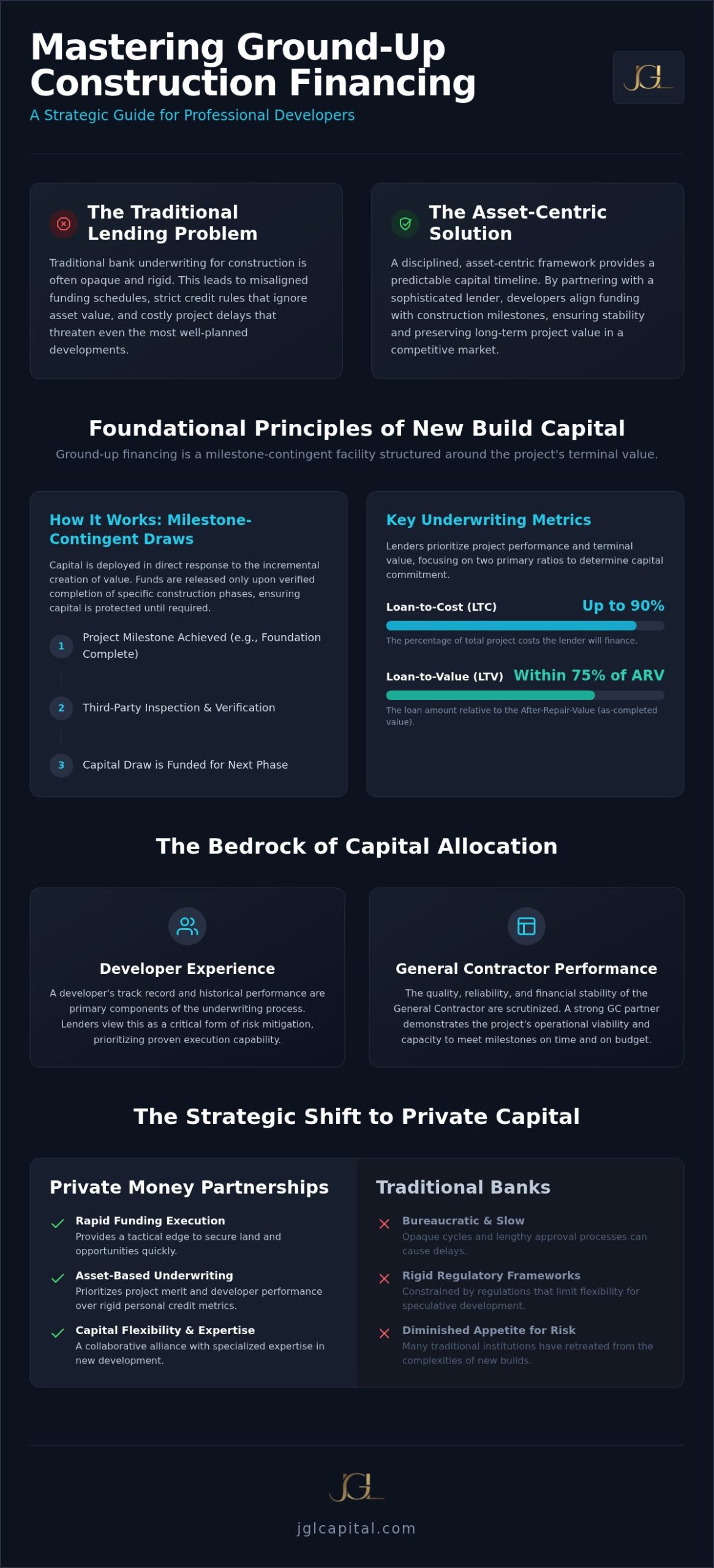
In the context of institutional development, the ground-up distinction is paramount. While a major renovation seeks to improve existing improvements, a ground-up project begins with raw land or the complete razing of prior structures. This necessitates a comprehensive assessment of the as-completed value, which serves as the primary anchor for determining loan-to-value (LTV) and loan-to-cost (LTC) ratios. Ground-up financing is a milestone-contingent capital facility where funds are released only upon the verified completion of specific construction phases. This structure frequently utilizes unfunded loan commitments, which are multiple-advance, closed-end arrangements that ensure capital is available yet protected until it’s actually required for the next stage of the build. By focusing on the terminal value of the asset, lenders provide a framework that supports the project’s long-term viability rather than just its immediate costs.
The Shift Toward Private Capital Allocation
The 2026 development landscape has witnessed a significant divergence between traditional institutional lenders and professional developers. Many traditional banks have retreated from speculative development, constrained by rigid regulatory frameworks and a diminished appetite for the complexities inherent in new builds. Professional developers now prioritize capital flexibility and speed over legacy banking relationships. They recognize that the ability to secure land quickly is a distinct competitive advantage. Private money provides a tactical edge by offering asset-based underwriting that prioritizes the developer’s historical performance and the project’s intrinsic merit. This strategic alignment ensures that the lender acts as a disciplined steward of capital, matching the deployment of resources to the actual project timeline rather than adhering to the opaque, bureaucratic cycles of a commercial bank. By focusing on the ground-up construction financing process as a collaborative alliance, developers can ensure their capital structure is as robust as the foundations they pour.
Essential Prerequisites: Aligning Project Fundamentals for Capital Allocation
The alignment of project fundamentals serves as the bedrock of a successful capital allocation strategy. Unlike traditional residential lending, which often over-emphasizes personal debt-to-income ratios, the ground-up construction financing process for professional developers prioritizes the intrinsic viability of the asset and the collective experience of the development team. A clear understanding of What is a construction loan in the commercial context reveals that the lender is essentially an equity partner in the project’s success. This relationship demands a high level of transparency and a rigorous assessment of risk before any capital is committed.
In the current 2026 financing environment, lenders typically evaluate projects based on sophisticated metrics such as Loan-to-Cost (LTC) and Loan-to-Value (LTV). Industry standards now frequently permit an LTC of up to 90%, provided the project’s Loan-to-After-Repair-Value (ARV) remains within a disciplined threshold of 75%. This shift reflects a market that values project performance and terminal value over simple credit scores. A thorough understanding of these ratios is vital when navigating the ground-up construction financing process, as it determines the level of equity required to stabilize the capital stack. For those seeking more detailed strategic insights, reviewing a comprehensive resource on New Construction Loans can provide the necessary depth for complex planning.
Vetting the Development Team
The General Contractor (GC) is the primary engine of project execution. Lenders conduct a granular review of the GC’s financial stability and operational history to mitigate the risk of project abandonment or cost overruns. A professional development resume must go beyond a simple list of past projects; it should demonstrate a consistent ability to deliver builds on time and within the projected budget. This vetting process isn’t merely a hurdle for the developer; it acts as a safeguard for their own equity by ensuring that the operational partners are capable of fulfilling the project’s strategic objectives.
Financial and Project Documentation
Precision in documentation is non-negotiable. Developers must provide exhaustive line-item budgets and architectural plans that have been vetted for feasibility. Beyond the build itself, environmental reports and site-specific assessments ensure that the land is truly ready for development, preventing unforeseen delays that could disrupt the capital deployment timeline. If you’re ready to align your project with a disciplined lending partner, you can explore customized financing solutions tailored to your specific development goals.
Navigating the Ground-Up Construction Financing Process: A Methodical Execution
The transition from project conceptualization to active development requires a capital deployment sequence that is as disciplined as the construction itself. While the previous phases focused on aligning prerequisites and vetting the development team, the actual execution of the ground-up construction financing process follows a three-phase methodology designed to ensure transparency and mitigate risk for all stakeholders. This methodical approach transforms a complex financial arrangement into a predictable operational roadmap, allowing developers to focus on physical execution rather than capital uncertainty.
From Application to Commitment
The initial phase begins with a preliminary project assessment, often resulting in a “Soft Quote” that determines high-level feasibility based on the asset’s projected value and the developer’s track record. This rapid filter allows sophisticated partners to gauge the viability of the capital structure before committing to the rigorous demands of formal underwriting. Once the project moves into Phase II, the lender initiates a deep-dive analysis, which includes site inspections and professional appraisals focused on the “as-completed” valuation. In the specialized private lending sector, the average timeline from initial application to a formal commitment of capital typically ranges from seven to ten business days. This speed is a hallmark of asset-based lending, providing a level of agility that traditional institutional banks, with their protracted committee-based approvals, simply cannot match.
The Closing and Funding Structure
Phase III involves the formal execution of the loan agreement and the establishment of the draw facility. During this stage, the developer and lender finalize the specific terms of the engagement, including interest-only payment structures and defined maturity dates that align with the projected build time. It’s common for developers to utilize Bridge Loans as a tactical precursor to construction, allowing them to secure land or stabilize an acquisition while the final permits and plans for the new build are being perfected. This strategic use of transitional capital ensures that the project doesn’t lose momentum during the pre-development phase.
The culmination of the closing process is the finalization of the draw schedule. This document isn’t merely a list of dates; it’s a disciplined mechanism for project governance that dictates exactly how and when funds will be released. By establishing these clear parameters upfront, the ground-up construction financing process creates a reliable framework for future disbursements. This ensures that capital is always available when milestones are met, maintaining the project’s momentum and protecting the developer’s equity throughout the entire lifecycle of the development.
Capital Disbursement and Risk Mitigation: Managing the Draw Schedule
The draw schedule functions as the primary instrument of project governance within the ground-up construction financing process. It ensures that capital is deployed in a manner that is strictly commensurate with the physical advancement of the asset. This disciplined approach protects the interests of both the developer and the lender by preventing the premature exhaustion of funds before the project reaches stabilization. By adhering to a pre-defined sequence of disbursements, stakeholders maintain a high degree of control over the project’s financial health, ensuring that every dollar advanced contributes directly to the creation of value.
The Mechanics of the Draw Process
Each disbursement request requires a comprehensive package of documentation to verify that the specified work has been completed to professional standards. This package typically includes itemized invoices from subcontractors, photographic evidence of progress, and a formal draw request form. Before any capital is released, a third-party inspector visits the site to perform a physical audit. This independent verification serves as a critical risk mitigation layer, confirming that the construction milestones reported by the General Contractor are accurate. Additionally, the collection of lien waivers is a non-negotiable requirement. These legal documents ensure that subcontractors have been paid and that the asset remains free from encumbrances that could complicate future refinancing or sale.
Financial Discipline During Construction
Maintaining operational cash flow is essential during the build phase, which typically spans 12 to 18 months for custom developments. Most professional construction facilities utilize an interest-only payment structure, where the developer only pays interest on the funds that have been actively drawn. Many sophisticated lenders also establish interest reserves within the loan structure, allowing the project to self-fund its debt service during the non-income-producing construction period. This preserves the developer’s liquidity for other strategic needs.
Effective contingency management is equally vital. Given that approximately 32% of building projects exceeded their budgets in 2024, maintaining a contingency buffer of 15% to 20% is a prudent standard. This reserve allows for the absorption of unforeseen variances without disrupting the primary capital deployment timeline. Consistent, transparent communication between the developer, the lender, and the contractor ensures that potential overruns are identified and addressed early. If you require a lending partner that understands the necessity of precise, milestone-based capital deployment, partner with JGL Capital to secure a disciplined funding structure for your next project.
Optimizing Capital Structure: The Role of Private Money in New Development
In the current 2026 economic environment, the divergence between institutional rigidity and private capital agility has never been more pronounced. While traditional banks often prioritize exhaustive personal credit histories and static income thresholds, the ground-up construction financing process through a private lender serves as a catalyst for professional growth by focusing on the intrinsic worth of the development itself. This shift from transactional lending to a strategic alliance allows developers to bypass the bureaucratic hurdles that frequently cause delays in traditional underwriting. When capital is treated as a strategic tool rather than a mere debt obligation, it becomes possible to align funding structures with the specific, often complex, requirements of institutional-grade projects.
The Private Money Advantage
Speed is a metric of profit. By utilizing asset-based underwriting, developers can secure land and initiate construction with a level of agility that significantly reduces the opportunity cost of idle capital. This flexibility is particularly vital in high-velocity markets where the ability to close quickly determines the success of an acquisition. For instance, engaging with Hard Money Lenders in Florida illustrates how private capital can be deployed to stabilize a project’s capital stack long before a traditional bank would even complete its preliminary review. This rapid funding execution translates directly into a higher project ROI by shortening the total development lifecycle and allowing for a more efficient rotation of equity.
Conclusion: Selecting the Right Capital Partner
Selecting a financing partner is one of the most consequential decisions a developer will make. It’s essential to choose an organization that offers more than just capital; you require a partner with a deep history of analytical rigor and a disciplined approach to value preservation. A firm possessing over 30 years of industry expertise provides a level of institutional knowledge that is indispensable when navigating the complexities of a new build. In 2026, the most effective partners combine a broad national reach with a nuanced understanding of local market dynamics, ensuring that the capital structure remains resilient regardless of regional economic shifts.
Mastering the ground-up construction financing process requires a commitment to precision and a rejection of speculative trends. For sophisticated developers ready to initiate their next project, the path forward involves selecting a partner that acts as a disciplined steward of capital. By aligning your project’s physical milestones with a customized, asset-based funding facility, you can ensure a predictable deployment of resources. The result is a stabilized, high-value asset that stands as a testament to strategic planning and meticulous capital execution.
Executing the Future of Institutional Development
The successful execution of a development mandate requires a synthesis of architectural vision and financial precision. By mastering the ground-up construction financing process, you transition from a position of capital uncertainty to one of disciplined operational excellence. This guide has emphasized the necessity of aligning project fundamentals with a milestone-contingent funding facility, ensuring that every disbursement serves the long-term preservation of value. As traditional institutional hurdles continue to expand, the strategic selection of an asset-backed partner who prioritizes project merit over rigid credit metrics becomes the primary differentiator for high-growth portfolios.
JGL Capital functions as a discreet and seasoned steward, bringing more than 30 years of strategic lending expertise to sophisticated national developers. Our commitment to fast, asset-backed underwriting allows you to secure high-value new construction projects with the confidence that only analytical rigor can provide. We invite you to align your strategic objectives with a partner dedicated to building lasting legacies through careful, deliberate action. Secure Your Development Capital with JGL Capital Today. Your next landmark project deserves a capital structure as robust as its foundation.
Frequently Asked Questions
What is the typical timeline for the ground-up construction financing process?
The preliminary phase of the ground-up construction financing process typically initiates with a soft quote delivered within 24 to 48 hours of the initial project assessment. Formal underwriting and the commitment of capital generally require seven to ten business days in the private lending sector. This expedited timeline provides developers with the agility necessary to secure land and initiate site preparation far faster than traditional institutional banking cycles allow.
How does a draw schedule work in construction financing?
A draw schedule functions as a disciplined roadmap for milestone-contingent capital disbursement. Funds are released in incremental stages only after a third-party inspector verifies that specific construction phases have been completed to professional standards. This mechanism ensures that the capital advanced remains strictly commensurate with the physical value created on-site, protecting the developer’s equity and the lender’s security throughout the build lifecycle.
Can land be included in a ground-up construction loan?
Land acquisition costs are frequently integrated into the total project capitalization. While some developers utilize bridge loans to secure a site rapidly, a comprehensive construction facility can often refinance that debt or fund the initial purchase as part of the broader development budget. Underwriting typically evaluates the land’s value alongside the projected as-completed value to determine the appropriate loan-to-cost structure for the new build.
What are the primary requirements for a developer to qualify for private construction funding?
Qualification centers on the developer’s historical project performance and the intrinsic merit of the proposed asset. Lenders conduct a granular review of the development team’s resume, focusing on the successful completion of similar builds and the financial stability of the General Contractor. While personal financial standing is reviewed, the project’s projected cash flow and terminal value serve as the primary anchors for the underwriting decision.
How do interest-only payments work during the construction phase?
During the construction period, borrowers are typically required to make monthly interest payments only on the portion of the loan that has been actively disbursed. This structure preserves operational liquidity during the non-income-producing phase of the development. Many sophisticated facilities also include an interest reserve, which allows the loan to self-fund these payments, ensuring that the project’s cash flow remains stable until stabilization or sale.
What happens if the construction project exceeds the initial budget?
Budget variances are managed through a pre-established contingency reserve, which is typically set at 15% to 20% of the total construction costs. If unforeseen expenses exceed this buffer, the developer must typically provide additional equity to maintain the project’s loan-to-cost balance. Regular communication between the lender and the development team is essential to identify these variances early and implement strategic adjustments before they impact the timeline.
Is a personal credit score the primary factor in construction loan approval?
In asset-backed lending, a personal credit score is a secondary consideration rather than the primary determinant of approval. The ground-up construction financing process prioritizes the project’s as-completed value and the developer’s proven track record of execution. While a minimum score is often required to demonstrate general financial responsibility, the analytical focus remains on the asset’s ability to generate value and the feasibility of the exit strategy.
How does the ‘as-completed’ value affect the loan amount?
The as-completed value serves as the foundational metric for determining the maximum loan-to-value (LTV) ratio. Lenders typically advance up to 75% of this projected terminal valuation, ensuring that the capital structure remains resilient against market fluctuations. This forward-looking assessment allows developers to secure higher levels of funding based on the future worth of the stabilized asset rather than merely the current value of the raw land.