

In the high-stakes environment of 2026 real estate, the distinction between a realized legacy and a missed opportunity often rests not on the intrinsic quality of the asset, but on the agility of the underlying capital structure. For the seasoned developer, the necessity for fast real estate funding is rarely a matter of desperation; rather, it’s a strategic choice to bypass the institutional delays and rigid, credit-based underwriting that characterize traditional lending. You likely recognize that in a stabilizing market, the ability to deploy capital with precision is what separates a disciplined steward of value from those constrained by capital illiquidity.
This article provides an analytical framework for leveraging private capital as a sophisticated tool for acquisition, development, and the deliberate scaling of a multi-family or construction portfolio. We will examine the strategic composition of the capital stack, address the operational shifts necessitated by the March 2026 FinCEN reporting requirements, and outline the criteria for establishing a collaborative alliance with a reliable national partner. By aligning your financing objectives with asset-backed underwriting, you ensure that your investment trajectory remains steady and your long-term growth is preserved through meticulous, deliberate action.
Key Takeaways
- Understand the evolution of private capital from a tertiary resource into a sophisticated institutional asset class essential for modern portfolio scaling and strategic acquisition.
- Identify how to leverage bridge and construction loans to secure fast real estate funding, allowing you to capitalize on time-sensitive opportunities without the delays of traditional credit-based underwriting.
- Evaluate the strategic advantages of flexible, customized deal structures over the rigid templates and protracted approval timelines characteristic of conventional institutional lending.
- Learn to navigate the rigorous underwriting process by prioritizing property valuation and developing comprehensive executive summaries that align with asset-backed lending criteria.
- Discover how aligning with a seasoned partner possessing over thirty years of industry expertise can facilitate the preservation of value and the generation of worth in a stabilizing market.
The Evolution of Private Capital in Real Estate Financing
The landscape of real estate financing has undergone a profound transformation, moving away from a reliance on traditional depository institutions toward a more diversified and resilient capital stack. Private capital, defined as non-institutional funding sourced from private investors or specialized firms, has shed its historical reputation as a secondary “hard money” option to become a sophisticated institutional asset class. This evolution reflects a broader trend within private equity real estate, where analytical rigor and disciplined management replace the opaque practices of the past. In 2026, the reliance on these alternative sources has intensified as developers seek to maintain liquidity amidst an economic environment characterized by modest home price appreciation and steady, yet cautious, growth.
The Shift Toward Alternative Financing
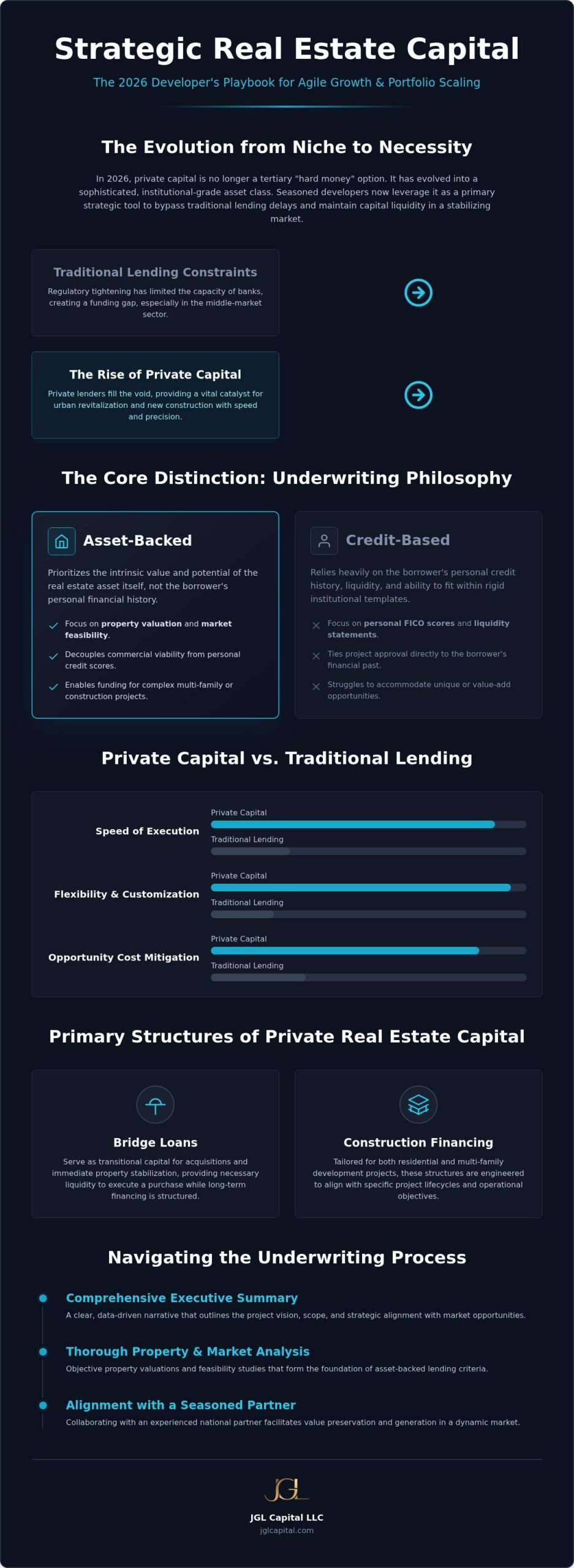
Regulatory tightening has effectively constrained the lending capacity of traditional banks, particularly within the middle-market real estate sector where the need for flexible capital is most acute. This systemic shift has created a vacuum that private capital is uniquely positioned to fill, serving as a vital catalyst for both urban revitalization and large-scale new construction projects. The strategic advantage of this model is rooted in the speed of execution. In a national market where the National Association of Realtors predicts a four percent increase in existing home sales, the ability to secure fast real estate funding is a prerequisite for capturing value before it’s bid away by slower-moving competitors. This agility allows for the following strategic benefits:
- Acceleration of acquisition timelines to meet demanding seller requirements.
- Provision of transitional capital necessary for property stabilization and repositioning.
- Mitigation of the significant opportunity costs associated with protracted institutional approval cycles.
Understanding the Asset-Backed Philosophy
The fundamental distinction of private capital lies in its underwriting methodology, which prioritizes the intrinsic value of the real estate asset over the personal financial history or liquidity of the borrower. This asset-backed philosophy ensures that capital allocation is based on the objective merits of the project, including thorough property valuations and market feasibility studies. By decoupling personal credit scores from commercial viability, private lenders provide a path forward for complex multi-family or construction projects that don’t fit the rigid templates of institutional underwriting. Asset-backed lending is the prioritization of collateral value over borrower liquidity. This approach allows for a more precise articulation of risk and reward, ensuring that capital remains available even when traditional credit markets experience volatility, thereby protecting the long-term interests of all stakeholders involved in the creation of worth.
Primary Structures of Private Real Estate Capital
The architecture of the modern capital stack requires a nuanced understanding of the various debt instruments available to the sophisticated developer. Unlike the rigid, one-size-fits-all products offered by traditional banks, private capital structures are engineered to align with specific project lifecycles and operational objectives. This strategic alignment is particularly evident in the deployment of Bridge Loans, which serve as transitional capital for acquisitions and immediate property stabilization. For those requiring fast real estate funding to capitalize on market inefficiencies, these instruments provide the necessary liquidity to execute a purchase while long-term financing is being structured. Understanding these private real estate investing fundamentals is essential for any sponsor who doesn’t want to rely on the fluctuating appetites of institutional lenders.
Beyond transitional debt, private capital encompasses a broad range of specialized solutions designed to preserve value and generate worth:
- Construction Financing: Tailored for residential and multi-family developments where traditional lenders often hesitate due to perceived risk or complexity.
- Rental Property Loans: Designed for long-term hold strategies, these products prioritize consistent cash flow and debt service coverage.
- Fix and Flip Funding: Optimized for rapid renovation and market re-entry, focusing on the after-repair value of the asset.
- Land Loans: Providing the foundational capital necessary for pre-development and site preparation.
Bridge Financing for Strategic Acquisitions
In the current market, the speed of execution is often the primary determinant of a deal’s success. Bridge financing allows sponsors to secure high-value properties while awaiting long-term institutional takeouts, effectively acting as a strategic buffer against capital illiquidity. This is especially critical in value-add multi-family investment strategies where immediate renovations are required to increase Net Operating Income. By utilizing bridge capital, developers mitigate the risk of losing a time-sensitive deal due to the protracted processing times and bureaucratic hurdles inherent in traditional bank underwriting. Accessing fast real estate funding through private channels ensures that the sponsor remains in control of the acquisition timeline rather than being subject to institutional delays.
Capital for New Construction and Development
Securing capital for new developments requires a partner who understands the complexities of the construction lifecycle. Effective construction financing involves meticulously structured draws and inspections to ensure project momentum and financial accountability. The role of a seasoned broker is indispensable here, as they facilitate the alignment of project milestones with capital availability. Integrating land loans into the initial phases of a development project further streamlines the capital stack, ensuring that the transition from site acquisition to vertical construction is seamless and well-capitalized. This disciplined approach to funding ensures that projects remain on schedule and within their projected budgetary frameworks, reinforcing a commitment to long-term growth and integrity.
Strategic Comparison: Private Capital vs. Traditional Institutional Lending
The decision to utilize private capital over traditional institutional lending is a strategic determination based on the required velocity of capital and the complexity of the underlying asset. Traditional institutions often operate within rigid frameworks that prioritize historical personal income and exhaustive credit-based underwriting, a process that frequently spans several months. In contrast, fast real estate funding through private channels is typically secured within days, allowing developers to execute on acquisitions that would otherwise be lost to more agile competitors. This disparity in execution speed is not merely an operational detail; it represents a fundamental difference in how risk is assessed and how value is perceived in a competitive 2026 market where the National Association of Realtors predicts a rise in transaction volume.
While institutional lenders rely on standardized templates, private capital providers offer customized deal structures that align with the specific needs of the project. These primary structures of private real estate capital allow for a high degree of nuance, such as interest-only periods or flexible draw schedules that mirror the project’s cash flow requirements. The underwriting focus shifts from the borrower’s personal liquidity to the project’s potential and the intrinsic value of the collateral. Consequently, the higher interest rates associated with private capital are viewed by sophisticated sponsors as a necessary investment to secure the agility required for high-stakes execution, especially when traditional credit markets remain cautious.
Evaluating the Real Cost of Capital
A thorough cost-benefit analysis reveals that the true cost of capital is not defined solely by the interest rate, but by the opportunity cost of capital illiquidity. Bank delays can lead to the forfeiture of earnest money deposits or the loss of a property poised for significant appreciation, particularly when economists are forecasting modest price growth through the remainder of 2026. Private capital often enables higher leverage in asset-backed scenarios, providing the liquidity necessary to preserve equity for other strategic initiatives. Interest rates are only one metric of a loan’s true strategic value. By prioritizing fast real estate funding, developers can secure assets at current valuations, effectively hedging against future price increases and market competition.
Complexity and Customization
Private capital excels where institutional appetite wanes, particularly regarding non-traditional property types or projects requiring complex cross-collateralization to enhance loan-to-value ratios. For developers managing multiple sites, the strategic use of new construction loans serves to bridge the critical gap between land acquisition and the completion of the finished product. This level of customization ensures that the capital structure supports the specific operational requirements of the development rather than forcing the project to conform to institutional limitations. The ability to cross-collateralize existing assets further enhances borrowing capacity, providing a disciplined path toward portfolio expansion without the need for excessive equity dilution.
Navigating the Underwriting Process for Private Capital Allocation
Navigating the underwriting process is the critical juncture where fast real estate funding transitions from a strategic objective into a tangible operational reality. This phase requires a disciplined approach to documentation and a clear articulation of the project’s long-term worth. The project executive summary serves as the foundational narrative, providing an analytical overview of the asset’s potential and the developer’s execution strategy. This document must be exhaustive, detailing market conditions, projected exit strategies, and the specific utility of the requested capital to ensure that every claim is qualified and every strategy is clearly defined.
A seasoned broker acts as a strategic ally throughout this process, leveraging intellectual capital to streamline the vetting of capital sources and ensure the alignment of objectives between the developer and the lender. Their role is to ensure that the project is presented with the necessary precision to attract the most competitive terms, effectively bridging the gap between national developers and specialized private funds. Rigorous property valuation and market feasibility studies are non-negotiable components of this evaluation. In a market where 2026 forecasts indicate modest home price appreciation of approximately 1% to 2%, the accuracy of these assessments is vital for maintaining the integrity of the capital stack, which often involves a meticulous balancing of debt, equity, and mezzanine considerations.
Preparing Your Asset for Evaluation
Asset-based loan reviews prioritize the project’s intrinsic value, yet the developer’s established history remains a vital indicator of execution capability and professional integrity. Key documentation, including detailed pro formas, site plans, and environmental assessments, must be meticulously organized to facilitate a rapid evaluation and avoid the delays typical of institutional lending. For rental property financing, the Debt Service Coverage Ratio (DSCR) serves as a primary metric, ensuring that the property’s income is sufficient to meet its debt obligations. Presenting a transparent and data-driven file doesn’t just expedite the process; it builds a sense of security for partners who value a serious and disciplined approach to value preservation.
Closing and Funding Logistics
The logistics of funding are characterized by a steady, logical progression from initial inquiry to the final disbursement of funds, often facilitating the fast real estate funding necessary to secure time-sensitive assets. Understanding the composition of points and fees is essential, as these represent a component of the total capital cost; in 2026, the industry standard for origination fees generally remains between 1.5 and 3 points. While the timeline is significantly compressed compared to institutional lending, the process remains methodical and grounded in analytical rigor. Reviewing a guide on private capital solutions provides valuable context on market-specific considerations and diverse market dynamics. To ensure your next acquisition is supported by a disciplined steward of capital, you should engage a seasoned partner for your capital needs to begin the formal allocation process.
Optimizing Your Capital Stack with JGL Capital
JGL Capital stands as a disciplined steward for national developers, leveraging over thirty years of industry expertise to navigate the complexities of the 2026 real estate market with precision. The firm functions as a seasoned, strategic partner for those who require more than just a source of capital; we provide a sophisticated framework for the preservation and creation of worth. By utilizing our established history and intellectual capital, we ensure that our partners are never constrained by the rigid limitations or the protracted timelines of traditional institutional lending. Our access to a diverse and meticulously vetted network of private capital sources allows for the delivery of highly customized solutions for projects across the country, reinforcing our position as a leader in high-stakes resource management.
The ability to secure fast real estate funding is often the primary catalyst for rapid growth among seasoned developers who recognize that timing is a critical component of value. In an environment where home price growth is forecasted to remain in the low single digits, the agility to deploy capital with precision allows for the acquisition and development of high-yield assets before market stabilization erodes the margin of opportunity. JGL Capital serves as a quiet expert, relying on analytical rigor rather than aggressive promotion to build lasting legacies for our stakeholders. This personality is defined by a sense of exclusivity and a focus on building collaborative relationships that transcend the transactional nature of the industry.
A Disciplined Approach to Value Creation
Our methodology is rooted in the belief that every financing structure must be perfectly aligned with the long-term strategic objectives of the investor. We reject speculative trends in favor of timeless principles, providing individual solutions for commercial real estate loans that address the unique requirements of each asset. By framing our activities as a high-level strategic alliance, we ensure that the transition from transitional bridge financing to long-term portfolio holds is managed with the same level of care and deliberate action that characterized the initial acquisition. This disciplined approach ensures that every project we touch is positioned for sustained performance and the generation of significant worth.
Your Next Step in Strategic Financing
Beginning the consultation process with JGL Capital involves a methodical presentation of your project’s principles and philosophies, allowing our team to conduct a thorough analysis of your specific capital needs. We maintain an unwavering commitment to transparency and analytical rigor in every deal, ensuring that every claim is qualified and every strategy is clearly defined. This patient approach to long-term objectives builds a case for our competence through precision, ensuring that your next major development is supported by a partner who values integrity above all else. Engage with JGL Capital to secure your private capital solution today.
Advancing Your Portfolio with Disciplined Capital Allocation
The transition toward a more resilient capital structure requires a rejection of transactional speed in favor of analytical precision. By prioritizing asset-backed project viability over traditional credit metrics, developers can maintain the agility necessary to thrive in a stabilizing market. This guide has articulated how the strategic use of private debt, ranging from bridge loans to complex construction financing, provides the liquidity required to capitalize on time-sensitive opportunities without the typical institutional delays that characterize 2026 lending. Success in this environment is predicated on the alignment of financing structures with long-term strategic objectives and the rejection of speculative trends.
As you navigate the evolving market dynamics, the ability to secure fast real estate funding through a disciplined steward of capital becomes a decisive advantage. JGL Capital offers over 30 years of strategic industry expertise and national coverage for both commercial and residential developments, ensuring that every allocation is grounded in rigorous valuation and the preservation of worth. Secure your next project with JGL Capital’s strategic private financing solutions. Aligning your vision with a partner who values integrity and deliberate action ensures that your legacy remains positioned for steady, sustainable growth.
Frequently Asked Questions
What is the primary difference between private capital and traditional bank financing?
The primary distinction lies in the underwriting methodology and the velocity of capital deployment. Traditional institutions prioritize historical personal income and rigid credit templates, whereas private capital focuses on the intrinsic value of the real estate asset. This shift in focus allows for a more flexible capital structure that can be customized to the specific requirements of a project rather than being constrained by institutional bureaucracy.
How quickly can I expect a private capital loan to be funded for a real estate project?
Private capital is typically deployed within several business days following the completion of a streamlined asset evaluation. This speed of execution provides a decisive advantage in competitive markets where delays often result in lost opportunities. By bypassing the protracted approval cycles inherent in institutional lending, developers can secure fast real estate funding to meet demanding closing deadlines and maintain project momentum.
Does private capital for real estate require a high personal credit score?
Private capital doesn’t strictly require a high personal credit score because the underwriting is fundamentally asset-backed. While a borrower’s experience is considered to instill trust, the primary collateral remains the property’s valuation and its projected performance. This approach allows sophisticated investors to access capital based on the objective merits of a commercial or residential development rather than being penalized for non-traditional financial profiles.
What are the typical interest rates for private money bridge loans in 2026?
In 2026, interest rates for private money bridge loans generally range from 9% to 12% for experienced residential borrowers and between 9% and 14% for commercial assets. These rates reflect the risk-adjusted nature of transitional capital and the premium placed on liquidity. While higher than conventional mortgage rates, which averaged around 6.55% in July 2026, the strategic agility provided by these loans often offsets the increased cost of capital.
Can private capital be used for new construction and multi-family developments?
Private capital is an ideal instrument for both new construction and multi-family developments where traditional bank appetite’s often limited. These loans are structured to support the entire project lifecycle, from initial land acquisition to vertical construction and final stabilization. By providing tailored draw schedules and flexible terms, private lenders ensure that developers have the necessary capital to preserve value and generate worth throughout the development process.
What is an asset-backed loan and how does it benefit a real estate investor?
An asset-backed loan is a financing structure that prioritizes the value of the real estate collateral over the borrower’s personal liquidity or cash flow. This methodology benefits investors by decoupling the viability of a project from their individual financial history, allowing for higher leverage and more creative deal structures. It ensures that capital remains available for high-potential assets that might not meet the rigid income requirements of institutional lenders.
Are there specific property types that private capital lenders prefer to fund?
Private lenders typically favor property types with strong value-add potential or clear exit strategies, such as multi-family units, new construction residential projects, and commercial assets. These properties provide the tangible collateral necessary for asset-based underwriting. By focusing on assets with predictable market demand, lenders can provide fast real estate funding that aligns with the developer’s long-term objectives for portfolio expansion and value creation.
How does a private capital broker like JGL Capital add value to a transaction?
A seasoned broker like JGL Capital adds value by serving as a strategic ally who aligns your project’s needs with a vast national network of capital sources. With over thirty years of industry expertise, we provide the analytical rigor necessary to navigate complex transactions and secure competitive terms. This collaborative relationship ensures that your financing is treated as a high-level strategic alliance rather than a simple transactional service.