

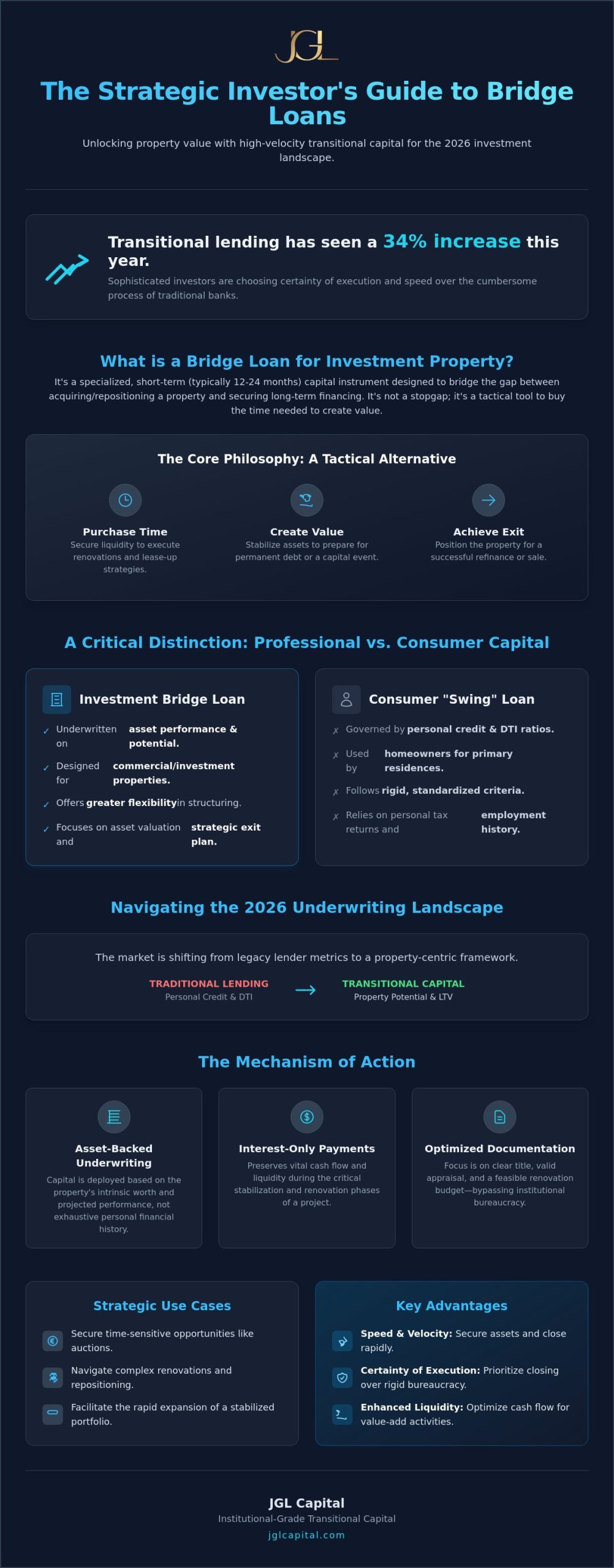
While many market participants view transitional financing as a secondary alternative, the reality of the 2026 fiscal environment suggests that a bridge loan for investment property is the premier tool for the disciplined acquisition of high-value assets. With transitional lending experiencing a 34 percent increase this year, it’s clear that sophisticated investors are prioritizing the certainty of execution over the cumbersome requirements of traditional banking institutions. You understand that the primary obstacle to portfolio growth is often the rigid underwriting of legacy lenders who prioritize personal credit metrics over the latent value of a commercial or residential asset.
This article provides a rigorous analysis of how tactical bridge financing enables you to secure time-sensitive opportunities and navigate complex renovations without the delays of institutional bureaucracy. You’ll discover how to leverage property potential to achieve rapid closings and maintain the liquidity necessary for successful stabilization. We will detail the strategic application of these capital structures, from managing the current interest rate environment to defining the precise exit strategies that preserve long-term wealth and ensure the alignment of your investment objectives.
Key Takeaways
- Differentiate professional transitional capital from consumer-grade financing to align your strategy with the rigorous demands of the 2026 investment landscape.
- Evaluate the shift toward property-centric underwriting where latent income potential and Loan-to-Value ratios supersede the rigid personal credit requirements of traditional lenders.
- Discover how a bridge loan for investment property serves as a high-velocity instrument for securing assets at auction or facilitating the expansion of a stabilized portfolio.
- Examine the role of interest-only payment structures in optimizing cash flow and maintaining institutional-grade liquidity during the property repositioning process.
- Identify the advantages of collaborating with a seasoned steward who offers over three decades of analytical expertise and a national reach across diverse asset classes.
Defining the Bridge Loan for Investment Property as a Strategic Asset
A bridge loan, in the context of sophisticated real estate management, represents a specialized form of transitional capital designed to facilitate the acquisition or repositioning of an asset before long-term financing is secured. These instruments typically carry a duration of 12 to 24 months, functioning as a pivot point within a broader investment strategy. Professional investors recognize that a bridge loan for investment property isn’t merely a stopgap but a deliberate tactical choice. It prioritizes speed and certainty of execution in markets where traditional institutional underwriting often fails to meet the requirements of time-sensitive transactions.
The Core Philosophy of Transitional Capital
This capital structure serves as the essential link between the initial acquisition of a distressed or underperforming asset and its eventual stabilization. In the lifecycle of a high-stakes project, the bridge loan provides the necessary liquidity to execute renovations or lease-up strategies that prepare the property for permanent debt or a capital event. Fundamentally, bridge financing for investment properties serves as a tactical alternative to traditional long-term mortgages, providing the necessary agility to execute complex value-add strategies. By utilizing this tool, you aren’t just borrowing funds; you’re purchasing the time required to create value. It’s a disciplined approach to managing time-sensitive opportunities that would otherwise be lost to the slow, bureaucratic processes of conventional banking.
Investment vs. Owner-Occupied: A Critical Distinction
It’s vital to distinguish these professional instruments from consumer-facing “swing loans” used by homeowners. While consumer products are governed by rigid debt-to-income ratios and personal credit metrics, a bridge loan for investment property is strictly underwritten based on the asset’s performance and future potential. These commercial-purpose loans fall outside the regulatory framework of owner-occupied residential mortgages, allowing for greater flexibility in structuring. You don’t need to rely on personal income statements when the asset itself provides the requisite security. The primary underwriting pillar is the asset-backed valuation, ensuring that capital is deployed based on analytical rigor and strategic alignment rather than the standardized criteria of the retail lending market. This distinction allows for a focus on the property’s ability to generate worth, rather than the borrower’s personal tax returns or employment history.
The Mechanism of Action: How Investment Bridge Loans Function
Understanding the operational mechanics of a bridge loan for investment property requires a shift in perspective from traditional retail lending toward a more analytical, asset-centric framework. While institutional banks often demand exhaustive documentation of personal income and historical tax returns, transitional capital providers focus on the underlying value and the strategic viability of the exit plan. This streamlined approach allows for the deployment of capital based on the property’s merits, which is essential for professional investors who must act with precision in a competitive marketplace. Private capital serves as a critical reservoir of liquidity during periods of institutional constraint, offering a disciplined alternative to the rigid structures of the conventional banking sector.
The structural advantage of these loans lies in their interest-only payment schedules. By requiring only the interest portion of the debt during the loan’s term, these instruments preserve an investor’s cash flow during the critical phases of property stabilization or renovation. This liquidity is vital for maintaining the momentum of a project, ensuring that capital remains available for operational needs rather than being tied up in principal reduction. The documentation requirements are similarly optimized, focusing on the clarity of the title, the validity of the appraisal, and the feasibility of the renovation budget, rather than the exhaustive personal financial history required by legacy institutions.
Asset-Backed Underwriting Frameworks
The underwriting process prioritizes the property’s intrinsic worth and its projected performance post-stabilization. Lenders evaluate the “as-is” value to determine initial risk, but they also carefully analyze the “after-repair value” (ARV) for projects involving significant capital improvements. This dual-layered analysis ensures that the financing aligns with the investor’s objective of value creation. By emphasizing private capital allocation strategies, investors can access funding that is inherently more responsive to the nuances of specific real estate markets than standardized bank products. This focus on the asset allows for a more flexible evaluation of risk, where the property’s potential serves as the primary security for the debt.
Loan Terms and Structural Qualities
Most transitional structures offer durations ranging from 12 to 24 months, often including extension options to accommodate unforeseen delays in construction or stabilization. A hallmark of these professional instruments is the absence of pre-payment penalties, a feature that allows for an early exit once the property is ready for refinancing or sale. Investors who understand how bridge loans work recognize that this flexibility is a vital component of a successful exit strategy. While origination fees and processing costs are standard components of the fee structure, they’re balanced by the speed and flexibility that these loans afford. For those seeking to optimize their portfolio’s performance, partnering with a firm that understands the gravity of strategic capital deployment ensures that every financial decision is grounded in analytical rigor.
Strategic Use Cases: Beyond Simple Acquisition
In the high-stakes environment of property auctions or foreclosure proceedings, the capacity for rapid capital deployment is the primary determinant of success. Traditional institutional lenders, burdened by exhaustive underwriting cycles, are often unable to meet the compressed timelines required in these competitive arenas. A bridge loan for investment property provides the necessary velocity to secure assets that would otherwise be inaccessible, allowing you to capitalize on market inefficiencies. This strategic agility is equally vital for investors navigating the strict IRS timelines of a 1031 exchange, where the failure to identify and secure a replacement property within 45 days can result in significant tax liabilities. By utilizing transitional debt, you ensure that capital is available precisely when the opportunity arises, regardless of the property’s current state of stabilization.
The BRRRR Method and Portfolio Expansion
The Buy, Rehab, Rent, Refinance, Repeat (BRRRR) methodology relies on the efficient recycling of capital, a process where the bridge loan for investment property serves as the initial catalyst. During the acquisition and intensive rehabilitation phases, the bridge structure provides the necessary funding to transform a distressed asset into a high-performing one. Once the property is stabilized and generating consistent cash flow, the investor can transition from high-velocity transitional debt into long-term rental property loans. This methodical approach allows for the preservation of liquidity, as the initial capital is recovered through the refinance event and redeployed into the next acquisition, facilitating aggressive yet disciplined portfolio scaling.
Commercial Asset Stabilization
For commercial real estate professionals, bridge financing is an indispensable tool for executing value-add strategies on underperforming assets. Distressed multi-family or retail properties often fail to meet the Debt Service Coverage Ratio (DSCR) requirements demanded by permanent lenders, creating a financing gap that transitional capital is uniquely positioned to fill. “Lease-up” bridge loans provide the runway needed to improve occupancy rates and optimize operational expenses before the asset is seasoned enough for traditional financing. This phase of stabilization acts as a critical precursor to securing institutional-grade commercial real estate loans. By addressing the property’s immediate capital needs and operational deficiencies, you create a path toward long-term value preservation and predictable yields, ensuring that the asset eventually qualifies for the most favorable permanent debt structures available in the market.
Navigating the 2026 Underwriting Landscape
Professional investors often scrutinize the interest rate spread between bridge financing and permanent debt. While bridge loan interest rates for investment properties in 2026 typically range from 8 percent to 14.5 percent, this spread represents the cost of agility and the removal of institutional friction. Unlike traditional residential mortgages that rely heavily on debt-to-income (DTI) ratios, a bridge loan for investment property is evaluated through the lens of the asset’s latent value. The lender’s primary concern isn’t your personal tax return or debt load but the property’s ability to support the debt and facilitate a successful exit. For developers, a proven track record of successful completions often serves as the most potent form of leverage, allowing for higher loan-to-value allocations based on historical performance rather than just personal creditworthiness.
The Primacy of the Exit Strategy
A professional bridge lender prioritizes the exit strategy above almost all other variables. Whether you intend to sell the asset after stabilization or refinance into permanent debt, the path must be clear and supported by current market data. This clarity mitigates the inherent risk of short-term capital, ensuring that the transition to permanent financing is seamless. A robust loan request package should include the following elements to demonstrate analytical rigor:
- An executive summary detailing the investment thesis and project scope.
- A comprehensive renovation budget with a defined timeline for completion.
- A specific exit plan supported by recent comparable sales or rental market data.
- A professional resume or project list highlighting relevant real estate experience.
Credit Score vs. Collateral Quality
In the transitional space, credit history is viewed as a character check rather than a primary disqualifier. While a baseline score is often required to establish financial responsibility, the focus remains on the collateral’s quality and its liquidity in the current market. This approach is detailed further in our strategic guide to transitional real estate capital, which emphasizes risk mitigation through asset-backed security. When the underlying asset is strong, the borrower’s personal financial nuances become secondary to the project’s viability. This shift in underwriting allows you to secure funding based on the property’s potential to generate worth, rather than the restrictive standards of the retail banking sector. If you’re seeking a partner who values property potential over personal tax returns, you can consult with our transitional capital specialists to discuss your project’s specific requirements.
The JGL Capital Advantage: Institutional-Grade Transitional Capital
JGL Capital LLC serves as a disciplined partner for sophisticated investors who require the analytical rigor of a seasoned steward. In a market where speed is often conflated with a lack of discipline, the firm provides a streamlined alternative to traditional bank lending that prioritizes property-specific value over personal credit metrics. With over 30 years of industry veteran experience, the firm understands the complexities of high-stakes real estate management, offering a bridge loan for investment property that aligns perfectly with your long-term strategic objectives. This alignment ensures that every capital allocation is executed with precision, providing the stability necessary for the creation and preservation of value across national markets. By focusing on the generation of worth through collaborative relationships, the firm distinguishes itself as a knowledgeable entity that rejects speculative trends in favor of timeless principles.
The institutional value of this partnership is reflected in the delivery of highly customized, individual solutions that address the specific needs of each asset. Whether you’re managing residential, multi-family, or new construction projects, the firm’s national reach provides a robust platform for the execution of complex acquisition and stabilization strategies. This strategic approach allows for the optimization of portfolio liquidity without the friction inherent in legacy banking institutions. The firm’s commitment to integrity and long-term growth ensures that your interests are protected, fostering a sense of security that is grounded in a serious and disciplined approach to capital management.
A Legacy of Strategic Stewardship
The value of working with industry veterans lies in their deep-seated expertise and ability to navigate diverse market cycles with composure. JGL Capital prioritizes the cultivation of long-term strategic alliances over simple transactional volume, recognizing that the preservation of capital requires a collaborative approach to resource management. The firm’s intellectual capital is deployed to handle complex, high-stakes commercial deals nationally, ensuring that every claim is qualified and every strategy is clearly defined. By framing its activities as a form of high-level strategic alliance rather than simple service provision, the brand carves out a distinct identity as a collaborative and deeply invested ally. This dedication to excellence allows for the precise articulation of core philosophies and the successful delivery of performance metrics that meet the expectations of high-net-worth stakeholders.
Initiating the Strategic Alliance
The process of securing a bridge loan for investment property with JGL Capital is designed to be as friction-free and professional as the sophisticated assets it finances. Investors are invited to submit their projects for evaluation through a disciplined intake process that emphasizes confidentiality and professional discretion. This methodical approach ensures that all necessary nuances are considered before capital is deployed. To initiate a professional consultation and explore how our transitional capital solutions can optimize your portfolio’s liquidity, you’re encouraged to submit your project details for a thorough analysis. By choosing a partner that relies on its established history and Intellectual capital, you ensure that your investment legacy is managed with the gravity and precision it deserves.
Executing Your 2026 Portfolio Strategy with Precision
The contemporary real estate environment demands a level of agility that traditional institutional lenders often fail to provide; therefore, the strategic application of a bridge loan for investment property has become a necessity for the disciplined investor. You’ve explored how these transitional capital structures prioritize the intrinsic value of the asset over personal credit history, allowing for the rapid execution of acquisition and stabilization strategies. By maintaining a clear focus on the exit strategy and property-level potential, you ensure that your portfolio remains liquid and responsive to time-sensitive opportunities.
JGL Capital offers the stability and deep-seated expertise required to navigate high-stakes transactions with institutional confidence. With more than 30 years of industry experience and a national reach that encompasses residential and multi-family projects, the firm acts as a seasoned steward of your strategic objectives. It’s essential to partner with an organization that values analytical rigor and the preservation of long-term worth. Secure Institutional-Grade Transitional Capital with JGL Capital and begin the process of building a lasting legacy through deliberate, asset-backed action. Your vision for portfolio expansion deserves a partner that is as invested in the outcome as you are.
Frequently Asked Questions
What is the typical interest rate for a bridge loan on an investment property in 2026?
Interest rates for a bridge loan for investment property typically range between 8 percent and 14.5 percent in the current fiscal environment. These rates are influenced by the specific asset class, the loan-to-value ratio, and the borrower’s historical performance. While these rates exceed those of permanent debt, they reflect the significant liquidity and execution speed that transitional capital provides to professional investors.
How quickly can a bridge loan be funded compared to a traditional mortgage?
Bridge financing can generally be secured within two to three weeks; whereas, traditional institutional mortgages often require forty-five to sixty days for completion. This expedited timeline results from streamlined underwriting that prioritizes asset valuation over the exhaustive personal financial audits required by legacy banks. Such velocity is essential for securing time-sensitive assets at auction or meeting strict 1031 exchange deadlines.
Are bridge loans available for new construction or only for existing properties?
Bridge loans are available for both existing properties and new construction projects. For existing assets, they facilitate acquisition and stabilization; for new developments, they provide the necessary capital for the construction phase before permanent financing is viable. This versatility makes them a fundamental tool for developers who must manage complex project lifecycles and maintain steady capital flow.
What are the primary requirements for securing an asset-based bridge loan?
The primary requirements for securing an asset-based bridge loan include a professional appraisal of the property, a clearly articulated exit strategy, and a viable renovation or stabilization budget. While personal credit is reviewed as a character check, the underlying collateral’s quality serves as the primary security for the debt. Lenders focus on the loan-to-value ratio to ensure the alignment of risk and capital.
Can I use a bridge loan for a multi-family property stabilization?
You can utilize a bridge loan for multi-family property stabilization to fund improvements or lease-up phases. These instruments are specifically designed for “value-add” projects where the asset’s current occupancy does not yet meet institutional debt service coverage requirements. Once the property reaches stabilization, it can be refinanced into long-term commercial debt structures that preserve the created value.
What happens if I cannot refinance or sell before the bridge loan term expires?
If a project’s exit path is delayed, professional lenders often provide extension options for an additional fee, provided the project remains viable. It’s critical to maintain transparent communication with your capital partner to negotiate these terms before the initial maturity date. Failure to refinance or sell without an extension can lead to default or the initiation of foreclosure proceedings to protect the lender’s interest.
Is a personal guarantee required for investment property bridge financing?
Most transitional capital structures require a personal guarantee, although some non-recourse options may exist for seasoned sponsors with significant equity. This guarantee ensures that the borrower remains committed to the project’s success and the execution of the stated exit strategy. The specific recourse requirements are typically determined by the loan-to-value ratio and the overall complexity of the asset being financed.
How does the Loan-to-Value (LTV) ratio affect my bridge loan terms?
The loan-to-value ratio directly influences the interest rate and the required equity contribution for a bridge loan for investment property. Lower LTV ratios, typically around 65 percent, often command more favorable interest rates due to the reduced risk profile for the lender. Conversely, higher leverage requests may result in more stringent underwriting or higher origination fees to balance the increased capital exposure.