

The preservation of momentum in high-stakes real estate acquisition requires a departure from the restrictive frameworks of traditional retail banking. While conventional financing remains a standard for the uninitiated, the seasoned investor recognizes that rigid credit requirements and bureaucratic delays often result in the forfeiture of prime opportunities. You’ve likely experienced the frustration of watching a meticulously analyzed deal dissolve because a traditional institution couldn’t match the pace of the market. This recognition of systemic inefficiency is the first step toward a more disciplined approach to asset-based growth.
This strategic guide explores how sophisticated operators leverage institutional private money for real estate investing to optimize capital allocation and scale their portfolios with surgical precision. By aligning with a partner who prioritizes the intrinsic value of the asset over the limitations of a balance sheet, you can secure the liquidity necessary for complex multi-family or new construction projects. We’ll analyze the mechanics of institutional-grade deal structures and demonstrate how a long-term financial alliance provides the stability required to build a lasting legacy in an increasingly competitive landscape. Our analysis will move through the specific operational strengths of bridge and rental property capital, ensuring your strategy remains grounded in analytical rigor.
Key Takeaways
- Understand how the transition toward institutional asset-backed evaluation enables the acquisition of high-value assets without the constraints of traditional banking metrics.
- Discover the tactical deployment of bridge and hard money solutions to facilitate rapid property stabilization and capitalize on value-add opportunities.
- Examine why institutional private money for real estate investing offers superior scalability and security compared to fragmented seller-led financing arrangements.
- Identify the optimal loan-to-value structures and cash-out refinance strategies required to maintain aggressive portfolio growth and capital liquidity.
- Recognize the advantages of aligning with a disciplined partner to ensure the precise allocation of capital across diverse commercial and multi-family asset classes.
The Evolution of Private Money for Real Estate Investing: An Institutional Perspective
Creative financing represents a fundamental departure from the standardized protocols of conventional depository institutions. It isn’t merely a tactical workaround for capital deficiencies; instead, it’s a sophisticated mechanism for achieving capital efficiency at scale. Sophisticated developers understand that traditional mortgage frameworks often stifle rapid portfolio expansion by prioritizing personal debt-to-income ratios over the economic viability of the specific project. Broadly defined, creative financing techniques encompass a range of non-traditional methods designed to bypass these structural limitations and provide a more agile path to acquisition.
The Institutional Shift Toward Private Money
Creative Financing vs. Traditional Lending
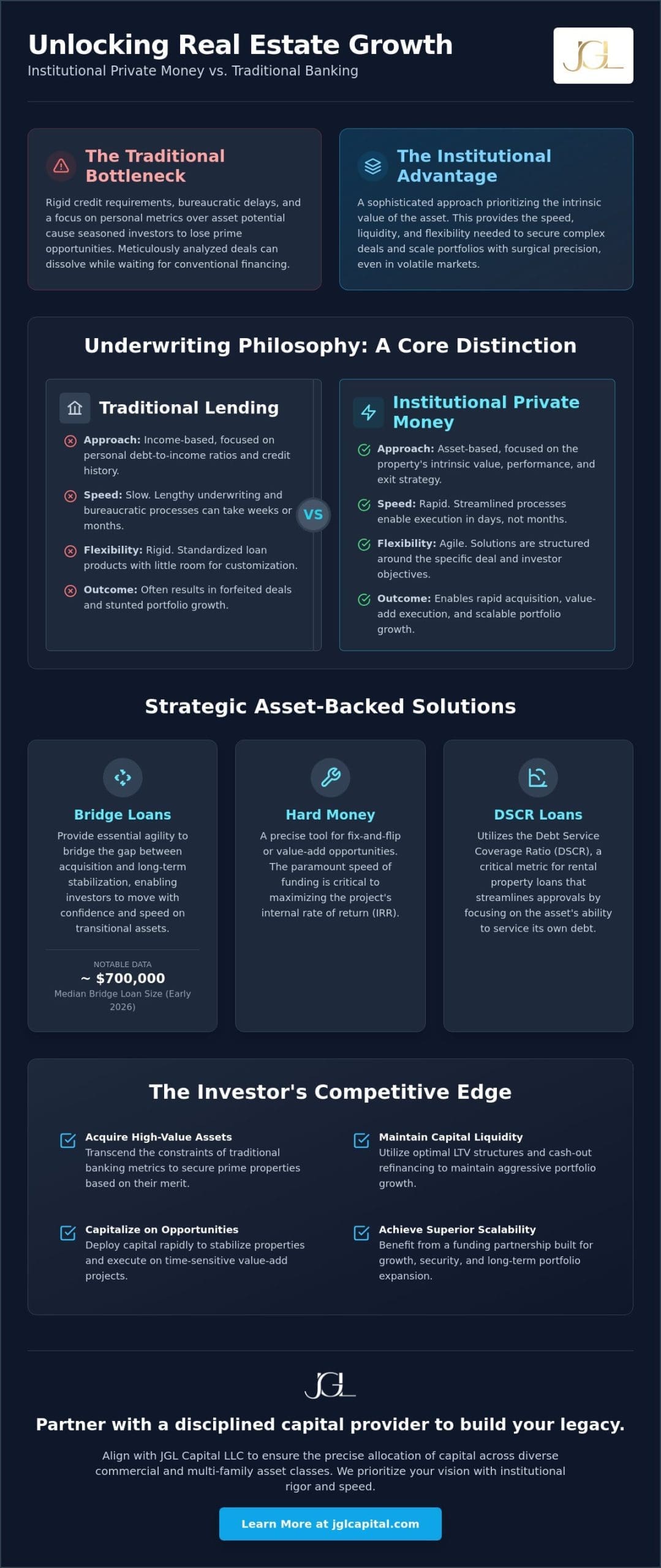
The core distinction between these two models lies in their underlying underwriting philosophies. Traditional lenders utilize an income-based approach that is often too slow for the demands of high-stakes management. In contrast, institutional private money for real estate investing employs an asset-based philosophy that focuses on the project’s merit and exit strategy. This institutional rigor doesn’t sacrifice precision for speed; it enhances both through specialized technical terminology and performance metrics. Investors in 2026 prioritize this flexibility over the perceived safety of long-term interest rate locking. They recognize that the ability to pivot and restructure is far more valuable in a dynamic economic environment than a rigid, 30-year commitment.
Strategic Asset-Backed Solutions: Navigating Bridge and Hard Money Frameworks
The tactical deployment of capital in the current market necessitates a granular understanding of asset-backed frameworks. While traditional institutions remain focused on historical borrower data, institutional private money for real estate investing prioritizes the intrinsic value and future performance of the property itself. This shift allows for the utilization of hard money as a precise tool for fix-and-flip or value-add opportunities, where the speed of funding is paramount to the project’s internal rate of return. For more complex commercial assets, the Debt Service Coverage Ratio (DSCR) has emerged as a critical metric, streamlining approvals by focusing on the asset’s ability to service its own debt. This methodology is particularly effective for rental property loans, where the median loan size for bridge financing reached just under $700,000 in early 2026.
Maximizing ROI with Bridge Financing
Professional investors often require a sophisticated mechanism to cover the temporal gap between an initial acquisition and the securing of permanent financing. Understanding what is a bridge loan is essential for those who manage transitional assets that aren’t yet ready for long-term institutional debt. Unlike the more restrictive nature of seller-led creative financing, which often lacks the scalability required for institutional-grade portfolios, professional bridge structures provide a reliable foundation for a diverse capital stack. Success in this arena is predicated on a clearly defined exit strategy, ensuring that the liquidity event is both predictable and well-timed. For those seeking to optimize their current holdings, a strategic capital partnership can provide the necessary leverage for rapid portfolio expansion.
New Construction and Development Capital
The complexities of ground-up development require a specialized form of capital that traditional banks often struggle to provide with the necessary speed. Navigating new construction loans involves a rigorous oversight process, including meticulous draw schedules and frequent site inspections to mitigate risk. Private money brokers offer a distinct advantage here, providing tailored development solutions that align with the specific operational milestones of a residential or multi-family project. This level of customization ensures that developers aren’t hindered by the generic constraints of commercial banking. By utilizing a steady flow of resources, builders can maintain momentum even in complex development cycles, reinforcing their position as leaders in their respective markets.
Institutional Private Capital vs. Seller-Led Creative Financing Strategies
Seller Financing and Lease Options
The mechanics of the Master Lease with Option to Buy remain a specialized tool for commercial acquisitions, allowing an investor to control an asset’s cash flow before the final transfer of title. However, as we analyze the 2026 market, the reliability of these individual Creative Financing Techniques is often secondary to the certainty provided by professional capital sources. For developers focused on high-growth regions, these individual strategies are frequently viewed as supplementary to the robust funding provided by hard money lenders florida. Professional scaling requires a level of liquidity and institutional rigor that seller-led notes simply cannot replicate at the volume required for modern portfolio management.
The Role of the Private Money Broker
Structuring Sophisticated Transactions for Maximum Capital Efficiency
Identifying the precise loan-to-value (LTV) threshold is a fundamental exercise in risk management and capital velocity. While conservative leverage might offer psychological comfort, the seasoned operator utilizes institutional private money for real estate investing to maintain a more aggressive growth trajectory. By executing disciplined cash-out refinances, investors can recycle equity from stabilized assets to fund subsequent high-value acquisitions. This cycle of reinvestment relies on a partnership with a firm like JGL Capital LLC, where asset-backed underwriting ensures that each layer of debt is sustainable and aligned with long-term performance metrics. Such a methodical approach allows for the expansion of holdings without the constant depletion of personal cash reserves.
Cross-collateralization serves as a secondary mechanism for enhancing capital efficiency within multi-property portfolios. By securing a single lien across several assets, developers often unlock more favorable terms or higher leverage than standalone financing would permit. This approach requires meticulous oversight to ensure risk is properly distributed, a process that’s significantly enhanced when working with the quiet expertise found at JGL Capital LLC. The objective remains the preservation of value through the deliberate synchronization of debt and equity across the entire portfolio.
The Capital Stack: Layering Creative Solutions
Complex acquisitions often require the layering of bridge debt with mezzanine or preferred equity to achieve the desired capital structure. Structuring commercial real estate loans for maximum efficiency involves analyzing how these different tiers interact during the stabilization phase. Maintaining liquidity while executing heavy value-add strategies ensures that transitional assets aren’t stalled by capital shortages, allowing for a seamless progression toward permanent financing or disposition. This analytical rigor prevents the over-leveraging of individual projects while maximizing the potential for institutional-grade returns.
Portfolio Scaling Strategies
High-velocity tools, such as fix and flip loans florida, provide the initial equity growth necessary for larger-scale endeavors. As developers mature, they often transition from residential flipping to the more stable cash flows of multi-family and commercial development. This evolution reflects a shift from transactional gains to the creation of lasting legacies through asset management. Capital efficiency in the context of private money by mid-2026 is defined as the strategic synchronization of debt maturity with asset stabilization to maximize equity velocity while maintaining the integrity of the core portfolio.
The JGL Capital LLC Advantage: Partnering for Strategic Capital Allocation
The operational framework at JGL Capital LLC ensures that the processing of Fix and Flip Loans, Bridge Loans, and New Construction Loans is conducted with institutional-grade speed. This efficiency is a byproduct of a serious, disciplined approach to value creation. We prioritize the generation of lasting legacies, viewing our role as a strategic ally rather than a simple service provider. This perspective distinguishes JGL Capital LLC from more transactional competitors, reinforcing our identity as a collaborative and deeply invested ally in your financial journey.
Customized Solutions for Complex Transactions
Engaging with Institutional Expertise
Moving from initial deal analysis to a fully funded transaction with JGL Capital LLC is a cumulative and logical process. Our commitment to responsibility and the generation of worth serves as a linguistic and operational signature. We focus on the alignment of objectives, ensuring that every strategic alliance is built on a foundation of trust and security. Analytical rigor isn’t just a metric; it’s the cornerstone of our stewardship. Inquire about your next strategic capital allocation with JGL Capital LLC to experience a partnership defined by stability and deep-seated expertise.
Orchestrating Long-Term Worth with Disciplined Capital
Your commitment to analytical rigor deserves a partner that reflects the same gravity of high-stakes management. With over 30 years of industry expertise and a focus on highly customized solutions across a national network, JGL Capital LLC stands ready to facilitate your next high-value acquisition. We invite you to Secure Your Strategic Capital with JGL Capital LLC and transition into a collaborative relationship grounded in intellectual capital and stability. The future of your portfolio is a product of the deliberate actions you take today; let those actions be supported by a partner invested in your enduring success.
Frequently Asked Questions
Is creative financing legal for institutional real estate investors?
Creative financing is entirely legal when conducted through established institutional frameworks that adhere to federal and state regulatory requirements. Sophisticated investors utilize these structures to ensure full compliance with anti-money laundering policies and disclosure mandates, providing a secure environment for high-stakes capital allocation. By maintaining a disciplined approach to documentation and legal review, partners can leverage non-traditional funding sources while preserving the integrity of their professional portfolios.
How does a bridge loan differ from a traditional commercial mortgage?
The primary distinction lies in the temporal nature and the underlying underwriting philosophy of the two instruments. Bridge loans are transitional, short-term vehicles designed to facilitate rapid acquisition and stabilization, whereas traditional commercial mortgages are long-term obligations predicated on historical cash flow and borrower credit. While a traditional mortgage provides permanent debt, the bridge structure offers the agility required to reposition an asset before seeking institutional stabilization.
Can I use creative financing for new construction projects in 2026?
Institutional capital for new construction remains a cornerstone of development strategies as we progress through 2026. Private lenders utilize asset-backed draw schedules and rigorous site inspections to fund ground-up builds that traditional depository institutions often find too complex or speculative. This approach ensures that developers maintain the necessary liquidity to execute their vision without the bureaucratic delays inherent in conventional construction lending.
What is the primary advantage of working with a private money broker?
A private money broker functions as a strategic ally by providing access to a national network of diverse capital sources that extend beyond the reach of a single lender. This partnership allows for the alignment of investor objectives with the precise financial vehicle required for a specific asset class. By leveraging a broker’s intellectual capital, sophisticated operators can secure deal structures that are optimized for both capital efficiency and long-term worth.
How much capital is typically required for an asset-backed bridge loan?
Institutional lenders typically require an equity stake or down payment representing 20% to 35% of the property’s appraised value or purchase price. The precise capital requirement is determined by the Loan-to-Value (LTV) ratio and the analytical rigor applied to the project’s projected performance metrics. This ensures that the investor maintains a significant interest in the asset’s success while leveraging private money for real estate investing to maximize their overall return.
What happens if I need to exit a creative financing deal early?
Can multi-family properties be funded through creative hard money?
Multi-family assets are frequently funded through hard money or bridge structures, particularly when the project involves acquisition, renovation, or stabilization phases. This methodology allows investors to enhance the property’s value and improve the Debt Service Coverage Ratio (DSCR) before seeking long-term institutional financing. Utilizing private money for real estate investing in the multi-family sector provides the flexibility needed to execute complex value-add strategies at scale.
Is seller financing better than institutional private money?
While seller financing may provide a temporary solution for single-asset transactions, institutional private money offers superior scalability and legal stability for professional developers. Seller-led notes are often limited by the individual’s liquidity and lack the standardized rigor found in institutional-grade debt. For those focused on building lasting legacies through multi-property portfolios, the stability and reliability of a professional capital partner are typically the more prudent choice.