

A construction loan draw inspection is not merely an administrative formality; it represents a critical strategic mechanism for the preservation of project equity and the disciplined deployment of capital. When documentation lacks precision or site progress fails to align with reported benchmarks, the resulting funding delays can jeopardize the stability of the entire development. Utilizing a rigorous construction loan draw inspection checklist is essential for developers who seek to eliminate the friction of unexpected overfunding risks or the frustration of incomplete disbursements.
It’s understandable that you view these inspections as high-stakes touchpoints where technical accuracy meets fiduciary responsibility. This article provides a sophisticated framework to help you master the draw process and ensure that capital flows remain uninterrupted. We’ll examine the specific requirements for 2026, including the impact of the 2025 California Building Standards Code, and provide a clear roadmap for aligning builder reports with lender expectations to protect your project’s long-term value.
Key Takeaways
- Understand the strategic role of inspections in preserving collateral value and maintaining capital stewardship throughout the project lifecycle.
- Execute a rigorous construction loan draw inspection checklist that encompasses critical phases such as site preparation and substructure integrity.
- Implement disciplined operational protocols by utilizing a precise Schedule of Values to ensure reporting accuracy and timely disbursements.
- Mitigate the risk of funding denials by identifying common causes for discrepancies and establishing clear resolution strategies with site inspectors.
- Leverage specialized expertise in construction financing to align development objectives with institutional expectations for seamless project execution.
The Strategic Role of Draw Inspections in Capital Stewardship
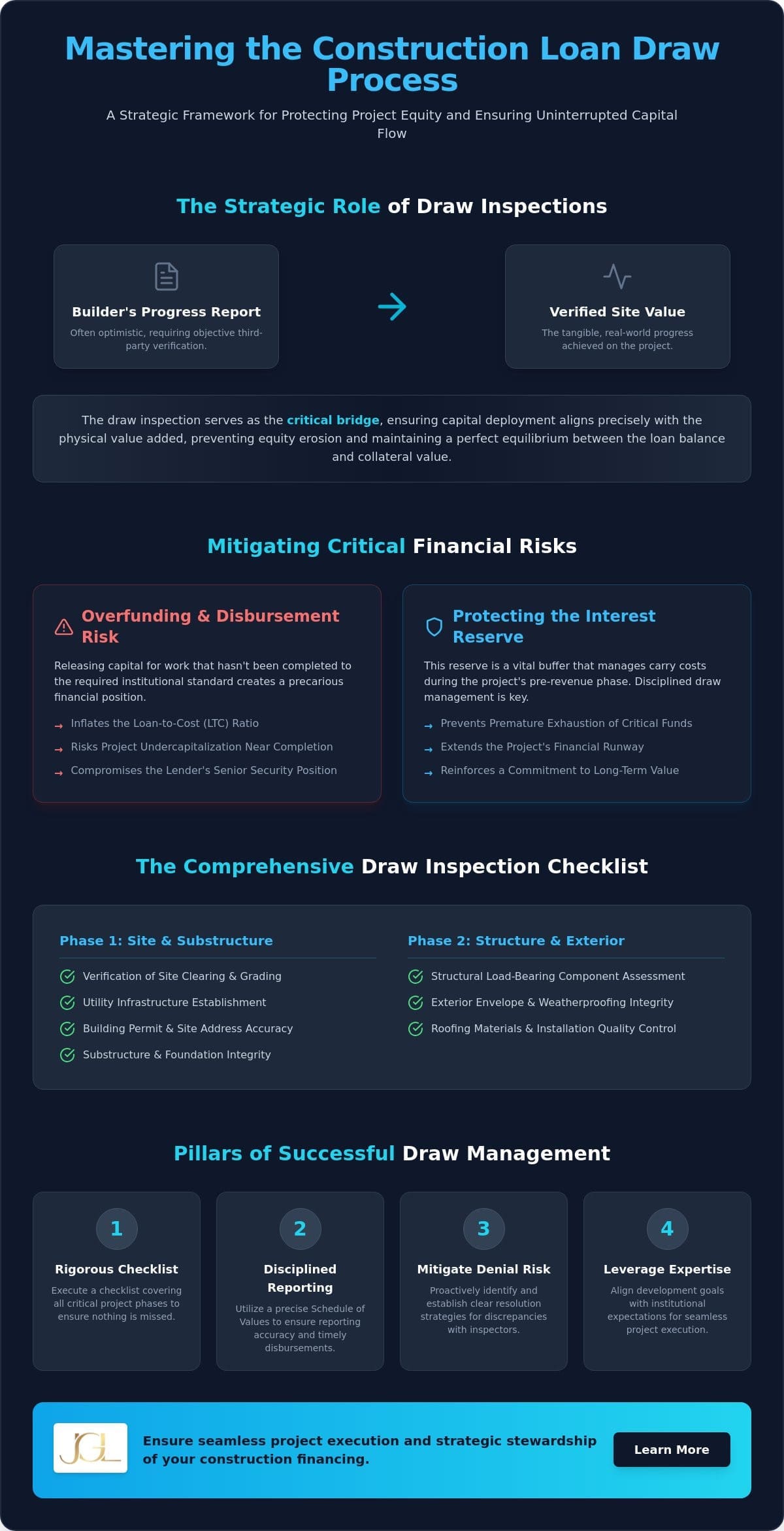
A draw inspection serves as a rigorous, third-party verification of project milestones, ensuring that the capital deployed aligns precisely with the physical value added to the site. This process is a cornerstone of professional Construction management, where the objective is to maintain a perfect equilibrium between the loan balance and the collateral’s market value. By employing a comprehensive construction loan draw inspection checklist, developers can bridge the inherent information gap that often exists between a builder’s optimistic progress reports and the objective reality of the job site. This oversight prevents the erosion of equity and ensures that every dollar disbursed translates into a tangible advancement of the project’s completion status.
The strategic oversight provided by these inspections acts as a safeguard against the dilution of project integrity. Without a disciplined verification protocol, a developer risks misaligning their financial resources with the project’s physical timeline. This misalignment doesn’t just create administrative friction; it introduces systemic vulnerabilities that can threaten the long-term viability of the investment. It’s through this analytical rigor that a project maintains its trajectory, ensuring that the interests of sophisticated partners and high-net-worth stakeholders remain protected against the volatility of the construction cycle.
Disbursement Risk vs. Overfunding
Releasing capital for work that hasn’t been completed to the required institutional standard creates a precarious financial position for the developer. When overfunding occurs, even in small increments, the cumulative effect can significantly inflate the loan-to-cost (LTC) ratio, potentially leaving the project undercapitalized as it nears the final certificate of occupancy. This risk is particularly acute in large-scale developments where small percentage errors in reporting can lead to six-figure discrepancies in funding. In the context of institutional private money lending, disbursement risk is the exposure created when capital is released in excess of the verified value of work in place, thereby compromising the lender’s senior security position.
Protecting the Interest Reserve
For developers engaged in new construction financing, the interest reserve serves as a vital buffer that manages carry costs during the pre-revenue phase of a project. Disciplined draw management, guided by a construction loan draw inspection checklist, ensures that this reserve isn’t prematurely exhausted by inaccurate or accelerated funding requests. When you align your draw schedule with a strategic project timeline, you effectively extend your financial runway and provide the project with the necessary breathing room to handle unforeseen delays. This meticulous approach to liquidity management reinforces a commitment to the long-term preservation of value and the successful generation of worth for all stakeholders involved.
The Comprehensive Construction Draw Inspection Checklist
A robust construction loan draw inspection checklist serves as the definitive bridge between capital allocation and tangible site progress. It requires a meticulous approach to documenting every phase of development, starting from the initial site preparation. This includes the verification of clearing, grading, and the establishment of utility infrastructure, all of which must be completed before the release of subsequent funding tiers. For developers, the goal is to present a project that is beyond reproach, demonstrating a disciplined adherence to the established construction draw schedule to facilitate a seamless disbursement of funds. Meticulous preparation at this stage prevents the administrative friction that often arises when builder reports lack the granular detail required by sophisticated lenders.
Structural and Exterior Milestones
Institutional oversight demands the precise verification of building permits and site address accuracy during the initial inspection phases. Inspectors prioritize the assessment of weatherproofing and the integrity of structural load-bearing components, as these elements form the foundation of the asset’s long-term value. Quality control checks for roofing materials and installation must be exhaustive, ensuring that the exterior envelope remains secure against environmental degradation. This phase also includes the validation of vertical framing, where the inspector confirms that the skeletal structure matches the approved architectural plans in every detail. Proper alignment at this stage is essential to avoid structural corrections that can derail the financial timeline.
Mechanical, Electrical, and Plumbing (MEP)
The MEP phase represents a high-stakes juncture where systems integration must be validated before wall closure occurs. Confirmation of rough-in completion for HVAC, electrical, and plumbing systems is non-negotiable for draw approval. In 2026, this includes rigorous testing of pressure lines and electrical circuit distribution to ensure compliance with modern energy efficiency standards, such as the Title 24 updates in California. This technical validation protects the project from costly remediation efforts later in the cycle. It’s essential that these systems are not only installed but also positioned correctly to allow for the seamless integration of final interior trims and finishes.
Soft Costs and Documentation
Beyond the physical site, the construction loan draw inspection checklist must account for the administrative rigor required for capital preservation. This involves the verification of stored materials, whether on-site or in a bonded warehouse, and a thorough review of lien waivers and subcontractor payment evidence. Every change order must be documented within the existing budget framework to maintain the project’s financial integrity. A failure to provide evidence of payment to subcontractors can lead to the immediate suspension of funding, as it introduces the risk of mechanics’ liens. For those seeking a partner that understands these complexities, exploring strategic construction financing can provide the institutional stability necessary for high-stakes projects.
Operational Protocols: Timing, Frequency, and Reporting Standards
Establishing a predictable rhythm for capital deployment is paramount for maintaining the momentum of sophisticated development projects. The Schedule of Values (SOV) acts as the fundamental blueprint for this rhythm, providing a detailed line-item breakdown that must correspond exactly with the physical milestones identified in your construction loan draw inspection checklist. Whether a project utilizes a monthly cycle or a milestone-based approach, consistency remains the primary safeguard against liquidity bottlenecks. This operational discipline ensures that the flow of capital mirrors the pace of construction, providing a transparent and verifiable record of value creation for all institutional partners involved.
Standard turnaround times from the initial inspection request to the final release of capital typically range from five to seven business days, depending on the complexity of the verification required. To enhance the analytical rigor of these reports, many developers now utilize geolocation-verified photography. This technology provides an immutable, time-stamped record of site progress, which is particularly valuable for remote project monitoring and the mitigation of disbursement risks. By integrating these high-fidelity data points into the reporting process, developers can provide stakeholders with a level of security that traditional, non-verified reporting simply cannot match.
Preparing for the On-Site Visit
Success in the draw process is often determined before the inspector arrives on the job site. Developers should ensure that the site superintendent is available to facilitate access and clarify technical nuances that might not be immediately apparent to an external observer. Since site mobility is essential for timely inspections, developers often discover Pinnacle Auto Glass to maintain the windshield integrity of their commercial vehicles and support fleets. Organizing physical documentation, including updated permits and evidence of subcontractor payments, for on-site review reinforces the project’s disciplined management. A thorough pre-walk of the site allows the development team to identify and resolve any potential discrepancies, ensuring the official visit is a mere confirmation of documented progress rather than a discovery phase for unresolved issues.
The Anatomy of a Professional Inspection Report
A professional inspection report provides a granular analysis of the project’s financial and physical health. It meticulously details the percentage of completion for each line item relative to the total budget, ensuring that the construction loan draw inspection checklist is fully satisfied before capital is released. High-value components, such as HVAC units or structural steel, require specific photographic evidence to validate their installation and quality. The inspector’s commentary on site cleanliness, safety compliance, and manpower levels serves as a qualitative metric, offering stakeholders a comprehensive view of the project’s operational discipline and its adherence to the strategic timeline.
Mitigating Disbursement Risk: Addressing Discrepancies and Delays
Discrepancies between a builder’s internal progress report and the findings of a third-party inspector represent a significant source of friction in the capital disbursement process. When these misalignments occur, they often result in partial funding or the outright denial of a draw request, which can disrupt the project’s liquidity and strain subcontractor relationships. To maintain the project’s financial momentum, developers must adopt a proactive stance toward conflict resolution. This involves utilizing a standardized construction loan draw inspection checklist to ensure that all parties are evaluating site progress against the same technical benchmarks. By institutionalizing this level of clarity, a developer can effectively mitigate the risk of administrative delays that threaten the strategic timeline.
Supply chain volatility in 2026 continues to complicate stored material claims, as developers often seek to hedge against future price increases by procuring long-lead items well in advance. However, lenders remain cautious about releasing capital for materials not yet incorporated into the physical structure. To successfully navigate these claims, developers must provide rigorous documentation, including bonded warehouse receipts and proof of insurance, to satisfy the inspector’s verification requirements. This disciplined approach to documentation ensures that capital is deployed responsibly while protecting the project from the solvency risks associated with “cost-to-complete” imbalances. Maintaining a surplus of unallocated funds relative to the remaining work is essential for preserving the project’s long-term viability.
Common Inspection Red Flags
Inspectors are trained to identify specific indicators of project distress that may lead to a suspension of funding. A significant variance between the reported percentage of completion and the observed reality on-site is the most common catalyst for a draw denial. Additionally, the absence of required municipal permits or a history of failed building inspections suggests a lack of operational discipline that institutional lenders find unacceptable. Stagnant site activity paired with high disbursement requests is another critical red flag, as it may indicate that capital is being diverted to other projects or used to cover unverified soft costs. Developers who require a lender capable of navigating these complex reconciliations with institutional precision should consider the advantages of securing a new construction loan through a partner committed to disciplined capital stewardship.
The Reconciliation Process
When a draw request is contested, the reconciliation process requires a methodical presentation of supplemental evidence to justify specific line items. This may include providing time-stamped, high-resolution photography or detailed invoices from specialized subcontractors to clarify the scope of work completed. A meticulously prepared Schedule of Values serves as the definitive reference point that minimizes reconciliation delays by providing an unambiguous framework for evaluating line-item completion. Ultimately, the lender’s internal review committee will evaluate this evidence against the construction loan draw inspection checklist to determine the final disbursement amount, ensuring that the project remains properly capitalized without compromising the lender’s security position.
Strategic Stewardship: The JGL Capital LLC Approach to Construction Financing
JGL Capital LLC has cultivated a three-decade legacy by providing the sophisticated capital structures that modern developers require for complex urban and suburban projects. By prioritizing the intrinsic value of the asset and the strategic viability of the development plan, JGL Capital LLC offers a level of flexibility that traditional depository institutions often lack. This asset-centric model is particularly advantageous for multi-family and residential developers who must navigate the high-stakes environment of 2026 with confidence and speed. The firm’s methodology emphasizes a serious and disciplined approach to the creation of value, ensuring that every strategic alliance is grounded in analytical rigor rather than speculative trends.
The integration of a rigorous construction loan draw inspection checklist into the firm’s operational framework ensures that capital remains a tool for progress rather than a source of administrative friction. JGL Capital LLC views these touchpoints as opportunities to reinforce the alignment of objectives between the developer and the capital provider. Through this collaborative lens, the firm helps partners maintain the disciplined oversight necessary to protect project equity and ensure the long-term preservation of value. This commitment to stewardship distinguishes JGL Capital LLC as an organization that values integrity and long-term growth above simple transactional volume.
Why Institutional Partners Choose JGL Capital LLC
Sophisticated partners and high-net-worth stakeholders gravitate toward JGL Capital LLC due to a focus on property viability that transcends conventional credit metrics. The firm maintains transparent fee structures and a disciplined capital allocation process, ensuring that every claim is qualified and every strategy is clearly defined. With a national reach that is complemented by local market sophistication, JGL Capital LLC provides the intellectual capital necessary to navigate diverse regulatory landscapes. This combination of institutional stability and analytical precision instills a sense of security in partners, allowing them to focus on the execution of their strategic objectives without the distraction of funding uncertainty.
Initiating Your Next Construction Project
The transition from an initial consultation to the first draw is a methodical process designed to establish a foundation of trust and operational clarity. JGL Capital LLC works closely with developers to refine their reporting protocols, ensuring that all expectations regarding the construction loan draw inspection checklist are aligned before the first shovel enters the ground. This proactive engagement is essential for the creation of lasting real estate legacies, as it ensures that the project remains properly capitalized throughout its entire duration. For those ready to elevate their development strategy through a high-level strategic alliance, the next step is to Partner with JGL Capital LLC for your next new construction project and experience the benefits of a disciplined, expert-led approach to project financing.
Advancing Your Development Strategy with Institutional Precision
Mastering the intricacies of capital deployment requires more than simple project oversight; it demands a commitment to analytical rigor and the alignment of physical milestones with financial strategy. By institutionalizing a rigorous construction loan draw inspection checklist, developers ensure that site progress remains perfectly aligned with financial disbursements, thereby protecting project equity from the risks of overfunding. This disciplined approach, centered on a precise Schedule of Values and the proactive reconciliation of site discrepancies, serves as the foundation for a seamless funding cycle. It’s through this meticulous stewardship that sophisticated developers maintain the momentum necessary to deliver high-value assets in a competitive landscape.
When you require a partner that values stability and possesses deep-seated expertise in the preservation of capital, JGL Capital LLC offers a sophisticated alliance. With over 30 years of industry expertise, the firm specializes in asset-backed real estate loans for residential and multi-family projects across the nation. You’re invited to secure your next new construction loan with JGL Capital LLC and leverage a relationship grounded in integrity and long-term growth. Your vision for a lasting real estate legacy deserves the support of a seasoned, strategic steward.
Frequently Asked Questions
What is the difference between a draw inspection and a final municipal inspection?
A draw inspection is a financial verification process conducted on behalf of the lender to confirm that physical progress justifies the release of capital, whereas a final municipal inspection evaluates adherence to fire, life safety, and building codes for the issuance of a certificate of occupancy. The lender’s inspector utilizes a construction loan draw inspection checklist to ensure the collateral value remains aligned with the loan balance. Municipal officials, however, are exclusively concerned with regulatory compliance and the legal safety of the structure.
How much does a typical construction draw inspection cost in 2026?
Industry data for 2026 indicates that individual inspection fees typically range from $150 to $300 per draw, depending on the project’s geographic location and technical complexity. Some institutional frameworks may collect an upfront administrative fee, documented in some sectors as approximately $1,400, to manage the comprehensive disbursement and inspection cycle. These costs represent a necessary allocation for the disciplined oversight and preservation of the project’s capital structure.
Can I request a draw for materials that are stored off-site?
Requesting a draw for materials stored off-site is a specialized procedure that requires rigorous documentation to satisfy institutional risk protocols. Developers must generally provide a bill of sale, evidence of insurance naming the lender as an additional insured, and confirmation that the materials are housed in a secure, bonded warehouse. This verification ensures the lender’s senior security position isn’t compromised by assets not yet physically incorporated into the improvement.
How long does it take to receive funds after the inspection is completed?
Capital disbursement typically occurs within three to seven business days following the successful completion of the site inspection and the submission of all required lien waivers. This duration allows for the analytical review of the inspector’s findings against the construction loan draw inspection checklist by the lender’s internal review committee. Establishing a consistent reporting rhythm is the most effective method for ensuring that this funding timeline remains predictable throughout the project lifecycle.
What happens if the inspector determines the project is behind schedule?
If an inspector identifies a significant variance from the strategic timeline, the lender will perform a cost-to-complete analysis to ensure the remaining loan proceeds are sufficient to reach completion. A documented delay may trigger a requirement for the developer to inject additional equity or re-evaluate the Schedule of Values to maintain project solvency. This mechanism is designed to protect the project from the risks of undercapitalization and ensure the final asset value remains intact.
Are draw inspections required for all types of construction loans?
Draw inspections are a standard institutional requirement for all forms of construction financing, including multi-family and commercial real estate loans, to safeguard the project’s collateral integrity. These inspections provide the necessary third-party verification that capital is being utilized for its intended purpose and that the project is advancing according to approved specifications. They are a fundamental component of the professional stewardship required in high-stakes real estate development.
How many draws are typically allowed during a construction project?
The frequency of allowed draws is established within the specific loan agreement, with monthly disbursements serving as the institutional standard for most large-scale developments. Some projects may instead utilize a milestone-based schedule, where funding is released only upon the verified completion of major structural phases, such as the foundation or the exterior envelope. This structure ensures that the flow of capital mirrors the project’s physical advancement and technical requirements.
Who is responsible for paying the draw inspection fees?
The borrower is traditionally responsible for the payment of all draw inspection fees, which are categorized as essential administrative costs within the project budget. These fees may be settled at the time of each inspection or deducted from the loan proceeds during the disbursement process. This arrangement ensures that the cost of professional progress verification is internalized within the project’s overall financial framework, reflecting a disciplined approach to resource management.