

A construction budget spreadsheet is frequently mischaracterized as a mere ledger of expenses; however, for the sophisticated developer, it functions as the definitive architecture for capital preservation and institutional trust. When you’re managing a construction budget spreadsheet, you aren’t simply recording costs, but rather articulating a commitment to fiscal discipline that satisfies both high-net-worth partners and stringent lender requirements. It’s a reality that inaccurate forecasting and misaligned draw schedules can quickly lead to capital shortfalls, creating avoidable friction with stakeholders who expect absolute precision in the deployment of their resources.
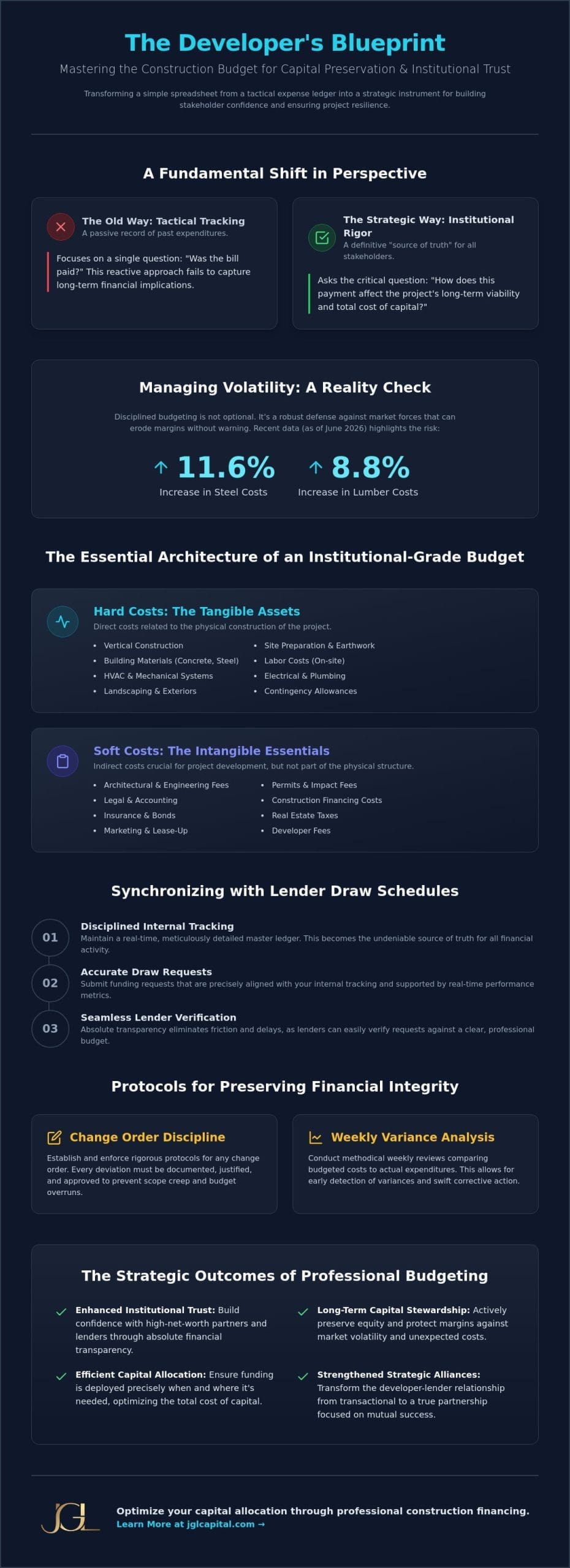
You likely agree that maintaining transparency is the cornerstone of any successful capital alliance, particularly as material costs for steel and lumber have risen 11.6% and 8.8% respectively as of June 2026. This guide provides the sophisticated architecture and disciplined oversight required to utilize your budgeting tools for capital preservation and lender transparency. We’ll examine a professional framework that aligns internal tracking with construction financing draws, ensuring your project remains resilient against market volatility while protecting the long-term interests of your stakeholders through methodical, analytical rigor.
Key Takeaways
- Understand why the budget spreadsheet serves as the primary ledger for institutional transparency and a critical instrument for long-term capital stewardship.
- Discover the essential architecture required for managing a construction budget spreadsheet, focusing on the rigorous categorization of hard and soft costs to ensure analytical precision.
- Learn to synchronize internal tracking with lender draw schedules, ensuring that every funding request is accurate and supported by real-time performance metrics.
- Establish disciplined protocols for change orders and weekly variance analysis to mitigate risk and preserve the project’s financial integrity.
- Recognize how institutional-grade budgeting facilitates more efficient capital allocation and strengthens the strategic alliance between developers and sophisticated lenders.
The Strategic Role of the Construction Budget Spreadsheet in Capital Stewardship
The construction budget spreadsheet is often misunderstood as a passive record of past expenditures, yet in the context of sophisticated development, it serves as the primary ledger for institutional transparency. It marks a fundamental transition from tactical cost-tracking to a higher order of strategic capital preservation and risk mitigation. Professional investors and institutional lenders prioritize standardized financial reporting because it provides a clear, defensible narrative of value creation. By establishing this document as the definitive “source of truth,” a developer ensures that every stakeholder, from limited partners to senior lenders, operates from a shared understanding of the project’s financial health.
Successfully managing a construction budget spreadsheet requires a deep commitment to analytical precision. This isn’t merely about administrative compliance; it’s about the disciplined stewardship of capital in an era where material inflation, such as the 11.6% rise in steel costs seen in June 2026, can erode margins without warning. To maintain this level of control, developers must be fluent in the Glossary of construction cost estimating, ensuring that every line item is categorized with institutional rigor. This standardization allows for the seamless integration of project data into broader financial strategies, transforming a simple tool into a robust defense against market volatility.
Institutional Rigor vs. Tactical Tracking
Simple lists or rudimentary trackers inevitably fail to capture the multi-dimensional complexity of large-scale new construction. Tactical tracking focuses on whether a bill was paid. Institutional rigor asks how that payment affects the project’s long-term viability and total cost of capital. Meticulous data entry is the bedrock of this approach. Without it, the “source of truth” becomes corrupted, leading to the inaccurate forecasting that plagues many undercapitalized projects. A disciplined approach to financial documentation throughout the lifecycle ensures that the project remains a bankable asset from groundbreaking through stabilization.
Aligning Objectives with Capital Partners
A rigorous budget does more than track dollars; it builds the intangible but essential asset of trust with high-net-worth stakeholders. These partners aren’t just looking for returns; they’re looking for the security that comes from knowing their capital is being managed by a seasoned professional. By utilizing financial data to make authoritative decisions, developers can preserve equity even when faced with the pressures of fluctuating interest rates or labor shortages. This alignment of objectives ensures that the developer and the capital partner are moving in unison, focused on the generation of worth rather than the mere avoidance of loss.
Essential Architecture: Structuring Your Spreadsheet for Institutional Rigor
To achieve this level of institutional rigor, the master ledger must distinctly separate hard costs from soft costs. Hard costs encompass the tangible components of vertical construction and site preparation, whereas soft costs include architectural fees, permits, and the carrying costs associated with private money bridge loans. By maintaining this separation, developers can more accurately assess their exposure to specific market pressures, such as the 11.6% increase in steel prices recorded in June 2026. This level of detail is essential for those seeking institutional capital solutions that require deep transparency.
Categorization and the Master Ledger
A professional spreadsheet breaks down the project lifecycle into granular phases, from site preparation and foundation work to vertical construction and interior finishes. Each category should be supported by a robust A Guide to Managing Budgets and Expenses to ensure that internal controls align with industry best practices. It’s imperative that every line item corresponds to a verifiable invoice or executed contract. This meticulous approach prevents the “budget creep” that often occurs when miscellaneous expenses are left uncategorized or poorly defined.
The Contingency Framework
The contingency fund serves as a strategic buffer designed to preserve capital by absorbing the financial impact of unforeseen market volatility and operational variances. Determining the appropriate contingency percentage requires an analytical assessment of project complexity and current market conditions. For instance, projects in jurisdictions with complex regulatory environments, such as those navigating California’s new SB 61 retention caps, may require a more substantial reserve. Establishing strict protocols for the release of these funds is vital; contingency should never be viewed as a general fund for scope expansion, but rather as a disciplined tool for risk mitigation.
Managing the Draw Schedule: Aligning the Spreadsheet with Lender Requirements
The synchronization of project milestones with disbursement protocols represents the most critical operational interface between a developer and their financing source. The discipline inherent in managing a construction budget spreadsheet reaches its zenith during the draw request process, where theoretical allocations transform into tangible liquidity. To maintain the steady flow of capital required for large-scale projects, the spreadsheet must function as a mirror to the lender’s specific reporting requirements, ensuring that every request for funding is substantiated by granular, real-time data. This alignment mitigates liquidity risk and reinforces the developer’s position as a meticulous steward of institutional resources.
A sophisticated budget framework tracks “Budget vs. Actual” figures with precision, allowing for the immediate identification of variances before they escalate into capital shortfalls. When utilizing new construction loans, developers must provide a clean audit trail that justifies every disbursement. This requires a level of documentation that exceeds simple accounting; it demands a comprehensive narrative of progress that satisfies the analytical rigor of institutional credit committees. By integrating the lender’s draw schedule directly into the spreadsheet architecture, a developer can anticipate funding needs and ensure that the project’s cash position remains resilient throughout the construction lifecycle.
Draw Request Integration
Efficient capital management depends on the seamless alignment of internal line items with the lender’s established cost categories. This structural harmony reduces administrative friction and accelerates the approval process by providing the lender with information in a familiar, professional format. A central component of this integration is the rigorous tracking of “Percent Complete” for each trade. By accurately reflecting the work in place, the spreadsheet ensures that draw requests are neither over- nor under-funded, maintaining a balanced relationship between the debt facility and the physical asset.
Inspection and Verification Alignment
The budget spreadsheet serves as the definitive roadmap for third-party inspectors who are tasked with verifying physical progress on behalf of the lender. If the digital ledger indicates that the framing phase is 80% complete, the site must reflect that reality to avoid funding delays or the imposition of restrictive holdbacks. Sophisticated spreadsheets also include dedicated tracking for interest reserves and contingency reallocations, ensuring that these specialized capital pools are managed with the same level of transparency as hard construction costs. This rigorous verification process protects the interests of all stakeholders, ensuring that capital is deployed only when value has been demonstrably created.
Mitigating Variance: Advanced Techniques for Real-Time Budget Oversight
Effective variance mitigation requires a shift from reactive accounting to proactive surveillance. When you’re managing a construction budget spreadsheet, you must implement a rigorous cadence of review that identifies deviations before they compromise the project’s capitalization. This process isn’t simply about identifying where money was spent; it’s about understanding the velocity of capital deployment and its implications for the remaining project lifecycle. By conducting weekly variance analysis, developers can distinguish between temporary timing differences and permanent cost overruns, allowing for the strategic reallocation of contingency funds before a shortfall becomes critical.
The utility of historical data in this context cannot be overstated. By analyzing the performance metrics of completed phases, a developer can refine their broader real estate investing strategies, ensuring that future estimations are grounded in empirical reality rather than optimistic projections. This disciplined approach to data management transforms the spreadsheet from a static document into a powerful forecasting tool that predicts future capital requirements with institutional precision. To ensure your next project is backed by a partner who values this level of analytical rigor, consider our Commercial Real Estate Loans for your capitalization needs.
Change Order Protocols
A change order is not merely a cost increase; it’s a strategic reallocation of resources that requires formal authorization to protect the budget baseline. Developers should establish a disciplined protocol that mandates a comprehensive impact analysis for every proposed deviation, including its effect on the draw schedule and interest reserves. This is particularly relevant in jurisdictions like California, where SB 440, effective January 1, 2026, has standardized the process for resolving change order disputes on large private works. By recording these adjustments with analytical rigor, you maintain a transparent audit trail that preserves the trust of your high-net-worth stakeholders.
Forecasting and Trend Analysis
Optimizing Capital Allocation through Professional Construction Financing
There is a profound synergy between disciplined management and the acquisition of commercial real estate loans. In a market where construction loan rates for professional builders typically range from 6.5% to 9.5% as of June 2026, the ability to demonstrate fiscal stewardship is a significant competitive advantage. A professional spreadsheet serves as the bridge between a developer’s vision and a lender’s requirement for stability, allowing for a strategic alliance that values the generation of worth over simple transactional exchange. By framing financial tracking as a form of high-level strategic alliance, developers can secure the liquidity necessary to navigate even the most complex market cycles.
The JGL Capital LLC Advantage
JGL Capital LLC functions as a seasoned, strategic partner for developers who require more than just a source of capital. Our commitment to providing customized solutions is grounded in over 30 years of expertise in asset-backed lending, a history that allows us to understand the nuances of complex project lifecycles. We recognize that managing a construction budget spreadsheet is a core competency of the modern developer, and we’ve designed our internal processes to mirror that same level of precision. By aligning our lending criteria with the rigorous standards of sophisticated stewards, we streamline the path from initial budget approval to successful project completion, ensuring that capital is deployed with maximum efficiency.
Securing Your Next Project
A robust financial foundation is the prerequisite for securing the private capital necessary for large-scale new construction. When presenting your budget to potential partners, it’s essential that the documentation reflects a comprehensive understanding of hard costs, soft costs, and the strategic use of contingency reserves. This level of professional presentation instills the trust required to build lasting legacies through careful, deliberate action. It signals to stakeholders that you’re a disciplined manager who values integrity and long-term growth above all else. To ensure your capitalization strategy is supported by a partner who shares these timeless principles, Align your project with a strategic capital partner at JGL Capital LLC.
Advancing Your Project through Disciplined Capital Stewardship
The transition from foundational site work to project stabilization requires more than just operational skill; it demands a profound commitment to financial transparency and institutional-grade oversight. By adopting the frameworks discussed—ranging from the meticulous categorization of hard and soft costs to the rigorous synchronization of draw requests—you elevate your development practice to a professional standard that commands respect in the capital markets. Successfully managing a construction budget spreadsheet serves as the definitive proof of this stewardship, providing the analytical rigor necessary to navigate the complexities of the current market environment while protecting your project’s internal rate of return.
This disciplined approach doesn’t just record historical expenditures; it secures the project’s future by preserving capital and fostering unwavering trust among high-net-worth stakeholders and institutional lenders alike. At JGL Capital LLC, we leverage over 30 years of expertise in asset-backed residential and multi-family financing to support developers who prioritize this level of fiscal integrity. We invite you to Secure Strategic Financing for Your New Construction Project and align your objectives with a partner dedicated to the generation of long-term worth. Your dedication to these timeless principles of management will ensure that your next development stands as a testament to both vision and discipline.
Frequently Asked Questions
What are the most critical categories to include in a construction budget spreadsheet?
The most critical categories include a master ledger that distinguishes between hard costs, soft costs, and dynamic contingency reserves. Hard costs focus on site preparation and vertical construction, while soft costs must account for architectural fees, legal requirements, and interest carrying costs. A professional architecture ensures that every line item is traceable to a specific contract, providing the institutional transparency required by sophisticated partners and lenders.
How often should a construction budget spreadsheet be updated for maximum accuracy?
Maintaining a weekly cadence of updates is essential for ensuring that the document remains an accurate reflection of the project’s financial status. When you’re managing a construction budget spreadsheet, real-time data entry allows you to identify inflationary trends early, such as the 6.5% rise in material costs seen in June 2026. This disciplined approach ensures that your forecasting models remain resilient against market volatility and operational delays.
What is the difference between hard costs and soft costs in a professional budget?
Hard costs represent the tangible expenses associated with physical construction, while soft costs encompass intangible administrative and financing requirements. Examples of hard costs include masonry, steel, and electrical components; conversely, soft costs include permits, insurance, and architectural design. Distinguishing between these categories is vital for accurate risk assessment, as each cost type reacts differently to market pressures and regulatory changes.
How do I manage a contingency fund within my construction spreadsheet?
Contingency funds should be managed as a dynamic line item with strict release protocols that prevent them from becoming a general fund for scope expansion. It’s a reality that these reserves must be maintained as a strategic buffer to absorb unforeseen variances in labor or material pricing. Given that California’s SB 61 now mandates a 5% cap on retention for many contracts, managing your liquidity through a disciplined contingency framework is more critical than ever.
Can a well-maintained budget spreadsheet help secure a new construction loan?
A well-maintained document is a primary tool for securing institutional capital because it instills trust in the developer’s expertise. Successfully managing a construction budget spreadsheet demonstrates to lenders that you possess the analytical rigor required to protect their investment. This level of transparency often results in more efficient funding cycles and reinforces your position as a seasoned, strategic partner capable of building lasting legacies.
How should I track change orders to avoid budget overruns?
Tracking change orders requires a formal protocol that records every deviation as a separate entry to preserve the integrity of the original budget baseline. This disciplined approach ensures that cost overruns are identified in real-time, allowing for strategic adjustments before the project’s equity is compromised. Adhering to standardized processes, such as those established by California’s SB 440, ensures that disputes are minimized and that the audit trail remains clean for all stakeholders.
What is a draw schedule, and how does it relate to my budget spreadsheet?
A draw schedule is the structured timeline for capital disbursements, and it must be integrated directly into the budget spreadsheet to ensure funding liquidity. By aligning your internal budget line items with the lender’s draw categories, you ensure that funding requests are accurate and substantiated by physical progress. This synchronization prevents capital shortfalls and maintains a steady flow of resources, which is essential for meeting project milestones and preserving investor trust.
How can I use my spreadsheet to improve communication with capital partners?
Utilizing a professional budgeting framework improves communication by providing a single source of truth that aligns the objectives of all stakeholders. It’s a fact that high-net-worth partners expect a level of transparency that only a rigorous, data-driven document can provide. By presenting variance analysis and forecasting metrics in a standardized format, you eliminate ambiguity and foster a collaborative relationship based on mutual accountability and the generation of long-term worth.