

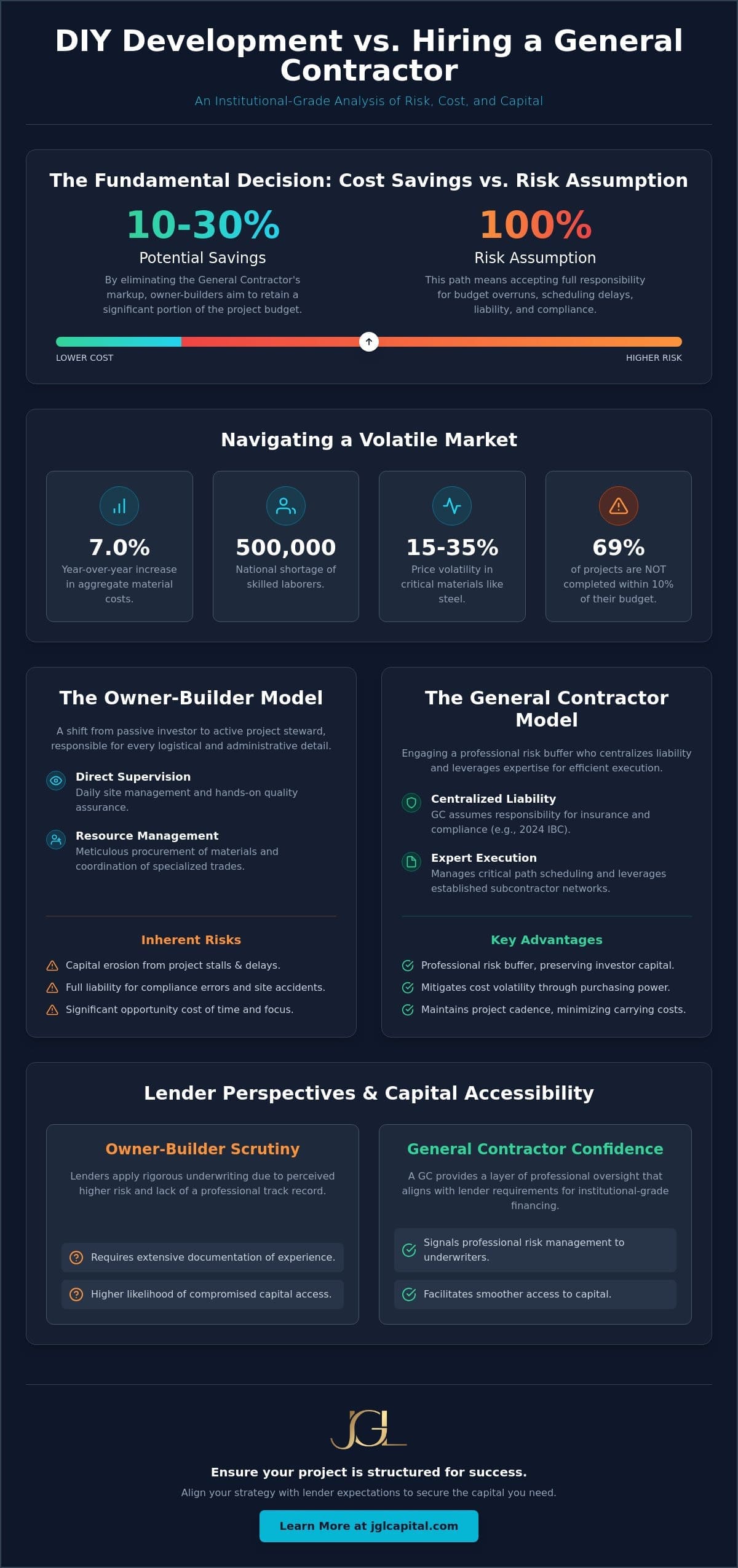
The decision to manage a construction project internally is often mischaracterized as a simple pursuit of cost savings; in reality, it represents a profound assumption of institutional risk that can fundamentally alter the capital structure of a development. When evaluating DIY real estate development vs hiring a GC, it’s essential to look beyond the immediate 10% to 30% contractor markup and consider the broader implications for project solvency and risk mitigation. You likely recognize that current margin compression, driven by a 7.0% year-over-year increase in aggregate material costs and a persistent national shortage of 500,000 skilled laborers, makes every basis point of project cost critical. This analysis provides an institutional-grade evaluation of how self-management affects your Internal Rate of Return and how lenders scrutinize owner-builder documentation during the underwriting process. We will examine the strategic trade-offs between professional oversight and direct management to establish a disciplined framework for your next capital deployment, ensuring that your choice aligns with the long-term preservation of value and capital accessibility.
Key Takeaways
- Evaluate the shift from capital provision to logistical stewardship, acknowledging how this transition impacts the fundamental risk profile of the asset.
- Quantify the trade-off between the elimination of contractor fees and the increased carrying costs that often accompany internal management.
- Gain insight into the underwriting rigor applied by lenders when evaluating DIY real estate development vs hiring a GC to ensure capital accessibility isn’t compromised.
- Recognize the role of the general contractor as a professional risk buffer against municipal compliance errors and direct liability exposure.
- Implement a strategic framework to select the management model that best aligns with project complexity and long-term portfolio objectives.
Defining the Strategic Divide: DIY Development vs. Professional General Contracting
The decision between DIY real estate development vs hiring a GC is fundamentally a question of risk allocation and fiduciary responsibility rather than a mere comparison of labor costs. While a passive investor provides capital, a DIY developer assumes the role of a primary steward, overseeing both the fiscal health and the logistical execution of the asset. This transition requires a departure from the “weekend warrior” mentality of aesthetic DIY, such as cosmetic renovations, toward a rigorous “Owner-Builder” model that focuses on structural integrity and complex systems management. It’s a high-stakes shift that demands an institutional mindset to ensure the preservation of value.
The General Contractor as a Strategic Ally
A What is a General Contractor? acts as a professional risk buffer between an investor’s capital and the volatile realities of the job site. By leveraging established subcontractor networks and significant purchasing power, a GC can often mitigate the 7.0% increase in material costs observed in early 2026. Their role is to ensure that every operational phase aligns with the project’s strategic objectives, providing a layer of professional oversight that many lenders require for institutional-grade financing. They provide the technical expertise necessary to navigate the 2024 International Building Code (IBC) while managing the critical path of the construction lifecycle.
- Execution of complex critical path scheduling and site logistics.
- Centralization of liability and professional insurance requirements.
- Established relationships with skilled trades in a market facing a shortage of 500,000 workers.
The DIY Approach: Assuming the Mantle of Management
- Direct supervision of daily site activities and quality assurance.
- Management of complex supply chains and material volatility.
- Coordination of specialized trades within a highly regulated environment.
The Financial Implications of the Owner-Builder Model
The financial architecture of a development project is often predicated on the perceived arbitrage between contractor markups and the perceived savings of self-management. While the prospect of retaining a 10% to 30% fee is compelling, a rigorous analysis must account for the “Expertise Premium” that professional general contracting provides. Investors operating under the Owner-Builder Exemption often underestimate the velocity of capital erosion when projects stall. In a market where only 31% of construction projects are completed within 10% of their initial budget, the margin for error is razor-thin. When weighing DIY real estate development vs hiring a GC, the calculation must extend beyond line-item expenses to include the final asset valuation and the efficiency of the exit strategy.
Direct Cost Savings vs. Opportunity Costs
Time is a finite resource with a quantifiable cost. For high-net-worth individuals, the hundreds of hours required for site supervision and administrative compliance represent a significant diversion from higher-value activities. This opportunity cost is compounded by the financial weight of debt service. If an investor utilizes bridge loans or construction financing, a three-month delay caused by logistical mismanagement can entirely offset the savings gained from avoiding a general contractor’s fee. Carrying costs don’t pause for learning curves. A professional’s ability to maintain a steady cadence ensures that capital remains productive rather than being trapped in a stagnant job site.
Resource Management and Economies of Scale
Institutional general contractors command pricing tiers that are typically inaccessible to individual owner-builders. While a DIY developer might secure one-off quotes, a professional firm leverages aggregate volume to negotiate favorable terms, especially given the 15% to 35% projected rise in steel prices and the 20% to 40% volatility in lumber. Errors in procurement or execution carry a heavy penalty. Remediating a structural oversight is invariably more expensive than the professional oversight required to prevent it. Sophisticated developers view the GC fee not as a cost, but as an insurance premium against the catastrophic expense of rework and material waste. Precision in resource management is the hallmark of a disciplined steward.
- Volume-based procurement strategies to combat 2026 material price volatility.
- Reduction of waste through professional staging and logistical coordination.
- Prevention of “retail” labor pricing through established trade partnerships.
Lender Perspectives: Capital Accessibility and Underwriting Rigor
Capital providers prioritize the certainty of execution as a fundamental component of their risk assessment when evaluating any development opportunity. When analyzing DIY real estate development vs hiring a GC, a lender views the management structure as a primary indicator of project viability and solvency. A licensed general contractor serves as a professional guarantor of the construction timeline, ensuring that the project adheres to the rigorous standards required by institutional capital. Without this professional buffer, the perceived risk of default or significant cost overruns increases, which often results in less favorable loan terms or restricted access to the most competitive financing products available in the market.
Mitigating Risk Through Professional Credentials
Professional credentials serve as a cornerstone of the underwriting process, providing an empirical basis for a lender’s confidence in the project’s eventual completion. A general contractor’s established track record of successful deliveries allows for a more favorable assessment of Loan-to-Cost (LTC) and Loan-to-Value (LTV) ratios. Aligning your project management strategy with the specific requirements of new construction loans typically necessitates a professional intermediary who can satisfy complex reporting and documentation standards. This alignment reduces the lender’s perceived asset risk, potentially unlocking interest rates at the lower end of the current 6.5% to 9.5% range observed in mid-2026 for professional builders.
The Challenges of Financing DIY Projects
Assuming “Owner-Builder” status frequently triggers a heightened degree of underwriting rigor that can complicate the capital stack for even seasoned investors. Lenders often demand larger contingency reserves, sometimes exceeding 15% of the total budget, to mitigate the risks inherent in self-management. The investor must directly assume all financial and legal liabilities associated with the project, including the administrative burden of managing draw schedules and ensuring timely lien releases from subcontractors. While alternative capital solutions exist for experienced self-managing investors, these often carry higher points and more restrictive covenants to compensate for the operational volatility associated with the absence of a professional general contractor.
- Increased scrutiny of personal financial statements and liquidity for owner-builders.
- Requirement for detailed, professional-grade project documentation and scheduling.
- Potential for limited loan proceeds based on a higher perceived risk of project abandonment.
Operational Realities: Compliance, Liability, and Risk Mitigation
The operational phase of a project introduces a complex layer of legal and regulatory exposure that requires meticulous stewardship. When assessing DIY real estate development vs hiring a GC, an investor must weigh the administrative burden of ensuring compliance with the 2024 International Building Code (IBC) against the security of professional oversight. In jurisdictions like Pennsylvania, which implemented 2021 International Codes on January 1, 2026, or California with its 2026 Building Standards Code, the margin for error in permitting is nonexistent. A failure to adhere to these evolving mandates doesn’t just delay timelines; it fundamentally compromises the long-term valuation and insurability of the asset. Ultimately, the choice in DIY real estate development vs hiring a GC dictates whether the investor is a passive beneficiary of growth or a direct participant in operational liability.
Regulatory Stewardship and Permitting
Professional permit management is a strategic necessity rather than a clerical task. A general contractor acts as the primary liaison with municipal inspectors, leveraging established rapport and technical expertise to navigate the nuances of site inspections. For the owner-builder, this relationship is often transactional and fraught with the risk of misinterpretation. Ensuring that every structural element meets local code is the only way to preserve the asset’s integrity. Meticulous record-keeping serves as a safeguard during future audits or dispositions, providing a transparent history of compliance that institutional buyers and lenders demand. Precision in this area is non-negotiable.
Liability Management and Insurance Strategies
The transfer of risk is perhaps the most compelling argument for professional contracting. A general contractor serves as a legal shield, assuming direct responsibility for subcontractor mishaps and site safety. In a DIY scenario, the investor is often the first point of contact for legal claims, creating a vulnerability that can threaten personal wealth and the stability of the entire portfolio. Structuring robust contracts to ensure professional accountability is essential for any disciplined approach to real estate investing. It’s about protecting the legacy you’re building.
Investors must distinguish between Builder’s Risk insurance, which protects the physical structure, and General Liability, which covers third-party injuries. While an owner-builder can secure these policies, the premiums are often elevated due to the lack of a professional track record. A GC’s existing insurance umbrella provides a layer of protection that’s difficult to replicate through individual procurement. If you’re seeking to optimize your project’s risk profile while securing competitive financing, our commercial real estate loans provide the structural support needed for high-stakes development.
- Utilization of professional contracts to indemnify the investor against site accidents.
- Adherence to the 2024 IBC tornado-specific design requirements in prone areas.
- Maintenance of a comprehensive digital audit trail for all municipal approvals and inspections.
Strategic Selection: Determining the Optimal Management Framework
Determining the optimal management framework requires an objective audit of one’s internal intellectual capital and the specific technical demands of the asset. The decision regarding DIY real estate development vs hiring a GC shouldn’t be predicated on a binary choice between cost and control; instead, it must reflect a disciplined assessment of project scale and market volatility. In an environment where 92% of contractors report challenges in securing skilled labor, the burden of recruitment and site management for an owner-builder is historically high. As a portfolio expands, the transition from direct management to institutional oversight becomes a prerequisite for maintaining operational integrity and ensuring the long-term preservation of value.
The Developer’s Decision Matrix
- Evaluation of project scale against the 2024 International Building Code requirements.
- Assessment of the investor’s ability to manage 20% to 40% lumber price volatility.
- Verification of a prospective GC’s track record in similar asset classes.
Finalizing the Capital and Management Alignment
The final stage of this strategic analysis involves the synchronization of your management choice with your capital stack. For investors operating in high-growth markets, securing the support of hard money lenders requires a transparent presentation of how the project will be managed to mitigate common risks. Establishing clear lines of responsibility ensures that every stakeholder, from the site supervisor to the equity partner, remains focused on the delivery of worth. A disciplined execution strategy is the only way to safeguard your IRR against the nationwide shortage of 500,000 construction workers. The choice between DIY real estate development vs hiring a GC serves as the foundation for your project’s financial and operational success, dictating the ease with which you can access and deploy transitional capital.
Optimizing the Capital and Management Alliance
The transition from passive investor to active developer requires a disciplined commitment to risk mitigation and the preservation of capital. As this analysis has demonstrated, the choice between DIY real estate development vs hiring a GC is a strategic determination that fundamentally dictates your project’s solvency and its standing during the underwriting process. By prioritizing professional oversight, you establish a vital buffer against the current volatility in material costs and the complexities of evolving building codes. This structured approach ensures that your development remains a stable vehicle for wealth creation rather than a source of unmanaged liability. Aligning your management framework with a sophisticated financial partner is the final step in securing a lasting legacy. With over 30 years of industry expertise, JGL Capital LLC provides streamlined asset-backed lending and customized capital solutions tailored for professional developers. Consult with JGL Capital LLC for Sophisticated Construction Financing Solutions to ensure your next deployment is supported by analytical rigor. We remain committed to your vision of disciplined, long-term growth and value creation.
Frequently Asked Questions
Can I secure a construction loan if I act as my own general contractor?
You can secure a construction loan as an owner-builder, though most institutional lenders require a licensed professional to mitigate completion risk. Private capital providers may permit self-management for experienced investors but typically mandate a larger contingency reserve, often exceeding 15% of the total budget. This structure ensures that the project remains solvent despite the potential for logistical delays or cost overruns associated with the absence of a professional intermediary.
What is the typical fee structure for a professional general contractor in 2026?
Professional general contractors typically utilize a markup structure ranging from 10% to 30% of the total project cost to cover overhead and profit. In 2026, hourly rates for these professionals average approximately $65, though specialized contractors in high-demand markets like Florida may charge up to $150 per hour. This fee represents a strategic allocation of capital toward risk mitigation and professional project execution rather than a simple administrative expense.
How does hiring a GC impact the interest rates on private money loans?
Hiring a professional general contractor frequently results in more competitive interest rates by reducing the lender’s perceived asset risk. While professional builders might access rates between 6.5% and 9.5%, owner-builders often face higher-risk pricing ranging from 9% to 12% or higher. The presence of a licensed GC provides the analytical rigor and technical expertise that capital providers require to offer institutional-grade financing terms.
What are the primary legal risks of the owner-builder model for real estate investors?
Will a bridge loan cover the costs of hiring a general contractor?
A bridge loan is designed to provide transitional capital that covers both acquisition and renovation costs, including the fees for a professional general contractor. These short-term financing solutions allow investors to maintain project momentum while professional oversight ensures that the asset is positioned for a successful exit or long-term refinancing. By including GC fees in the initial loan-to-cost calculation, developers can preserve their internal liquidity for other strategic opportunities.
At what project scale does hiring a GC become a financial necessity?
Hiring a GC becomes a financial necessity when a project moves beyond cosmetic renovations into structural development or multi-family construction. At this scale, the complexity of managing 500,000 missing skilled workers and 15% to 35% steel price volatility requires a dedicated professional. The strategic value of a GC is most evident when the cost of a potential delay exceeds the 10% to 30% fee required for professional management.
How do lenders evaluate the experience of a DIY developer during underwriting?
Lenders evaluate the experience of a DIY developer by scrutinizing their historical track record of completed projects and their internal intellectual capital. During underwriting, capital providers review the developer’s professional resume, previous project P&Ls, and the depth of their subcontractor relationships. When comparing DIY real estate development vs hiring a GC, lenders prioritize the certainty of execution, often requiring more liquid collateral from self-managing investors to offset the operational risk.
What insurance policies are required for a self-managed real estate development project?
Self-managed projects require a comprehensive suite of insurance products, including Builder’s Risk to protect the physical asset and General Liability to cover third-party injury claims. Investors must also ensure that every subcontractor provides a valid certificate of insurance naming the investor as additionally insured. In the absence of a general contractor’s umbrella policy, the developer must meticulously manage these requirements to avoid catastrophic financial exposure in the event of a site accident or structural failure.