

The most conservative strategy for professional portfolio expansion is frequently not the preservation of existing equity, but rather the deliberate deployment of that capital through sophisticated leverage. Many seasoned investors recognize the inherent friction of seeing significant wealth locked within stabilized assets while time-sensitive opportunities vanish because of the systemic delays associated with traditional banking institutions. When evaluating a bridge loan vs cash out refinance for investment property, the determination depends on whether your strategic objective is the rapid acquisition of a transitional asset or the long-term stabilization of your capital stack.
We recognize that the 2026 financial environment requires a disciplined approach to asset stewardship and the precise alignment of debt structures with specific business plans. This analysis provides an institutional-grade evaluation of how these distinct financing models impact your liquidity and overall portfolio resilience. You’ll gain a comprehensive decision-making framework that clarifies LTV implications and DSCR requirements, ensuring you can maximize growth through informed capital allocation. We’ll examine the specific mechanics of each instrument to help you determine which path best supports your long-term value creation.
Key Takeaways
- Identify the critical distinctions between transitional capital and permanent debt to determine which structure best supports your current portfolio objectives.
- Evaluate the specific LTV and DSCR thresholds required to optimize equity extraction through a stabilized refinance strategy.
- Understand how the accelerated underwriting cycles of private bridge financing can serve as a tactical advantage in highly competitive, time-sensitive markets.
- Utilize the ‘Tactical Hunt vs. Strategic Hold’ framework when evaluating a bridge loan vs cash out refinance for investment property to align leverage with asset maturity.
- Analyze the total cost of capital versus the potential for missed opportunity to ensure your financing choice facilitates maximum long-term value preservation.
Navigating Capital Liquidity: The Choice Between Bridge Financing and Equity Extraction
Sophisticated investors frequently encounter a strategic crossroads where the preservation of established equity conflicts with the necessity of immediate liquidity for acquisition. The determination between a bridge loan vs cash out refinance for investment property isn’t merely a transactional choice; it’s a disciplined evaluation of how capital should function within a broader portfolio lifecycle. High-stakes asset management requires an alignment of debt maturity with the specific stabilization phase of the underlying collateral. When capital is locked within a stabilized asset, the investor’s ability to respond to market shifts or distressed opportunities is fundamentally compromised. This dilemma necessitates a clear understanding of whether one is seeking a temporary tactical advantage or a permanent capital restructuring.
Traditional banking institutions often operate on timelines that are fundamentally incompatible with the requirements of modern real estate management. While a conventional lender might spend several months in the discovery and underwriting phases, a time-sensitive opportunity can easily vanish. This systemic inefficiency forces a more agile approach to capital. Speed of execution must be weighed against the long-term cost of the debt structure. Analytical rigor dictates that one must account for the opportunity cost of stagnant capital when evaluating these paths. If an investor cannot move within a narrow window, perhaps as short as ten days, the asset frequently moves to a more liquid competitor. Maintaining a competitive edge in 2026 requires access to capital structures that prioritize the velocity of the transaction.
The Strategic Role of Transitional Capital
A Bridge loan serves as a tactical lever, providing the necessary velocity to secure assets that require immediate intervention or repositioning. In the 2026 environment, short-term debt functions as a catalyst for value-add projects. It allows investors to bridge the gap between acquisition and eventual stabilization. These instruments prioritize asset-based underwriting over historical cash flows. This focus makes them indispensable for properties currently undergoing transition. The core philosophy here is one of tactical agility. The focus remains on the eventual exit strategy, ensuring that the temporary nature of the debt aligns with the project’s physical or operational turnaround. By utilizing this transitional capital, investors can secure properties that wouldn’t meet the stringent requirements of permanent financing.
Equity Extraction as a Long-Term Growth Engine
Conversely, equity extraction through a cash-out refinance represents a commitment to long-term asset stabilization and the systematic recycling of capital. By replacing an existing mortgage with a higher-balance, permanent facility, investors can unlock liquid equity from stabilized properties to fuel new ventures. This approach favors the preservation of worth across a portfolio. It utilizes the strength of established assets to provide the foundation for future growth. Unlike the temporary nature of bridge debt, this strategy locks in long-term rates. It provides a stable capital base. However, it requires the asset to meet stringent stabilized performance metrics, including specific Debt Service Coverage Ratio (DSCR) targets that reflect the asset’s mature earning potential. When evaluating a bridge loan vs cash out refinance for investment property, the latter is the primary tool for those who prioritize stability over speed.
The Mechanics of Cash-Out Refinancing: Optimizing Long-Term Asset Stabilization
A cash-out refinance for investment property is the replacement of an existing mortgage with a new, higher-balance loan to access liquid equity. In the 2026 fiscal environment, this instrument serves as a primary mechanism for capital recycling, allowing sophisticated managers to transition from high-velocity growth phases into a period of stabilized value preservation. This process requires a disciplined evaluation of the asset’s current performance against prevailing market benchmarks. For those seeking a comprehensive overview of cash-out refinancing, it’s clear that the strategic advantage lies in locking in fixed-rate debt that aligns with the property’s long-term hold period. While interest rates for investment properties in mid-2026 have stabilized between 7.0% and 7.5%, the trade-off for a 30-year term is often the security of predictable debt service.
The determination between a bridge loan vs cash out refinance for investment property often rests on the asset’s ability to meet stringent institutional thresholds. Current national standards typically cap these transactions at a 75% Loan-to-Value (LTV) ratio, necessitating a minimum 25% equity position. This conservative underwriting ensures that the capital stack remains resilient against market fluctuations. Partnering with a disciplined steward like JGL Capital LLC allows investors to navigate these LTV thresholds with precision, ensuring that equity extraction doesn’t compromise the asset’s long-term viability. The choice represents a commitment to permanent financing, trading the flexibility of transitional debt for the stability of a fully amortizing structure.
Seasoning Requirements and Institutional Discipline
Institutional lenders generally require a formal seasoning period before an asset is eligible for a cash-out refinance. As of June 2026, standard requirements from major entities like Fannie Mae and Freddie Mac mandate that the existing mortgage be at least 12 months old. This period allows the lender to verify the stability of the rent roll and the efficacy of any property improvements. Professional appraisals play a critical role here, establishing a new capital baseline that reflects the asset’s ‘as-stabilized’ value rather than its historical purchase price. This rigorous verification process ensures that the extracted equity is grounded in actual performance rather than speculative projections.
DSCR and the Preservation of Portfolio Health
The Debt Service Coverage Ratio (DSCR) is the definitive metric for evaluating an asset’s health during the refinance process. Lenders in the current environment typically require a DSCR between 1.0 and 1.25, ensuring the property’s gross income sufficiently covers all debt obligations. This shift toward property-centric underwriting prioritizes the asset’s performance over the borrower’s personal income, a hallmark of sophisticated lending. By maintaining a healthy cash flow margin, investors can mitigate the risks of over-leveraging. This disciplined approach to debt service ensures that the extracted capital can be redeployed into new ventures without jeopardizing the stability of the existing portfolio.
Bridge Loans as Tactical Instruments: Facilitating Speed and Transitional Growth
The structural flexibility of these loans provides a distinct advantage for seasoned asset managers. Non-recourse options and interest-only payment schedules allow for the preservation of operational cash flow during the critical transitional phase of a property’s lifecycle. By utilizing these flexible frameworks, investors can allocate their liquid reserves toward value-add improvements rather than heavy debt service. This approach is particularly effective for those specializing in new construction or property repositioning, where the initial phase of the project doesn’t yet support the stringent requirements of a stabilized mortgage facility.
Asset-Based Underwriting vs. Traditional Credit Analysis
Institutional bridge lenders prioritize the After-Repair Value (ARV) and the property’s eventual stabilization potential rather than the borrower’s personal balance sheet. This shift in focus allows for a streamlined documentation process that rewards experienced developers and repeat investors who possess a proven track record of execution. Bridge lenders assess the exit strategy as the primary risk mitigation factor, ensuring a clear path to repayment through either a sale or a transition to permanent financing. By centering the underwriting on the asset’s future worth, capital becomes available for properties that traditional institutions would deem unfinanceable due to current vacancy rates or deferred maintenance.
Capital Allocation for Value-Add Projects
Utilizing bridge funds to consolidate both acquisition and renovation costs into a single facility ensures institutional precision throughout the construction lifecycle.
- Milestone Management: Lenders manage the construction draw process with rigor, ensuring that capital is deployed in alignment with physical progress.
- Strategic Flexibility: This debt structure is the primary engine for the BRRRR strategy, providing the initial leverage needed to rehab and rent an asset before seeking permanent extraction.
- Portfolio Velocity: Rapid access to transitional capital allows investors to maintain multiple active projects, maximizing portfolio growth without waiting for the lengthy cycles of equity extraction.
By aligning the debt structure with the project’s physical turnaround, investors can ensure that their capital remains as dynamic as the assets they manage.
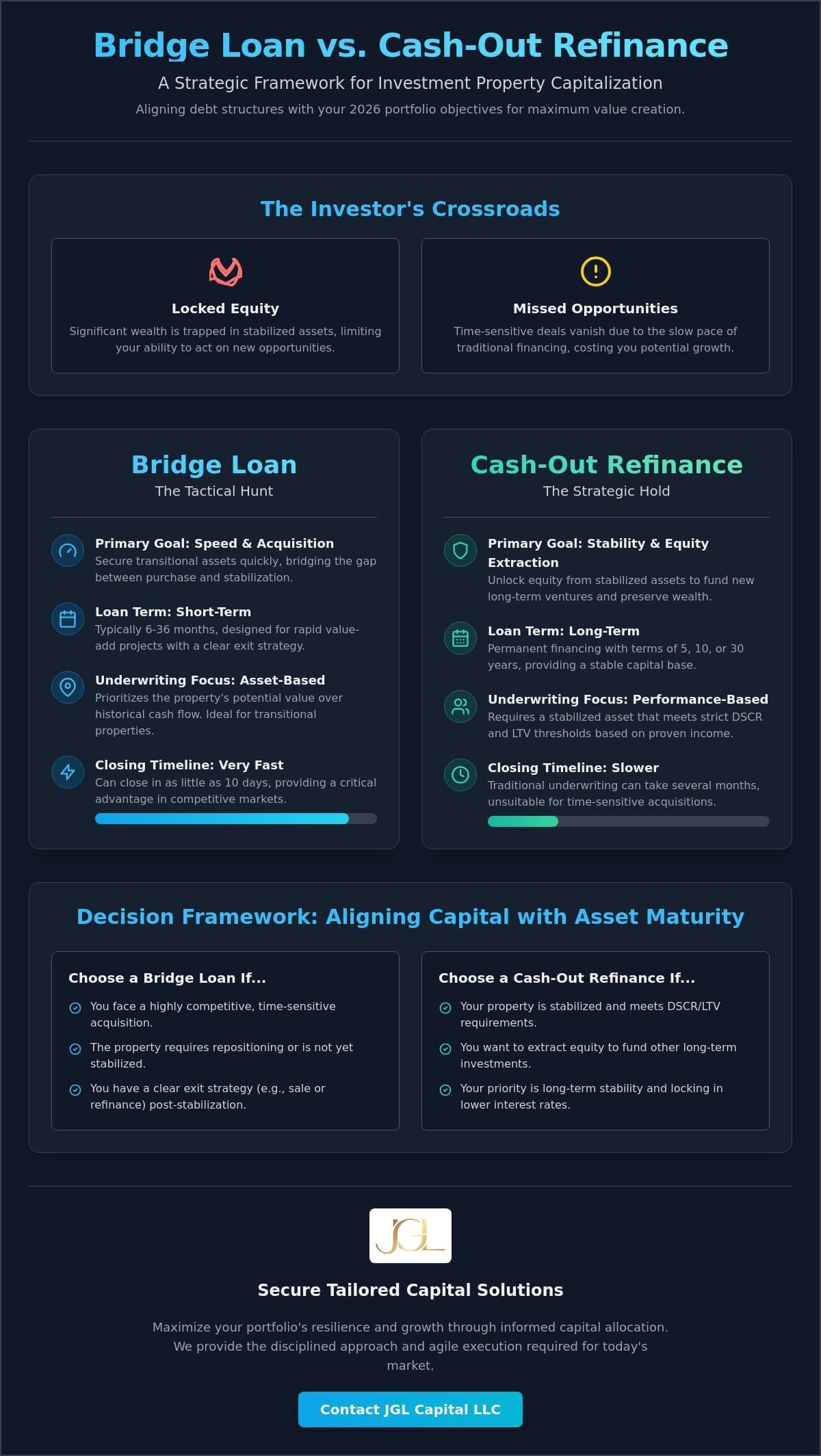
Comparative Framework: Aligning Financing Structures with Investment Lifecycles
The decision-making process for executive-level asset management requires a framework that transcends simple interest rate comparisons. We define this as the ‘Tactical Hunt versus Strategic Hold’ paradigm. When evaluating a bridge loan vs cash out refinance for investment property, the investor must determine the precise lifecycle stage of the capital requirement. A tactical hunt prioritizes the rapid deployment of liquidity to capture undervalued or distressed assets, while a strategic hold focuses on the long-term optimization of the capital stack. For deeper context on current market dynamics, review our analysis on Real Estate Investing: Strategies and Insights for 2026.
Execution risk is a critical component of this comparative analysis. While a cash-out refinance offers the allure of lower interest rates, the process is frequently encumbered by extensive institutional hurdles, including rigorous seasoning requirements and a reliance on stabilized DSCR metrics. Conversely, bridge financing provides a higher degree of closing certainty because the underwriting is anchored in the asset’s intrinsic potential. The opportunity cost of a missed acquisition can far exceed the interest rate delta. If a competitor secures a distressed property with a 20% equity margin while you await a 60-day refinance approval, the cost of that delay represents a significant loss of potential worth.
Scenario Analysis: Acquisition vs. Optimization
Consider Case Study A, where an investor identifies a distressed multi-family asset priced significantly below market value. By utilizing a bridge loan, they can execute a closing in ten days, beating out competitors reliant on traditional funding. The higher cost of capital is offset by the immediate capture of equity. In Case Study B, the objective shifts to leveraging a cash-out refinance on a fully stabilized property. This move consolidates existing debt and lowers the Weighted Average Cost of Capital (WACC), creating a more resilient foundation for the portfolio. The break-even point occurs when the projected appreciation or immediate equity gain from a new acquisition exceeds the total interest expense of the transitional debt.
Cost of Capital and Worth Generation
A disciplined steward must evaluate the total cost of capital, accounting for points, processing fees, and the impact of prepayment penalties on the overall Internal Rate of Return (IRR). Bridge loans often carry higher origination fees, yet their interest-only structures preserve the liquidity necessary for renovations. Aligning the loan term with the projected hold period is essential; using a 30-year stabilized product for a 12-month repositioning project creates unnecessary friction and potential exit fees. You can secure your next high-stakes acquisition by partnering with JGL Capital LLC for a customized financing solution that prioritizes your strategic objectives. Every capital decision must serve the ultimate goal of long-term value preservation and portfolio velocity.
Strategic Stewardship: Securing Tailored Capital Solutions with JGL Capital LLC
JGL Capital LLC functions as a disciplined partner in the creation and preservation of real estate value, operating with the understanding that sophisticated investors require more than mere transactions. Our firm leverages over thirty years of analytical expertise to navigate the complexities of transitional financing, ensuring that every capital structure is meticulously balanced against the partner’s broader objectives. While the debate regarding a bridge loan vs cash out refinance for investment property often centers on interest rates, we focus on the alignment of the debt with the asset’s specific stabilization trajectory. Our asset-backed approach prioritizes the intrinsic worth of the collateral, effectively removing the systemic delays and bureaucratic hurdles inherent in traditional institutional lending. For those seeking a foundational understanding of these instruments, our resource on What Is a Bridge Loan? A Strategic Guide to Transitional Real Estate Capital provides the necessary technical clarity.
The commitment to highly customized solutions ensures that every strategic alliance we form is grounded in analytical rigor rather than speculative trends. We recognize that the needs of a high-net-worth stakeholder differ significantly from retail borrowers, necessitating a high-register business style that reflects the gravity of high-stakes management. By framing our activities as a form of strategic stewardship, we help our partners optimize their property equity while maintaining the acquisition speed required in a competitive 2026 market. This disciplined approach to the preservation of value allows for the generation of worth that extends beyond a single fiscal cycle.
A Disciplined Approach to Private Capital
Working with a strategic ally who understands property value as the primary collateral is essential for maintaining portfolio velocity. JGL Capital LLC maintains a national reach, providing developers and investors with a certainty of execution that’s often absent in the conventional mortgage market. We view our engagements as collaborative relationships rather than simple service provisions. This perspective is vital for those focused on building lasting investment legacies, as it ensures that the capital stack remains resilient through various market cycles. Our focus remains on the generation of worth through careful, deliberate action.
Initiating Your Next Strategic Alliance
Our streamlined evaluation process is designed for high-stakes management, allowing for the rapid assessment of Multi-Family Loans, New Construction Loans, and bridge opportunities. The underwriting team at JGL Capital LLC applies the same analytical rigor to a transitional bridge facility as they do to a long-term commercial structure. We recognize that the determination between a bridge loan vs cash out refinance for investment property requires a nuanced understanding of the asset’s current and future performance. By prioritizing the alignment of objectives, we provide the stability required for ambitious growth. Our personality is that of a quiet expert, relying on intellectual capital to deliver results.
Contact JGL Capital LLC to discuss your strategic financing requirements and discover how a disciplined capital partner can optimize your property equity and support your long-term portfolio objectives.
Optimizing Capital Structures for Future Portfolio Resilience
The determination between a bridge loan vs cash out refinance for investment property ultimately rests on the alignment of capital with your specific investment lifecycle. We’ve established that while a cash-out refinance provides the stability of permanent debt for mature assets, bridge financing offers the tactical velocity required to capture emerging opportunities before the market can react. Successful portfolio growth in 2026 demands a sophisticated understanding of these distinct capital functions. It’s no longer enough to simply seek the lowest rate; you must prioritize the debt structure that facilitates your broader strategic objectives.
JGL Capital stands ready to serve as your disciplined partner in this endeavor. With over 30 years of industry expertise and a specialized focus on fast, asset-backed loan execution, we provide the certainty of performance that traditional institutions often don’t possess. Our national reach for commercial and residential investment properties ensures that your strategic objectives are met with precision and analytical rigor. Secure Your Strategic Financing with JGL Capital to ensure your next acquisition is supported by a legacy of stability and expertise. We look forward to facilitating your continued success in the creation and preservation of significant real estate value.
Frequently Asked Questions
Is a bridge loan or a cash-out refinance better for a fix-and-flip project?
A bridge loan is the superior instrument for fix-and-flip projects because it prioritizes the After-Repair Value (ARV) rather than the property’s current distressed state. These facilities provide the necessary liquidity for both acquisition and renovation costs, facilitating a rapid turnaround that a stabilized refinance structure cannot accommodate. The focus remains on the asset’s future potential, which is essential for properties requiring significant repositioning.
What is the typical seasoning period for a cash-out refinance on an investment property in 2026?
Institutional seasoning requirements in 2026 generally mandate that a property be held for at least 12 months before a cash-out refinance can be initiated. While some private capital sources may consider a six-month window if you’ve documented significant capital improvements, the 12-month standard remains the benchmark for most agency-backed debt. This period allows lenders to verify the stability of the rent roll and the property’s operational performance.
How does the Debt Service Coverage Ratio (DSCR) impact my ability to refinance?
The Debt Service Coverage Ratio functions as the primary determinant of loan sizing by measuring the asset’s ability to cover its debt obligations from gross rental income. Lenders in the current environment typically require a minimum ratio between 1.0 and 1.25. If the property’s cash flow doesn’t meet these thresholds, the loan-to-value (LTV) ratio may be reduced to ensure the asset maintains a healthy operational margin.
Can I use a bridge loan for the down payment on a second investment property?
You can utilize a bridge loan to unlock equity from an existing asset to fund the down payment on a subsequent acquisition. This strategy allows sophisticated investors to maintain portfolio momentum without the necessity of liquidating stabilized assets. For those exploring residential entry points, programs such as MSHDA down payment assistance can facilitate the acquisition of initial properties. By leveraging the equity in a current property, you can secure transitional capital that bridges the gap until a more permanent financing solution is established for the new asset.
Are bridge loan interest rates significantly higher than traditional refinance rates?
Bridge loan interest rates are inherently higher than those for a bridge loan vs cash out refinance for investment property, reflecting the increased risk and shorter duration of the debt. As of June 2026, bridge rates typically range from 8% to 14.5%, whereas stabilized 30-year refinance rates for investment properties generally settle between 7% and 7.5%. The higher cost is the trade-off for the speed and flexibility these tactical instruments provide.
What are the primary closing costs associated with asset-backed bridge financing?
Closing costs for asset-backed bridge financing include origination fees that typically range from 1% to 3% of the loan amount, alongside professional appraisal, title, and underwriting fees. These costs reflect the analytical rigor required to evaluate transitional assets and the accelerated nature of the closing process. It’s essential to factor these settlement charges into your overall internal rate of return (IRR) calculations when evaluating the facility’s total cost.
What happens if I cannot secure permanent financing before my bridge loan expires?
Failure to secure permanent financing before a bridge loan matures necessitates either a formal loan extension or the immediate liquidation of the asset to satisfy the debt. Sophisticated lenders require a verified exit strategy during the initial underwriting phase to mitigate this risk. Maintaining a disciplined approach to stabilization ensures you don’t encounter liquidity constraints when the transitional debt term concludes.
Does JGL Capital offer non-recourse bridge loans for commercial properties?
JGL Capital provides highly customized financing solutions, including non-recourse bridge loans for qualified commercial properties and multi-family assets. These structures align with our commitment to strategic stewardship, allowing our partners to limit personal liability while executing complex value-add business plans. We focus on the property’s value as the primary collateral, ensuring a professional and disciplined approach to the creation of long-term worth.