

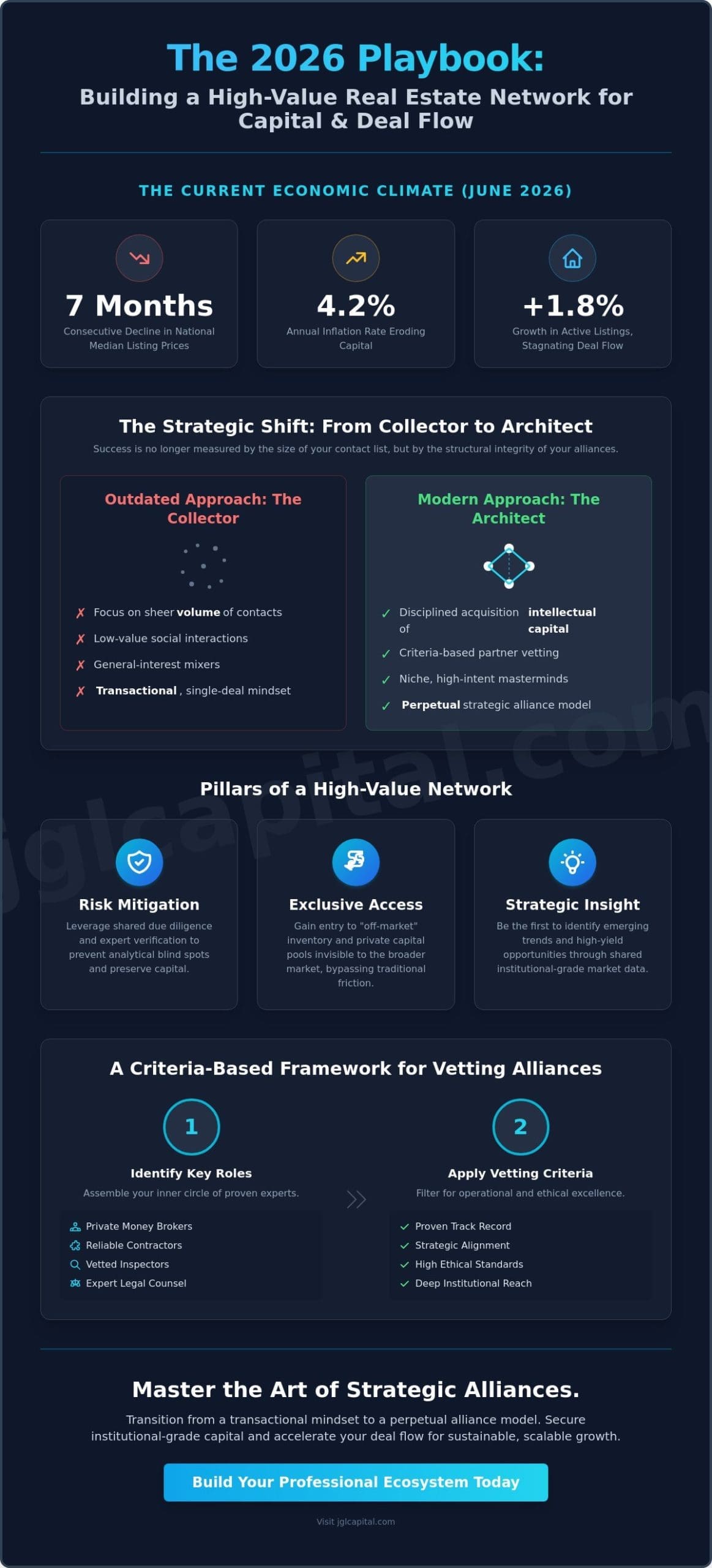
In an economic climate where national median listing prices have declined for seven consecutive months as of June 2026, the primary differentiator between a stagnant portfolio and a thriving enterprise is no longer the sheer volume of one’s contacts, but the structural integrity and strategic alignment of one’s alliances. While many practitioners search for standard real estate investor networking tips to expand their reach, the reality is that high-stakes management requires a more analytical and disciplined approach to relationship building. You likely recognize the inherent frustration of fragmented deal flow and the persistent difficulty of accessing reliable private capital in an environment where the annual inflation rate remains at 4.2 percent.
This article provides the necessary framework to master the disciplined art of building a high-value professional network that secures capital and accelerates deal flow. By moving beyond low-value social interactions, you can establish a rigorous methodology for vetting partners and gaining consistent access to institutional-grade lenders. We will explore the strategic integration of private money brokers and the long-term preservation of value through deliberate alliances that are designed to navigate the complexities of the 2026 regulatory landscape, including the significant FinCEN reporting requirements for non-financed residential purchases by legal entities.
Key Takeaways
- Understand networking as a disciplined acquisition of intellectual capital that serves to mitigate risk through shared due diligence and expert verification.
- Implement a criteria-based framework for vetting strategic alliances to ensure every partner in your professional inner circle aligns with your long-term growth objectives.
- Discover essential real estate investor networking tips for balancing digital reach with the irreplaceable impact of face-to-face interactions during high-stakes capital negotiations.
- Refine your investor profile and institutional pitch to present a low-risk, professional image to private money brokers and sophisticated lenders.
- Transition from a transactional, single-deal mindset toward a perpetual strategic alliance model that fosters sustainable and scalable portfolio expansion.
The Strategic Value of Networking in Modern Real Estate Markets
In the sophisticated environment of 2026, networking has transcended its former reputation as a mere social exercise. It’s now a disciplined acquisition of intellectual capital and a critical component of market positioning. For the serious practitioner, building a network isn’t about collecting business cards; it’s about the deliberate assembly of a strategic apparatus that provides a competitive advantage. This involves moving beyond surface-level interactions to cultivate deep-seated alliances that can weather the current annual inflation rate of 4.2 percent and the complexities of a rebalancing housing market. Utilizing advanced real estate investor networking tips allows an organization to secure a position where they’re the first to identify emerging trends and high-yield opportunities before they reach the broader market.
A robust network serves as a primary conduit for accessing “off-market” inventory and private capital pools that remain invisible to the uninitiated. These exclusive channels are essential for maintaining deal flow when active listings are only up 1.8 percent, as reported in June 2026. By aligning with sophisticated partners, investors can bypass the friction of traditional acquisition channels. Many of these professional synergies are formalized through Real Estate Investment Clubs, where the collective intelligence of the group facilitates the pooling of resources and the sharing of institutional-grade market data.
Networking as a Risk Mitigation Strategy
The primary function of a high-value network is the mitigation of risk through shared due diligence and expert verification. Diverse perspectives within a professional circle prevent the analytical blind spots that often lead to capital erosion during property evaluation. It’s essential to maintain a vetted roster of contractors, inspectors, and legal counsel whose reliability has been proven through repeated successful engagements. Furthermore, leveraging the expertise of compliance specialists such as AML Partners ensures that your network remains resilient against evolving global regulatory demands. Strategic networking is the deliberate alignment of professional objectives to ensure the preservation and growth of capital through collective rigor.
The 2026 Shift: Quality Over Quantity
The era of the large-scale, general-interest mixer has been replaced by niche, high-intent masterminds focused on specific asset classes and operational systems. This shift is a response to increased market volatility and the need for stable, institutional-grade partnerships that can withstand economic fluctuations. The return on investment for a professional relationship is now measured by the consistency of capital access and the quality of deal flow it generates. In this disciplined framework, real estate investor networking tips prioritize the depth of the alliance over the breadth of the contact list, ensuring that every interaction contributes to a lasting legacy of value creation.
Identifying and Vetting High-Value Strategic Alliances
Establishing a professional inner circle requires more than a cursory introduction; it demands a criteria-based framework that filters for intellectual alignment and operational excellence. While generic real estate investor networking tips often emphasize the sheer volume of contacts, sophisticated practitioners prioritize the rigorous vetting of every potential alliance. This process necessitates a clear distinction between service providers, who perform discrete tasks for a fee, and strategic partners, who are deeply invested in the long-term preservation of value. A disciplined steward understands that every addition to their ecosystem must reinforce their strategic objectives and mirror the commitment to analytical rigor exemplified by an institutional partner like JGL Capital LLC.
Private money brokers occupy a pivotal role in this ecosystem, serving as the essential bridge between high-yield opportunities and the capital required to secure them. Vetting these individuals involves a deep dive into their ethical standards and a methodical verification of their track record of execution. It isn’t enough to possess a broad reach; a partner must demonstrate a deep reach into institutional-grade resources and a history of navigating complex market cycles. As sophisticated investors build their network, they look for partners whose core philosophies align with the generation of worth through careful, deliberate action.
The Essential Pillars of an Investor Network
A resilient network is constructed upon several foundational disciplines that ensure the stability of high-stakes management:
- Private Money and Hard Money Lenders: These entities provide the liquidity necessary for fast-moving acquisitions, offering the agility required for Bridge Loans or fix and flip ventures.
- Real Estate Attorneys and Title Experts: These professionals ensure the legal integrity of every transaction, a function that has become increasingly critical following the March 2026 FinCEN reporting regulations for non-financed purchases.
- Asset Management Specialists: Their expertise is focused on optimizing performance metrics and ensuring long-term value preservation for diversified rental portfolios.
A Disciplined Approach to Due Diligence
Verifying a potential partner’s past performance is a non-negotiable component of the vetting process. This involves a methodical review of their institutional reputation and their history of successful execution on similar projects. During initial consultations, one should remain vigilant for red flags, such as a lack of transparency regarding fee structures or an inability to provide verifiable references. Professional integrity is the primary currency of real estate networking. By maintaining a high threshold for entry into your inner circle, you ensure that your strategic objectives remain uncompromised by substandard alliances.
Digital vs. Physical Networking: A Comparative Analysis
The modern real estate environment demands a sophisticated dual-channel approach to relationship management, balancing the broad-spectrum efficiency of digital platforms with the profound depth of physical interaction. While digital tools offer an unparalleled capacity for initial outreach and data gathering, they cannot fully replicate the nuanced trust required for high-stakes capital negotiations. A disciplined steward recognizes that while digital presence initiates the conversation, physical presence often secures the alliance. Integrating these two mediums requires a consistent, professional brand presence that projects stability and expertise across all networking channels, ensuring that every touchpoint reinforces the investor’s institutional reputation.
To optimize this balance, many practitioners are now utilizing AI-driven networking tools to filter for high-intent professional connections, effectively reducing the time wasted on low-value interactions. These systems analyze performance metrics and historical deal data to identify partners whose strategic objectives align with your own. By applying such analytical rigor to the selection process, you ensure that your efforts remain focused on alliances capable of generating significant worth. Using these advanced real estate investor networking tips transforms networking from a passive activity into a targeted business function that prioritizes quality over sheer volume.
Digital Networking for Market Research
Digital platforms serve as the primary mechanism for broad market research and the preliminary vetting of potential partners. A robust digital footprint is increasingly recognized among the essential skills for successful real estate investors, as it provides a verifiable record of professional history and intellectual capital. LinkedIn, in particular, allows for targeted outreach to hard money lenders and institutional partners, facilitating a level of granular precision that was previously unattainable. Specialized investor forums also play a critical role, offering real-time insights into national market trends and shifting investor sentiment, which are vital for maintaining a competitive edge in a rebalancing market.
Physical Events as High-Level Closing Environments
Despite the efficiency of digital outreach, physical events remains the superior environment for finalizing high-level strategic alliances and capital commitments. National real estate conferences should be selected based on their potential for maximum capital exposure and the presence of seasoned developers. These executive-level settings allow for the development of rapport through face-to-face dialogue, a process that is essential for establishing the security and trust required for large-scale ventures. Success in these environments is predicated on follow-up discipline. A methodical approach to post-event engagement ensures that initial introductions are converted into lasting, productive partnerships. By treating physical networking as a high-stakes closing environment, you solidify your position as a serious and disciplined participant in the national real estate market.
The Institutional Pitch: Networking for Capital Access
Securing capital within a professional network is an exercise in institutional positioning rather than simple persuasion. When implementing advanced real estate investor networking tips, the objective is to present a profile that signals the same stability and analytical rigor found at firms like JGL Capital LLC. In a market where the annual inflation rate is 4.2 percent, the margin for error is significantly reduced, making the clarity of your financial projections a primary indicator of professional competence. You aren’t merely a borrower seeking a transaction; you’re a disciplined steward of capital inviting a strategic partner to participate in a well-vetted opportunity. This distinction is vital for those seeking specialized funding, such as new construction loans, where the complexity of the development cycle requires a high degree of operational precision and transparency.
Communicating with Private Money Brokers
Private money brokers act as the essential gatekeepers to exclusive capital pools, and their primary concern is the “fundability” of the investor. They evaluate your experience, liquidity, and asset focus to determine if you meet the rigorous standards of their lending partners. To demonstrate consistent activity and operational success, it’s effective to present a documented pipeline of fix and flip loans or previous rental acquisitions. This historical data serves as a testament to your ability to execute under pressure and manage resources effectively, which is critical for establishing trust with sophisticated brokers.
Data-Driven Credibility
Credibility in the capital markets is built upon a foundation of verifiable performance metrics. Using past performance data to justify future capital requests allows you to build a case for your competence through a methodical presentation of facts. Transparency regarding project timelines, cost overruns, and actualized returns fosters a sense of security in your partners, reinforcing your position as a seasoned and discreet professional. The perfect pitch is a meticulously balanced articulation of asset potential and borrower reliability. If you’re ready to secure the capital necessary for your next acquisition, you can access institutional-grade Commercial Real Estate Loans through the strategic lending platform at JGL Capital LLC.
Cultivating Long-Term Partnerships for Scalable Growth
Transitioning from isolated, single-deal interactions to a perpetual strategic alliance model represents the final stage of professional maturation for the sophisticated investor. While the initial real estate investor networking tips discussed in previous sections focus on the identification and vetting of potential contacts, the ultimate objective is the cultivation of a relationship that transcends any single asset. JGL Capital LLC serves as a seasoned and discreet partner in national real estate ventures, providing the stability and intellectual capital necessary to navigate the intricacies of commercial real estate loans. By aligning your growth objectives with a lender that values integrity and long-term worth, you secure a foundation for scalable expansion that’s grounded in mutual responsibility and analytical rigor.
Execution requires precision. In an environment where the national unemployment rate stands at 4.3 percent and builder confidence remains suppressed, the ability to act with certainty is a significant competitive advantage. A disciplined steward understands that a network isn’t just a list of names; it’s a functional apparatus designed to preserve capital. It’s about moving away from the noise of the market to focus on the quiet expertise of established history. This commitment to timeless principles ensures that every strategic alliance contributes to the creation of a lasting legacy rather than a fleeting speculative gain.
The Value of a Reliable Capital Partner
A consistent relationship with a capital provider is a critical operational advantage, particularly when market conditions demand rapid execution on time-sensitive opportunities. When a partner understands your historical performance and investment criteria, the administrative friction traditionally associated with funding is significantly reduced. This efficiency is most evident when utilizing transitional capital, where a deep understanding of what is a bridge loan allows for the swift repositioning of assets without the delays of conventional underwriting. Trust, built over multiple successful cycles at JGL Capital LLC, transforms the lending process from an obstacle into a streamlined component of your acquisition strategy.
Building a Legacy Through Disciplined Alliances
The preservation and creation of value are best achieved through the collective expertise of a disciplined alliance. Choosing partners who prioritize the alignment of long-term objectives over short-term gains ensures that your portfolio remains resilient against broader economic shifts. This strategic approach to growth focuses on building a lasting legacy through careful, deliberate action. Real estate investor networking tips are most effective when they lead to a collaborative relationship that functions as a high-level strategic alliance rather than a simple service provision. Engage with JGL Capital LLC to discuss your strategic financing requirements.
Securing a Legacy of Value through Strategic Alliances
The 2026 real estate landscape demands that practitioners transcend transactional interactions in favor of a disciplined, criteria-based approach to relationship management. By integrating the analytical frameworks discussed, you position your enterprise as a low-risk, professional entity capable of securing the most competitive capital allocations. Implementing these real estate investor networking tips effectively bridges the gap between fragmented deal flow and institutional-grade funding, ensuring that every alliance contributes to the structural integrity of your portfolio. This transition from social networking to strategic capital allocation is the hallmark of a seasoned investor who’s committed to long-term value preservation.
JGL Capital stands ready to serve as your strategic ally, bringing over 30 years of industry expertise and national coverage to your commercial and residential investment projects. Our specialization in asset-based lending, coupled with a commitment to streamlined processing, provides the stability and agility necessary for high-stakes management. As you refine your approach to professional alliances, the alignment of your growth objectives with a partner that values integrity above all else will secure your competitive advantage. Connect with JGL Capital for professional real estate capital solutions. We invite you to build a lasting legacy through our collaborative and deeply invested approach to financing.
Frequently Asked Questions
How do I find high-value real estate networking events?
High-value events are identified by their focus on specific asset classes and their exclusion of speculative participants. You should prioritize national conferences hosted by institutional bodies or exclusive masterminds that require a verifiable track record for entry. These environments ensure that your time is invested among sophisticated partners who possess the intellectual capital and liquidity necessary for large-scale ventures.
What is the most effective way to follow up after a networking event?
Effective follow-up is a disciplined process that moves beyond pleasantries to address specific strategic objectives discussed during the initial encounter. A formal communication detailing a potential alignment of interests and proposing a follow-up consultation should be delivered within forty-eight hours. This methodical approach maintains the momentum of the engagement and reinforces your image as a serious, professional participant in the market.
How can a private money broker help expand my professional network?
A private money broker serves as a primary node in a professional ecosystem, offering access to sophisticated capital pools and vetted industry specialists. By leveraging their established history and intellectual capital, you can integrate into a network of institutional-grade service providers who prioritize the preservation of value. This relationship often facilitates introductions to legal experts and asset managers who are essential for scalable growth.
What information should I have ready when networking with lenders?
You should maintain a comprehensive investor profile that includes verifiable performance metrics, current liquidity positions, and a clear articulation of your acquisition strategy. Providing a documented pipeline of previous project successes signals a disciplined approach to risk management and borrower reliability. This level of preparation is essential for establishing the trust required for high-stakes capital commitments and favorable lending terms.
Is online networking as effective as in-person for real estate investors?
Online platforms are superior for broad-spectrum market research and preliminary outreach, whereas physical interactions remain the definitive environment for high-stakes negotiations. A dual-channel strategy utilizes digital footprints for pre-vetting potential partners and in-person events for finalizing strategic alliances. Utilizing sophisticated real estate investor networking tips across both mediums ensures a consistent professional presence that projects stability and expertise.
How do I vet a potential real estate partner for a joint venture?
Vetting involves a methodical review of a partner’s institutional reputation and their past performance on similar ventures. It’s critical to verify their ethical standards and ensure their core philosophies are perfectly aligned with your long-term growth objectives before formalizing any agreement. A criteria-based framework should be used to filter for partners who demonstrate a commitment to analytical rigor and value preservation.
What are the most common networking mistakes for real estate investors?
The most frequent error is adopting a transactional mindset that prioritizes immediate deal flow over the cultivation of long-term alliances. Many practitioners also fail by engaging in low-value social interactions that lack strategic intent or analytical rigor. By applying disciplined real estate investor networking tips, you avoid these pitfalls and focus on building high-value professional circles that contribute to the generation of worth.
How does networking impact my ability to secure bridge loans?
Robust networking establishes the trust and historical performance data necessary to secure Bridge Loans with minimal administrative friction. A capital partner who’s familiar with your operational strengths and strategic objectives can provide the liquidity required for rapid execution on time-sensitive acquisitions. This established history allows for a more streamlined underwriting process, which is vital for maintaining a competitive edge in a rebalancing market.