

In the sophisticated arena of real estate bridge financing, the traditional view of capital as a static barrier to entry has been replaced by a dynamic framework of risk-adjusted leverage. Understanding the nuanced fix and flip loan down payment requirements is no longer a matter of simple arithmetic; it’s a strategic necessity for those seeking to optimize their capital structures in a competitive market. Most seasoned investors recognize that opaque underwriting and the rigid constraints of traditional banking institutions often lead to capital being unnecessarily tied up in illiquid assets, hindering the pursuit of high-yield opportunities.
This guide provides a rigorous analysis of the current capital requirements and liquidity standards that define the 2026 lending environment. It’s designed to clarify how institutional lenders evaluate professional experience to determine leverage ratios and the specific liquidity benchmarks required to secure expedited, asset-backed funding. You’ll gain a comprehensive understanding of the mechanics involved in maximizing Loan-to-Cost ratios, ensuring that your capital remains a tool for growth rather than a dormant resource. By aligning your project’s viability with the sophisticated expectations of modern lenders, you can secure the flexible financing necessary to build a lasting legacy in the property sector.
Key Takeaways
- Identify how the transition from credit-centric to asset-based underwriting creates more sophisticated pathways for capital deployment in the 2026 market.
- Analyze the specific fix and flip loan down payment requirements to understand how “skin in the game” serves as a foundational element of institutional risk mitigation.
- Master the distinction between Loan-to-Value (LTV) and Loan-to-Cost (LTC) ratios to optimize the leverage available for both property acquisition and renovation phases.
- Execute a disciplined approach to underwriting by maintaining seasoned capital and providing the rigorous documentation required for institutional-grade approvals.
- Explore advanced capital stack strategies, such as gap funding and junior liens, to preserve liquidity and maximize the efficiency of your investment portfolio.
The Architecture of Capital: Understanding Fix and Flip Down Payments
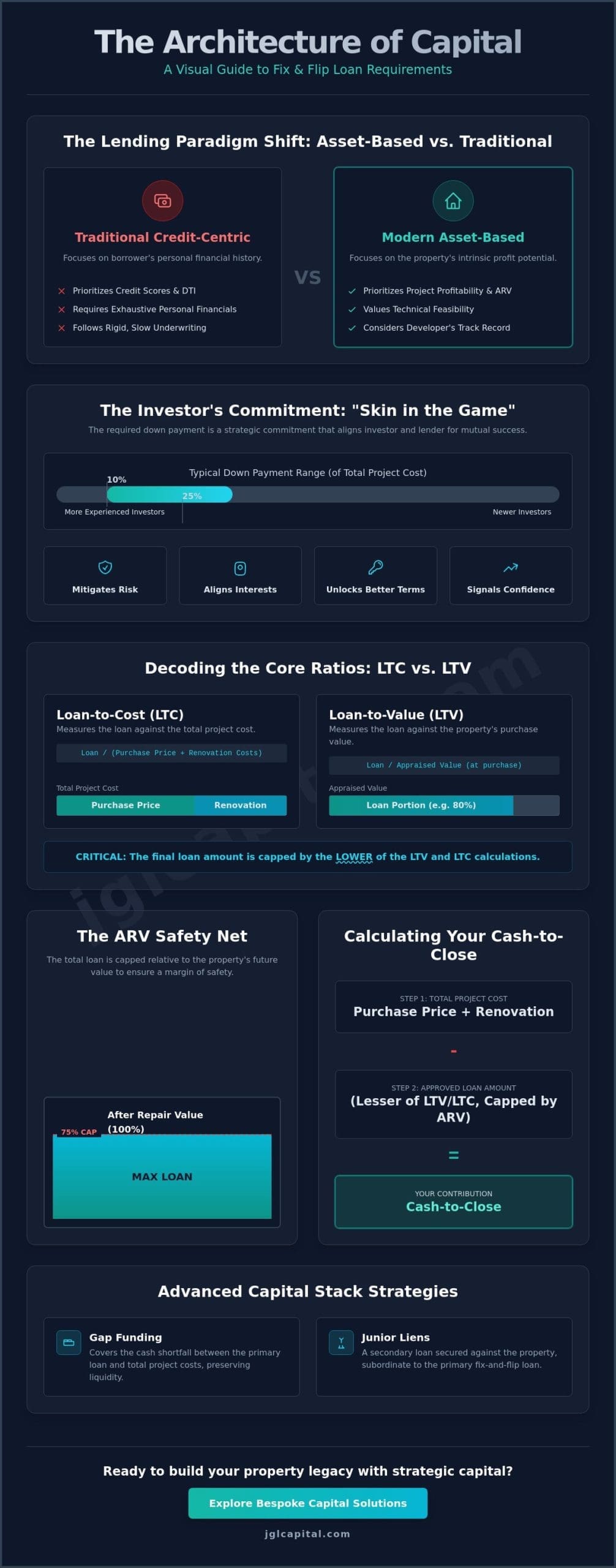
The structure of a fix and flip transaction is built upon a foundation of risk management and capital preservation. Within this framework, the fix and flip loan down payment requirements, which typically range from 10% to 25% of the total project cost depending on the developer’s profile, serve as a critical buffer between the lender’s capital and the inherent volatility of the short-term property market. This financial contribution isn’t viewed by institutional partners as a mere entry fee. Instead, it’s regarded as a strategic commitment that ensures the investor’s objectives remain perfectly aligned with the preservation of the asset’s value throughout the renovation cycle.
Modern private lending has undergone a significant evolution, moving away from the restrictive, credit-heavy models that define traditional retail banking. While conventional institutions often prioritize personal debt-to-income ratios and historical earnings, sophisticated asset-backed lenders focus their analytical rigor on the property’s intrinsic potential. This transition to asset-based underwriting allows for a more nuanced deployment of capital. In this environment, the feasibility of the project and the projected After Repair Value (ARV) take precedence over the borrower’s personal balance sheet. Professional developers often prioritize capital velocity over total equity ownership during the renovation phase. By utilizing leverage, they can distribute their available liquidity across multiple high-yield opportunities rather than concentrating their resources in a single project.
Asset-Based vs. Traditional Lending Requirements
Private money lenders operate with a disciplined focus on property performance rather than consumer credit metrics. In the context of real estate investing, the underlying collateral dictates the terms of the engagement. While traditional banks might demand exhaustive personal financial histories, institutional-grade fix and flip lenders prioritize the following metrics:
- The projected profitability and technical feasibility of the renovation plan.
- The accuracy of the market analysis supporting the ARV.
- The historical performance of the developer in executing similar scopes of work.
The Psychology of “Skin in the Game”
The requirement for a substantial initial capital contribution creates a symbiotic relationship between the investor and the financing partner. This “skin in the game” serves to mitigate moral hazard, ensuring that the developer remains disciplined in their management of timelines and budgets. When investors meet higher fix and flip loan down payment requirements, they often unlock more favorable interest rates and streamlined draw schedules. This correlation between capital contribution and project priority reflects a serious approach to value creation. The investor’s willingness to deploy their own resources signals a high degree of confidence in the project’s eventual success and its ability to withstand market fluctuations.
Calculating Leverage: The Interplay of LTV and LTC Ratios
Precision in capital deployment requires a rigorous understanding of how institutional lenders evaluate risk through the simultaneous application of multiple leverage ratios. While traditional mortgages rely heavily on the purchase price, professional Fix and Flip Loans utilize a dual-ratio framework consisting of Loan-to-Value (LTV) and Loan-to-Cost (LTC). LTV measures the debt relative to the property’s current appraised value at the time of acquisition, whereas LTC provides a broader view by including the total renovation budget within the capital stack. This distinction is vital because the total loan amount is almost always capped by the lower of these two figures, adjusted further by a ceiling based on the projected After Repair Value (ARV).
The final fix and flip loan down payment requirements are determined by a formula that balances these ratios against the lender’s exposure limits. In the 2026 market, most disciplined lenders cap their total commitment at 75% of the ARV to maintain a conservative margin of safety. To find your required cash-to-close, you must subtract the approved loan amount from the total project cost, which includes the purchase price, renovation expenses, and closing fees. This methodical approach ensures that every participant has a clear understanding of the capital necessary to bring a project to fruition. For those seeking to optimize these ratios, consulting with a strategic partner can provide clarity on available leverage for specific asset classes.
Experience-Based Tiering and Leverage
Institutional lenders categorize developers into tiers based on their historical performance and volume. Those who can document five or more successful exits within the preceding 24 months often qualify for the most aggressive leverage, sometimes requiring as little as 10% of the total project cost. Conversely, first-time developers face a novice premium. These individuals should anticipate bringing 20% to 25% of the total cost to the closing table. Diligent documentation of your portfolio is the most effective way to migrate between these tiers and reduce your initial capital outlay.
The Impact of Renovation Scope on Down Payment
The complexity of the proposed renovation significantly influences the final leverage offered. Cosmetic flips, involving non-structural upgrades like flooring and cabinetry, are viewed as lower-risk endeavors and typically allow for maximum LTC ratios. Structural projects, such as additions or foundation work, introduce variables that may cause a lender to reduce the available leverage or require higher interest reserves. Balancing the purchase price leverage with a well-structured construction draw schedule is essential to maintaining liquidity throughout the project’s lifecycle.
Strategic Alternatives: Minimizing the Initial Cash Outlay
For the strategic investor, the primary objective often involves the preservation of liquid capital to facilitate a rapid response to emerging market opportunities. While the standard fix and flip loan down payment requirements suggest a significant upfront cash commitment, sophisticated capital structures allow for the mitigation of this initial outlay through the strategic use of subordinate debt or asset-backed alternatives. Utilizing gap funding or junior liens within the capital stack can effectively bridge the distance between institutional leverage and the total acquisition cost; this allows for a more efficient allocation of resources across a broader portfolio. By leveraging other people’s money to cover the initial 10% to 20% of the project cost, developers can maintain the capital velocity necessary for institutional-scale operations.
Cross-Collateralization Strategies
Cross-collateralization represents a sophisticated mechanism for developers with established portfolios to bypass traditional cash requirements. By utilizing the existing equity in a rental portfolio or other investment properties, a borrower can secure 100% financing for a new acquisition through a blanket lien. This strategy effectively replaces the cash down payment with a secondary security interest in a performing asset. However, a disciplined risk assessment is necessary; over-leveraging multiple assets simultaneously can create systemic vulnerability if market conditions shift or exit timelines extend beyond the original projections.
Seller Financing and Subordinate Debt
Negotiating with a property owner to carry a portion of the purchase price as a second mortgage can significantly reduce the cash-to-close requirement. This seller carry-back acts as subordinate debt, sitting behind the primary fix and flip loan. It’s essential to understand that institutional lenders require full disclosure of these arrangements during the underwriting process. Professional lenders don’t permit “silent” seconds, as they must evaluate the total debt service obligations of the project. When properly structured and disclosed, combining private money with seller financing creates a highly efficient capital stack that maximizes the developer’s return on equity.
Even when a developer successfully utilizes these high-leverage strategies, maintaining a robust liquidity buffer remains a hallmark of disciplined management. Capital should be reserved for unforeseen holding costs, interest reserves, and construction contingencies that may arise during the renovation phase. Relying exclusively on external leverage without a secondary cash reserve introduces unnecessary fragility into the investment model. The most successful partners in the 2026 market are those who balance aggressive capital efficiency with the stability of a well-funded balance sheet, ensuring that every project has the necessary resources to reach a profitable exit.
Underwriting Rigor: Preparing Your Balance Sheet for Approval
Securing institutional trust during the financing process requires a transparent and meticulous presentation of one’s financial position. While meeting the fix and flip loan down payment requirements is a foundational hurdle, sophisticated lenders look beyond the mere presence of capital to evaluate its stability and source. Underwriters prioritize “seasoned funds,” which refers to capital that has resided in the borrower’s accounts for a minimum of 60 to 90 days. This requirement ensures that the down payment is not the result of an undisclosed, short-term loan that could compromise the project’s debt service capacity. A professional executive summary, detailing the developer’s track record and the specific milestones of the proposed project, serves as the primary vehicle for establishing this institutional-grade credibility.
Beyond the initial acquisition capital, a disciplined borrower must demonstrate the presence of interest reserves and construction buffers. These “rainy day” funds, often required to cover six months of holding costs, protect the project from the friction of unforeseen delays or market shifts. Presenting a comprehensive balance sheet that accounts for these contingencies signals to the lender that the investor is a disciplined steward of capital. If you are ready to demonstrate your project’s viability, you can apply for professional-grade financing to begin the formal underwriting process.
Liquidity vs. Net Worth
Institutional underwriters draw a sharp distinction between total net worth and immediate liquidity. A high net worth anchored in illiquid assets, such as undeveloped land or restricted equity, does not satisfy the immediate cash requirements of a fix and flip transaction. Lenders seek “Cash Equivalents,” which include unrestricted bank balances, money market accounts, or accessible brokerage totals. For developers looking to preserve cash, utilizing a Securities-Backed Line of Credit (SBLOC) or a 401k loan can provide the necessary liquidity without necessitating the liquidation of long-term investment positions.
The Project Feasibility Study
A rigorous feasibility study is essential for mitigating perceived risk and securing maximum leverage. This study must include a granular, line-item construction budget that accounts for every phase of the renovation, from demolition to final finishes. Lenders validate these projections through third-party appraisals and Broker Price Opinions (BPOs) to ensure the project’s economics are grounded in current market data. The After Repair Value serves as the definitive anchor for all leverage calculations and risk assessments within the capital stack.
JGL Capital: Bespoke Capital Solutions for Strategic Investors
JGL Capital LLC functions as a disciplined steward of private capital, specifically tailored for the requirements of sophisticated real estate developers who demand analytical rigor and institutional stability. Unlike conventional lenders that remain tethered to rigid, consumer-grade credit metrics, our underwriting philosophy prioritizes the intrinsic value of the property and the overall viability of the project. This shift in perspective allows for a more fluid deployment of capital, ensuring that strategic objectives are met without the bureaucratic friction often encountered in traditional finance. With three decades of industry expertise, JGL Capital LLC provides the intellectual capital necessary to navigate complex market conditions and streamline the path to a successful closing.
Our approach to fix and flip loan down payment requirements is characterized by a commitment to customized solutions that align with the long-term investment objectives of our partners. We understand that every project presents a unique set of variables, and our role is to provide the flexible, asset-backed financing necessary to capitalize on those opportunities. By framing our activities as a high-level strategic alliance, JGL Capital LLC distinguishes itself from transactional competitors who lack the depth of experience required to handle high-stakes property management. Every decision we make is grounded in a serious and disciplined approach to the creation and preservation of value.
The JGL Advantage in Fix and Flip Financing
Investors who partner with JGL Capital LLC gain access to expedited, asset-backed loans that bypass the inherent delays of conventional banking systems. We maintain a transparent fee structure and a steady communication rhythm, fostering a collaborative relationship built on trust and shared objectives. For developers seeking regional expertise, our analysis of Fix and Flip Loans in Florida provides critical context for one of the nation’s most active investment corridors. This localized knowledge, combined with our institutional strength, ensures that your capital structure is optimized for the specific demands of the current market.
Initiating Your Strategic Alliance
The process of securing professional-grade financing begins with a streamlined application designed for efficiency and precision. During the initial consultation, our experts conduct a thorough evaluation of the property and the proposed renovation plan to determine the most effective leverage ratios. We focus on the alignment of objectives, ensuring that the fix and flip loan down payment requirements and draw schedules are structured to support the project’s successful completion. To begin this collaborative journey, you are invited to engage with JGL Capital LLC to secure your next investment project and experience the benefits of a partnership rooted in integrity and expertise.
Optimizing Asset Leverage for Sustained Growth
The successful execution of property development in the 2026 market necessitates a rigorous approach to capital structure and resource allocation. By mastering the nuances of fix and flip loan down payment requirements, sophisticated investors can transition from basic market participation to high-level strategic asset management. We’ve analyzed how a disciplined balance sheet and a focus on After Repair Value (ARV) establish the foundation for institutional trust. This analytical framework ensures that your resources aren’t just deployed; they’re optimized for maximum velocity and the preservation of long-term worth.
JGL Capital LLC stands as a seasoned partner for those who value integrity and intellectual capital over speculative trends. Our firm brings over 30 years of industry expertise in private capital allocation to every transaction. We utilize asset-based underwriting that focuses on project worth rather than traditional credit scores, providing a national reach with a disciplined, institutional approach to lending. We invite you to Partner with JGL Capital LLC for Professional Fix and Flip Financing and begin a collaborative alliance designed to build lasting legacies. Your vision for professional-grade development deserves a partner with the expertise to bring it to fruition.
Frequently Asked Questions
What is the minimum down payment for a fix and flip loan in 2026?
The minimum down payment for a fix and flip loan in 2026 generally ranges between 10% and 20% of the total project cost. Experienced developers with a documented history of successful exits often secure the lower end of this range, while those with limited history should anticipate a requirement closer to 25%. This capital serves as essential risk mitigation, ensuring the interests of the investor and the financing partner remain aligned throughout the renovation cycle.
Can I use a HELOC for the down payment on a fix and flip property?
Utilizing a Home Equity Line of Credit (HELOC) for a down payment is a standard method to unlock liquidity from existing residential assets. Lenders typically permit this practice provided the additional debt service doesn’t compromise the project’s overall financial viability. During the underwriting process, you must disclose the source of these funds to maintain transparency and ensure that the total leverage across your portfolio remains within institutional risk parameters.
How does my credit score affect the down payment requirement?
A borrower’s credit score directly influences the tiering of fix and flip loan down payment requirements by serving as a proxy for financial discipline. Scores above 700 often unlock maximum leverage and reduced interest rates, whereas scores below 650 may necessitate an increased initial capital contribution of 25% or more. While asset-based lending prioritizes property value, your credit history remains a secondary indicator of reliability that informs the final risk-adjusted terms.
Is it possible to get a fix and flip loan with zero money down?
Achieving a zero-down transaction is possible through the strategic application of cross-collateralization against other properties with significant equity. By providing a blanket lien on multiple investment assets, a developer can effectively substitute a cash down payment with additional collateral. This approach requires a sophisticated understanding of portfolio leverage and a disciplined assessment of the risks associated with encumbering multiple assets for a single project.
Do lenders require me to have cash reserves after the down payment?
Lenders strictly require borrowers to maintain cash reserves to cover holding costs, interest payments, and unforeseen construction contingencies. These reserves, typically equivalent to six months of carrying costs, ensure that the project remains solvent even if the renovation timeline extends beyond the original projections. Demonstrating this liquidity is a prerequisite for institutional approval, as it signals a serious and disciplined approach to project management.
What documents are required to prove funds for a fix and flip loan?
Proof of funds is established through the provision of bank statements, brokerage account summaries, or formal letters of credit that document accessible liquidity. Institutional lenders prioritize seasoned funds that have remained in the account for 60 to 90 days to verify the stability of the capital. This documentation must clearly demonstrate that the investor possesses the necessary resources to meet fix and flip loan down payment requirements and closing costs without external reliance.
How does the experience of the investor change the loan-to-cost (LTC) ratio?
A developer’s historical performance significantly dictates the Loan-to-Cost (LTC) ratio, with more experienced investors qualifying for higher leverage. Those who can document five or more successful exits often secure up to 90% of the total project cost, whereas novices are frequently limited to 75% or 80%. This tiering reflects the lender’s confidence in the borrower’s ability to manage complex renovations and achieve the projected After Repair Value.
Can I use a business partner’s capital for the down payment?
Utilizing a business partner’s capital for the down payment is a permissible and common strategy for diversifying the financial burden of an investment. This arrangement is typically structured through a formal Operating Agreement or a partnership entity that clearly defines the roles and capital contributions of each stakeholder. Lenders will evaluate the financial standing of all principal partners to ensure the collective balance sheet meets the rigorous standards required for asset-backed financing.