

The institutionalization of the residential rental market has rendered traditional mortgage products nearly obsolete for the disciplined investor seeking to compete against well-capitalized cash buyers. Securing a hard money loan for first rental property acquisitions represents a strategic pivot from debt-burdened personal liabilities toward sophisticated, asset-based wealth generation. You understand that the rigid debt-to-income requirements and protracted approval cycles of conventional banking institutions often result in the loss of high-yield opportunities to more agile market participants. This guide offers a rigorous analysis of how private capital serves as a bridge to long-term stability and portfolio expansion.
This discussion provides a comprehensive framework for navigating the 2026 lending environment, including the recent FinCEN reporting mandates and shifting interest rate benchmarks. We’ll explore the mechanics of asset-based collateral and how these structures allow for rapid capital deployment without the constraints of traditional underwriting. By the conclusion of this analysis, you’ll possess the intellectual capital necessary to leverage private debt as a deliberate tool for the creation and preservation of generational value. We’ll move from high-level strategic objectives to the specific operational strengths required to scale your portfolio with precision.
Key Takeaways
- Understand how a hard money loan for first rental property acquisitions functions as a high-velocity capital vehicle, allowing investors to bypass the inertia of traditional banking.
- Shift your focus from personal credit metrics to asset-based underwriting, where the intrinsic value of the collateral dictates the terms of the engagement.
- Learn to align your financing structure with the specific lifecycle of the asset, utilizing private capital for the acquisition phase before transitioning to long-term debt.
- Master the institutional framework for presenting deals, ensuring your executive summary reflects the analytical rigor required by elite private lenders.
- Recognize the importance of a strategic alliance with a disciplined lending partner to maintain liquidity and ensure scalability in volatile market conditions.
The Strategic Role of Hard Money in First-Time Rental Acquisitions
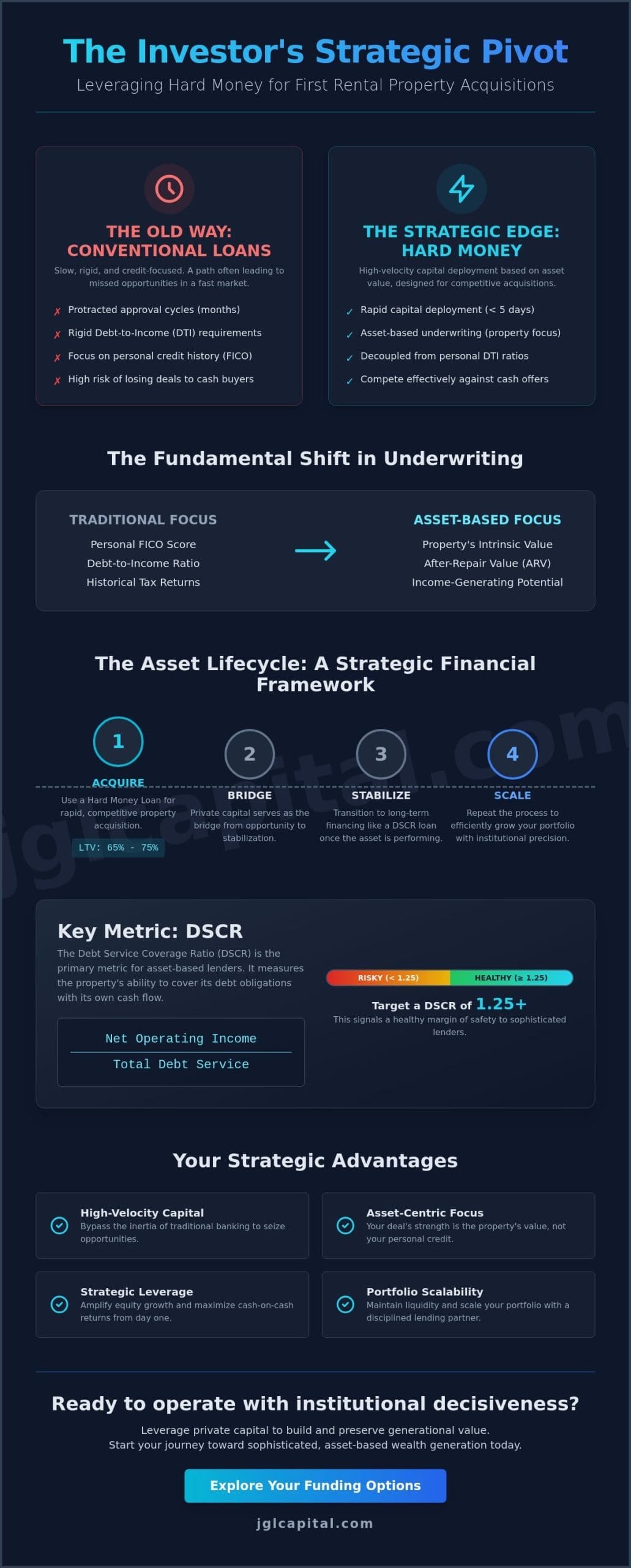
The acquisition of income-generating assets requires a sophisticated understanding of capital structures that prioritize property performance over individual history. For the serious professional, a hard money loan for first rental property acquisition serves as a high-velocity, asset-backed vehicle designed for rapid deployment. This methodology marks a fundamental departure from traditional, credit-centric borrowing. Instead, it emphasizes property-centric capital allocation, where the intrinsic value and potential of the collateral dictate the viability of the transaction. In a market characterized by institutional competition, the ability to decouple financing from personal debt-to-income ratios is a prerequisite for scaling a meaningful portfolio.
Hard Money vs. Conventional Mortgages
Traditional banking institutions often lack the agility required to compete in the 2026 real estate market, where high-quality assets are frequently secured in less than five business days. The standard 30-year fixed mortgage, while useful for long-term stabilization, imposes rigid debt-to-income requirements and approval timelines that can span several months. This hard money loan overview illustrates how private capital bridges the gap between asset identification and final acquisition. While these vehicles carry higher interest rates, the cost isn’t prohibitive when compared to the opportunity cost of losing a high-yield asset to a cash-ready competitor. The institutional advantage lies in the speed of due diligence, focusing on the asset’s after-repair value rather than the borrower’s historical tax returns.
The Utility of Leverage for Emerging Portfolios
Leverage is the strategic use of debt to amplify equity growth. By utilizing private capital, investors can maximize their cash-on-cash returns from the inception of the project. A hard money loan for first rental property allows for a more efficient distribution of personal liquidity across multiple assets rather than concentrating capital in a single down payment. This capital efficiency is vital for investors aiming to build a diversified portfolio in a high-interest environment. Maintaining balanced Loan-to-Value (LTV) ratios, typically between 65% and 75%, is essential for project stability and risk mitigation. This disciplined approach ensures that the investor retains sufficient liquidity to address unforeseen operational requirements while benefiting from the accelerated equity growth that only professional leverage can provide. Strategic use of these tools allows an emerging investor to operate with the same decisiveness as a seasoned institutional fund.
Transitioning to Asset-Based Underwriting: Beyond Personal Credit
The core philosophy of asset-based lending resides in the prioritization of the collateral over the individual borrower. While traditional institutions often focus on FICO scores and debt-to-income (DTI) ratios, private capital markets view the transaction through a commercial lens. This approach allows first-time investors with modest credit profiles to secure funding by presenting high-potential real estate assets. The diminishing relevance of personal DTI ratios in this space is a hallmark of hard money in real estate investing. Sophisticated lenders prioritize the intrinsic value and income-generating potential of the target property above all else. When evaluating a hard money loan for first rental property acquisition, the underwriting process shifts its gaze from the individual’s past to the property’s future.
Analyzing the Debt Service Coverage Ratio (DSCR)
The Debt Service Coverage Ratio (DSCR) serves as the primary metric for determining the viability of a rental property. It measures the property’s ability to cover its debt obligations using its own cash flow. Specifically, it’s the ratio of Net Operating Income (NOI) to the total debt service. A property with a DSCR of 1.25 or higher generally signals a healthy margin of safety. This metric allows an investor to qualify regardless of personal employment status or salary, as the asset itself generates the necessary liquidity. Finding the “break-even” point, where the DSCR is 1.0, is critical for ensuring a sustainable long-term hold strategy. Investors who understand this calculation can present deals that speak the language of institutional capital.
The Role of Professional Appraisals in Private Lending
Underwriting in the private sector relies heavily on the distinction between the current market value and the After-Repair Value (ARV). A disciplined appraisal process protects both the investor and the capital provider by validating the underlying investment thesis with institutional-grade data. While traditional banks might only consider the purchase price, an asset-based rental property loan often accounts for the value created through strategic renovations. Utilizing a hard money loan for first rental property entry requires a meticulous evaluation of these figures to ensure the project remains solvent after construction costs. Professional appraisals provide the empirical evidence needed to justify the leverage. This rigorous due diligence minimizes the impact of personal financial history on the funding outcome, focusing instead on these key factors:
- ARV Validation: Ensures the property’s projected value supports the exit strategy.
- Market Rent Analysis: Confirms the property meets or exceeds minimum DSCR requirements.
- Collateral Integrity: Evaluates the physical condition and structural viability of the asset.
By shifting the focus to these property-centric metrics, the emerging investor can bypass the rigid barriers of conventional finance. This transition is not merely a change in paperwork; it’s an adoption of a professional investment mindset that values performance over personal history. For those who value this level of professional rigor, Jackson-Wagner LLC provides a similarly disciplined methodology for mastering complex legal examinations, reflecting the commitment to excellence required in high-stakes real estate.
Evaluating Financing Vehicles: Hard Money vs. DSCR Loans
The sophisticated investor recognizes that capital is not a monolithic resource; rather, it’s a tool that must be meticulously calibrated to the specific lifecycle of the underlying asset. When securing a hard money loan for first rental property acquisitions, the primary objective is often the rapid capture and rehabilitation of a distressed or undervalued property. This initial phase, frequently referred to as the “Buy and Rehab” component of the BRRRR strategy, demands a high-velocity capital vehicle that prioritizes speed over the lower interest rates associated with permanent financing. Once the property is stabilized and tenanted, the strategic transition to a long-term Debt Service Coverage Ratio (DSCR) loan ensures the preservation of equity and the optimization of monthly cash flow. This progression from transitional to permanent capital is the hallmark of a disciplined investment framework.
Bridge Loans for Rapid Acquisition
In highly competitive bidding environments, the ability to deploy capital with institutional speed provides a decisive advantage over retail buyers who remain reliant on conventional mortgage approvals. Utilizing bridge loans allows the emerging investor to secure assets that might otherwise be lost during protracted due diligence cycles. These transitional capital structures are designed to be temporary. They serve as a tactical bridge until the property meets the stabilization requirements of permanent lenders. Structuring this transition with precision is essential for minimizing interest carry costs. It ensures a seamless move toward a long-term hold without the friction common in traditional banking transitions.
Long-Term Rental and Multi-Family Structures
As portfolios expand, the integration of multi-family loans offers a scalable path for those seeking commercial-grade entry points from the outset. These structures often provide the benefit of non-recourse debt, which serves as a critical mechanism for personal wealth preservation by limiting the lender’s recovery to the property itself in the event of a default. This protection is a significant advantage for the high-net-worth stakeholder. For investors interested in long-term growth, aligning a hard money loan for first rental property projects with future new construction financing can create a disciplined framework for sustained value creation. This approach moves beyond simple acquisition. It frames each transaction as a component of a larger, institutional-grade investment strategy designed to build lasting legacies through careful, deliberate action.
The Institutional Path to Funding: A Meticulous Acquisition Framework
Navigating the capital markets requires a disciplined approach to deal presentation that mirrors the standards of institutional funds. For the emerging investor, securing a hard money loan for first rental property acquisitions depends on the ability to articulate a deal’s merits with analytical rigor. Elite private money brokers utilize a streamlined due diligence process designed to identify high-potential assets while minimizing the administrative friction common in retail banking. This framework prioritizes the property’s performance metrics and the investor’s exit strategy. Understanding that points and fees represent a necessary cost of capital is essential for professional growth. These costs are investments in the speed and scalability required to maintain a competitive edge in volatile markets.
The Streamlined Underwriting Timeline
The path from submission to funding is characterized by three distinct phases of professional oversight. This methodical progression ensures that every risk is quantified and every strategy is clearly defined.
- Step 1: Submission and Preliminary Analysis: The process begins with the presentation of a property-specific term sheet. This document outlines the acquisition price, renovation budget, and projected after-repair value.
- Step 2: Rapid Collateral Valuation: Once the initial thesis is validated, the lender initiates a rapid collateral valuation and title verification. This step ensures the integrity of the asset and confirms that the collateral meets the required Loan-to-Value (LTV) benchmarks.
- Step 3: Final Execution and Funding: The final phase involves the preparation of closing documents and the deployment of capital. This expedited funding allows the investor to close on the asset with the same decisiveness as a cash buyer.
Essential Documentation for Professional Investors
While the focus remains on the asset, certain documentation is required to establish the legal and financial framework of the transaction. Utilizing an LLC or corporate entity has become the standard for professional real estate investing. This structure provides a layer of separation between personal liabilities and investment assets, which is a core principle of wealth preservation. A hard money loan for first rental property projects typically requires a Purchase and Sale Agreement alongside detailed financial projections. By focusing on property-centric data, the investor can minimize the burden of personal financial disclosures. This specialized approach allows for a faster closing cycle and a more professional relationship with the capital provider. Secure your capital through a strategic lending alliance that values precision and efficiency above all else.
Cultivating a Strategic Alliance for Portfolio Scalability
The selection of a capital provider should never be reduced to a cursory comparison of interest rates. For the professional investor, the reliability and execution certainty of a lending partner far outweigh marginal variances in basis points. In the volatile capital markets of 2026, the role of a private money broker is to serve as a strategic steward who ensures consistent liquidity when traditional channels constrict. Utilizing a hard money loan for first rental property acquisitions is merely the initial step in a broader capital allocation strategy. By leveraging thirty years of institutional expertise, investors can access highly customized solutions that align with their specific risk profiles and long-term objectives. Building this scalable relationship is the foundation for acquiring subsequent assets with increasing efficiency. This collaborative approach distinguishes the firm from transactional competitors who prioritize volume over the generation of worth. For industry partners who wish to support this ecosystem of professional growth, you can explore Vendor Exhibition and Sponsorship Fees for the Los Angeles Real Estate Grand Expo.
The Value of Institutional Pedigree
Accessing an institutional pedigree provides entry to a diverse range of programs, including fix and flip loans and new construction financing. A partner who understands the strategic alignment of capital and asset allows the emerging investor to transition into the role of a seasoned developer. This evolution is supported by a consistent flow of private capital that adapts to the shifting requirements of a growing portfolio. The firm acts as a disciplined steward, valuing long-term growth and integrity above all else. This persona of a quiet expert relies on intellectual capital rather than aggressive self-promotion to build lasting legacies. By securing a hard money loan for first rental property through a partner with deep-seated expertise, the investor gains a competitive advantage that scales alongside their ambitions.
Securing Your Investment Legacy
Reframing debt as a strategic instrument is essential for the creation of generational wealth. Disciplined capital allocation in a high-stakes environment demands a rejection of speculative trends in favor of timeless investment principles. This philosophy ensures that every transaction is a deliberate action toward a larger mission of value preservation. The communication of these strategic objectives requires a measured and steady rhythm, mirroring a patient approach to long-term wealth. By viewing financing as a form of high-level strategic alliance, the investor moves beyond simple service provision toward a deeply invested partnership. Consult with the experts at JGL Capital to secure your first investment and establish a rigorous framework for enduring value.
Establishing a Foundation for Long-Term Portfolio Growth
The transition from an individual borrower to a disciplined real estate professional requires a fundamental shift in capital procurement. By utilizing a hard money loan for first rental property acquisitions, you’ve established a mechanism for rapid growth that operates independently of traditional banking constraints. This methodology prioritizes the intrinsic worth of the collateral and the analytical rigor of your investment thesis. It’s about more than just immediate funding; it’s about the strategic alignment of capital with your long-term vision for wealth preservation and equity growth. Each acquisition serves as a cumulative step toward a more sophisticated and resilient portfolio.
Success in the 2026 market demands a partner with the intellectual capital to navigate complex regulatory shifts and volatile interest rate environments. JGL Capital provides a streamlined asset-based underwriting framework that allows for the precise deployment of capital across a national reach. With over 30 years of strategic industry expertise, the firm offers institutional-grade capital access tailored to the unique requirements of your emerging portfolio. Partner with JGL Capital for your investment financing needs to ensure your first income-generating asset becomes the cornerstone of a lasting legacy. You’re now equipped to move forward with the confidence that comes from professional stewardship.
Frequently Asked Questions
Is it possible to secure a hard money loan for a first rental property with no prior experience?
Yes, securing a hard money loan for first rental property acquisitions is achievable for emerging investors without an extensive transactional history because the underwriting is primarily property-centric. Lenders prioritize the asset’s after-repair value and income potential rather than the borrower’s historical resume. This structure allows disciplined individuals to leverage high-potential collateral to enter the market with institutional support.
What is the typical down payment required for a first-time investment property loan in 2026?
In the 2026 lending environment, the typical down payment for a first-time investment property loan ranges from 25% to 35% of the property’s value. This requirement mirrors the current Loan-to-Value (LTV) ratios of 65% to 75% offered by sophisticated private capital providers. These structures ensure that the project remains well-capitalized while protecting the interests of all stakeholders through a serious approach to risk management.
How does a DSCR loan differ from a traditional residential mortgage for rental properties?
A DSCR loan differs from a traditional mortgage by utilizing the property’s Net Operating Income to qualify the debt rather than the borrower’s personal debt-to-income ratio. Traditional residential products rely on personal tax returns and employment history, which can limit scalability for real estate professionals. DSCR underwriting ensures that the asset’s cash flow is sufficient to cover the debt service, regardless of the borrower’s personal salary.
Can I use a bridge loan to acquire a rental property and refinance later?
Utilizing a bridge loan to acquire a rental property with the intent to refinance later is a standard strategic framework for professional portfolio expansion. This approach provides the high-velocity capital needed for acquisition and rehabilitation before transitioning to long-term, stabilized financing. It’s an effective tool for investors who need to secure assets quickly in competitive bidding environments where traditional banking timelines are insufficient.
What are the primary advantages of utilizing private money over conventional bank financing?
The primary advantages of private money include institutional speed, flexible asset-based underwriting, and the ability to secure distressed properties that conventional banks often reject. Private capital allows investors to operate with the agility of cash buyers, which is critical in a market where timing dictates the success of a transaction. This methodology decouples the funding process from personal credit constraints and focuses on the generation of worth.
How quickly can JGL Capital close a hard money loan for a new investment property?
JGL Capital maintains a streamlined due diligence process that allows for expedited funding, typically closing transactions in as little as three to five business days. This professional precision is achieved through a meticulous underwriting framework that prioritizes collateral integrity and analytical rigor. It ensures that capital is deployed with the speed required to meet the demands of high-stakes real estate management and acquisition.
Do I need to form an LLC before applying for a private money investment loan?
Forming an LLC or corporate entity is a professional standard for investors seeking private money investment loans and is often a prerequisite for institutional-grade capital. This structure serves as a mechanism for wealth preservation and limits personal liability to the assets held within the entity. It aligns with the commercial nature of asset-based lending protocols and signals a disciplined approach to the creation of value.
What happens if the property appraisal comes in lower than the purchase price?
If a property appraisal is lower than the purchase price, the loan amount is adjusted based on the established Loan-to-Value ratio of the appraised figure. The investor must then either renegotiate the acquisition price with the seller or provide additional equity to cover the capital gap. This disciplined appraisal process serves as a necessary safeguard to ensure the project remains financially viable and grounded in analytical reality.