

The assumption that a missed payment signifies the inevitable loss of a property is a common misconception that ignores the nuanced reality of distressed asset management. You’re likely concerned about the immediate legal ramifications and the potential for punitive interest rates to consume your equity; it’s an unsettling position to occupy, especially as commercial mortgage delinquency rates reached 4.02% in early 2026. Understanding what happens if you default on a hard money loan is essential for protecting your personal credit and your broader investment strategy from unnecessary volatility.
This strategic analysis serves as an institutional-grade guide to the consequences of default, prioritizing the preservation of capital over reactive decision-making. We’ll provide a meticulous breakdown of the foreclosure timeline, alongside sophisticated strategies for loan modifications or extensions that can mitigate long-term damage. You’ll gain a comprehensive understanding of how to manage these high-stakes scenarios with the discipline and clarity required to protect your financial legacy.
Key Takeaways
- Distinguish between technical and monetary defaults to understand how specific contractual breaches trigger lender intervention beyond simple payment delays.
- Map the procedural progression from initial delinquency to the formal acceleration of debt to identify critical windows for strategic response.
- Quantify the financial impact of default interest rates and legal fees to understand exactly what happens if you default on a hard money loan and how it affects your remaining equity.
- Explore professional mitigation strategies such as forbearance agreements and loan modifications to align distressed assets with revised project timelines.
- Evaluate the long-term implications for your institutional reputation to ensure continued access to high-leverage capital for future investment cycles.
Understanding the Contractual Anatomy of a Hard Money Loan Default
A comprehensive hard money loan overview reveals that these instruments are fundamentally asset based, yet they’re governed by a dual layered legal structure that dictates the trajectory of a distressed scenario. To understand what happens if you default on a hard money loan, one must first deconstruct the specific contractual obligations that bind the borrower to the lender. While the physical property represents the primary security, the legal mechanisms of the Promissory Note and the Deed of Trust create a multifaceted environment where even minor deviations from the agreed upon terms can trigger significant institutional responses. Asset based lenders prioritize the preservation of the underlying property value above all else, as their primary responsibility is the stewardship of capital and the mitigation of downside risk.
Monetary vs. Technical Defaults
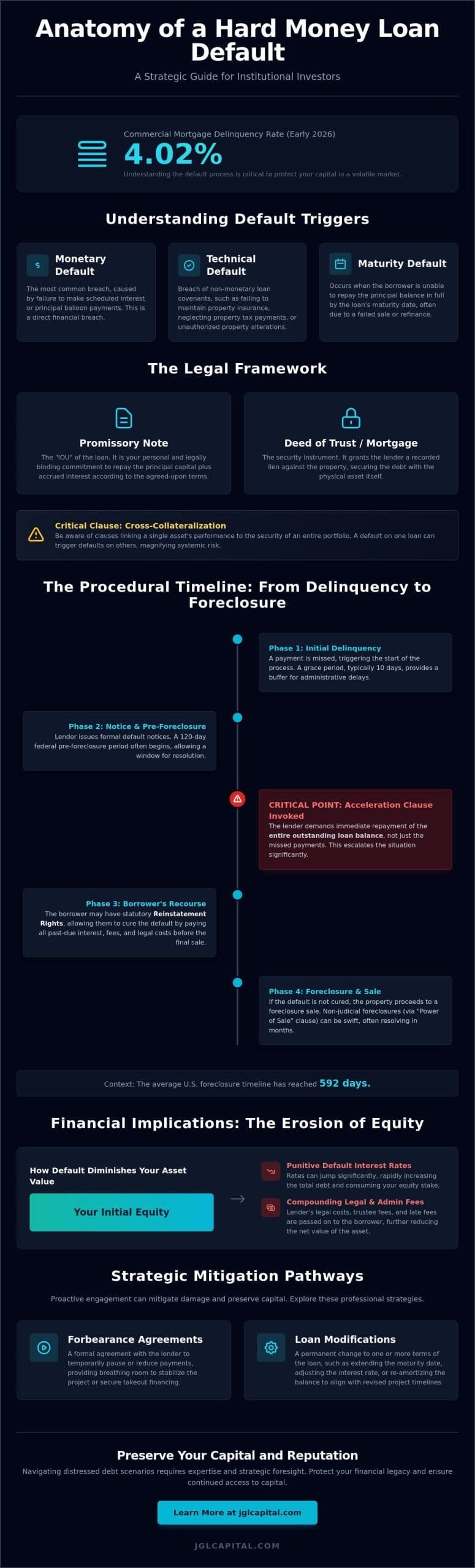
Default isn’t a monolithic event; it’s categorized by the nature of the breach, which can be either monetary or technical. Monetary defaults are the most frequent occurrences, manifesting when a borrower fails to meet the scheduled interest payments or the final principal repayment. These events typically trigger immediate late fee provisions and can lead to the acceleration of the entire debt. Technical defaults, however, are breaches of non-monetary covenants, such as the failure to maintain adequate property insurance or the neglect of property tax obligations. Maturity defaults represent a particularly critical subset of this category, occurring when a borrower is unable to refinance or sell the asset by the conclusion of the loan term, which is a frequent challenge in the current environment where the average U.S. foreclosure timeline has reached 592 days.
The Legal Instruments of Debt Security
The relationship between the borrower and the lender is codified through two distinct yet interdependent legal instruments. The Promissory Note functions as the foundational evidence of the debt, representing a personal and legally binding commitment by the borrower to return the principal capital alongside the accrued interest. Conversely, the Deed of Trust or Mortgage serves as the security instrument, granting the lender a recorded lien against the property. In many jurisdictions, this document includes a “Power of Sale” clause, which empowers a designated Trustee to initiate an out of court foreclosure process if the borrower fails to rectify a default. This non-judicial process is significantly more efficient than traditional litigation, often allowing for a resolution within a few months. Sophisticated investors must also remain cognizant of cross-collateralization clauses, which can link the performance of a single asset to the security of an entire portfolio, thereby magnifying the systemic risk of a single default event.
The Procedural Timeline: From Delinquency to Foreclosure
The progression from a missed payment to a property auction is not an instantaneous event; it’s a methodical series of legal milestones governed by both contractual language and state statutes. Initially, most agreements provide a brief grace period, typically ten days, which serves as a buffer for administrative delays. If the delinquency persists beyond this window, the lender issues formal notifications to signal the commencement of the default process. For those analyzing what happens if you default on a hard money loan, it’s vital to recognize that institutional lenders generally adhere to a structured timeline that includes a 120 day federal pre-foreclosure threshold before formal proceedings begin, as outlined in certain federal default regulations regarding debt collection and notice requirements. This period allows for a final attempt at a negotiated resolution before the debt is accelerated.
The Acceleration Clause and Reinstatement Rights
The transition from simple delinquency to formal default is marked by the invocation of the acceleration clause. This provision is a standard feature in private lending that empowers the lender to demand the immediate repayment of the entire outstanding loan balance, rather than just the missed installments. Once acceleration occurs, the borrower’s primary recourse is through statutory reinstatement rights. These rights allow the borrower to “cure” the default by paying all past due interest, late fees, and legal costs before the final foreclosure sale. Institutional protocols typically require a formal “Right to Cure” notice, providing a specific window during which the borrower can restore the loan to good standing and halt the foreclosure machinery.
Judicial vs. Non-Judicial Foreclosure Processes
The speed and complexity of the foreclosure process are dictated by the geographic location of the asset and the corresponding state laws. In judicial states, such as Florida, the lender must file a lawsuit to obtain a court order for the sale, a process that can take 6 to 18 months in uncontested cases and significantly longer if the borrower mounts a defense. Conversely, non-judicial states like California follow a more efficient timeline through a “Power of Sale” clause, which bypasses the court system entirely. In these jurisdictions, the process often concludes within five to eight months from the initial missed payment. Understanding these regional nuances is essential for investors who need to maintain strategic bridge loan stability across diverse markets. While the average U.S. foreclosure timeline stood at 592 days at the end of 2025, the actual duration of your specific scenario will depend heavily on whether your asset sits in a judicial or non-judicial jurisdiction.
Financial Implications and the Erosion of Equity
The erosion of equity in a distressed asset scenario is a function of compounding financial penalties and the non-negotiable costs of legal recovery. A granular analysis of what happens if you default on a hard money loan reveals that the primary threat to an investor isn’t merely the loss of the asset, but the rapid depletion of accrued equity through contractually mandated escalations. In the private lending sector, these costs are designed to compensate the lender for the heightened risk profile of a non-performing asset. If left unaddressed, the cumulative effect of these fees can result in “equity stripping,” where the borrower’s remaining stake in the property is entirely consumed before the asset even reaches the auction block.
Default Interest and Penalty Fee Structures
Default interest rates represent the most significant driver of equity loss. While standard rates for bridge or multi-family loans might range between 9.5% and 12.5% in 1st position, a formal default often triggers an escalation to a range of 18% to 25%. This “per diem” cost is calculated daily, meaning that every day the loan remains in default, the payoff amount increases substantially. These rates aren’t merely punitive; they’re institutional tools used to incentivize immediate resolution and cover the internal capital costs of managing a distressed file. Beyond the interest rate jump, administrative default fees and trustee costs further inflate the total debt, often totaling thousands of dollars before the foreclosure process even reaches its midpoint.
Protective Advances and Property Preservation
When a borrower fails to meet their obligations, the lender must act as a disciplined steward of the collateral. This often involves making protective advances. These are payments made by the lender to cover critical property expenses that the borrower has neglected, such as delinquent property taxes, lapsed insurance premiums, or essential maintenance. Because these advances are necessary to protect the seniority of the lender’s lien, they’re added to the principal balance and typically accrue interest at the default rate. In some cases, property preservation costs, including boarding windows, changing locks, or addressing environmental hazards, further burden the loan balance. These expenses take priority over the borrower’s equity, ensuring that the lender is made whole before any proceeds are returned to the investor. If the eventual sale price at a foreclosure auction is insufficient to cover this expanded debt, the lender may pursue a deficiency judgment, placing the borrower’s personal capital at risk.
Strategic Mitigation: Navigating Distressed Debt Scenarios
The transition from delinquency to a formal default necessitates a shift from tactical management to institutional-grade strategic planning. While the procedural milestones and financial escalations detailed in earlier sections underscore the gravity of a breach, the ultimate outcome of what happens if you default on a hard money loan is frequently determined by the borrower’s ability to present a viable mitigation framework. Lenders, acting as disciplined stewards of capital, often prefer the certainty of a structured resolution over the unpredictability and expense of a foreclosure auction. This preference creates a window for sophisticated partners to navigate distressed debt through several established pathways.
Several strategic pathways exist for investors seeking to preserve their capital and avoid the finality of a trustee’s sale:
- Forbearance Agreements: A temporary pause in payment obligations, typically granted when a project is nearing a liquidity event, such as a pending sale or a final certificate of occupancy.
- Loan Modifications: The formal restructuring of loan terms, including adjustments to the maturity date or the capitalization of arrears, to align the debt with revised project timelines.
- Deed in Lieu of Foreclosure: A discreet exit strategy where the borrower voluntarily transfers the property title to the lender, effectively settling the debt while avoiding the public record of a foreclosure.
- Short Sales: Negotiating a payoff where the lender accepts proceeds from a third-party sale that are lower than the total outstanding balance, often utilized when market shifts have impacted the asset’s valuation.
The Architecture of a Loan Extension Request
A successful loan extension request is built upon a foundation of analytical transparency and updated performance metrics. Borrowers must provide a rigorous “Budget to Complete” that reflects current labor and material costs, paired with a revised exit strategy that accounts for the “return to fundamentals” observed in the 2026 market. If the original underwriting assumptions no longer hold, a “Cash-In” modification may be required. This process involves a capital injection from the borrower to restore the loan-to-value ratio to an acceptable threshold, thereby re-balancing the risk between the two parties and demonstrating a continued commitment to the project’s success.
Refinancing and Bridge Loan Solutions
Securing a new bridge loan remains a viable path for taking out a maturing note, provided the underlying asset retains sufficient value to support the new debt structure. While refinancing a loan already in formal default status presents significant challenges, sophisticated asset-backed loans focus on the intrinsic worth of the collateral rather than the borrower’s temporary liquidity constraints. Investors who act decisively to restructure their debt often find that early intervention is the most effective method for preserving their long-term investment capacity. To explore tailored solutions for managing complex debt structures, investors should connect with a seasoned capital alliance that prioritizes the alignment of long-term objectives.
Preserving Investor Reputation and Future Capital Access
The final consideration in evaluating what happens if you default on a hard money loan extends beyond the immediate loss of equity or the conclusion of a foreclosure sale. In the sophisticated landscape of private capital, an investor’s reputation serves as a critical form of intangible currency that dictates the terms of all future engagements. While a monetary breach is a quantifiable event, the manner in which a borrower manages that breach determines their long-term viability within the lending ecosystem. Institutional lenders and capital brokers possess a robust “institutional memory,” maintaining detailed records of borrower conduct that often carry more weight than a traditional credit score during the underwriting of high-leverage opportunities.
Proactive communication and a commitment to transparency are the hallmarks of a professional partner, even when an asset is underperforming. By engaging with a lender before a delinquency becomes a formal default, a borrower can often transition a distressed scenario into a “soft default” or a settled record, which is viewed with significantly less severity than a completed foreclosure auction. This disciplined approach to crisis management preserves the borrower’s status as a serious operator who prioritizes the alignment of objectives and the integrity of the capital stack.
The Long-term Cost of a Foreclosure Record
A formal foreclosure record creates significant friction in the acquisition of future capital, often resulting in a multi-year exclusionary period from institutional lending platforms. For investors seeking fix and flip loans or other transitional debt, a prior default typically triggers a reclassification into a high-risk tier. This status manifests as increased origination points, higher interest rates, and more stringent loan-to-value requirements that can render future projects mathematically unfeasible. Furthermore, a foreclosure necessitates the inclusion of a detailed “Letter of Explanation” in every subsequent capital application, requiring the borrower to provide an analytical justification for the failure of the previous project to satisfy the risk committees of future partners.
Maintaining Integrity Through Collaborative Resolution
The role of a disciplined steward is to ensure the preservation of value even in the face of project failure. When a borrower chooses a collaborative resolution, such as a deed in lieu or a negotiated short sale, they demonstrate a level of professional maturity that institutional lenders value. At JGL Capital, the approach to distressed scenarios is rooted in the generation of worth and the maintenance of long-term strategic alliances rather than simple transactional recovery. Partnering with a strategic broker to navigate complex commercial real estate loans allows investors to leverage intellectual capital and established history to resolve debt obligations with their reputation intact. Ultimately, the preservation of one’s professional standing is the most effective strategy for ensuring continued access to the liquidity required to build a lasting investment legacy.
Navigating the Path to Strategic Recovery and Capital Preservation
The complexities of distressed debt require a transition from reactive anxiety to analytical rigor. By understanding the interplay between legal instruments and the financial escalations inherent in private lending, investors can effectively manage the risks associated with underperforming assets. While the immediate concern regarding what happens if you default on a hard money loan often centers on the potential for foreclosure, the most successful resolutions are found through proactive engagement and structured mitigation. It’s essential to recognize that a default is a manageable phase of asset management rather than a terminal failure of the investment strategy.
Preserving your standing within the private lending ecosystem is paramount for maintaining long-term liquidity and investment growth. At JGL Capital, we leverage over 30 years of industry expertise to provide a disciplined approach to value preservation and fast, asset-backed capital allocation. We remain committed to the alignment of objectives and the delivery of customized solutions that reflect the gravity of high-stakes management. Partner with JGL Capital for strategic asset-backed financing solutions. With the right strategic alliance, even the most challenging asset scenarios can be navigated to protect your financial legacy and ensure continued success in the marketplace.
Frequently Asked Questions
Can a hard money lender take my personal home if I default?
A hard money lender typically cannot seize your personal residence unless that specific asset was pledged as collateral or you executed a personal guarantee that allows for the pursuit of non-pledged assets. Since these loans are primarily asset-based, the lender’s security interest is usually confined to the investment property. However, sophisticated investors should meticulously review their loan documents for cross-collateralization clauses that might link personal holdings to the performance of the investment debt.
How long does the foreclosure process take for a hard money loan?
The duration of the foreclosure process is dictated by state statutes and the nature of the legal proceedings. While the national average reached 592 days by the end of 2025, specific timelines vary significantly between judicial and non-judicial jurisdictions. In California, the process often concludes within five to eight months, whereas contested cases in Florida can extend from twelve to thirty-six months. Federal law generally mandates a 120-day waiting period after the first missed payment before formal proceedings commence.
Will a hard money default show up on my personal credit report?
A default on a hard money loan will likely appear on your personal credit report if the lender reports to the major credit bureaus or if a public record, such as a foreclosure judgment, is filed. Understanding what happens if you default on a hard money loan involves recognizing that a formal default or a deficiency judgment becomes a matter of public record. This record can significantly impair your credit score and influence the institutional memory of future capital partners for several years.
Can I stop a foreclosure once the lender has filed a Notice of Default?
You can stop a foreclosure after a Notice of Default has been filed by exercising your statutory right to reinstate the loan or through a negotiated workout. Reinstatement involves paying all past-due interest, late fees, and legal costs to restore the loan to good standing. Alternatively, a forbearance agreement or a loan modification can halt the process if you can provide a viable plan to rectify the delinquency and preserve the asset’s value.
What is a ‘Deficiency Judgment’ and am I at risk of one?
A deficiency judgment is a court-ordered ruling that holds a borrower personally liable for the difference between the loan balance and the proceeds from a foreclosure sale. When assessing what happens if you default on a hard money loan, you must consider the risk of a deficiency judgment, which depends on state law and the specific terms of your promissory note. Some states prohibit these judgments for certain property types, so consulting with legal counsel regarding your specific jurisdiction is essential.
Is there a grace period for hard money loan payments?
Most hard money contracts include a grace period, typically ranging from five to ten days, before a late fee is assessed. This window serves as an administrative buffer for payment processing delays rather than a formal extension of the due date. It’s vital to recognize that habitual reliance on the grace period can strain the relationship with your lender and may trigger increased scrutiny of your project’s financial health and long-term viability.
Should I file for bankruptcy to stop a hard money foreclosure?
Filing for bankruptcy should be viewed as a last-resort measure because it triggers an automatic stay that temporarily halts foreclosure proceedings. While this provides a brief window for restructuring, it doesn’t eliminate the underlying debt or the lender’s security interest in the property. For professional investors, the long-term reputational damage of a bankruptcy often outweighs the temporary relief, making a negotiated workout a more strategic path for capital preservation and reputation management.
What is the difference between a judicial and non-judicial foreclosure?
The primary distinction lies in the requirement for court intervention to finalize the property sale. Judicial foreclosures require the lender to file a lawsuit and obtain a judge’s approval, a process that is historically slower and more expensive. Non-judicial foreclosures rely on a “Power of Sale” clause in the deed of trust, allowing a trustee to auction the property without court oversight, which significantly accelerates the timeline for debt recovery in states like California.