

In the current institutionalized lending environment, the true cost of capital is not measured by the nominal interest rate on a term sheet, but by the operational reliability of the entity providing the funds. For the disciplined real estate professional, the primary risk is not high leverage; it’s the catastrophic failure of a capital partner to perform during the final stages of a transaction. Understanding how to vet private money lenders is therefore a critical competency for any principal who values the preservation of capital and the certainty of execution. You likely recognize that a low-cost offer is an empty promise if the lender retracts their commitment during the due diligence phase, potentially leading to the forfeiture of earnest money and the erosion of your professional reputation.
This article provides a rigorous strategic framework for identifying reliable capital partners and ensuring that your strategic objectives remain uncompromised. By mastering this disciplined approach to due diligence, you will learn to distinguish between transactional intermediaries and stable, long-term capital sources. We will examine the essential components of institutional-grade vetting, including verifying compliance with FinCEN’s 2026 AML/KYC regulations, evaluating state-specific licensing requirements, and auditing a partner’s historical performance metrics to ensure they possess the intellectual capital necessary to support your portfolio’s long-term growth.
Key Takeaways
- Learn to differentiate between institutional balance-sheet lenders and capital intermediaries to ensure the stability and availability of your project’s funding.
- Implement a disciplined framework for how to vet private money lenders by prioritizing certainty of execution and capital origin over superficial interest rate quotes.
- Quantify the total cost of capital by identifying hidden administrative fees and evaluating the rigor of a lender’s draw schedule and inspection processes.
- Protect your real estate portfolio from capital loss by identifying early operational red flags and “bait and switch” tactics during the underwriting phase.
- Discover the strategic advantages of aligning with seasoned capital partners who value long-term value creation over simple transactional lending.
The Imperative of Due Diligence in Private Capital Allocation
Private money lending, within the framework of asset-backed real estate finance, represents a sophisticated alternative to traditional depository institutions. While often categorized under the broad umbrella of a Hard money loan, the distinction between institutional private lenders and unverified individual sources is profound. Professional capital allocation requires a disciplined approach to identifying partners who possess both the liquidity and the operational infrastructure to support complex transactions. Learning how to vet private money lenders is not merely a defensive measure; it’s a fundamental requirement for maintaining the integrity of a real estate portfolio in a volatile market.
The 2026 economic environment, characterized by the private credit market exceeding $2 trillion in assets under management, has introduced unique pressures on lender liquidity. This growth makes the verification of a partner’s capital source more critical than ever. As regional banks continue to tighten credit standards, the influx of private capital has attracted both seasoned professionals and opportunistic intermediaries. Discerning the difference is essential. A lender’s ability to fund a deal shouldn’t be assumed based on a preliminary term sheet. It must be proven through a rigorous review of their balance sheet and historical performance.
The Risks of Inadequate Lender Scrutiny
Neglecting the due diligence process can lead to severe financial and legal repercussions. Some predatory entities employ “loan-to-own” strategies, where they intentionally structure terms that facilitate default to seize the underlying asset. Beyond these extreme cases, operational incompetence is a more common threat. Funding delays can derail construction timelines, leading to increased carry costs and missed market opportunities. Additionally, working with unlicensed or non-compliant lenders exposes you to regulatory risks. This is especially true as FinCEN’s 2026 regulations increase the compliance burden for privately financed residential transfers.
Vetting as a Strategic Competitive Advantage
When you master how to vet private money lenders, you transform your capital procurement into a competitive weapon. In a multi-bid scenario, a seller is more likely to accept an offer backed by a lender with a documented history of certain execution. This reliability allows you to move with the speed of a cash buyer while maintaining the leverage necessary to scale. By establishing a Certainty of Execution mindset, you ensure that your reputation remains untarnished and your portfolio remains positioned for long-term growth through stable, strategic alliances.
Evaluating the Stability and Origin of Private Capital
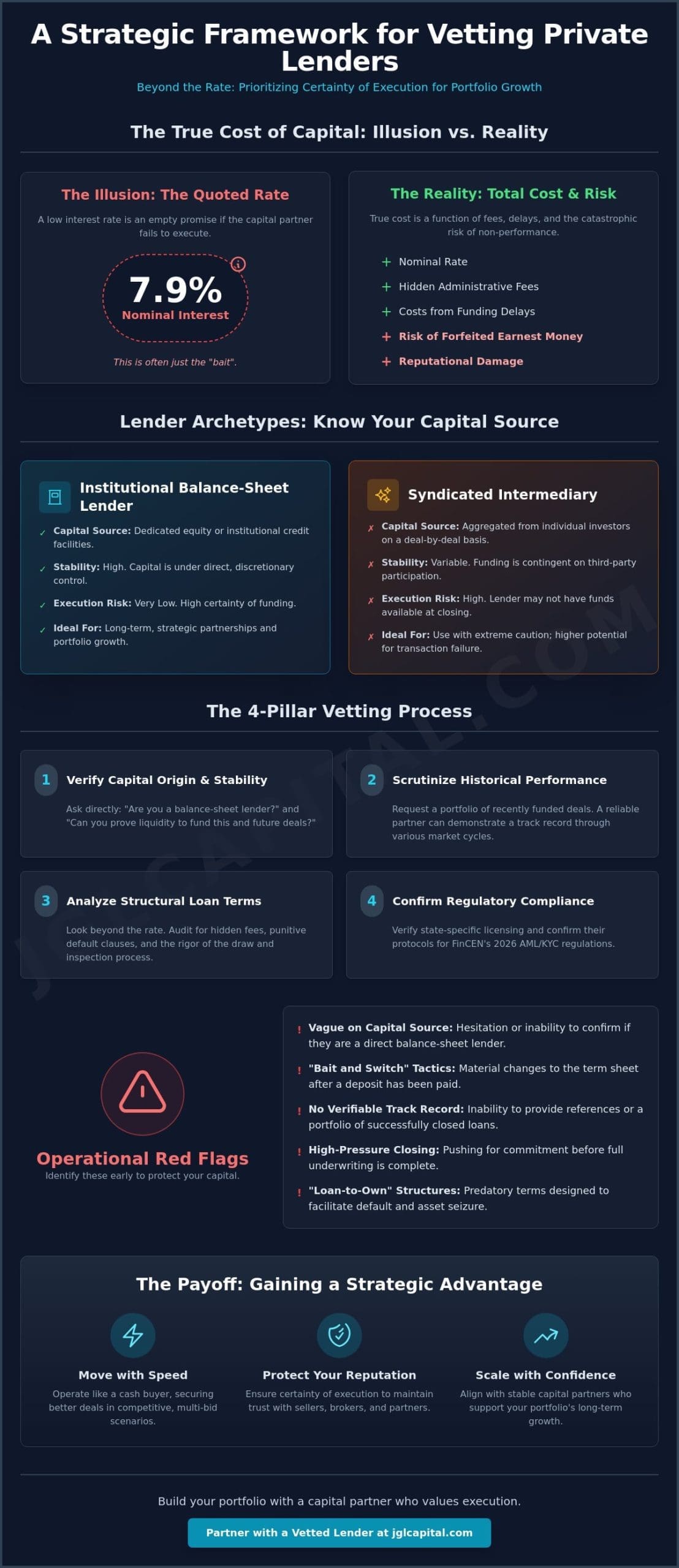
Sophisticated capital allocation begins with a thorough interrogation of the lender’s capital stack, as the underlying source of funds dictates the stability and reliability of the entire transaction. When determining how to vet private money lenders, you must distinguish between balance-sheet lenders, who utilize dedicated equity or institutional credit facilities, and syndicated intermediaries, who aggregate capital from individual investors on a deal-by-deal basis. The latter model introduces a significant layer of execution risk, as the lender’s ability to fund is often contingent upon third-party participation rather than internal discretionary control. For developers managing multiple simultaneous projects, verifying a firm’s capacity to provide consistent liquidity across a growing portfolio is a prerequisite for any long-term strategic alliance.
The longevity and track record of a firm’s principal management offer the most transparent view into their operational stability. A disciplined lender should be able to articulate their performance through various market cycles, demonstrating a commitment to timeless principles rather than speculative trends. Engaging in comprehensive due diligence on private money lenders ensures that you’re aligning with a steward who values the preservation of value as much as you do. For those seeking an alliance grounded in institutional stability, exploring strategic capital solutions provides the necessary foundation for portfolio expansion.
Direct Lenders vs. Capital Brokers
While capital brokers provide strategic value by sourcing specialized capital for diverse asset classes, it’s vital to identify who holds discretionary control over the funds. You should inquire directly about the lender’s institutional backing and the specific terms of their warehouse lines of credit. A lender with a direct, non-syndicated capital source offers a level of certainty that intermediaries simply cannot match, particularly when navigating the compressed timelines of high-stakes real estate acquisitions.
Historical Performance and Transactional Evidence
A lender’s historical performance serves as a primary indicator of their operational maturity. You should prioritize partners who demonstrate a disciplined history of funding complex New Construction Loans and bridge scenarios, as these require a high degree of analytical rigor. While online testimonials offer a superficial perspective, the most reliable verification comes from title companies and legal counsel who have overseen the closing process. Their firsthand experience with a lender’s administrative efficiency and funding consistency is far more valuable than unverified digital reviews.
Beyond the Interest Rate: Analyzing Structural Loan Terms
Professional capital allocation requires a granular analysis of the total cost of capital, extending far beyond the superficial interest rate quoted in a preliminary discussion. While interest rates in 2026 typically range from 8% to 15%, the true expense of a facility is found within the aggregate of origination fees, which generally fall between 1% and 5%, and the various administrative charges that can erode project margins. A rigorous approach to how to vet private money lenders involves deconstructing every line item on a term sheet to identify non-standard costs that lack transparent utility. Beyond these immediate figures, the structural flexibility of the loan, particularly regarding draw schedules and the administrative rigor of the inspection process, often exerts a greater influence on a project’s internal rate of return than the interest rate itself.
The transition from a preliminary quote to a funded deal depends heavily on the lender’s underwriting philosophy. You must evaluate how a partner balances asset-based valuation with personal credit requirements, as this indicates their level of comfort with complex, non-traditional collateral. Understanding these structural nuances ensures that your exit strategy remains viable, especially when accounting for prepayment penalties or the availability of extension options. A lender who lacks a clear, repeatable framework for these terms is likely to introduce friction during the most critical phases of your project lifecycle.
Analyzing the Term Sheet and Commitment Letter
Identifying “junk fees” is a primary objective during the early stages of lender evaluation. You should scrutinize the preliminary term sheet for excessive processing, underwriting, or document preparation fees that deviate from institutional standards. It’s also vital to distinguish between an informal “proof of funds” and a legally weighted commitment letter. The latter signals a disciplined intent to fund, providing the security necessary to move forward with acquisitions. Alignment between the loan term and your projected project lifecycle is paramount; a mismatch here can lead to forced liquidations or costly, unplanned refinances.
Underwriting Philosophies and Asset Valuation
Lenders vary significantly in their application of Loan-to-Value (LTV) versus Loan-to-Cost (LTC) metrics, a distinction that directly impacts your required equity contribution. A partner’s reliance on internal versus external appraisals can also affect both the speed and the reliability of the valuation. Their specific expertise in Commercial Real Estate Loans often dictates their underwriting speed, as a deep understanding of complex asset classes allows for more decisive action. When you determine how to vet private money lenders, you should prioritize those whose underwriting standards reflect a sophisticated understanding of market dynamics rather than those who rely on rigid, one-size-fits-all formulas.
Identifying Operational Red Flags and Ensuring Execution
The transition from a signed term sheet to a successful closing is often where operational weaknesses become visible. While structural terms provide the framework, the administrative machine behind the lender determines whether your project proceeds or stagnates. Inconsistent communication serves as a primary leading indicator of internal instability. If a lender’s response times fluctuate during the initial inquiry, it’s highly probable that these delays will intensify during the high-pressure period of final underwriting. A disciplined approach to how to vet private money lenders requires a close interrogation of their “buy-box” or stated investment criteria. Lenders who deviate from their core competencies frequently encounter internal friction, leading to eleventh-hour requests for additional collateral or unvetted adjustments to the Loan-to-Value (LTV) ratio.
Execution risk is further compounded by “bait and switch” tactics, where a lender presents an aggressive preliminary quote only to retract those terms as the closing date approaches. This behavior often signals a lack of discretionary capital or a desperate attempt to secure a deal flow they cannot technically support. Evaluating the professionalism of the lender’s internal processing and closing team is essential. You should assess whether they possess the analytical rigor to manage complex variables without reverting to speculative adjustments. For those prioritizing certain execution over nominal costs, identifying reliable capital partners who adhere to institutional standards is the only way to safeguard a professional reputation.
The Certainty of Execution Test
Execution is the ultimate metric of a lender’s competence. You must verify their ability to close within contractually mandated timeframes, especially when supply chain delays or shifting project variables require a degree of flexibility. Certainty of Execution is the probability of a lender funding a deal on the original terms without mid-stream adjustments. A partner who maintains this discipline provides the stability necessary to manage high-stakes acquisitions with confidence. When project conditions shift, a seasoned lender relies on established history and intellectual capital to navigate the change rather than penalizing the borrower with arbitrary fee increases.
Professionalism and Institutional Rigor
The quality of a lender’s technology stack and documentation often reflects their commitment to regulatory compliance. As of March 1, 2026, FinCEN’s Residential Real Estate Rule requires private lenders to maintain rigorous AML and KYC policies, including the filing of Suspicious Activity Reports for specific transactions. In the Hard Money Lenders sector, adherence to these mandates is a non-negotiable indicator of institutional stability. Furthermore, state-specific licensing in jurisdictions like California, Nevada, and Utah serves as a critical vetting filter. A formal, disciplined approach to these requirements signals that the lender is a long-term steward of capital rather than a transactional opportunist. Understanding how to vet private money lenders through the lens of compliance ensures that your portfolio remains protected from the legal vulnerabilities of unverified partners.
Aligning with Strategic Lending Partners for Long-Term Growth
The culmination of a disciplined due diligence process is the transition from transactional borrowing to a high-level strategic capital alliance. While the initial steps of your inquiry focus on risk mitigation, the ultimate objective is to secure a partner whose institutional stability facilitates the consistent generation of worth across your entire portfolio. Understanding how to vet private money lenders allows you to bypass the volatility of unverified sources in favor of entities that possess the intellectual capital and established history required for complex asset management. A partner with over 30 years of industry expertise provides more than just liquidity. They offer an analytical rigor that ensures your strategic objectives are aligned with market realities, transforming capital procurement from a recurring hurdle into a predictable component of your growth strategy.
A disciplined brokerage model ensures that you aren’t limited by the constraints of a single balance sheet, but rather have access to the most stable capital sources available in the 2026 credit market. This approach prioritizes the alignment of objectives, ensuring that the capital structure provided is perfectly suited to the specific requirements of your asset class. By moving beyond the search for the lowest nominal rate, you position your next project for success within a framework that values integrity and long-term stewardship over short-term gains.
The JGL Capital Approach to Capital Stewardship
Our commitment to asset-backed lending is rooted in a philosophy that prioritizes property value and the inherent potential of the investor. We recognize that traditional banking delays can be catastrophic for high-stakes transactions, which is why we provide a streamlined alternative that doesn’t sacrifice analytical depth. By leveraging three decades of experience, we’re able to offer a level of certainty that transactional competitors simply cannot replicate. This history allows us to conduct a thorough analysis of every deal, ensuring that when we commit to a project, our partners can rely on certain execution regardless of market shifts. We don’t just fund deals; we build lasting legacies through careful, deliberate action.
Executing Your Next Transaction
Success in complex real estate finance requires early-stage consultation, particularly when navigating the nuances of Bridge Loans or other transitional capital structures. Preparing your project for a rigorous but efficient underwriting process is the most effective way to ensure a seamless closing. This preparation involves more than just gathering documentation; it requires a clear articulation of your exit strategy and long-term objectives. When you understand how to vet private money lenders, you realize that the most valuable partners are those who act as a quiet expert, providing the intellectual capital necessary to support your vision. You’re invited to contact JGL Capital to discuss your specific capital requirements and discover how our strategic framework can support the continued growth of your real estate portfolio.
Securing the Future of Your Capital Strategy
Navigating the complexities of the contemporary credit market requires more than just a source of funds; it demands a partner whose operational stability and intellectual depth mirror your own commitment to excellence. By mastering the process of how to vet private money lenders, you’ve established a rigorous framework that prioritizes the stability of capital origin and the detailed analysis of structural loan terms over superficial interest rate quotes. This disciplined approach ensures that your real estate portfolio remains protected from the volatility of unreliable intermediaries, allowing you to focus on the long-term generation of worth through certain execution. The transition from a transactional mindset to a strategic alliance is the final step in securing a legacy of growth and professional integrity.
Leveraging over 30 years of industry-leading expertise and a specialized focus on asset-backed certainty of execution, our firm offers the national reach and institutional-grade capital access required for high-stakes management. We invite you to consult with JGL Capital to secure reliable, asset-backed financing for your next project. We look forward to establishing a disciplined alliance that supports your strategic objectives and fosters the continued expansion of your professional legacy.
Frequently Asked Questions
What is the most important document to request when vetting a private lender?
A legally weighted commitment letter is the most critical document because it represents a formal, institutional intent to fund. Unlike an informal proof of funds, a commitment letter outlines specific terms and conditions that the lender is prepared to execute upon. When learning how to vet private money lenders, you should prioritize those who provide transparent, high-register documentation that leaves little room for ambiguity during the final stages of the closing process.
How can I verify if a private money lender actually has the funds to close?
You can verify a lender’s capacity to close by requesting a documented track record of successfully funded projects within your specific asset class. Reliable partners often provide references from title companies and legal counsel who have overseen their transactions. Inquiring about their capital source, such as institutional warehouse lines or a dedicated balance sheet, provides a clearer picture of their discretionary control over funds and their ability to perform under pressure.
Are private money lenders required to be licensed in 2026?
Yes, many states require private lenders to be licensed for business-purpose residential loans as of 2026. In California and Nevada, a license is required for loans secured by any real estate; Utah and Idaho require licensing for single-family residential loans even for business purposes. FinCEN’s 2026 Residential Real Estate Rule also requires lenders to maintain written AML and KYC compliance policies, reinforcing the necessity of working with regulated, disciplined entities.
What is the difference between a direct private lender and a private money broker?
A direct private lender utilizes their own balance sheet or institutional credit facilities to fund deals, providing greater discretionary control and certainty of execution. Conversely, a private money broker acts as an intermediary, sourcing capital from a network of third-party investors. While brokers offer access to diverse capital stacks, they often lack the final decision-making authority found in a direct lending relationship, which can introduce execution risk.
Why do some private lenders back out of deals at the last minute?
Lenders typically back out due to a lack of discretionary capital or the discovery of unmitigated project risks during late-stage underwriting. Some opportunistic entities use “bait and switch” tactics, where they retract aggressive preliminary terms once the borrower is committed. This behavior underscores the importance of knowing how to vet private money lenders to identify partners with a proven history of certain execution rather than those who rely on speculative capital.
How do I compare loan points and fees between different private lenders effectively?
To compare costs effectively, you must calculate the total cost of capital, which includes origination fees, points, and all administrative charges. In 2026, origination fees generally range between 1% and 5% of the loan amount. By aggregating these costs with the interest rate, you can determine the effective cost of the facility. This analytical rigor prevents hidden fees from eroding your project’s internal rate of return and ensures a fair comparison.
Can I use a private money lender for a new construction project?
Yes, private lenders provide specialized New Construction Loans for developers who require a streamlined alternative to traditional bank financing. These facilities are typically asset-based, focusing on the projected value of the completed property and the developer’s historical performance. A seasoned partner with over 30 years of experience can provide the intellectual capital and stable funding necessary to support large-scale residential or commercial developments through every phase of construction.
What should I do if a lender changes the terms of the loan during underwriting?
If a lender changes terms during underwriting, it’s a leading indicator of operational instability or predatory intent. Such mid-stream adjustments compromise the certainty of execution and can jeopardize your entire transaction. In these scenarios, you should re-evaluate the partnership immediately. It’s often safer to consider alternative partners who demonstrate a more disciplined approach to capital stewardship and value the integrity of their original commitments.