

The structural limitations of traditional banking institutions often render them incapable of facilitating the acquisition of high-yield distressed assets, effectively ceding the most lucrative opportunities to those who command private capital. You’ve likely encountered the friction of rigid credit requirements and the categorical rejection of assets based solely on their physical condition. When speed is the primary determinant of transaction success, waiting months for a conventional appraisal is a luxury that sophisticated investors simply cannot afford. Securing financing for property that needs repairs requires a transition from standardized retail lending toward a more disciplined, asset-based allocation strategy.
This guide delineates the methodologies used by seasoned partners to secure capital based on After-Repair Value (ARV) rather than current distressed pricing. You’ll learn how to maximize leverage for renovation costs while maintaining the ability to close transactions within days. We will examine the mechanics of fix and flip loans and bridge lending as essential instruments for value creation in an evolving real estate market. By aligning your capital structure with your strategic objectives, you can transform property condition from a liability into a significant source of competitive advantage.
Key Takeaways
- Analyze the structural divergence between conventional consumer lending and the institutional agility of private capital to navigate the complexities of distressed asset acquisition.
- Evaluate the specific mechanics of fix-and-flip and bridge loans to determine the most effective financing for property that needs repairs based on your project’s stabilization timeline.
- Capitalize on the strategic advantages of asset-based underwriting, which prioritizes the property’s intrinsic potential and allows for competitive execution within seven to ten days.
- Implement a disciplined After-Repair Value (ARV) framework and a comprehensive Scope of Work to ensure alignment between project revitalization and institutional capital requirements.
- Leverage thirty years of disciplined expertise to access tailored solutions for multi-family assets, commercial real estate loans, and residential revitalization projects.
Navigating Financing Options for Distressed Real Estate Assets
Distressed asset financing functions as a specialized form of transitional capital, specifically designed for non-habitable properties that fall outside the parameters of traditional credit markets. There’s a fundamental dichotomy between government-backed consumer loans, which focus on the borrower’s debt-to-income ratios, and private institutional capital, which prioritizes the viability of the real estate project itself. The physical condition of a structure dictates the available financing pathways. Properties requiring substantial rehabilitation are often viewed as high-risk liabilities by commercial banks but represent significant value-creation opportunities for private funds. Asset-based lending provides the necessary liquidity to bridge the gap between acquisition and stabilization, allowing investors to secure financing for property that needs repairs without the constraints of retail banking protocols.
The Limitations of Conventional Mortgages
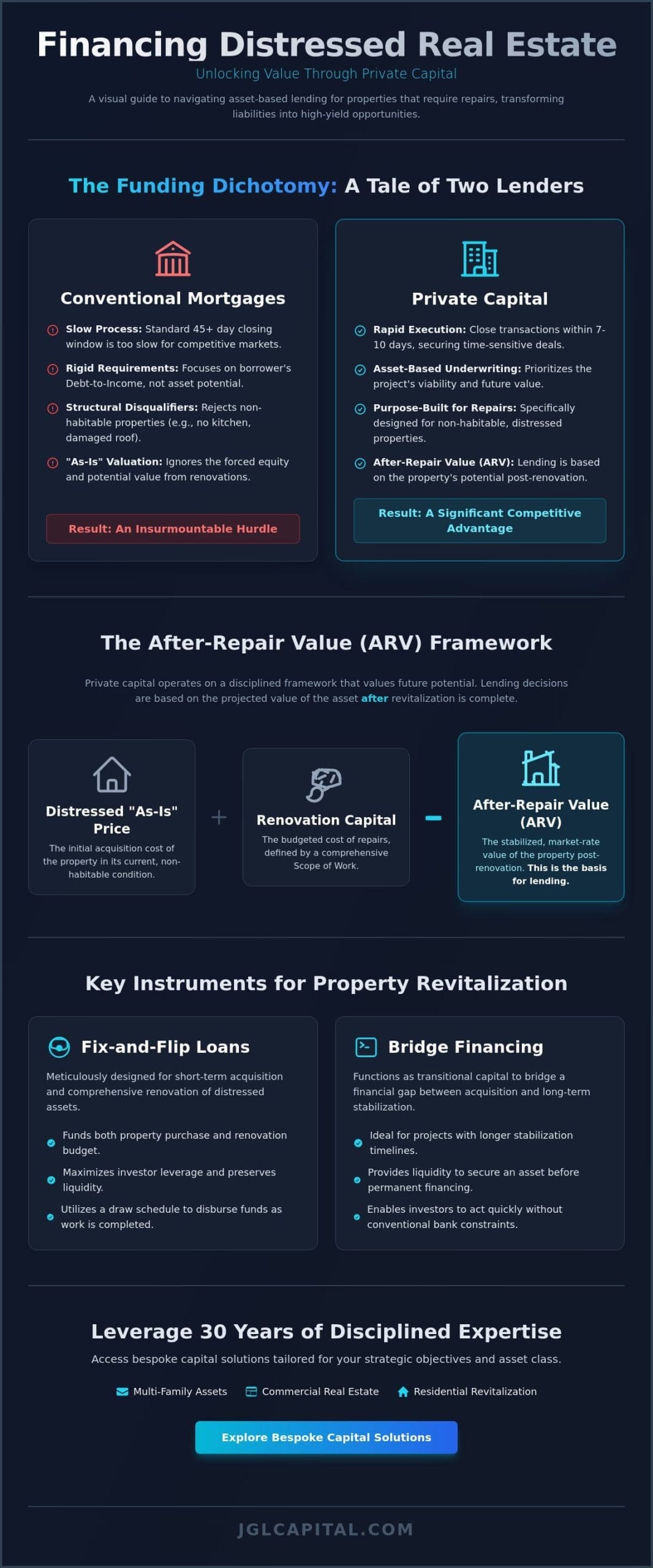
Conventional lending frameworks are ill-equipped to handle the nuances of distressed real estate. Most traditional mortgages require a certificate of occupancy and strict adherence to habitability standards. A missing kitchen or a damaged roof isn’t just a repair issue; it’s a structural disqualifier for funding. Traditional appraisals often focus on the “as-is” value in a vacuum, ignoring the forced equity that renovation provides. This creates an insurmountable hurdle for those attempting to use retail products for institutional-grade investments. Speed is also a critical factor. The standard 45-day closing window of a bank is often too slow for distressed property auctions where cash-equivalent offers are the baseline for entry.
The Emergence of Private Capital as a Strategic Tool
Private capital has emerged as a disciplined strategic tool for the modern real estate partner. By focusing on asset value rather than individual credit profiles, this capital source allows for a more analytical approach to risk. A hard money loan provides the speed and flexibility necessary to outperform competitors who are tied to traditional financing timelines. Investors often partner with hard money lenders to facilitate rapid acquisitions in high-demand markets. This relationship is built on a shared commitment to property revitalization. Unlike the transactional nature of big-box banks, private capital allocation relies on a deep understanding of resource management and performance metrics. It’s a sophisticated solution for financing for property that needs repairs, ensuring that capital is deployed where it can most effectively generate long-term worth and preserve investor equity.
Mechanics of Asset-Based Lending: Fix-and-Flip vs. Bridge Financing
The strategic allocation of private capital requires a nuanced understanding of the specific instruments available for property revitalization. While both fix-and-flip and bridge products provide essential financing for property that needs repairs, they’re engineered to address distinct phases of the investment lifecycle. Asset-based lending prioritizes the intrinsic value and future potential of the real estate, allowing for a more disciplined deployment of resources than is possible through conventional channels. This methodical approach ensures that capital remains aligned with the project’s performance metrics and long-term objectives, providing a stable foundation for the creation of worth in distressed markets.
Understanding Fix-and-Flip Loan Structures
Fix-and-flip loans are meticulously designed for the short-term acquisition and comprehensive renovation of distressed assets. Unlike traditional products, these facilities frequently provide capital for both the initial purchase and the entirety of the renovation budget, maximizing the investor’s leverage and preserving their liquidity for other opportunities. A critical component of this structure is the draw schedule, a risk-mitigation tool where funds are disbursed in tranches upon the successful completion of verified construction milestones. Fix and flip loans typically feature interest-only payments to preserve cash flow during the intensive rehabilitation phase, ensuring that the burden of debt service doesn’t impede the progress of the renovation. For those looking to scale their operations, utilizing specialized fix and flip loans provides a repeatable framework for institutional-grade revitalization projects.
Bridge Loans as Transitional Capital
Bridge financing serves as a high-velocity liquidity solution, often utilized to secure an asset before permanent financing can be established. When investors ask what is a bridge loan, they’re essentially inquiring about transitional capital that prioritizes speed of execution over long-term duration. These loans are indispensable in competitive markets where the ability to close within days, rather than months, is a primary competitive advantage for the sophisticated buyer. By providing the capital necessary to stabilize a property and meet habitability standards, bridge loans act as a vital precursor to traditional refinancing, effectively serving as a strategic bridge toward a permanent capital structure. This form of financing for property that needs repairs allows sophisticated partners to maintain agility while pursuing complex stabilization strategies. If your current project requires rapid capital deployment, exploring a strategic bridge solution can ensure your acquisition strategy remains uninterrupted by institutional delays.
Strategic Advantages of Private Capital Over Conventional Mortgages
The structural divergence between traditional banking and private institutional capital becomes most apparent during the acquisition of distressed assets. While conventional institutions focus heavily on historical personal income and debt-to-income ratios, private capital allocation prioritizes the intrinsic potential of the real estate itself. This shift in underwriting perspective enables the provision of financing for property that needs repairs that would otherwise be disqualified by the rigid habitability standards of retail lenders. By replacing bureaucratic red tape with analytical rigor, sophisticated investors can secure commitments and close transactions within seven to ten days, a pace that consistently outperforms even cash-heavy competitors.
Traditional mortgages are often bound by government-insured guidelines that mandate a property be move-in ready to qualify for funding. This requirement creates an immediate barrier for properties with structural deficiencies, dated mechanical systems, or significant cosmetic damage. Private capital bypasses these as-is valuation hurdles by evaluating the stabilized value of the asset. Whether the project involves a distressed multi-family complex or a commercial revitalization, the flexibility of asset-based lending allows for the funding of diverse property types that traditional banks are structurally incapable of servicing. This situational awareness allows the lender to see opportunity where a bank only sees risk.
Efficiency in the Underwriting Process
The underwriting process within the private sector is characterized by a focus on the Scope of Work (SOW) rather than exhaustive personal tax documentation. This streamlined approach allows for a precise evaluation of the renovation strategy and the anticipated value-add. Unlike government programs such as the FHA 203(k), which are restricted by owner-occupancy mandates and limited to residential use, private capital is free from such constraints. Investors benefit from direct access to decision-makers, ensuring that the strategic objectives of the project are understood and supported from the initial inquiry through to the final disbursement of funds.
Maximizing Capital Allocation and Leverage
A primary objective for the sophisticated partner is the preservation of liquidity to facilitate portfolio expansion. By financing the majority of renovation costs, private capital allows investors to maintain higher cash reserves for operational contingencies or additional acquisitions. Implementing high-leverage real estate investing strategies is essential for those seeking to maximize their return on equity. This disciplined use of capital not only fuels immediate project success but also serves to build a robust professional track record. Establishing a history of successful property revitalizations through private funding eventually positions the investor to secure even larger institutional deals, transforming financing for property that needs repairs into a catalyst for long-term legacy building.
Due Diligence and the After-Repair Value (ARV) Framework
The disciplined investor understands that the acquisition of distressed real estate is an exercise in predictive analysis. Central to this process is the After-Repair Value (ARV) framework, which serves as the primary metric for securing financing for property that needs repairs. Unlike conventional appraisals that fixate on the current state of neglect, private capital allocation is predicated on the stabilized worth of the asset once the proposed revitalization is complete. This forward-looking methodology requires a rigorous feasibility study to ensure that the projected capital expenditure aligns with market-driven exit values, effectively mitigating risk through conservative Loan-to-Value (LTV) ratios on the back end.
Calculating After-Repair Value (ARV)
Determining the ARV involves a meticulous analysis of comparable sales for fully renovated properties within a specific geographic radius. This process goes beyond simple square footage comparisons; it requires an evaluation of specific upgrades and their direct impact on valuation. While the “as-is” value provides a baseline, the “should-be” value is the operative figure in private lending. Many sophisticated partners utilize the “70% rule” as a strategic benchmark. This industry standard dictates that the maximum allowable offer is calculated by taking 70% of the ARV and subtracting the total repair costs. Adhering to this formula ensures that the investor maintains a sufficient equity cushion to absorb market fluctuations or unforeseen structural challenges.
Executing the Scope of Work (SOW)
A robust Scope of Work (SOW) functions as the operational blueprint for the entire project. It must include detailed line-item budgeting for both materials and labor to satisfy the analytical requirements of institutional lenders. Given that renovation costs are projected to rise by 4% to 8% throughout 2026 due to labor market pressures and material tariffs, precise budgeting is more critical than ever. Lenders typically mandate the use of licensed and insured contractors to ensure that the revitalization meets professional standards and local building codes. Managing the construction timeline with precision is essential to minimize interest carry costs, which can erode profit margins if the project experiences significant delays. With annual spending on home improvements projected to reach $518 billion by the end of 2026, the demand for skilled trades remains high, making proactive management a necessity.
Successful property revitalization is built upon a foundation of data-driven decision-making and strategic capital placement. If you are prepared to leverage the potential of a distressed asset, you can apply for asset-based financing to secure the capital required for your next institutional-grade project. By aligning your SOW with a conservative ARV framework, you position yourself as a disciplined steward of capital, ready to generate significant worth in a competitive landscape.
JGL Capital: Bespoke Capital Solutions for Property Revitalization
Building a legacy in the real estate sector requires more than just access to funds; it demands a partnership with an institution that possesses a deep-seated understanding of asset stabilization and market cycles. With over 30 years of experience in the private lending space, JGL Capital LLC operates as a disciplined steward for professional developers and sophisticated investors. Our firm provides specialized financing for property that needs repairs, ensuring that complex distressed deals receive the analytical rigor they deserve. By maintaining a focus on long-term growth and integrity, we’ve established ourselves as a quiet expert in the field, prioritizing the generation of worth over simple transactional volume.
Our institutional approach extends across a diverse range of asset classes, providing the stability necessary for high-stakes management. We offer a sophisticated framework for commercial real estate loans and residential flips, allowing our partners to execute on opportunities with absolute confidence. While our reach is national, the communication rhythm remains steady and personalized, mirroring the patient approach required for long-term objectives. We don’t rely on aggressive self-promotion; instead, our history of successful capital allocation serves as the primary testament to our competence and intellectual capital.
The JGL Capital LLC Advantage
Partnership with our firm provides a level of certainty that traditional institutions simply cannot match. We recognize that in the acquisition of distressed assets, the speed of decision-making is often the primary determinant of success. Our internal processes are designed to provide rapid response times and a certainty of execution without sacrificing the precision of our underwriting. Every loan program is customized to the unique requirements of the specific asset, ensuring a total alignment of strategic objectives between the borrower and our team of seasoned professionals. This commitment to individual solutions distinguishes JGL Capital LLC from more rigid, transactional competitors who lack our depth of situational awareness.
Initiating Your Capital Partnership
The transition from a distressed acquisition to a stabilized, high-value asset begins with a methodical submission process. Professional developers are encouraged to provide a comprehensive project package that includes a detailed Scope of Work (SOW), the purchase contract, and a realistic project timeline. This documentation allows our team to conduct a thorough analysis of the project’s viability and its alignment with our performance metrics. Once the initial due diligence is complete, we move toward a streamlined closing process that respects your operational requirements and allows you to maintain momentum.
If you’re seeking a collaborative ally for your next revitalization project, you can partner with JGL Capital LLC for your next distressed property acquisition. By securing financing for property that needs repairs through a firm that values responsibility and strategic alliances, you ensure that your investment activities are supported by three decades of industry expertise and a shared commitment to the creation of lasting value.
Advancing Your Revitalization Strategy with Disciplined Capital
The transition from rigid conventional frameworks to a more specialized, asset-based model empowers sophisticated investors to secure high-yield assets that traditional institutions are structurally incapable of funding. By integrating the After-Repair Value (ARV) framework into your due diligence, you effectively mitigate risk while maximizing the liquidity required for comprehensive property stabilization. This disciplined approach ensures that every capital allocation serves the long-term objective of value creation and portfolio preservation, transforming the physical condition of an asset from a barrier into a strategic opportunity.
Securing financing for property that needs repairs is a strategic necessity for those operating in the distressed real estate sector. JGL Capital LLC utilizes over 30 years of intellectual capital to deliver highly customized solutions that prioritize the intrinsic worth of the collateral rather than restrictive personal credit profiles. With a national reach and a commitment to analytical rigor, the firm provides the stability and certainty of execution essential for navigating complex residential and commercial revitalizations across the country.
Secure Strategic Funding for Your Next Project with JGL Capital LLC. We are prepared to act as your collaborative partner in the generation of lasting worth and the successful execution of your revitalization objectives.
Frequently Asked Questions
What is the most efficient way to finance a property that needs major repairs?
Asset-based lending represents the most efficient methodology for securing financing for property that needs repairs, as it prioritizes the project’s future value over the borrower’s current liquidity. Private institutional capital allows for the simultaneous funding of the acquisition and the renovation budget. This structure eliminates the need for multiple loan originations, providing a streamlined capital source that supports the entire lifecycle of the revitalization project from acquisition to stabilization.
Can I get a loan for a house that is not currently habitable?
Private institutional lenders frequently provide capital for properties that are currently non-habitable, a scenario that typically results in an immediate rejection from conventional banking institutions. Because these loans are secured by the asset’s potential rather than its present condition, structural deficiencies or missing essential systems don’t serve as disqualifiers. This flexibility is essential for investors targeting distressed assets that require comprehensive stabilization before they can meet traditional habitability standards.
How does After-Repair Value (ARV) affect my loan amount?
The After-Repair Value (ARV) serves as the primary benchmark for determining the total capital allocation for a project. Lenders typically apply a Loan-to-Value (LTV) ratio to this projected stabilized value to establish the maximum loan capacity. By focusing on the ARV, investors can access higher levels of leverage than would be possible if the loan were based solely on the property’s current distressed purchase price, allowing for greater capital efficiency.
What is the difference between a 203(k) loan and a private fix-and-flip loan?
The primary distinction lies in the intended use and the speed of execution. An FHA 203(k) loan is a government-backed product designed for owner-occupants, requiring strict adherence to personal credit guidelines and longer approval timelines. Conversely, a private fix-and-flip loan is an institutional tool engineered for real estate partners, offering rapid closing speeds and underwriting that focuses on the asset’s profitability rather than the borrower’s primary residence requirements.
Do private lenders require a minimum credit score for repair financing?
While conventional banks rely heavily on rigid credit score thresholds, private lenders prioritize the intrinsic value of the real estate asset and the borrower’s experience. A specific minimum score is often less critical than the project’s viability and the strength of the collateral. However, a borrower’s credit history may still be evaluated to determine the specific interest rate and leverage levels, serving as one component of a comprehensive risk assessment during underwriting.
How fast can I close on a property using private money for repairs?
Sophisticated investors can typically close on a property within seven to ten business days when utilizing private capital for repairs. This accelerated timeline is made possible by a streamlined underwriting process that bypasses the bureaucratic delays inherent in traditional mortgage processing. The ability to execute transactions at this pace provides a significant competitive advantage when bidding on distressed assets in high-demand markets where sellers prioritize certainty and speed above all else.
What documents are required to secure financing for a distressed property?
Securing financing for property that needs repairs requires a professional documentation package centered on the project’s operational plan. Key requirements include a detailed Scope of Work (SOW) with line-item budgeting, a signed purchase contract, and documentation regarding the legal entity holding the asset. Lenders also evaluate the investor’s track record of successful revitalizations to ensure that the strategic objectives of the renovation are supported by demonstrated expertise and analytical rigor.
Is it possible to finance 100% of the renovation costs?
Many private institutional lenders offer programs that fund 100% of the documented renovation costs, provided the total loan amount remains within a conservative percentage of the After-Repair Value. This structure allows investors to preserve their personal liquidity for operational contingencies or additional acquisitions. While the purchase price may require a down payment, the comprehensive funding of the construction budget is a standard feature of sophisticated fix-and-flip loan products designed for property revitalization.