

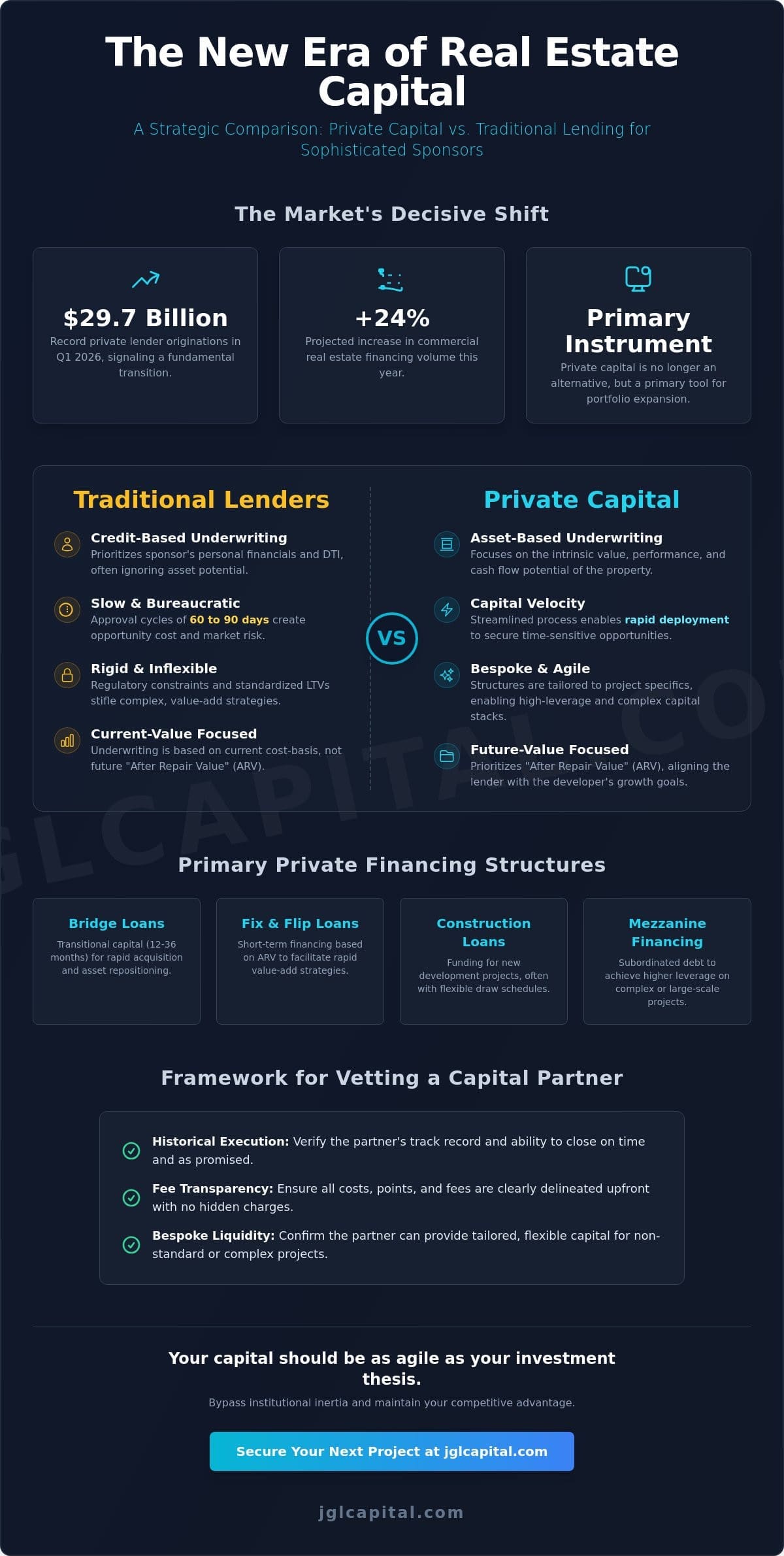
The era of relying on traditional depository institutions for rapid capital deployment has effectively concluded for the sophisticated sponsor. While conventional lenders remain tethered to rigid, credit-based underwriting and prolonged approval cycles, private lender originations reached a record $29.7 billion in the first quarter of 2026. This shift underscores a fundamental transition where private real estate financing options are no longer viewed as secondary alternatives but as primary instruments for maximizing capital velocity. For investors navigating a market where commercial real estate financing volume is projected to increase by 24% this year, the ability to bypass institutional inertia is a prerequisite for maintaining a competitive advantage.
You likely recognize that the opportunity cost of a delayed closing often outweighs the nominal spread of a traditional mortgage. It’s frustrating to see high-conviction projects stalled by administrative friction or inflexible loan-to-value constraints. This guide provides an institutional-grade analysis of private capital structures, specifically designed to facilitate high-leverage execution for complex, asset-heavy developments. We’ll examine the strategic application of bridge, construction, and multifamily lending frameworks within the current fiscal environment to ensure your capital remains as agile as your investment thesis.
Key Takeaways
- Understand the evolution of private capital from a secondary alternative to a primary strategic instrument for professional portfolio expansion.
- Evaluate various private real estate financing options to determine which structures, such as bridge or fix and flip loans, best facilitate rapid asset stabilization.
- Learn to navigate asset-based underwriting protocols that prioritize After Repair Value (ARV) and project performance over rigid institutional credit requirements.
- Establish a framework for vetting capital partners based on historical execution, fee transparency, and the ability to provide bespoke liquidity for complex developments.
The Evolution of Private Real Estate Financing in 2026
Private real estate financing options have undergone a profound structural metamorphosis, moving far beyond their historical association with sub-prime lending. In the current fiscal year, these instruments represent a sophisticated tier of asset-backed capital sourced from non-depository entities, including private equity funds, family offices, and specialized debt funds. The historical perception of private credit as a high-cost tool for distressed borrowers has been replaced by its role as a strategic catalyst for professional developers. As traditional banking institutions grapple with increased regulatory oversight and capital reserve requirements, private capital has emerged as a stabilizing force in the 2026 commercial landscape. It provides the necessary liquidity for high-stakes acquisitions where timing is the primary variable of success.
The Limitations of Traditional Lending for Investors
Institutional lenders frequently operate under rigid frameworks that prioritize a sponsor’s personal financial history over the intrinsic value and performance potential of the real estate asset. This adherence to standardized Debt-to-Income (DTI) metrics often ignores the robust cash flow potential of a property, creating a disconnect between the developer’s vision and the bank’s risk assessment. This friction is compounded by several systemic factors:
- Bureaucratic Approval Cycles: Conventional appraisal and committee approval processes can extend for 60 to 90 days, which is often incompatible with the speed of the current market.
- Regulatory Constraints: Federal guidelines limit the exposure banks can have to high-leverage or speculative development projects, regardless of the sponsor’s track record.
- Rigidity of Underwriting: Traditional banks rarely account for the “After Repair Value” (ARV), focusing instead on current cost-basis, which stifles value-add strategies.
The Strategic Advantage of Private Capital Velocity
Capital velocity serves as a critical metric for the modern investor, representing the speed at which capital is deployed into an asset and subsequently returned for reinvestment. Private financing structures facilitate this velocity by streamlining the underwriting process and focusing on the property’s merit rather than the sponsor’s personal balance sheet. This agility allows sponsors to secure distressed or undervalued assets before traditional competitors can navigate their internal red tape. It’s common for sophisticated capital stacks to incorporate various tiers of debt, including mezzanine financing, to achieve the necessary leverage for complex projects. By utilizing private real estate financing options, developers align themselves with partners who understand the nuances of asset-based growth. This alignment of interests ensures that the lender acts as a collaborative ally in the generation of long-term worth rather than a transactional obstacle.
Primary Private Financing Structures for Professional Investors
The architecture of sophisticated capital requires a precise understanding of how different debt instruments align with specific asset lifecycles. For the institutional developer, selecting from available real estate financing options is a matter of strategic alignment rather than a search for basic funding. Unlike consumer-facing private loans, institutional-grade private real estate financing options prioritize the preservation and creation of value through asset-centric underwriting. This section delineates the primary structures utilized by professional sponsors to navigate the complexities of the 2026 market.
Bridge Loans and Transitional Capital
Transitional financing serves as a vital bridge between acquisition and long-term stabilization. Understanding what is a bridge loan involves recognizing its role as a temporary liquidity tool that facilitates the rapid closing of time-sensitive opportunities. These loans typically feature interest-only structures and durations ranging from twelve to thirty-six months. Professional investors utilize this capital to reposition assets, address vacancy issues, or complete light renovations before transitioning to permanent financing. The exit strategy is paramount. It usually involves a sale or a refinance once the property meets stabilized debt service requirements.
Ground-Up Development and New Construction
The complexities of horizontal and vertical development require a specialized approach to debt. Securing new construction loans in 2026 necessitates a rigorous analysis of project viability and sponsor experience. Private lenders in this space utilize detailed draw schedules, where funds are released in tranches based on verified construction milestones. This structure ensures that the capital remains aligned with the physical progress of the project. Developers often utilize land loans to secure the site during the entitlement phase, eventually rolling that debt into a comprehensive construction facility.
Asset-Backed Commercial Lending
The private sector offers a robust alternative to conventional commercial real estate loans, particularly for multifamily and mixed-use developments. In the first quarter of 2026, Residential Transitional Loan (RTL) volume surged by 13.0% year-over-year, reflecting a significant appetite for value-add residential projects. Underwriting for these assets focuses on the Loan-to-Cost (LTC) during the development phase and the Loan-to-Value (LTV) upon stabilization. For stabilized rental portfolios, Debt Service Coverage Ratio (DSCR) loans remain a staple, allowing for a more nuanced assessment of debt service capacity than traditional bank models. These private real estate financing options ensure that capital remains deployed efficiently across the asset lifecycle. If your portfolio requires a more tailored approach, exploring bespoke capital structures can provide the necessary flexibility for unique asset classes.
Asset-Based vs. Credit-Based Underwriting: A Strategic Comparison
The fundamental distinction between conventional depository lending and institutional-grade private capital lies in the primary locus of risk assessment. While traditional banks utilize credit-based underwriting—a process heavily weighted toward a sponsor’s historical tax returns and personal liquidity—sophisticated private real estate financing options prioritize the intrinsic performance and collateral value of the asset itself. This strategic pivot allows for a more nuanced evaluation of project viability, particularly in value-add or opportunistic scenarios where the current financial state of the property doesn’t yet reflect its terminal worth. By focusing on the asset’s potential rather than the borrower’s personal balance sheet, private lenders facilitate a more disciplined approach to the creation and preservation of value.
The Mechanics of Asset Evaluation
Private lenders function as strategic partners, analyzing the After Repair Value (ARV) and the feasibility of the proposed exit strategy with analytical rigor. This methodology requires a deep understanding of local market dynamics and demographic shifts, moving beyond the binary “pass/fail” metrics of a credit score. A robust business plan is essential in this context; it serves as the definitive roadmap that demonstrates how the sponsor will generate worth. By examining the various real estate financing options available through asset-based lenders, sophisticated developers can leverage their historical track record to secure capital that traditional institutions would deem too speculative or complex.
Underwriting for Speed and Certainty
Velocity is a primary driver in high-stakes real estate management. Traditional approval cycles often collapse under the weight of secondary market compliance and committee-led inertia, frequently resulting in months of delay. In contrast, private capital firms operate with a level of autonomy that eliminates the need for the exhaustive documentation typical of self-employed or complex corporate entities. This streamlined approach enables closing timelines of 7 to 14 days, providing the certainty of execution required to secure competitive off-market deals. The focus remains on the generation of value through the asset, ensuring that the alignment of objectives between the lender and developer is maintained throughout the project’s lifecycle. This commitment to efficiency ensures that private real estate financing options remain the preferred choice for sponsors who value precision over bureaucratic process.
Evaluating a Private Capital Partner for Your Portfolio
Selecting a capital provider is a decision that extends far beyond the immediate acquisition of funds; it’s the selection of a long-term strategic ally. In a market where North America-focused real estate funds raised $109 billion in 2025, the challenge for the sophisticated developer is not the availability of capital, but the quality and reliability of the partnership. Evaluating private real estate financing options requires a disciplined vetting process that prioritizes stability over marketing claims. A partner’s historical performance during periods of market volatility serves as the most reliable indicator of their future conduct. You must ensure that your capital source possesses the intellectual depth to understand the nuances of your specific asset class, whether you’re navigating ground-up development or stabilizing a multifamily portfolio.
Technical Due Diligence for Borrowers
A thorough assessment of a lender’s operational hierarchy is essential for ensuring certainty of execution. You should verify their historical expertise with specific asset classes, as the underwriting requirements for land loans differ fundamentally from those of stabilized rental properties. Understanding the internal decision-making process is equally critical. Is the capital discretionary, or does the lender rely on external committees that may introduce delays? You also need to inquire about the flexibility of loan modifications. In complex real estate cycles, the ability to secure a structured extension can be the difference between a successful exit and a forced liquidation. This level of technical due diligence protects the integrity of your investment thesis. It ensures the lender can scale alongside your portfolio growth.
Transparency and Ethical Stewardship
Integrity in the private sector is manifested through absolute transparency in fee structures and closing costs. Sophisticated sponsors often engage a private money broker to navigate the landscape of hard money lenders, ensuring that the capital stack is optimized for the specific project. It’s necessary to distinguish between legitimate administrative costs, such as legal fees and site inspections, and arbitrary “junk fees” that erode project margins. A disciplined partner will provide a comprehensive breakdown of points and fees at the term sheet stage, reflecting a serious commitment to the alignment of objectives. This transparency builds the trust required for a lasting legacy. If you’re seeking a partner who values analytical rigor and consistent funding, consult with our capital allocation experts to align your portfolio with institutional-grade liquidity.
JGL Capital: Bespoke Financing for the Modern Developer
JGL Capital LLC stands as a cornerstone of stability in the private lending sector, leveraging over 30 years of intellectual capital to navigate the complexities of modern debt markets. We recognize that sophisticated sponsors require more than just funding; they require a partner with the institutional rigor to support ambitious, long-term growth. Our national platform provides a comprehensive suite of private real estate financing options, ranging from agile bridge facilities to sophisticated multifamily debt structures. By prioritizing the generation of worth over mere transactional volume, we ensure that every capital allocation is meticulously aligned with the sponsor’s strategic objectives. This commitment to excellence is reflected in our disciplined approach to risk management and our rejection of speculative trends in favor of timeless underwriting principles.
Our Strategic Approach to Capital Allocation
JGL Capital LLC operates on the fundamental principle that the merit of the project and the intrinsic value of the collateral are the most accurate predictors of investment success. This philosophy allows us to bypass the bureaucratic limitations of credit-based underwriting, focusing instead on property-level performance and the developer’s historical execution. Our streamlined, multi-program platform is engineered to support the diverse needs of the modern developer, including specialized tranches for new construction, fix and flip projects, and land loans. We don’t view our clients as simple borrowers but as high-performing partners in a collaborative relationship. This approach fosters long-term strategic alliances, where our capital serves as a reliable instrument for scaling complex portfolios across the United States.
Initiating Your Next Real Estate Transaction
Securing institutional-grade capital for your next acquisition or development requires a disciplined approach to documentation and review. To initiate an expedited asset-based review, sponsors should prepare a detailed executive summary, a project pro forma, and a comprehensive track record of previous executions. This transparency allows our underwriting team to conduct a thorough analysis and provide a customized quote that reflects the unique risk-return profile of your asset. We remain committed to a steady, measured pace that values precision over the haste often found in speculative markets. If your investment thesis demands the agility of private real estate financing options such as bridge loans or commercial real estate financing, we invite you to align with a partner who values integrity above all else. Contact the capital allocation team at JGL Capital LLC today to secure the liquidity your project deserves.
Strategic Capital Allocation for the Next Real Estate Cycle
The transition from conventional depository reliance toward sophisticated private capital structures represents a fundamental maturation of the real estate sector. By prioritizing asset performance over personal financial history, professional sponsors achieve the capital velocity required to secure high-conviction assets in a competitive landscape. Understanding the nuances of your private real estate financing options is the first step toward building a resilient and scalable portfolio. This strategic pivot ensures that your investment thesis remains unencumbered by institutional inertia; instead, it’s supported by a partnership grounded in analytical rigor and execution certainty.
JGL Capital LLC provides the stability and expertise necessary to navigate these complex markets. With over 30 years of industry experience, we offer asset-backed funding that bypasses personal income requirements, providing a national reach for diverse investment portfolios. Whether you’re developing new construction or stabilizing multifamily assets, our commitment to disciplined stewardship remains constant. Secure Your Private Capital Solution with JGL Capital LLC and ensure your next project is positioned for long-term value creation. We look forward to facilitating your continued success in the evolving market.
Frequently Asked Questions
What are the typical interest rates for private real estate financing in 2026?
Interest rates for Residential Transitional Loans (RTL) typically range between 9.5% and 11% as of the first quarter of 2026. For stabilized assets, the median interest rate for Debt Service Coverage Ratio (DSCR) loans currently sits at approximately 7%. These rates reflect the premium for capital velocity and the specialized, non-bank nature of these private real estate financing options.
Can I use private financing for owner-occupied residential properties?
Private capital is strictly reserved for non-owner-occupied investment properties and commercial real estate developments. It’s not available for primary residences or owner-occupied residential mortgages. This institutional-grade capital is designed for professional developers and high-net-worth stakeholders who are focused on the creation and preservation of value through income-producing assets.
How does Loan-to-Value (LTV) differ between private lenders and banks?
Private lenders frequently offer higher leverage by underwriting based on the After Repair Value (ARV) or Loan-to-Cost (LTC) rather than just the current appraised value. While traditional banks often cap leverage at 65% to 75% of the current cost basis, private structures allow sponsors to maximize their capital velocity. This approach facilitates the execution of complex, asset-heavy projects that require significant transitional liquidity.
What is the minimum credit score required for a private money loan?
There is no rigid, institutional credit floor for asset-based lending because the primary focus remains on the property’s intrinsic merit and the sponsor’s track record. While a credit review is part of the analytical rigor, private lenders prioritize project viability and exit feasibility over standard FICO benchmarks. This allows sophisticated developers with complex financial backgrounds to secure capital based on the strength of the asset.
How long does the approval process take for a private bridge loan?
The approval and funding cycle for a private bridge loan typically ranges from 7 to 14 days. This expedited timeline is possible because private firms operate with discretionary capital and bypass the secondary market compliance hurdles that slow traditional banks. Such speed ensures that sponsors can secure time-sensitive acquisitions or distressed assets without the risk of bureaucratic delay.
Are there prepayment penalties associated with private real estate loans?
Prepayment structures depend on the specific loan program and the anticipated duration of the capital deployment. Short-term private real estate financing options, such as bridge or fix and flip loans, often feature minimal or no prepayment penalties to facilitate rapid asset stabilization. Long-term rental property loans may include yield maintenance provisions to ensure the alignment of objectives over a multi-year horizon.
Can private financing be used for ground-up construction projects?
Private capital is a primary instrument for ground-up development through specialized new construction loans. These facilities utilize a disciplined draw schedule where funds are released in tranches based on verified construction milestones. This structure provides the necessary liquidity for both horizontal and vertical development while ensuring the debt remains aligned with the physical progress of the project.
What documentation is typically required for an asset-based loan?
Underwriting for an asset-based loan requires a detailed project pro forma, a comprehensive executive summary, and a documented track record of the sponsor’s previous executions. Unlike traditional institutions, private lenders don’t typically require exhaustive personal tax returns or personal debt-to-income verification. The focus remains on the property’s ability to generate worth and the developer’s capacity for operational execution.