

The global asset-based lending market is projected to reach a valuation of $1.005 trillion in 2026, marking a decisive shift where the intrinsic value of property assets finally supersedes the restrictive constraints of traditional borrower underwriting. For the sophisticated investor, the reliance on onerous bank documentation and rigid debt-to-income ratios often results in the forfeiture of time-sensitive opportunities; you’ve likely seen how slow closing times can jeopardize even the most robust acquisitions. In a climate where $936 billion in commercial mortgages are set to mature this year, the ability to secure asset-based lending for real estate based on collateral intelligence rather than historical cash flow has become an essential competitive advantage for those seeking to maintain momentum.
This article provides a disciplined analysis of how private capital allocation through asset-centric financing optimizes liquidity and accelerates portfolio growth. We’ll explore how prioritizing the underlying worth of your holdings ensures predictable capital access and the speed of execution required to preserve and create a lasting legacy. By framing these financial arrangements as high-level strategic alliances, you can transition away from transactional friction and toward a model of sustainable, long-term worth.
Key Takeaways
- Analyze the fundamental transition from borrower-centric underwriting to sophisticated collateral valuation models that prioritize the intrinsic worth and performance potential of the asset.
- Learn how asset-based lending for real estate provides a streamlined alternative to traditional debt-to-income requirements, ensuring it’s possible to achieve the rapid execution required for competitive acquisitions.
- Master the application of loan-to-value and loan-to-cost metrics to maintain precise leverage throughout the critical lifecycle of property acquisition and eventual stabilization.
- Explore tactical capital allocation strategies, including bridge financing and construction facilities, to facilitate disciplined portfolio expansion while optimizing your firm’s liquidity.
- Identify the advantages of a collaborative partnership with seasoned stewards who prioritize the alignment of strategic objectives, ensuring your organization isn’t constrained by transactional lending models.
The Strategic Framework of Asset-Based Lending for Real Estate
Within the sophisticated architecture of modern finance, an asset-based lending framework serves as a specialized mechanism for capital deployment where the primary security is the real property itself rather than the borrower’s personal balance sheet. This distinction is critical; while traditional commercial mortgages often stall under the weight of exhaustive personal financial scrutiny, asset-based lending for real estate prioritizes the intrinsic value and revenue-generating potential of the collateral. The shift from borrower-centric underwriting to a collateral-centric model represents a fundamental evolution in risk assessment, allowing for a more precise alignment of capital with high-yield opportunities. It’s a strategy that recognizes the asset as the primary driver of value, ensuring that liquidity remains accessible even when traditional banking channels remain constrained by rigid debt-to-income requirements.
As we progress through 2026, the landscape is defined by a significant divergence between institutional demand and traditional credit availability. With approximately $936 billion in commercial mortgages set to mature this year, the necessity for flexible, transitional debt has never been more pronounced. Institutional investors increasingly favor asset-based structures because they provide the agility required to navigate a global market now valued at over $1 trillion. This preference isn’t merely a matter of convenience; it’s a strategic choice to utilize private capital that recognizes the specialized nature of real estate as a hard asset capable of sustaining worth through complex market cycles. By decoupling the financing from the sponsor’s historical cash flow, investors can execute on acquisitions with a level of precision that traditional debt structures simply cannot facilitate.
Core Principles of Asset-Centric Underwriting
The efficacy of this model rests upon the primacy of the property’s current and future valuation, often articulated as the After-Repair Value. In this disciplined framework, equity functions as the definitive risk mitigation factor for the lender. Lenders prioritize the tangible worth of the hard asset over the paper assets or historical cash flows of the sponsor. This ensures that the financing remains rooted in the physical reality of the real estate, providing a secure foundation for both the steward of capital and the investor. The focus remains on the asset’s ability to perform within its specific market, rather than the borrower’s personal financial history.
The Role of Private Capital in 2026
Current liquidity trends indicate a robust migration toward the private money sector, where non-bank lenders offer a level of responsiveness that traditional institutions often lack. Asset-based structures are currently outpacing conventional mortgages in speed of execution, a factor that’s indispensable for securing assets in high-stakes environments. This growth is underpinned by a commitment to disciplined stewardship, where capital is allocated through a methodical analysis of market absorption rates and property viability. It allows for a collaborative relationship between lender and borrower, focusing on the shared objective of asset stabilization and long-term value creation.
Mechanics of Asset-Based Real Estate Finance
Operationalizing asset-based lending for real estate requires a meticulous understanding of the metrics that define risk and liquidity. Central to this process are the Loan-to-Value (LTV) and Loan-to-Cost (LTC) ratios; these figures represent the primary guardrails for capital preservation. While traditional lenders might fixate on a borrower’s tax returns, an asset-centric approach focuses on the capital stack’s relationship to the property’s purchase price and its ultimate market value. For investment properties in the current environment, LTV ratios often settle around 65% according to industry standards, providing a necessary equity cushion that protects the interests of all stakeholders involved in the transaction. This equity serves as a primary risk mitigation factor.
The analytical rigor applied to these deals accounts for the current opportunities and challenges in asset-based lending, particularly regarding market absorption rates. Lenders apply a calculated discount factor to the collateral, ensuring that the loan remains secure even if market volatility impacts short-term valuations. This disciplined approach moves the transaction through a steady institutional timeline, transitioning from the initial inquiry to capital deployment with a level of speed that traditional banks cannot replicate. It’s a process designed for those who value precision and require a disciplined capital partner to navigate complex acquisitions.
Property Valuation and Risk Assessment
The valuation process extends beyond simple third-party appraisals; it involves comprehensive internal feasibility studies that scrutinize the property’s viability within its specific submarket. Analysts evaluate market volatility and historical performance to determine how a specific asset will behave under various economic conditions. A well-defined Exit Strategy is not merely a preference; it’s a core component of the loan structure. Whether the objective is a long-term hold or a strategic disposition, the financing must align with the intended lifecycle of the asset to ensure a stable path toward stabilization.
Structuring the Asset-Based Deal
Effective deal structuring often utilizes interest-only payment models, which serve to maximize investor cash flow during the critical phases of a project. These structures allow for a more efficient allocation of resources, particularly when managing the total cost of capital. Institutional-grade lending relies on transparent fee structures, where points and closing costs are clearly articulated at the outset. This clarity eliminates ambiguity, allowing partners to calculate their internal rate of return with a high degree of accuracy. By prioritizing transparency and analytical depth, the asset-based model provides a sophisticated alternative to the rigid constraints of conventional commercial finance.
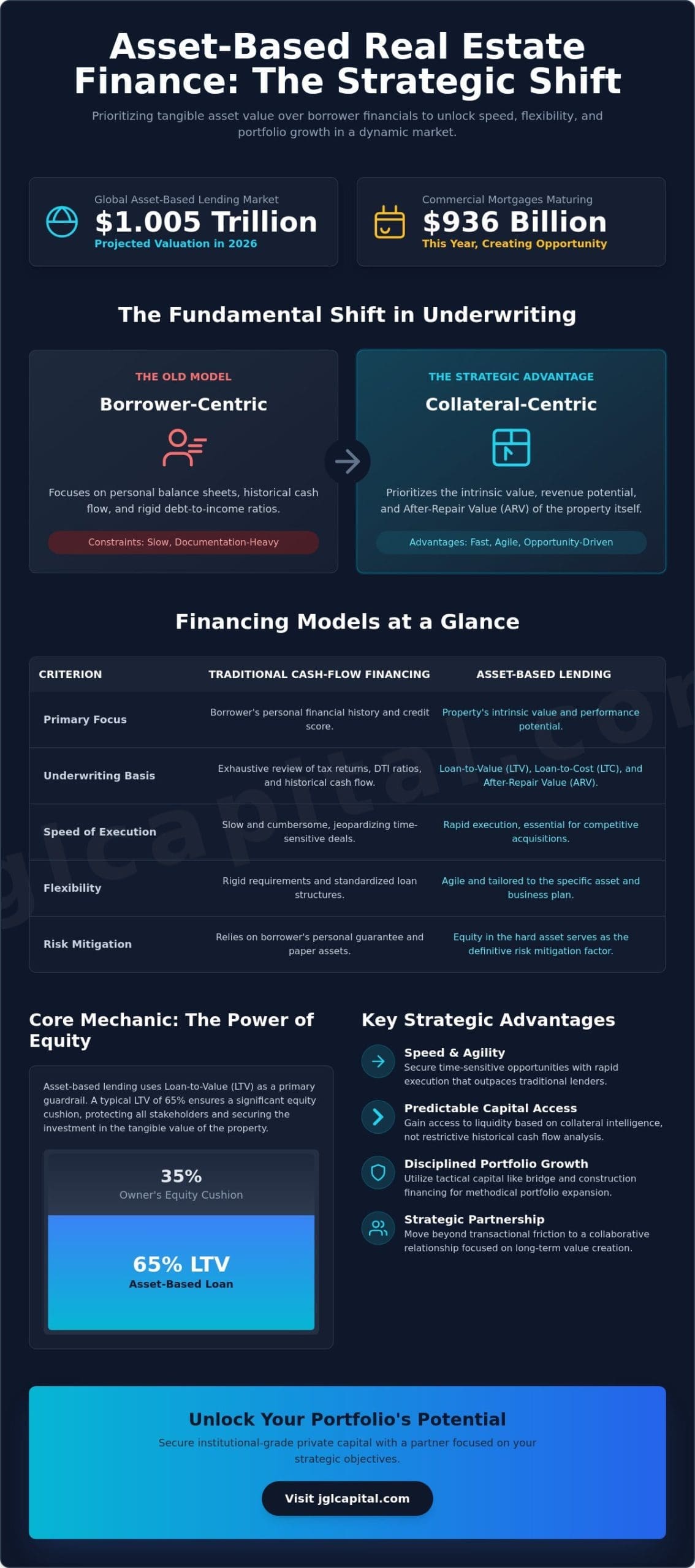
Asset-Based Lending vs. Traditional Cash-Flow Financing
The fundamental divergence between traditional banking and private capital lies in the direction of the analytical lens. Conventional commercial finance is inherently retrospective, relying on historical tax returns and personal debt-to-income ratios to justify a loan’s issuance. Conversely, asset-based lending for real estate is prospective; it prioritizes the property’s intrinsic equity and its capacity to generate future value. This shift in underwriting philosophy allows for a far more flexible arrangement of loan covenants. While commercial banks often impose rigid constraints that can stifle an investor’s agility, asset-based lenders operate with a mandate of institutional speed and certainty of execution. The trade-off is a higher cost of capital, with rates for no-employment verification products averaging approximately 8.25% as of May 2026, compared to conventional 30-year fixed rates that sit between 6.37% and 6.56%. For the sophisticated steward of wealth, this interest rate differential is viewed as a strategic premium paid to eliminate the friction of traditional bureaucracy.
Choosing between these models requires a disciplined assessment of the opportunity cost associated with capital delays. Traditional institutions often require a minimum of 45 to 60 days to move from inquiry to funding, a timeline that frequently results in the loss of high-yield acquisitions. Asset-centric models bypass this “red tape” by focusing on the collateral’s liquidation value and the sponsor’s track record rather than exhaustive personal financial audits. This provides a level of certainty that is indispensable when navigating the $936 billion in commercial mortgage maturities expected throughout 2026. The ability to deploy capital rapidly transforms financing from a mere utility into a tactical weapon for portfolio expansion.
The Speed Advantage in Competitive Markets
In the high-stakes environment of 2026, the velocity of capital often dictates the success of a strategic acquisition. Rapid funding enables investors to secure distressed or high-demand assets that would otherwise be captured by cash buyers while traditional bank committees are still reviewing documentation. There are numerous scenarios where the ability to close in days rather than months far outweighs the impact of a 2% interest rate spread. By utilizing asset-based lending for real estate, seasoned partners can maintain a competitive edge in markets where inventory remains scarce and institutional competition is fierce.
Underwriting Philosophy: Income vs. Equity
Traditional debt-to-income (DTI) requirements often fail real estate entrepreneurs whose wealth is concentrated in illiquid holdings or complex entity structures. Asset-based models solve this by leveraging the property’s Debt Service Coverage Ratio (DSCR) and existing equity. This “lite-doc” approach is particularly beneficial for seasoned developers who require a streamlined path to liquidity. By focusing on the asset’s performance, lenders can offer highly customized solutions that align with the specific strategic objectives of the investment, rather than forcing the deal into a standardized, one-size-fits-all banking box.
Optimizing Portfolio Growth via Tactical Asset-Based Capital
The optimization of a real estate portfolio requires a shift from passive acquisition to the tactical deployment of equity across a diverse project pipeline. While the preceding analysis established the mechanics and comparative benefits of this model, the practical application of asset-based lending for real estate functions as a form of strategic arbitrage. By utilizing cross-collateralization, sophisticated sponsors can leverage the dormant equity in stabilized holdings to fuel new, high-yield acquisitions without the dilution of their primary capital reserves. This disciplined approach to leverage ensures that liquidity remains fluid, allowing for a self-sustaining cycle of growth that isn’t tethered to the restrictive caps or retrospective audits of traditional commercial banking institutions.
Transitional Capital and Bridge Solutions
In the architecture of a sophisticated capital stack, understanding what is a bridge loan is essential for managing assets in transition. These short-term facilities serve as the connective tissue between the initial acquisition and the eventual stabilization of a property, providing the time necessary to execute value-add strategies. The transition from private debt to permanent financing is a deliberate maneuver that requires a seasoned partner to ensure the asset’s trajectory remains unencumbered. This phase is fundamental to the preservation of equity and the creation of lasting worth through careful, deliberate action.
Scaling Through Asset-Based Leverage
Scaling requires access to specialized facilities such as fix and flip loans florida or large-scale new construction loans. The analytical justification for utilizing higher-cost private debt lies in the enhanced Internal Rate of Return achieved through increased project volume and accelerated turnaround times. When a developer can execute multiple transactions simultaneously, the resulting net profit gain significantly outweighs the interest expense associated with private capital. Strategic diversification is only achievable when capital is responsive and aligned with the sponsor’s specific project milestones. To explore how these customized structures can enhance your specific portfolio objectives, you may secure institutional-grade capital with JGL Capital LLC.
Securing Institutional-Grade Private Capital with JGL Capital LLC
For the sophisticated investor, the selection of a financing partner is a decision that carries the weight of long-term portfolio integrity. JGL Capital LLC operates with over 30 years of strategic lending expertise, positioning itself as a disciplined steward of capital rather than a mere transactional service provider. Our philosophy is rooted in the belief that effective asset-based lending for real estate requires a profound alignment of objectives between the lender and the sponsor. We don’t just facilitate debt; we forge collaborative relationships designed to support the preservation and creation of worth across complex market cycles. This commitment to a high-level strategic alliance ensures that every capital solution is meticulously tailored to the individual requirements of the project, providing a stable foundation for institutional-grade growth.
Our streamlined evaluation process for commercial real estate loans is engineered to eliminate the friction typically associated with traditional banking. By focusing on the intrinsic value of the collateral and the strategic vision of the developer, JGL Capital LLC provides a level of responsiveness that is essential in the competitive 2026 landscape. This approach allows us to deliver customized capital structures that respect the nuances of each asset, whether the objective involves the acquisition of land, the development of multi-family units, or the stabilization of a commercial property. It’s a method grounded in analytical rigor, ensuring that liquidity remains accessible when it’s most critical for the execution of your strategic objectives.
The JGL Capital LLC Underwriting Advantage
The advantage offered by JGL Capital LLC lies in our rejection of rigid, one-size-fits-all credit boxes. We prioritize property value and developer experience, recognizing that the strength of a deal is often found in the asset’s potential rather than a sponsor’s personal balance sheet. Our institutional-grade closing process is defined by transparency; we ensure that every partner understands the total cost of capital without the ambiguity of hidden fees. This clarity is why professional investors consistently choose JGL Capital LLC as their long-term financing ally. We provide the certainty of execution that seasoned sponsors require to maintain a steady project pipeline.
Initiating Your Strategic Alliance
Beginning a partnership with JGL Capital LLC starts with a rigorous yet efficient evaluation phase. To facilitate a rapid asset-based assessment, we require comprehensive documentation regarding the property’s current standing, its pro-forma potential, and a clearly articulated exit strategy. Our underwriting team conducts a methodical analysis of these factors to ensure the loan structure supports your long-term goals. Once the analysis is complete, we move decisively toward final closing logistics and capital deployment. This steady, cumulative rhythm ensures that your organization can secure the necessary funding without the delays inherent in traditional institutional finance.
Advancing Your Portfolio Through Disciplined Capital Allocation
The transition toward a collateral-centric financing model represents a fundamental evolution for the sophisticated investor. By prioritizing the intrinsic value of the property, asset-based lending for real estate eliminates the bureaucratic friction of traditional banking, ensuring that your firm maintains the agility required to capture high-yield opportunities in a fast-moving market. This strategic shift facilitates not only the preservation of liquidity but also the deliberate expansion of your project pipeline through predictable and reliable funding structures.
Success in this high-stakes environment requires a partner with deep-seated expertise and a commitment to institutional-grade execution. JGL Capital LLC provides over 30 years of industry veteran experience, offering asset-focused underwriting that bypasses personal income requirements to focus on the worth of the collateral. With a national reach and a meticulous approach to closing efficiency, we stand ready to support your long-term growth objectives. We invite you to Secure Your Strategic Capital Allocation with JGL Capital LLC Today. Your next acquisition deserves the precision and stability of a seasoned financial ally.
Frequently Asked Questions
What is the primary difference between asset-based lending and hard money?
Asset-based lending for real estate typically represents a more institutional and disciplined approach to capital compared to the often fragmented hard money sector. While both models prioritize collateral over borrower credit, asset-based structures generally offer a lower cost of capital and more sophisticated underwriting standards. Hard money loans frequently command interest rates of 12% or higher; conversely, asset-centric financing remains more closely aligned with broader market benchmarks while maintaining superior execution speed.
How much equity is typically required for an asset-based real estate loan?
Lenders generally require a minimum equity position of 25% to 35% to ensure adequate risk mitigation and the preservation of capital. For investment properties, this translates to a maximum Loan-to-Value (LTV) ratio of approximately 65% to 70% of the asset’s appraised worth. This equity cushion serves as the primary security for the institution, allowing the financing to remain rooted in the physical reality of the hard asset rather than the personal financial history of the sponsor.
Can I qualify for asset-based lending with a low credit score?
Qualification is primarily determined by the intrinsic value of the real estate collateral rather than the borrower’s personal credit history. While a minimum FICO score of 620 is a common threshold for most institutional programs, the emphasis remains on the property’s potential to generate worth and the viability of the exit strategy. This allows seasoned developers with complex financial backgrounds or limited traditional income documentation to secure the capital necessary for large-scale acquisitions.
What types of real estate assets are eligible for this type of financing?
Eligible assets include a diverse range of non-owner-occupied properties, such as multi-family complexes, commercial buildings, and land parcels intended for development. Financing is also available for specialized residential investment strategies, including fix-and-flip projects and long-term rental portfolios. These facilities are strictly for investment purposes; owner-occupied residential mortgages are excluded from this institutional framework to maintain a focus on professional capital allocation.
How fast can an asset-based loan be funded compared to a bank?
Asset-based structures offer a decisive speed advantage, often reaching full capital deployment within 7 to 14 days of the initial inquiry. In contrast, traditional commercial banks typically require 45 to 60 days to navigate exhaustive committee reviews and personal documentation audits. This accelerated timeline is essential for investors who must move with precision to secure high-demand assets in competitive markets where delays often result in lost opportunities.
Are asset-based loans for real estate available for new construction projects?
Specialized new construction loans are a central component of the asset-based lending for real estate landscape. These facilities provide the transitional capital required to move a project from the entitlement phase through to vertical completion without the restrictive hurdles of conventional construction financing. By focusing on the future value of the completed asset, lenders can structure draws and interest-only payments that align with the specific operational milestones of the development.
What are the typical loan terms and durations for asset-based financing?
Durations typically range from 12 to 36 months, reflecting the transitional nature of the capital provided. These loans are frequently structured as interest-only facilities, which serves to maximize investor cash flow during the acquisition and stabilization phases. This short-to-medium-term horizon allows sponsors to execute their value-add strategies before transitioning to long-term permanent debt or pursuing a strategic disposition of the asset.
How does the lender determine the value of the real estate collateral?
Value is determined through a combination of professional third-party appraisals and rigorous internal feasibility studies that analyze current market conditions. Lenders evaluate both the current “as-is” value and the projected After-Repair Value (ARV) to establish a secure lending baseline. This process involves a detailed examination of market absorption rates and comparable sales, ensuring that the capital allocation is grounded in analytical rigor rather than speculative trends.