

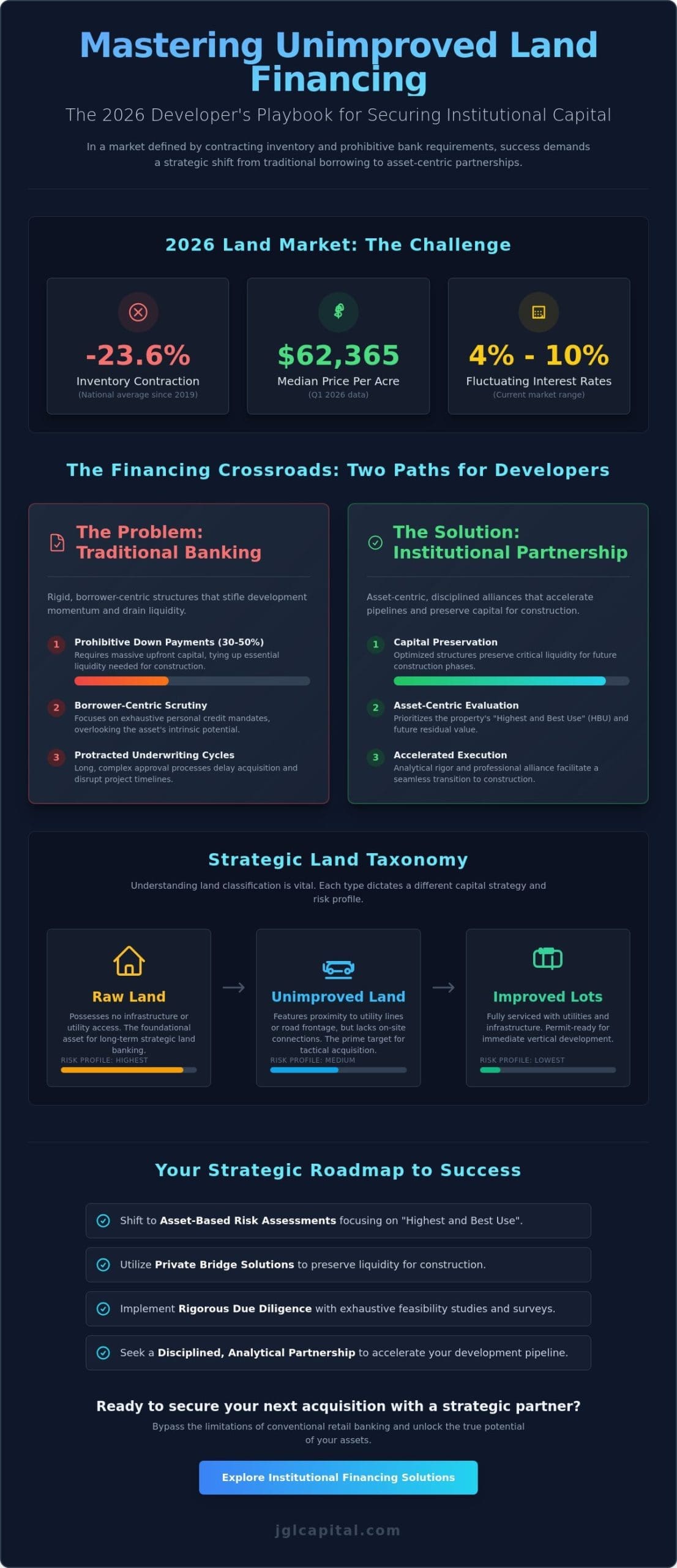
While the national inventory of available acreage has contracted by 23.6% since 2019, the median price per acre has ascended to $62,365 as of the first quarter of 2026, presenting a formidable barrier for even the most seasoned developers. Securing sophisticated financing for unimproved land remains a significant hurdle in this climate, particularly as traditional lending institutions continue to enforce prohibitive down payment requirements ranging from 30% to 50% for raw sites. You’ve likely recognized that these rigid capital structures, often coupled with protracted underwriting cycles and exhaustive personal credit mandates, serve to stifle the momentum of your development pipeline rather than facilitate its expansion.
This guide serves as a definitive resource for mastering the complexities of institutional capital acquisition, allowing you to secure the necessary funding for land acquisition while preserving critical liquidity for future construction phases. It’s essential to shift your focus toward asset-centric partnerships that prioritize the intrinsic value and long-term potential of the real estate itself to bypass the limitations of conventional retail banking. We will explore the current 2026 market dynamics, including the nuances of interest rates that currently fluctuate between 4% and 10%, and provide a strategic roadmap for identifying a disciplined partner committed to the generation of lasting worth through a collaborative, professional alliance.
Key Takeaways
- Establish a sophisticated taxonomy for various land types to ensure your acquisition strategy aligns with long-term institutional investment objectives.
- Transition from borrower-centric metrics to asset-based risk assessments by mastering how institutional lenders evaluate a property’s highest and best use.
- Analyze diverse capital structures, including private bridge solutions, to identify the most efficient financing for unimproved land while preserving your liquidity.
- Implement a rigorous due diligence protocol that integrates exhaustive feasibility studies and precise land surveys to safeguard your firm’s capital allocation.
- Understand why it’s vital to seek a disciplined, analytical partnership that can accelerate your development pipeline and facilitate a seamless transition to the construction phase.
Understanding Unimproved Land as a Strategic Asset Class
Professional developers view land not as a static resource, but as a strategic inventory component that requires precise institutional categorization. While retail mortgage providers often conflate all land types into a single risk bucket, sophisticated stakeholders recognize the critical distinctions between raw acreage, unimproved land, and improved lots. Raw land typically possesses no infrastructure or utility access; conversely, unimproved land may feature proximity to utility lines or road frontage without on-site meters or internal access. Improved lots are those that have been fully serviced and are essentially permit-ready for vertical development. Distinguishing these states is vital, as each phase dictates a different capital allocation strategy and impacts the overall risk profile of a diversified real estate portfolio.
Traditional lending institutions frequently categorize these parcels as high-risk assets due to the absence of immediate cash flow and the inherent complexities of valuation. Because land doesn’t generate yield during the hold period, banks often impose restrictive terms to mitigate their exposure. Securing financing for unimproved land therefore necessitates an alliance with an institutional partner that prioritizes asset-centric underwriting over the rigid, borrower-centric metrics favored by consumer banks. This disciplined approach allows for the acquisition of high-value tracts that serve as the foundation for future development pipelines.
Defining the Parameters of Unimproved Acreage
The “unimproved” designation typically signifies a lack of essential infrastructure, such as internal paved roads, water meters, or sewage connectivity. It’s this specific status that impacts how capital is deployed. A disciplined land banking strategy involves acquiring these parcels in the path of growth, allowing a firm to secure inventory before market saturation drives prices to prohibitive levels. This isn’t speculative holding; it’s a tactical acquisition aimed at controlling the supply of buildable area within high-demand corridors. The underwriting for these assets must account for several factors:
- Proximity to Infrastructure: The distance to the nearest municipal tie-ins.
- Access Rights: Existing easements or road frontage that facilitate future ingress.
- Topographical Viability: The physical readiness of the site for grading and utility installation.
The Economic Rationale for Land Acquisition in 2026
Market dynamics in 2026 have underscored the importance of securing undeveloped parcels as a hedge against rising inventory costs. Since land serves as the prerequisite for new construction loans, early-stage acquisition is a fundamental component of value preservation. Zoning and land-use designations remain the primary drivers of financing eligibility. A parcel’s “highest and best use” must be meticulously documented to satisfy institutional standards. By securing financing for unimproved land through a partner that values analytical rigor, developers can maintain the momentum required to move from the entitlement phase to vertical construction without the delays inherent in traditional banking cycles.
Risk Mitigation and Valuation Metrics in Land Acquisition
Institutional lenders prioritize the “highest and best use” (HBU) analysis as the primary metric for valuation. This methodology involves a rigorous assessment of what is physically possible, legally permissible, and maximally productive for a specific site. Unlike residential appraisals, which rely heavily on historical sales of similar lots, institutional valuation focuses on the future residual value after development. This forward-looking perspective is fundamental when seeking financing for unimproved land, as it shifts the focus from the property’s current lack of utility to its potential to support high-density residential or commercial structures.
Managing the liquidity challenge inherent in land acquisition requires a disciplined loan structure. Because unimproved land doesn’t produce immediate income, lenders often require significant equity positions. Research indicates that down payment requirements for raw and unimproved land typically range from 30% to 50% in the 2026 market. To preserve capital for the vertical phase, developers must identify partners who understand these liquidity constraints and offer structures that align with the project’s anticipated cash flow. A disciplined approach to loan-to-value (LTV) ratios ensures that the project remains solvent even during protracted entitlement periods.
Asset-Based Underwriting vs. Traditional Credit Metrics
Traditional banks often emphasize personal credit scores and debt-to-income ratios; this borrower-centric approach frequently fails to account for the scale of professional development. In contrast, institutional partners utilize asset-based underwriting, where the property’s intrinsic value and the developer’s track record serve as the primary security. This shift is particularly evident in the deployment of commercial real estate loans for large-scale acquisitions. By focusing on the LTV ratio and the project’s feasibility, lenders provide a more stable capital foundation than those relying on volatile personal financial statements. While specialized programs like USDA Rural Housing Site Loans offer specific utility for low-income housing initiatives, most commercial developers require the flexibility of private institutional capital to maintain their pipeline.
Environmental and Regulatory Risk Assessment
Securing financing for unimproved land also demands a meticulous review of environmental and regulatory hurdles. A Phase I Environmental Site Assessment is a non-negotiable requirement for commercial-grade financing, as it ensures that no historical contamination exists that could jeopardize future development or lender security. Developers must also evaluate local zoning ordinances and potential natural resource restrictions, such as wetlands or protected habitats, which can significantly alter development timelines. Those seeking to navigate these complexities should consider a strategic alliance with a disciplined land lender capable of conducting deep-tier analytical rigor before capital is deployed.
Comparing Financing Structures for Raw and Unimproved Acreage
The selection of a capital structure for raw acreage requires a deliberate alignment with the project’s anticipated development timeline. Traditional land loans, typically issued by community banks or credit unions, often feature 10 to 15-year amortizations with fixed rates; however, these products frequently lack the flexibility required for professional development cycles. In contrast, institutional financing for unimproved land often utilizes interest-only structures during the pre-development phase. This specific strategy preserves a developer’s cash flow by deferring principal repayment until the project transitions to vertical construction or a permanent refinancing event occurs. By prioritizing liquidity, developers can allocate resources toward the essential engineering and entitlement work that ultimately creates value.
Seller financing also maintains a significant presence in the unimproved land market, offering a collaborative alternative to institutional debt. In these arrangements, the land owner essentially acts as the lender, often accepting a lower down payment in exchange for a higher purchase price or a structured payout. While this can be a useful tool for land banking, it’s often a temporary solution. Sophisticated developers eventually transition these positions into more stable institutional facilities as they move closer to the construction phase. This transition is a critical juncture that requires a partner capable of assessing the project’s increased value following successful entitlement.
The Strategic Use of Bridge Capital
Strategic bridge capital serves as a vital instrument for developers operating in highly competitive markets where speed of execution is paramount. A bridge loan provides the necessary transitional funding to secure a parcel while the developer navigates the complexities of entitlement, zoning adjustments, and permitting. Unlike traditional bank underwriting, which may span several months, private bridge capital can often be deployed with greater efficiency. This agility allows sophisticated stakeholders to capitalize on undervalued opportunities without the constraints of conventional institutional inertia. Utilizing bridge financing as a tactical tool during the entitlement phase ensures that the acquisition doesn’t stall while awaiting municipal approvals.
Private Money and Hard Money Alternatives
For asset-backed deals where the intrinsic value of the land is the primary security, non-traditional hard money lenders provide a necessary alternative to standard credit-based institutions. While these facilities may carry higher interest rates than amortizing bank loans, the trade-off is significantly increased capital accessibility and a focus on the project’s ultimate viability. As noted in a comprehensive Guide For Land Investors, the success of these high-leverage positions depends on a clearly defined exit strategy. Whether the exit involves a sale to a merchant builder or a transition into a construction facility, the financing must be structured to facilitate a seamless handover between capital phases. This methodical approach to financing for unimproved land ensures that the development remains adequately capitalized from initial acquisition through the commencement of vertical work.
Critical Due Diligence for Land Capital Allocation
Successful capital deployment requires more than market intuition; it demands an exhaustive analytical framework. When developers seek financing for unimproved land, the quality of their due diligence often dictates the terms of the institutional partnership. This process involves a meticulous verification of the site’s physical and legal characteristics to ensure the collateral remains untainted by unforeseen liabilities. A disciplined approach to feasibility studies allows stakeholders to quantify the risks associated with topography, soil composition, and municipal zoning before capital is committed. By synchronizing the financing structure with these development milestones, firms can avoid the liquidity traps that often ensnare less prepared organizations.
The underwriting of raw acreage in 2026 necessitates a rigorous examination of the property’s entitlement status. Lenders look for a clear path to the project’s “highest and best use,” as established in previous phases of this guide. Any discrepancy between the developer’s vision and the municipal reality can jeopardize the entire capital stack. It’s essential to conduct these studies early, as the findings will directly influence the loan-to-value ratios and interest rates offered by sophisticated institutional partners.
Surveys and Legal Descriptions
Institutional lenders typically require an ALTA/NSPS land title survey to establish a precise legal baseline for the property. This high-register survey goes beyond basic boundary marking; it identifies recorded easements, potential encroachments, and existing utility lines that could impede future development. Verifying property boundaries is essential for maintaining collateral integrity and ensuring that the project’s footprint aligns with legal descriptions. Any ambiguity in the legal title can cause significant delays in the underwriting process, making these surveys a non-negotiable component of early-stage planning. Without this level of precision, the risk of litigation or title claims increases, which can devalue the asset and complicate future construction phases.
Infrastructure Feasibility and Cost Analysis
Evaluating the “soft costs” associated with bringing utilities to an unimproved site is a critical step in the feasibility phase. Developers must account for municipal impact fees, which can vary significantly by jurisdiction, and the substantial engineering costs required to prepare the site for vertical construction. These infrastructure expenses must be integrated into the broader real estate investing strategy to ensure the project remains financially viable. Aligning the acquisition loan with these development milestones prevents capital shortfalls during the crucial period between land possession and the commencement of construction. To ensure your next acquisition is supported by disciplined capital and analytical rigor, partner with an institutional lender that understands the complexities of unimproved land.
Institutional Private Capital: The JGL Capital LLC Methodology
JGL Capital LLC operates on the foundational principle that high-stakes real estate development requires a partner whose discipline matches the complexity of the project. Our firm brings over 30 years of industry expertise to every transaction, ensuring that our capital stewardship is grounded in historical performance and analytical rigor. We don’t view ourselves as a mere service provider. Instead, JGL Capital LLC functions as a seasoned, discreet partner dedicated to the preservation of value and the generation of worth for sophisticated stakeholders. By prioritizing intellectual capital over aggressive self-promotion, we’ve established a history of building lasting legacies through careful, deliberate action.
Our methodology transcends the transactional nature of conventional banking. We recognize that securing financing for unimproved land is merely the initial stage of a multi-year development lifecycle. Therefore, we structure our facilities to provide a seamless bridge between initial land acquisition and the eventual transition to vertical construction. This holistic view allows developers to maintain their momentum without the administrative friction typically associated with traditional lending institutions.
A Collaborative Approach to Value Creation
The alignment of objectives is the cornerstone of our strategic alliances. We understand that a developer’s success is predicated on the ability to execute a long-term vision; consequently, JGL Capital LLC delivers customized individual solutions that reflect the specific nuances of each parcel. This collaborative relationship ensures that the capital stack is optimized for the property’s highest and best use, as defined in our earlier analysis of risk mitigation. By acting as a quiet expert, JGL Capital LLC provides the stability and security necessary for high-net-worth partners to focus on the creation of enduring real estate assets.
Expediting the Funding Lifecycle
Precision and transparency define our operational strengths. Our process is designed to reduce the protracted timelines that often characterize the acquisition of raw acreage. Because our underwriting is asset-centric, we focus on the intrinsic value of the real estate and the feasibility of the proposed development, which significantly mitigates the delays caused by exhaustive personal credit requirements. When developers seek financing for unimproved land through our firm, they benefit from a measured and steady communication rhythm that prioritizes precision over speed. This disciplined approach ensures that every claim is qualified and every objective is clearly defined, providing a clear path toward securing the necessary capital to accelerate your development pipeline. To initiate a strategic alliance and explore our specialized Land Loans, we invite you to engage with our team for a methodical review of your project’s potential.
Advancing Your Development Pipeline Through Disciplined Capital
Mastery of the current acreage market requires a departure from standard retail lending practices in favor of an institutional approach that prioritizes property potential and analytical rigor. By implementing the rigorous due diligence protocols and forward-looking valuation metrics discussed in this guide, your firm can navigate the complexities of 2026 market dynamics with absolute confidence. Securing sophisticated financing for unimproved land is the essential prerequisite for establishing a robust development pipeline that remains resilient against economic fluctuations. It’s this commitment to analytical precision that distinguishes a successful long-term legacy from a mere speculative venture.
JGL Capital LLC offers a strategic alliance grounded in over 30 years of expertise and a specialized focus on high-stakes, asset-backed loans. Our national reach and institutional-grade processing provide the stability and security that sophisticated developers demand. We invite you to Secure Strategic Capital for Your Next Land Acquisition and experience a partnership defined by integrity and the preservation of value. Your vision for a lasting legacy deserves a capital partner like JGL Capital LLC, with the discipline and intellectual capital to see it through to completion.
Frequently Asked Questions
What is the primary difference between raw land and unimproved land financing?
The distinction lies in the existing infrastructure; raw land lacks all utility access and road frontage, whereas unimproved land typically possesses proximity to municipal services without on-site connectivity. Consequently, institutional lenders perceive unimproved parcels as lower risk, often offering more favorable loan-to-value ratios than those available for completely undeveloped raw acreage. This proximity to infrastructure reduces the capital required for initial site preparation, making the underwriting process more efficient.
Why do lenders typically require a higher down payment for unimproved land?
Higher down payments are required to mitigate the inherent risk of non-income-producing assets that exhibit greater valuation volatility during market shifts. Data from early 2026 confirms that institutional providers typically mandate equity positions between 30% and 50% for raw or unimproved sites. This capital cushion protects the lender’s interest during the entitlement phase when the property lacks immediate cash flow and remains sensitive to regulatory changes.
Can I secure a bridge loan for unimproved land before obtaining a construction loan?
Securing a bridge loan before a construction facility is a common tactical move for developers who must close quickly on a competitive parcel. This transitional capital allows you to maintain control of the asset while finalizing the entitlement and permitting processes required for vertical construction. It’s a strategic bridge that preserves liquidity during the critical pre-development window, ensuring the project remains viable as you transition to a construction loan.
What are the most critical due diligence documents required for land financing?
The most critical documents include an ALTA/NSPS land title survey, a Phase I Environmental Site Assessment, and a comprehensive Highest and Best Use analysis. These technical reports provide the empirical data necessary for an institutional partner to verify the collateral’s integrity and legal standing. Without these verified documents, the underwriting process for financing for unimproved land cannot proceed with the required level of analytical rigor or professional discipline.
How does zoning impact the availability of financing for undeveloped plots?
Zoning designations dictate the legally permissible density and intended use of a parcel, which serve as the primary drivers of institutional valuation. Lenders are significantly more likely to approve financing for plots that are already zoned for their proposed use, as rezoning introduces a layer of regulatory uncertainty. A property with by-right development potential commands more competitive terms than speculative tracts requiring extensive municipal variances or land-use amendments.
Is it possible to finance the soft costs of land development within the acquisition loan?
While acquisition loans primarily focus on the purchase price of the property, some sophisticated institutional lenders allow for the inclusion of certain soft costs within the initial facility. These costs often include engineering fees, environmental studies, and municipal impact fees that directly contribute to the project’s ultimate value. The total loan amount remains strictly governed by the asset’s current appraised value and the developer’s equity position to ensure capital stability.
What is the typical term length for a private land loan in 2026?
In the 2026 capital market, private land loans typically feature term lengths ranging from 12 to 36 months. These durations are designed to align with the typical lifecycle of the entitlement and pre-development phases. These facilities often include interest-only periods, providing the developer with the necessary time to secure construction financing or a permanent exit strategy without the pressure of immediate principal amortization or capital depletion.
How does an asset-based lender evaluate a property with no existing structures?
An asset-based lender evaluates vacant property by focusing on its residual land value and the potential for future income generation through development. This process involves a meticulous review of the site’s topography, utility access, and local market demand for the proposed project. By prioritizing the intrinsic value of the real estate over the borrower’s personal credit, the lender ensures that the financing for unimproved land is anchored in the asset’s actual worth and long-term viability.