

The true cost of a real estate acquisition in 2026 is measured less by the nominal interest rate and more by the lost equity resulting from a delayed closing. As traditional lenders struggle with the administrative weight of the March 2026 executive orders, sophisticated investors require a precise understanding of how to get funding for a real estate deal quickly without sacrificing the analytical rigor their portfolios demand. You’ve likely experienced the frustration of seeing a prime multi-family or commercial asset slip away because a bank’s underwriting process couldn’t match the pace of the market.
JGL Capital LLC recognizes that capital velocity is a strategic necessity for wealth preservation. This guide provides the framework to master the sophisticated mechanisms of rapid asset-backed financing to secure high-stakes real estate opportunities in 2026. We’ll examine the fundamental shift toward property-centric underwriting and provide a systematic execution roadmap designed to ensure your capital is deployed with institutional precision and strategic oversight.
Key Takeaways
- Identify why the 2026 regulatory landscape makes expedited capital a critical component of a successful real estate acquisition strategy.
- Learn how to get funding for a real estate deal quickly by prioritizing asset-backed underwriting over traditional documentation, allowing for rapid capital deployment in competitive markets.
- Analyze the comparative benefits of bridge loans and transactional funding to ensure your financing strategy aligns with the specific requirements of your portfolio.
- Implement a systematic execution roadmap to reduce friction in the underwriting process and secure capital within a ten-day window.
- Understand the benefits of aligning with a seasoned capital partner to maintain a competitive advantage in high-stakes asset allocation.
The Strategic Importance of Expedited Capital in 2026 Real Estate Markets
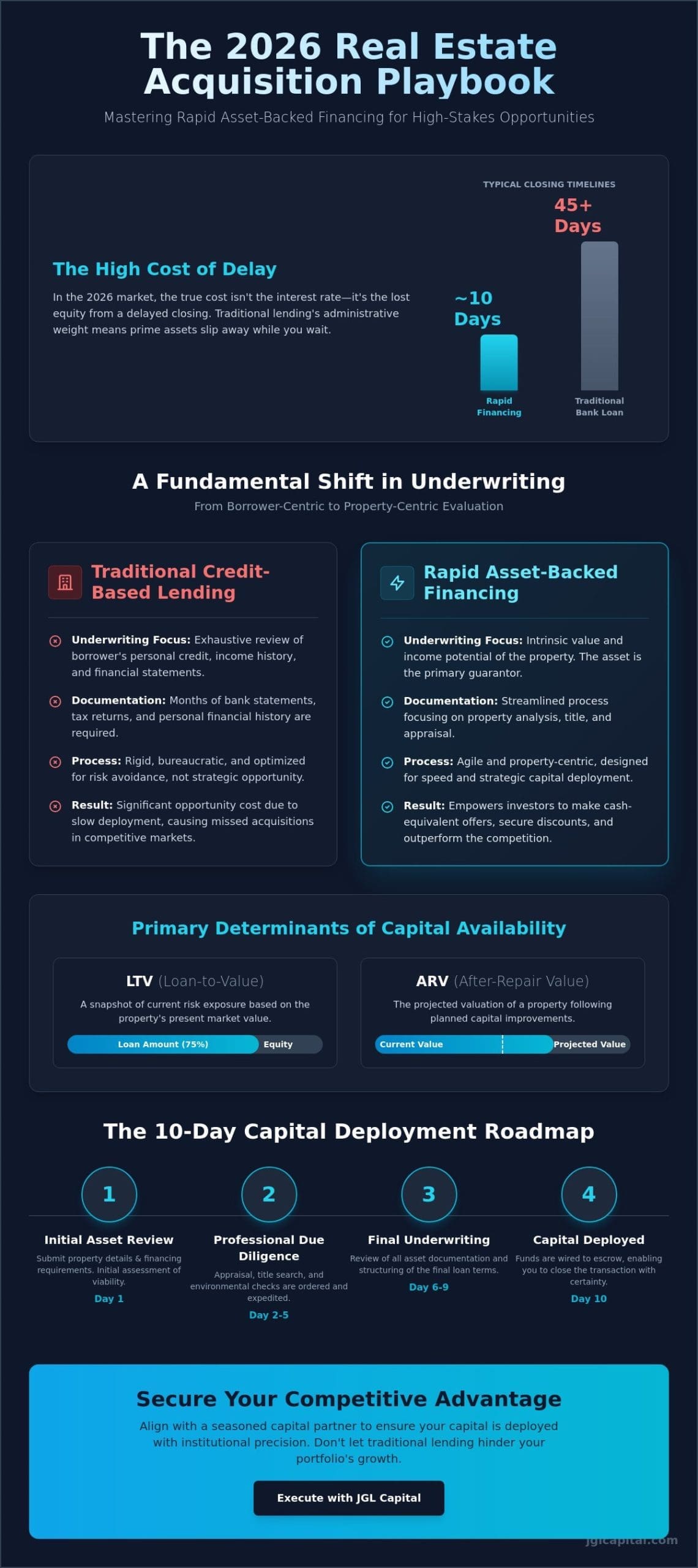
Expedited capital, in its most disciplined form, is defined as asset-backed financing engineered for rapid deployment within institutional and high-stakes investment environments. It serves as a sophisticated alternative to the sluggish mechanisms of traditional credit; it prioritizes the intrinsic value and income potential of the underlying asset over the exhaustive personal history of the borrower. As of May 2026, the real estate market continues to exhibit significant volatility, making the speed of capital allocation a primary determinant of investment success. Understanding how to get funding for a real estate deal quickly allows an investor to present offers that are functionally equivalent to cash, providing a distinct advantage in a landscape where traditional 45-day closing cycles often result in lost equity. While conventional commercial mortgage rates range from 5.26% to 8.75% as of May 5, 2026, the inherent friction in their approval processes creates a substantial opportunity cost for those seeking to optimize their portfolios through timely acquisitions.
The Velocity of Capital as a Competitive Advantage
The capacity to provide immediate liquidity often allows institutional partners to secure deeper discounts on assets that are either distressed or subject to time-sensitive liquidation requirements. Sellers, particularly those managing complex commercial portfolios, frequently value the certainty of a rapid closing over a marginally higher offer that remains contingent on a bank’s protracted underwriting. A Hard money loan or similar bridge facility provides the necessary agility to execute these transactions before competitors can even complete their initial site inspections. Capital velocity is the measurable rate at which an organization can deploy, recover, and reinvest capital to achieve superior risk-adjusted returns. For those utilizing fix and flip loans, this velocity is the primary engine of compound growth and portfolio expansion.
Limitations of Traditional Financial Institutions
The divergence between traditional financial institutions and private capital providers has become more pronounced following the March 13, 2026, executive orders intended to ease regulatory burdens. Despite these federal efforts, the bureaucratic infrastructure of conventional banks remains optimized for risk avoidance rather than strategic opportunity. Their rigid adherence to credit-based underwriting often overlooks the nuanced value of a high-performing multi-family or commercial property. High-net-worth individuals and institutional investors increasingly bypass these traditional mortgages, recognizing that the flexibility of transitional capital is essential for effective stewardship. When considering how to get funding for a real estate deal quickly, it’s clear that the institutional bottlenecks of the banking sector represent a systemic barrier to rapid asset acquisition and the preservation of long-term wealth legacies.
Primary Mechanisms for Rapid Funding: Asset-Backed vs. Credit-Based Lending
The evolution of capital allocation in the real estate sector has necessitated a fundamental shift from borrower-centric to property-centric underwriting. While traditional institutions remain tethered to the exhaustive personal financial histories and credit scores of individuals, the private market prioritizes the intrinsic value and income potential of the collateral. This transition is the primary mechanism behind how to get funding for a real estate deal quickly; by focusing on the asset’s performance, lenders can bypass the months of personal documentation typically required for conventional mortgages. This property-centric approach mitigates the need for traditional credit hurdles, allowing the underlying real estate to serve as the primary guarantor of the transaction’s viability.
In this high-velocity environment, two metrics serve as the primary determinants of capital availability: Loan-to-Value (LTV) and After-Repair Value (ARV). LTV provides a snapshot of current risk exposure, whereas ARV assesses the projected valuation of a property following a specific capital improvement plan. Precise professional due diligence in these areas accelerates the approval process by providing underwriters with an objective data set. This disciplined approach ensures that capital is deployed based on the strength of the deal rather than the liquidity of the borrower. It’s a method that values analytical rigor over bureaucratic box-ticking.
Hard Money and Private Capital Allocation
Institutional hard money lenders play a vital role in 2026 by providing the liquidity necessary for high-velocity transactions. As of May 5, 2026, interest rates for these first position loans typically range from 9.5% to 12%, often structured as interest-only payments to maximize cash flow during the holding period. This alignment of interests ensures that both the lender and the investor are focused on the successful execution of the asset’s strategic plan. For those seeking to scale their portfolios, a strategic partnership with a private capital provider offers a level of agility that traditional banks cannot replicate.
Bridge Loans for Transitional Real Estate
Understanding what is a bridge loan is essential for investors managing “gap” financing requirements. These facilities are designed to stabilize multi-family or commercial assets, providing the necessary runway to achieve full occupancy or complete renovations before transitioning to long-term refinancing. While there are over 14 Real Estate Financing Options available to modern investors, bridge capital remains the most effective tool for transitional assets. Approval for such financing requires a clearly articulated exit strategy, typically involving the sale of the asset or a transition to permanent agency debt once stabilization is achieved.
Evaluating High-Velocity Funding Sources: A Comparative Analysis
Selecting the appropriate financial instrument requires a rigorous assessment of the asset’s lifecycle and the specific capital requirements of the transaction. While many investors focus solely on the nominal interest rate, a sophisticated approach prioritizes the alignment between the funding source and the investment strategy. When determining how to get funding for a real estate deal quickly, one must weigh the immediate liquidity of transactional funding against the longer duration and stabilization potential of bridge facilities. Hard money typically offers a balance of speed, often closing within 3 to 7 days, and a moderate duration of 6 to 18 months. This makes it a primary choice for fix and flip loans, where the cost of capital is secondary to the agility of execution.
In the sector of commercial real estate loans, the complexity of the underlying asset often requires a more nuanced approach than simple debt. Private equity and joint venture partnerships emerge as viable alternative paths for those seeking to leverage institutional intellectual capital alongside traditional financing. These structures allow for more flexible capital allocation, especially when time is of the essence and the asset requires significant repositioning or stabilization before it can qualify for permanent financing. Understanding how to Find Money For Real Estate Investing involves identifying which of these mechanisms provides the best risk-adjusted return for your specific portfolio objectives.
Transactional Funding for Wholesaling and Rapid Flips
Transactional funding operates on the mechanics of a “double closing,” where capital is deployed and recovered within a narrow 24 to 48 hour window. To secure 100% financing for these deals, underwriters typically require a fully executed purchase contract and a verifiable end-buyer commitment. While this represents a highly efficient method to facilitate rapid turnovers, it isn’t without institutional risk. The primary vulnerability lies in end-buyer default; if the secondary closing fails, the sponsor may find themselves in a compromised position without a secondary exit strategy or the capital to hold the asset.
Mezzanine and Preferred Equity Structures
For larger-scale projects, specifically those requiring new construction loans, the capital stack often involves mezzanine debt or preferred equity. These structures fill the gap between senior debt and the sponsor’s equity, allowing for higher leverage while maintaining a disciplined risk profile. Integrating these multiple capital sources requires significant strategic oversight to ensure that the interests of all stakeholders remain aligned throughout the development lifecycle. This layered approach to capital allocation ensures that even the most ambitious projects have the necessary liquidity to move from groundbreaking to stabilization without unnecessary delays.
A Systematic Framework for Securing Funding Quickly: The Investor’s Execution Roadmap
The process of determining how to get funding for a real estate deal quickly is fundamentally a matter of reducing the informational asymmetry between the sponsor and the capital provider. While transactional brokers might emphasize speed at the expense of detail, an institutional approach utilizes a comprehensive Executive Memorandum to facilitate immediate clarity. This document serves as the cornerstone of the underwriter’s review; it provides a synthesized view of the asset’s risk profile and its potential for value creation. By presenting a professional deal package that anticipates an underwriter’s inquiries, you demonstrate a level of strategic oversight that instills confidence and accelerates the capital allocation process.
A rapid-response due diligence file must be exhaustive yet organized, reflecting the investor’s commitment to transparent communication. The regulatory landscape in 2026 demands a clear audit trail for capital sources; providing this transparency is essential for maintaining momentum during the underwriting phase. A Proof of Funds (POF) letter must carry institutional weight to be effective. This requires more than a simple account screenshot; it necessitates a formal statement from a verified financial institution that confirms the availability of liquid capital for the specific transaction at hand.
Curating the Professional Deal Package
- Step 1: Provide a clear property executive summary that includes the current physical condition and rigorous pro-forma projections based on 2026 market data.
- Step 2: Submit a detailed scope of work (SOW) accompanied by verified contractor bids to eliminate ambiguity regarding renovation costs.
- Step 3: Include a definitive exit strategy, whether it involves a strategic sale or a transition to long-term refinancing once the asset is stabilized.
Mitigating Underwriting Friction
The primary objection encountered during the underwriting process is a lack of clarity regarding the asset’s “as-is” value. To address this, investors should utilize expedited third-party appraisals or Broker Price Opinions (BPOs) that provide an objective valuation based on recent comparable sales. This data-driven approach is the most reliable method for those seeking how to get funding for a real estate deal quickly without compromising on the analytical rigor of the transaction. Additionally, maintaining a standing relationship with a title insurance provider and an escrow officer who understand the requirements of high-velocity closings is vital. To ensure your next acquisition is backed by a partner who values precision as much as speed, you should apply for a strategic capital facility with JGL Capital LLC.
Strategic Capital Allocation: Partnering with JGL Capital LLC for Rapid Execution
The successful acquisition of high-stakes assets requires more than a mere source of liquidity; it demands a relationship with a disciplined steward of capital who understands the nuances of portfolio optimization. JGL Capital LLC operates on a philosophy of discreet stewardship, prioritizing the preservation of wealth and the creation of lasting legacies through meticulous capital deployment. For investors seeking how to get funding for a real estate deal quickly, the transition from a transactional borrower to a strategic partner is essential for maintaining a competitive edge. Our firm provides the analytical rigor necessary to navigate complex financial landscapes, ensuring that every allocation is grounded in a deep understanding of risk-adjusted returns and strategic oversight.
With a 30-year track record in managing asset-backed transactions, JGL Capital LLC has established itself as a quiet expert in the field of private finance. We recognize that institutional partners and high-net-worth individuals require bespoke solutions that are tailored to their specific investment philosophies. This commitment to professional integrity ensures that our interests remain perfectly aligned with those of our partners, fostering a sense of security and stability throughout the investment lifecycle. By rejecting speculative trends in favor of timeless financial principles, we provide a foundation for growth that remains resilient regardless of broader market volatility.
The JGL Capital LLC Advantage
Our organization maintains a significant national reach, possessing the capacity to fund diverse asset classes without the geographic restrictions that often hinder traditional regional banks. Whether the requirement involves new construction loans, multi-family assets, or complex commercial acquisitions, our underwriting process is defined by precision rather than marketing hype. We value intellectual capital as our primary asset, utilizing a sophisticated framework of risk assessment to evaluate the intrinsic value of every property. This institutional approach allows us to bypass the bureaucratic bottlenecks of conventional lending, providing a level of exclusivity and professional discipline that is rare in the private market.
Initiating the Partnership
The path to a strategic partnership begins with a collaborative preliminary due diligence phase, where our team works closely with you to evaluate the viability of your acquisition. We invite you to experience a more sophisticated approach to real estate financing by submitting your primary deal summary for a professional evaluation. This process is designed to be cumulative and logical, moving from high-level strategic objectives to specific operational strengths without the pressure of aggressive self-promotion. If you’re focused on how to get funding for a real estate deal quickly while maintaining the highest standards of analytical rigor, JGL Capital LLC stands ready to serve as your collaborative and deeply invested strategic ally.
Establishing Institutional Alignment for Long-Term Portfolio Growth
Mastery of rapid asset-backed financing is no longer a peripheral skill but a core requirement for those seeking to capitalize on the 2026 real estate landscape. By transitioning from a reliance on traditional credit structures to a property-centric underwriting model, you secure the agility necessary to execute on high-stakes opportunities before they’re absorbed by the broader market. Understanding how to get funding for a real estate deal quickly through a disciplined execution roadmap ensures that your capital remains productive and your risk-adjusted returns remain optimized.
JGL Capital LLC offers over 30 years of industry expertise to investors who value analytical rigor and professional integrity above transactional speed alone. Our national funding capabilities for both residential and commercial projects provide the stability required to navigate a shifting regulatory environment. We invite you to Secure Your Strategic Capital Partner: Submit Your Deal to JGL Capital LLC Today and begin a relationship defined by stewardship and value creation. Your next acquisition deserves a partner committed to your long-term legacy. It’s time to elevate your capital strategy.
Frequently Asked Questions
How quickly can a private money loan be funded in 2026?
Private money loans can be funded in as little as 3 to 5 business days. This rapid deployment is possible because the underwriting process focuses on the asset’s intrinsic value rather than the borrower’s personal financial history. As of May 2026, the digitization of title and escrow services has further streamlined these timelines, allowing for capital allocation that matches the pace of high-stakes acquisitions.
What is the minimum credit score required for an asset-backed real estate loan?
There is typically no rigid minimum credit score for asset-backed loans because the property serves as the primary security for the transaction. While traditional banks often require scores above 700, private capital providers prioritize the Loan-to-Value ratio and the property’s income potential. Some institutional lenders may look for a score of 600 or higher to ensure the sponsor’s basic financial stability, but the asset remains the central focus.
Can I get funding for a real estate deal with no money down?
Securing 100% financing is rare and typically requires significant additional collateral or a highly distressed purchase price relative to the After-Repair Value. Investors often utilize transactional funding for double closings, which can cover the entire purchase price for a 24 to 48 hour period. For longer terms, most lenders require a 10% to 20% equity stake to ensure an alignment of interests between the sponsor and the capital steward.
What is a Proof of Funds letter, and how do I obtain one quickly?
A Proof of Funds letter is a formal document from a capital provider verifying that an investor has the liquid resources necessary to close a transaction. You can obtain one by submitting a preliminary deal summary and proof of liquidity to your lender. In 2026, many private lenders provide these letters within 24 hours to help sponsors understand how to get funding for a real estate deal quickly and secure competitive assets in volatile markets.
How do hard money interest rates compare to traditional commercial rates?
Hard money rates are consistently higher than traditional commercial rates, reflecting the increased risk and speed of the capital. As of May 5, 2026, hard money rates for first position loans range from 9.5% to 12%, while conventional commercial mortgage rates range from 5.26% to 8.75%. This premium represents the cost of bypassing the months of documentation and bureaucratic friction required by traditional financial institutions.
What documentation is essential for a 10-day real estate closing?
A 10-day closing requires an executed purchase contract, a detailed scope of work, and a preliminary title report. You must also provide corporate entity documents, such as an Operating Agreement or Articles of Incorporation, alongside a clearly defined exit strategy. Having these documents organized in a digital due diligence file is the most effective way to learn how to get funding for a real estate deal quickly while maintaining professional standards.
Is it possible to secure funding for a new construction project quickly?
New construction projects can be funded quickly if the sponsor provides a shovel-ready site with all necessary permits and entitlements. While the underwriting is more complex than a simple acquisition, private lenders can often issue a commitment letter within 5 to 7 days. This speed is critical for developers who need to secure materials and labor in a volatile 2026 construction market where delays result in significant cost overruns.
What happens if my exit strategy for a bridge loan fails?
If a primary exit strategy fails, such as a property not selling as expected, the borrower must immediately seek a loan extension or alternative refinancing. Most bridge loan agreements include provisions for maturity extensions, though these often involve additional fees or interest rate adjustments. Transparent communication with the capital provider is vital to restructuring the debt and preserving the asset’s equity during the stabilization phase.