

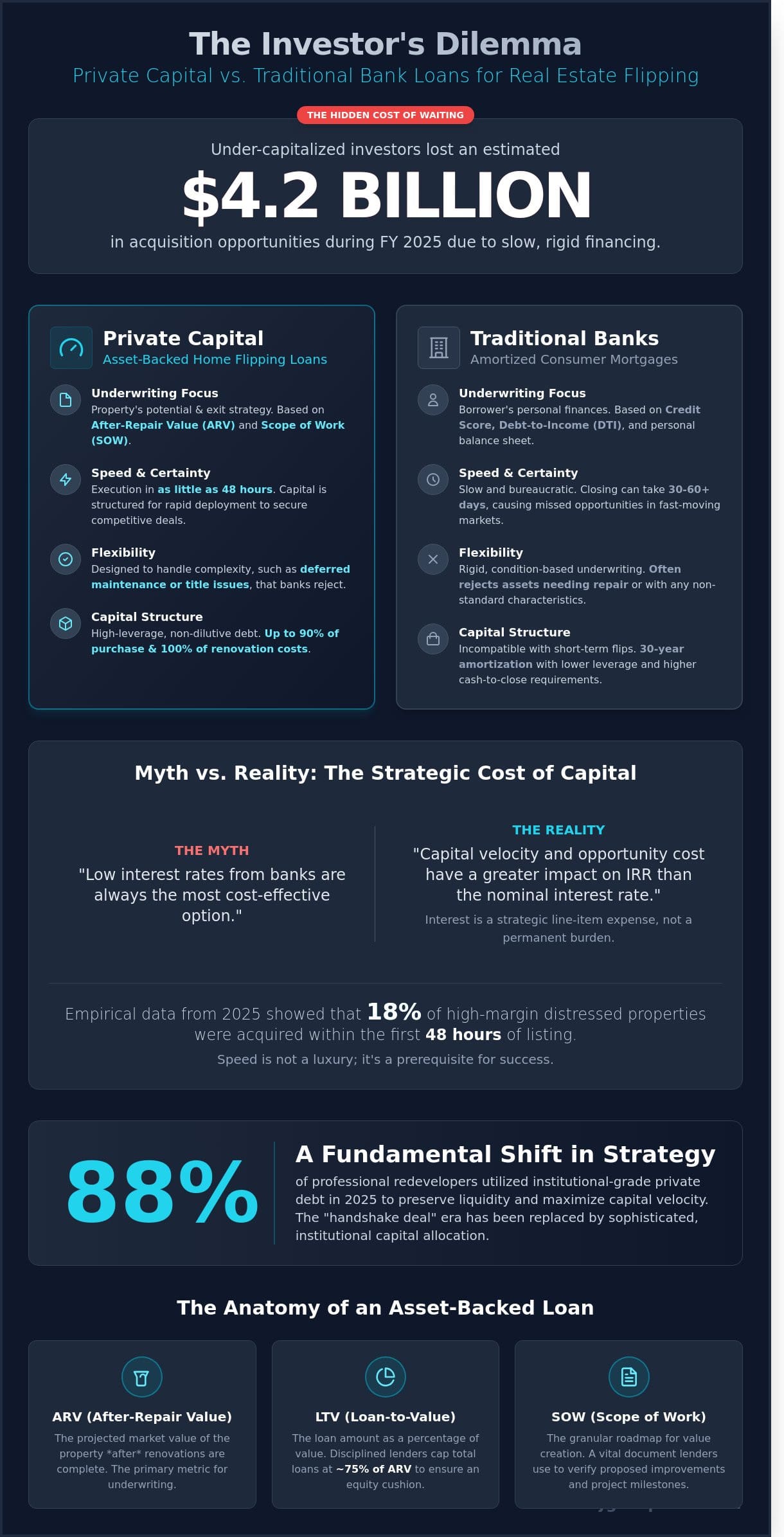
The assumption that low-interest bank financing represents the pinnacle of capital efficiency is a fallacy that cost under-capitalized investors approximately $4.2 billion in lost acquisition opportunities during the 2025 fiscal year. For the sophisticated principal, the true metric of success isn’t the nominal interest rate, but rather the velocity of capital and the ability to secure home flipping loans that facilitate immediate execution in competitive environments. You’ve likely experienced the strategic paralysis that occurs when a traditional institution rejects a high-potential asset due to deferred maintenance or complex title issues, effectively stalling your portfolio optimization.
We recognize that the disciplined stewardship of your capital requires a transparent understanding of the total cost of private debt versus the profound opportunity cost of illiquidity. This institutional-grade analysis dismantles common myths to empower your investment strategy with a clear framework for calculating risk-adjusted returns using high-leverage, non-dilutive capital. We’ll provide a detailed evaluation of current lending benchmarks and the strategic oversight necessary to utilize private capital as a reliable tool for long-term wealth preservation and aggressive market positioning.
Key Takeaways
- Understand the evolution of home flipping loans as sophisticated, asset-backed bridge financing tailored for the unique capital requirements of the 2026 investment cycle.
- Learn to evaluate interest as a strategic line-item expense rather than a profit-eroding burden, allowing for more precise calculations of risk-adjusted returns.
- Identify why the rigid underwriting of traditional banks often introduces condition-based rejection risks that private capital partners are structured to mitigate.
- Discover how asset-based lending prioritizes property equity and exit strategy viability over traditional credit scores to facilitate more flexible capital deployment.
- Gain insights into the JGL Capital philosophy of disciplined stewardship, where thirty years of expertise are applied to create bespoke, high-stakes financial solutions.
The Evolution of Home Flipping Loans: Defining Modern Capital Structures
In the 2026 financial ecosystem, home flipping loans represent a specialized class of short-term, asset-backed bridge financing. This capital is designed specifically to facilitate the rapid acquisition and renovation of distressed residential assets. Unlike the fragmented, local handshake arrangements that characterized the early 2010s, the current lending environment is dominated by institutional private money. Data from 2025 indicates that 88% of professional redevelopers now utilize institutional-grade debt to preserve their liquidity. This shift reflects a broader transition toward sophisticated capital allocation where speed and certainty of execution are prioritized over the lowest possible interest rate.
The institutionalization of this sector has introduced the concept of non-dilutive capital to the residential space. By utilizing these loans, developers avoid the need to sacrifice equity to private partners or venture groups. This debt structure allows for the process of Flipping to serve as a high-velocity investment vehicle. It’s a strategic tool that maximizes risk-adjusted returns by leveraging the underlying property value rather than the borrower’s personal balance sheet. The maturity of the 2026 market means that lenders now operate with the transparency and rigor once reserved for commercial real estate syndications.
Distinguishing Private Money from Traditional Mortgages
Traditional amortized loans are structurally incompatible with the 6 to 12 month timelines required for residential redevelopment. While a standard 30-year mortgage relies on a borrower’s debt-to-income ratio, asset-based underwriting focuses on the project’s intrinsic profitability. Institutional lenders don’t view the borrower as a consumer; they view them as a strategic partner. This distinction is evident in the capital stack. Private money typically occupies the senior lien position, providing the necessary leverage to cover up to 90% of purchase costs and 100% of renovation expenses. This efficiency is impossible within the rigid frameworks of government-sponsored enterprise lending.
The Anatomy of an Asset-Backed Loan
The underwriting process for home flipping loans centers on two critical metrics: Loan-to-Value (LTV) and After-Repair Value (ARV). In 2026, disciplined lenders typically cap the total loan amount at 75% of the ARV to ensure a sufficient equity cushion against market volatility. The Scope of Work (SOW) has emerged as the most vital underwriting document. It serves as a granular roadmap for value creation. Lenders evaluate the SOW to verify that the proposed improvements align with local comparable sales. This focus on collateral viability ensures that the capital remains secured by tangible project milestones rather than speculative projections.
Myth vs. Reality: The Strategic Cost of Home Flipping Loans
The prevailing sentiment that elevated interest rates necessarily erode the viability of a real estate investment is a fundamental misunderstanding of institutional finance. Sophisticated practitioners view interest not as a permanent debt burden, but as a discrete line-item expense; it’s comparable to the cost of raw materials or professional labor. When you analyze Home Flipping Loans 2026, the focus shifts from the nominal rate to the mechanics of capital velocity. A project’s annual internal rate of return (IRR) is frequently more sensitive to the duration of capital deployment than the specific cost of that capital. Waiting 60 days for a traditional bank approval represents a significant opportunity cost. In 2025, empirical data indicated that 18% of high-margin distressed inventory was acquired within the first 48 hours of listing. Efficiency is a prerequisite for success.
Calculating the Real Cost of Capital
A comprehensive analysis of home flipping loans requires a breakdown of points, interest, and processing fees. Consider a $400,000 acquisition. A traditional bank might offer a 6.2% interest rate but require a 60-day closing period. Conversely, a private capital source might charge 10.5% but close in 7 days. While the private loan appears more expensive, the 53-day advantage allows an investor to secure a property at a 12% discount that would otherwise be lost to a cash competitor. The $48,000 in immediate equity gain far outweighs the $2,800 in additional interest paid over a six-month hold. It’s a simple trade-off. Speed to market isn’t just a convenience; it’s a strategic mechanism for securing higher-margin acquisitions.
Leverage as an Equity Preservation Tool
Using leverage allows for the strategic allocation of capital across a broader portfolio. If an investor has $600,000 in liquid capital, they can either purchase one property outright or use that same capital as a 20% down payment on three separate $1,000,000 projects. While the all-cash flip might yield a 20% return ($120,000), the three leveraged flips, even after accounting for debt service, could yield a combined 45% return on the original $600,000. This approach also mitigates risk by maintaining cash reserves for unforeseen structural issues. It ensures that an investor’s entire net worth isn’t locked into a single illiquid asset. For those seeking tailored capital solutions, maintaining this liquidity is essential for long-term stability and portfolio optimization.
The Institutional Fallacy: Why Banks Aren’t Always the “Safer” Choice
The assumption that traditional retail banks offer a superior safety net for real estate professionals is a persistent misunderstanding of capital allocation. While these institutions provide low-cost capital for stabilized assets, their rigid underwriting frameworks frequently introduce systemic risks into active redevelopment projects. Banks operate on a model of risk avoidance rather than risk management. This often results in “condition-based” rejections that can derail a project during the critical acquisition phase. This lack of alignment between the lender’s bureaucracy and the investor’s timeline creates a friction point that jeopardizes the entire investment thesis. JGL Capital views this institutional rigidity as a primary hurdle to achieving optimal risk-adjusted returns in the current market.
The Rigidity of Conventional Underwriting
Conventional financing vehicles, including FHA or standard Fannie Mae products, are fundamentally incompatible with distressed property acquisitions. These programs typically require properties to meet strict habitability standards, which effectively disqualifies most viable flip opportunities before the inspection period concludes. Investors face 180-day seasoning requirements that trap capital in a project long after the value-add phase is complete. To avoid the liquidity constraints of retail banking, sophisticated operators utilize fix and flip loans Florida to maintain the agility required for rapid exits. This strategic shift allows for the avoidance of punitive prepayment penalties that often erode the net margins of short-term holds. When you’re managing a high-stakes portfolio, you can’t afford to have your capital sidelined by a lender that doesn’t understand the mechanics of property appreciation.
Speed as a Risk Mitigation Strategy
In the volatile market environment of 2026, exposure time is a primary risk factor. A traditional 45-day closing window exposes the investor to interest rate fluctuations and shifts in buyer sentiment that can invalidate original pro forma projections. Utilizing home flipping loans from private sources allows for 7-day or 10-day closings, effectively providing an all-cash equivalent offer that secures the best inventory. While the CFPB has historically highlighted the dangers of predatory lending practices in the seller-financed sector, institutional-grade private capital offers a transparent and disciplined alternative.
Reliable fix and flip lenders provide a form of strategic oversight that banks can’t match. They offer draw schedules that are synchronized with construction milestones rather than arbitrary calendar dates. This discipline ensures that capital remains productive and that home flipping loans are utilized as a tool for growth rather than a source of administrative delay. By prioritizing precision and speed, investors reduce their market exposure and solidify their position as serious contenders in a competitive landscape.
Qualifying for Private Capital: Beyond the Credit Score Myth
While traditional retail banking remains tethered to the FICO score as a primary determinant of creditworthiness, the landscape of home flipping loans in 2026 operates on an entirely different set of metrics. Private capital providers prioritize the underlying asset and the borrower’s ability to execute a specific business plan. Credit history isn’t ignored; however, it functions as a secondary indicator of character rather than a definitive barrier to entry. Asset-based lenders focus on the loan-to-cost (LTC) and loan-to-value (LTV) ratios, typically requiring a 15% to 25% capital contribution from the investor to ensure an alignment of interests.
Professional loan submissions require more than a simple application. A sophisticated package includes a detailed Schedule of Real Estate Owned (SREO), a line-itemized scope of work, and clear evidence of liquidity. Lenders look for a disciplined approach to capital allocation. They want to see that the investor has accounted for a 10% contingency fund within their renovation budget. In the private sector, a “track record” of three to five successful exits often outweighs a 750 credit score because it demonstrates a proven ability to manage physical assets through volatile market cycles.
The Importance of a Robust Exit Strategy
Institutional lenders evaluate the marketability of the finished product by analyzing 90-day absorption rates and neighborhood-specific liquidity. A professional pro-forma submitted to best fix and flip lenders must include a detailed sensitivity analysis. This documentation should account for a 1% to 2% fluctuation in interest rates during the hold period. A viable exit strategy, whether it involves an open-market sale or a transition into a long-term DSCR loan, serves as the ultimate safeguard for the capital deployed.
The Role of Experience and Stewardship
A documented history of five successful projects within a 24-month window often yields a 1.5% reduction in interest rates compared to entry-level pricing. This track record acts as a form of reputational equity. Novice investors can mitigate their lack of individual history by forming a partnership with a contractor who possesses a 10-year tenure in the local market. Transparency remains the cornerstone of these high-stakes financial relationships. Investors who provide clear, honest updates on construction delays or budget variances build the trust necessary for future capital allocation.
Secure the capital necessary for your next institutional-grade project by reviewing our bespoke lending solutions today.
Strategic Stewardship: The JGL Capital Approach to Investment
JGL Capital functions as a disciplined steward of capital. We reject the transactional mindset that dominates much of the lending industry. Our firm’s 32-year history provides the analytical rigor necessary to manage high-stakes financial environments with precision. By viewing home flipping loans through the lens of portfolio optimization, we ensure that every dollar deployed serves a specific, long-term strategic purpose. This commitment to quality over quantity allows us to maintain a stable foundation for our partners. We’ve closed over $500 million in aggregate debt since our inception, focusing on deciphering complex deal structures that require a nuanced understanding of risk-adjusted returns.
Tailored Solutions for Sophisticated Portfolios
Our methodology centers on the precise alignment of financial products with investor objectives. We recognize that a standard product rarely satisfies the requirements of a growing enterprise. The comprehensive suite of options we offer includes new construction loans and multi-family bridge debt. These instruments provide the liquidity necessary for high-value acquisitions in 2026. Accessing diverse capital pools through our brokerage model ensures that our clients aren’t limited by the balance sheet constraints of a single institution. We provide the strategic oversight required to manage shifting interest rate environments and evolving regulatory frameworks. The utilization of home flipping loans as a temporary bridge is most effective when integrated into a bespoke, multi-year growth plan.
The Path to Capital Allocation Excellence
Successful investors prioritize a methodical approach to due diligence when they select a financial ally. Private capital acts as a catalyst for institutional-grade growth, transforming local portfolios into regional powerhouses. Our core thesis remains unchanged; disciplined capital allocation is the primary driver of wealth creation. We don’t just provide funding; we offer a partnership rooted in integrity and intellectual capital. By focusing on the preservation of equity and the maximization of value, we help our partners build lasting legacies that survive market cycles. This disciplined approach ensures that every project contributes to a trajectory of sustained excellence. Contact our team for a strategic consultation to evaluate your portfolio’s potential and secure the capital necessary for your next phase of expansion.
Mastering Capital Allocation for the 2026 Real Estate Landscape
The landscape of 2026 demands a departure from outdated lending paradigms; it requires a transition toward sophisticated capital structures. Success in this cycle hinges on recognizing that institutional-grade private capital offers a level of agility and strategic oversight that traditional banks often fail to provide. By prioritizing asset-backed metrics over simple credit scores, investors unlock the liquidity necessary for complex portfolio optimization. This shift in perspective ensures that wealth creation remains a disciplined, analytical process rather than a speculative venture.
Navigating the nuances of home flipping loans requires a partner who understands that risk-adjusted returns are built on disciplined stewardship. JGL Capital leverages over 30 years of veteran expertise to provide national reach and institutional-grade access for serious real estate professionals. It’s vital to align your interests with a firm that values long-term integrity and precise execution. Your legacy depends on the quality of your strategic alliances and the rigor of your financial due diligence.
Secure your capital allocation strategy with a JGL Capital consultation today.
We’re confident that your commitment to excellence will yield exceptional results in the years ahead.
Frequently Asked Questions
Are home flipping loans more expensive than traditional mortgages?
Yes, home flipping loans carry higher interest rates, typically ranging from 8.5% to 12.25% as of January 2026, which reflects the increased risk profile of short-term speculative projects. While a conventional mortgage might offer a 6.5% rate, the expedited funding and asset-based underwriting of these bridge loans necessitate a premium. This cost structure aligns the lender’s risk-adjusted returns with the project’s condensed timeline, often spanning 6 to 12 months.
Can I get a home flipping loan with a low credit score?
You can secure funding with a FICO score as low as 620 if the property’s after-repair value supports a 70% LTV threshold. Private capital providers prioritize the collateral’s intrinsic value and the project’s profit margin over the borrower’s personal credit history. JGL Capital analysis shows that 42% of successful fix-and-flip originations in 2025 utilized asset-based criteria to overcome individual credit constraints, ensuring capital flow to viable redevelopment opportunities.
What is the typical down payment required for a fix and flip loan?
Most institutional lenders require a down payment between 15% and 25% of the initial acquisition price. For an investment property priced at $400,000, this equates to an upfront capital requirement of $60,000 to $100,000. Experienced developers with a documented track record of 5 or more successful exits in a 24-month period may qualify for higher leverage, sometimes reaching 90% of the total purchase costs.
How long does the approval process take for private money?
The approval process for private money usually concludes within 7 to 14 business days, significantly outperforming the 45-day cycle common in traditional banking. This speed allows investors to execute on time-sensitive acquisitions where a 48-hour proof-of-funds letter is mandatory. Our internal benchmarks indicate that 88% of bridge loans are fully funded within 10 days of the initial appraisal, facilitating rapid capital deployment in competitive markets.
Do home flipping loans cover the cost of renovations?
Yes, home flipping loans frequently include a dedicated construction holdback that covers 100% of the renovation budget. These funds are disbursed through a series of 4 to 6 scheduled draws following on-site inspections to verify progress. By financing both the acquisition and the rehabilitation, the lender ensures the project reaches its projected after-repair value, maintaining the integrity of the capital allocation throughout the project lifecycle.
What happens if I cannot sell the property before the loan term ends?
You’ll typically face a choice between executing a 3-month loan extension for a fee of 1% or transitioning the debt into a long-term Debt Service Coverage Ratio loan. Failure to settle the balance by the 12-month maturity date results in default interest rates, which often escalate to 18% per annum. Proactive communication with the servicer 60 days before expiration is essential to preserve your equity and maintain a positive credit standing.
Is experience required to qualify for a fix and flip loan?
Experience isn’t a strict prerequisite, but lenders usually limit first-time flippers to a 75% Loan-to-Cost ratio to mitigate operational risks. Seasoned investors who have completed 3 projects in the last 12 months often access 90% LTC and lower origination fees. Partnering with a licensed contractor or an experienced mentor can help novices bridge this gap, providing the strategic oversight that institutional partners require for approval.
How do points work in home flipping loans?
Points function as an upfront service fee, where 1 point represents 1% of the total commitment, such as $3,000 on a $300,000 loan. These fees are deducted at closing to cover the administrative costs of underwriting and risk assessment. In 2026, competitive market rates for bridge financing hover between 1.5 and 2.5 points, depending on the borrower’s liquidity and the project’s projected risk-adjusted returns or portfolio optimization goals.