

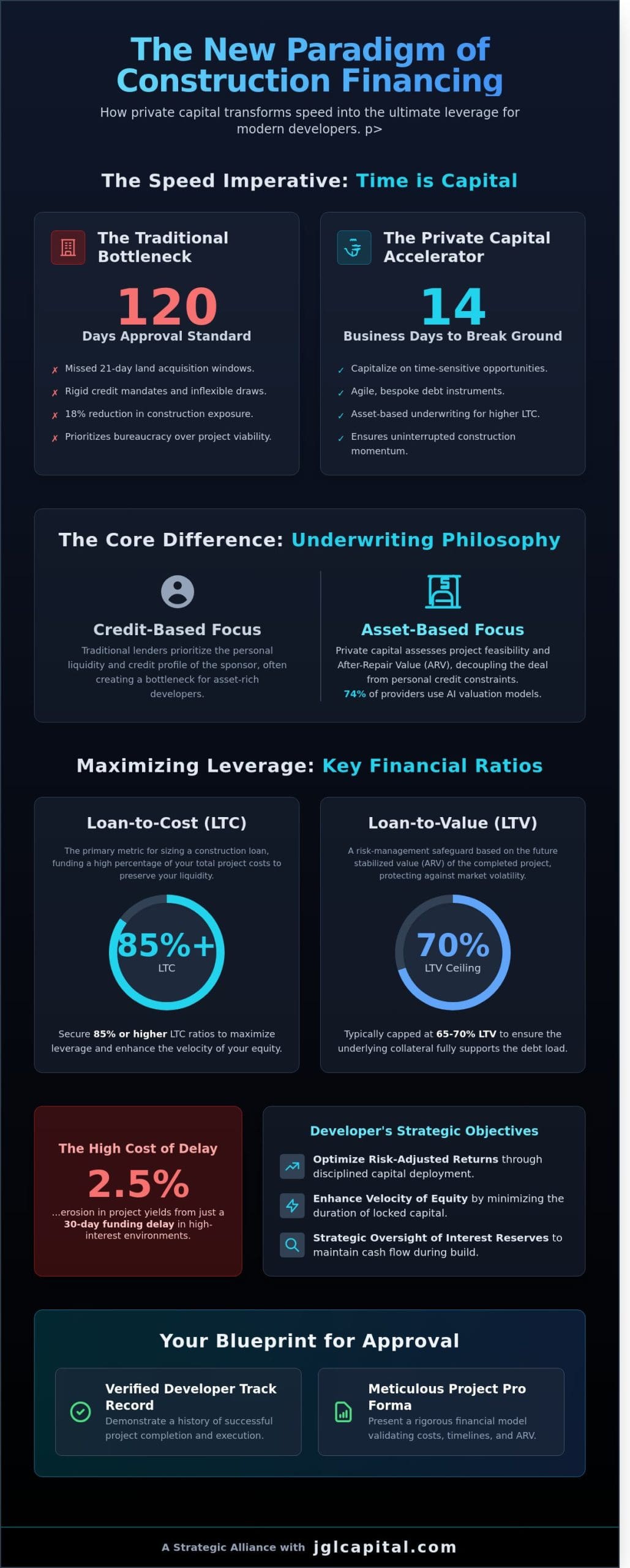
The institutional failure of traditional banking to adapt to the 2026 development cycle has transformed speed into the ultimate form of leverage, particularly for firms seeking new construction loans to capitalize on time-sensitive urban opportunities. While a 120-day approval process was once the industry standard, modern developers recognize that missing a 21-day land acquisition window can compromise an entire five-year portfolio strategy. You’ve likely experienced the frustration of seeing a viable project stall because a lender’s rigid credit mandates or inflexible draw schedules failed to account for the nuances of your specific site logistics. It’s a systemic inefficiency that prioritizes administrative box-checking over the sophisticated stewardship of capital.
This guide offers a rigorous analysis of how private capital markets facilitate superior risk-adjusted returns through specialized, institutional-grade financing. We’ll demonstrate how to secure Loan-to-Cost ratios of 85% or higher while compressing the time to break ground to as little as 14 business days. By the end of this article, you’ll understand the strategic deployment of bespoke debt instruments designed to optimize capital allocation and ensure your construction momentum remains uninterrupted from initial excavation through final certificate of occupancy.
Key Takeaways
- Distinguish between speculative investment vehicles and consumer-to-permanent financing to ensure your capital structure aligns with institutional development objectives.
- Analyze the sophisticated mechanics of new construction loans, specifically the strategic calibration of Loan-to-Cost (LTC) and Loan-to-Value (LTV) ratios to maximize project ROI.
- Evaluate the critical trade-offs between traditional banking interest rates and the superior execution speed of private capital to mitigate the opportunity costs of project delays.
- Identify the essential components of a rigorous underwriting package, including the presentation of a verified developer track record and a meticulous project pro forma.
- Understand the advantages of a strategic alliance with JGL Capital, where a philosophy of stewardship and bespoke financial solutions replaces purely transactional lending.
Understanding New Construction Loans in the Professional Landscape
Professional real estate development in 2026 requires a sophisticated understanding of capital structures, specifically regarding new construction loans as short-term, asset-backed financing vehicles. These instruments aren’t merely extensions of credit; they’re strategic tools designed to facilitate the transition from land acquisition to vertical completion. While residential borrowers often utilize FHA insured loan programs for consumer-to-permanent financing, professional developers prioritize speculative investment financing that offers greater agility. Private capital now fills the void left by traditional depository institutions, which reduced their commercial construction exposure by 18% following the regulatory shifts of late 2025. This pivot to private debt ensures that project timelines remain unencumbered by the bureaucratic delays typical of conventional banking cycles.
The Shift from Credit-Based to Asset-Based Underwriting
Institutional lenders have transitioned their focus toward the After-Repair Value (ARV) of a project, placing secondary importance on the personal liquidity of the sponsor. This methodology prioritizes project feasibility within the risk-assessment matrix, ensuring the underlying collateral supports the debt load. Asset-based lending serves as a sophisticated strategy for professional portfolio optimization by decoupling individual credit profiles from the intrinsic value of the real estate development. Data from Q1 2026 indicates that 74% of private debt providers now utilize AI-driven valuation models to verify projected exit prices. This rigorous analytical approach allows for higher loan-to-cost ratios when the pro forma demonstrates exceptional market demand.
Strategic Objectives of Construction Financing
Modern developers utilize new construction loans to maximize leverage, effectively preserving their liquid reserves for concurrent opportunities. Speed-to-market remains the primary driver of profitability; a 30-day delay in funding can erode project yields by as much as 2.5% in high-interest environments. Successful capital allocation depends on aligning the debt’s maturity with a clearly defined exit strategy, whether that involves a stabilized refinance or a prompt divestment. The following objectives define the professional approach to debt acquisition:
- Optimization of risk-adjusted returns through disciplined capital deployment.
- Enhanced velocity of equity by minimizing the duration of locked capital.
- Strategic oversight of interest reserves to maintain cash flow throughout the build cycle.
The 2026 market demands a level of flexibility that traditional institutions simply can’t provide. By partnering with private capital sources, developers secure the bespoke solutions necessary to navigate volatile material costs and shifting labor availability. This institutional alignment ensures that every project isn’t just a build, but a calculated contribution to a long-term legacy of wealth preservation. The emphasis remains on precision, where every basis point and every day saved on the construction timeline contributes to the overall health of the developer’s portfolio.
The Mechanics of Professional Construction Financing
The deployment of capital within the framework of new construction loans necessitates a granular understanding of interest-only debt service. This structure preserves liquidity for operational exigencies during the active build phase. Lenders typically focus on the Loan-to-Cost (LTC) ratio, often capped at 85% for institutional-grade projects; meanwhile, the Loan-to-Value (LTV) ratio serves as a safeguard against market volatility, usually targeting a 65% to 70% ceiling based on the future stabilized value. Strategic oversight involves a rigorous evaluation of these metrics to ensure that the developer’s equity remains appropriately leveraged.
Effective risk management requires a disciplined approach to project milestones. Lenders don’t simply release funds; they verify progress through third-party inspections and cost-to-complete analyses. While some smaller developers might explore the 203(k) Rehabilitation Mortgage Insurance Program for residential renovations, institutional developers require more sophisticated instruments that account for complex vertical construction. The transition phase marks the final critical juncture. Developers must successfully navigate the “bridge-to-perm” window, either refinancing into long-term debt at a projected 5.5% cap rate or executing a project disposition to realize capital gains.
Mastering the Draw Schedule and Fund Disbursement
Precision in the draw schedule is the primary defense against construction stalls. Each request must be accompanied by comprehensive documentation, including AIA G702/G703 forms and unconditional lien waivers from all major subcontractors. It’s vital to maintain a 10% retainage to ensure performance through the final punch list. Proactive communication regarding budget reallocations prevents the funding delays that plagued 18% of mid-market developments in 2025.
Collateral and Security in High-Stakes Development
Lenders secure their position through a first-priority lien on the real property and all improvements. The “as-completed” appraisal serves as the cornerstone of this security, utilizing a discounted cash flow analysis to project future NOI. Land equity often serves as the initial capital contribution, and its valuation at the time of the loan closing can significantly influence the overall debt structure. Securing a tailored financing solution ensures that the capital stack remains resilient through the final certificate of occupancy.
Private Capital vs. Traditional Banking: A Comparative Analysis
The selection of a capital partner requires a meticulous evaluation of the friction between capital cost and capital velocity. Traditional banking institutions offer lower interest rates, typically sitting 200 to 400 basis points below private alternatives, yet they impose significant administrative burdens that can stall a project’s momentum. Developers must weigh these nominal savings against the tangible opportunity cost of stagnation. In a market where construction material costs can fluctuate by 3% to 5% per quarter, a three-month delay in bank processing often negates any benefit derived from a lower interest rate. For those seeking a foundational understanding of how construction loans work, the distinction lies in the source of liquidity and the flexibility of the underwriting process. Private capital providers excel at navigating complex ownership structures, such as multi-tiered LLCs or irrevocable trusts, which frequently trigger compliance red flags in conventional depository institutions.
Speed of Execution as a Competitive Advantage
Traditional banks operate on a 45 to 90 day approval cycle. This timeline’s often incompatible with the volatility of the 2026 real estate market. Private money lenders condense this window to 7 or 14 days by focusing on asset quality and sponsor experience rather than exhaustive personal financial audits. This acceleration allows developers to secure prime sites through quick-close offers, which can yield a 5% to 10% discount on the land purchase price. Utilizing bridge-to-construction facilities ensures site control is established immediately, providing a seamless transition into new construction loans once the entitlement phase concludes. For developers operating in Florida’s competitive market, partnering with experienced hard money lenders in Florida can provide the institutional-grade private capital necessary to secure time-sensitive opportunities.
Leverage and Capital Allocation Efficiency
Capital efficiency is the primary driver for high-leverage financing. While traditional lenders typically cap their Loan-to-Cost (LTC) ratios at 65% or 70%, private capital sources frequently extend leverage to 85% or 90%. This shift in the capital stack significantly alters the project’s financial profile. Consider these impacts:
- IRR Optimization: Increasing leverage from 70% to 90% can boost a developer’s internal rate of return by 15% or more upon exit.
- Portfolio Diversification: Lower equity requirements allow developers to distribute their available capital across three projects instead of one.
- Liquidity Preservation: Maintaining a robust cash reserve protects the sponsor against unforeseen site conditions or interest rate spikes.
Partnering with a private money broker acts as a strategic hedge. These allies provide access to diverse capital pools, ensuring that new construction loans are structured to align with the specific exit strategy of the development. It’s a relationship built on the alignment of interests and the delivery of bespoke solutions for complex projects. Developers expanding beyond residential builds into income-producing assets should also evaluate commercial real estate loans as a complementary instrument for optimizing their broader capital stack.
Strategic Requirements: Navigating the Underwriting Process
Institutional underwriting for new construction loans represents a meticulous evaluation of both the physical asset and the human capital behind it. Lenders in 2026 prioritize developers who’ve successfully completed a minimum of four projects of similar scale within the previous 48 months. This track record serves as a primary indicator of a developer’s ability to manage complex timelines and mitigate the inherent risks of ground-up builds. Beyond the developer, the General Contractor’s (GC) financial health is equally scrutinized; lenders often require the GC to demonstrate a bonding capacity that exceeds the total project cost by at least 20%.
A comprehensive pro forma serves as the project’s financial roadmap, requiring a level of detail that accounts for a 12% contingency reserve for unforeseen material escalations. This document must be supported by fully executed architectural plans and a “shovel-ready” status, meaning 100% of municipal permits are secured before the first draw. Lenders view the absence of these components as a fundamental failure in risk management. Precision in the early stages isn’t just a preference; it’s a prerequisite for capital allocation.
The Importance of a Robust Exit Strategy
Defining the path to repayment is the most critical component of the underwriting narrative. Whether the objective is a strategic sale upon certificate of occupancy or a transition into long-term rental hold via Debt Service Coverage Ratio (DSCR) refinancing, the plan must withstand rigorous stress testing. Market volatility, such as a 50-basis-point shift in capitalization rates, can significantly alter the feasibility of a planned exit. A clear exit strategy is the cornerstone of institutional trust. Without a secondary repayment source, the project’s risk profile becomes untenable for traditional institutional partners.
Documentation and Due Diligence Standards
The due diligence phase demands a standardized “investor kit” to streamline the approval process and demonstrate professional readiness. This kit should include detailed entity documents, site plans, and independent feasibility studies conducted within the last 90 days. Specific technical reports are non-negotiable. A Phase I Environmental Site Assessment and a comprehensive geotechnical soil report are essential to identify latent liabilities that could derail construction schedules. By centralizing these documents, developers project a sense of strategic oversight that facilitates faster closing cycles.
In addition to meticulous documentation, engaging a dedicated project manager can further enhance this strategic oversight. For developers looking to ensure their project remains on schedule and within budget from start to finish, it’s beneficial to explore Owner’s Representation.
Success in large-scale development requires a partner who understands the nuances of capital structure. We invite you to explore our bespoke financing solutions to see how our expertise aligns with your long-term growth objectives.
Forging a Strategic Partnership with JGL Capital
JGL Capital operates on the foundational principle that capital serves as a tool for legacy, not merely as a commodity to be traded. With thirty years of specialized expertise in asset-backed lending, the firm transcends the limitations of traditional, transactional finance. Our philosophy centers on stewardship; we prioritize the creation of long-term value over the mere volume of originations. This disciplined approach ensures that every project, whether it’s a high-rise multi-family development or a complex commercial hub, receives a bespoke financing structure. We’ve refined our internal protocols to expedite the transition from the initial application to the first shovel in the ground. By removing bureaucratic friction, we allow developers to maintain momentum in a sector where timing dictates the ultimate internal rate of return. Our commitment to precision ensures that new construction loans are treated as strategic assets rather than simple debt obligations.
A Disciplined Approach to Wealth Preservation
Success in the 2026 real estate market requires more than just liquidity; it demands a partner who understands the nuances of risk-adjusted returns. JGL Capital aligns its interests with those of the developer to ensure project viability through every cycle of the market. Working with a seasoned strategic partner provides a necessary buffer against the volatility often found in secondary and tertiary markets. Our clients gain access to a national network of capital through a single institutional point of contact. This centralization simplifies the management of new construction loans while maintaining the high-touch service expected by sophisticated investors. We focus on portfolio optimization to ensure that every dollar allocated contributes to the preservation and growth of our partners’ wealth.
Initiating the Capital Allocation Process
The journey toward project realization begins with a rigorous preliminary review. We transition from your initial project concept to a definitive term sheet with a focus on analytical precision. Our fee structures remain transparent, reflecting our commitment to institutional-grade processing and ethical clarity. We don’t believe in hidden costs or late-stage adjustments that jeopardize project pro formas. Our team conducts a thorough evaluation of your capital requirements to facilitate a seamless allocation. To begin your next development, secure your project funding with a bespoke new construction loan from JGL Capital. Our strategic oversight ensures that your vision is supported by a foundation of financial stability and professional integrity.
Securing the Future of Development through Strategic Capital Allocation
The landscape of 2026 demands a sophisticated approach to capital allocation, where the distinction between traditional banking and private capital determines the velocity of a developer’s success. Achieving milestones in the current market requires a meticulous understanding of institutional underwriting and a commitment to superior risk-adjusted returns. By prioritizing strategic oversight and the optimization of capital structures, developers can navigate the complexities of multi-family and commercial assets with precision. Securing new construction loans isn’t a mere transaction. It’s a deliberate act of stewardship that requires a partner capable of executing at the highest professional level. For developers seeking comprehensive guidance on navigating these complex capital structures, our strategic construction financing reference guide provides institutional-grade insights into draw schedules, risk management, and due diligence requirements. JGL Capital leverages over 30 years of industry expertise to provide national reach and institutional-grade underwriting for the most complex assets. We invite you to Partner with JGL Capital for your next new construction project to ensure your vision is supported by analytical rigor and deep-seated expertise. It’s the right moment to build a lasting legacy through disciplined financial management and a collaborative, strategic partnership.
Frequently Asked Questions
How do new construction loans differ from traditional mortgages for investors?
Unlike traditional mortgages which provide a lump sum for existing structures, new construction loans are short-term facilities disbursed in stages based on project milestones. These instruments prioritize the future value of the asset and require interest-only payments during the 12 to 24-month build cycle. While a standard mortgage relies on historical property data, it’s necessary for construction financing to undergo a rigorous analysis of pro forma projections and architectural specifications.
What is the typical Loan-to-Cost (LTC) ratio for a private construction loan?
Private lenders typically offer a Loan-to-Cost (LTC) ratio between 75% and 85% of the total project budget. This metric ensures developers maintain a 15% to 25% equity stake, which aligns the interests of the sponsor with the capital provider. In 2026, institutional-grade lenders often cap this leverage at 80% to mitigate volatility in material costs, ensuring that risk-adjusted returns remain prioritized throughout the project’s lifecycle.
Can I get a new construction loan with a lower credit score if the project is strong?
A robust project with a projected Internal Rate of Return (IRR) exceeding 20% can often offset a personal credit score below 680. Private capital partners prioritize the asset’s viability and the developer’s track record over traditional FICO benchmarks. If the debt service coverage ratio (DSCR) remains above 1.25 upon stabilization, lenders don’t hesitate to view the underlying collateral as sufficient security for new construction loans.
How does the draw process work during the construction phase?
The draw process involves a structured release of funds following the completion of predefined construction phases, such as foundation pouring or framing. A third-party inspector validates the work within 48 to 72 hours of a request to ensure capital allocation matches physical progress. Once the inspection report confirms the milestone, the lender wires the requested funds to the developer’s account, typically within 5 business days, maintaining steady project momentum.
What documentation is required to qualify for professional construction financing?
Qualification requires a comprehensive project package including a detailed line-item budget, architectural blueprints, and a 12-month execution timeline. Developers must also provide a personal financial statement and a track record detailing at least 3 completed projects of similar scale. Lenders don’t overlook these documents because they assess the feasibility of strategic objectives and the sponsor’s ability to manage unforeseen contingencies through disciplined stewardship.
Is it possible to use a bridge loan to purchase land before securing construction funding?
It’s common for developers to utilize bridge loans to acquire raw land or entitled parcels within a 30-day window while finalizing new construction loans. These short-term instruments provide the necessary liquidity to secure a site before competitors can intervene. Most bridge facilities offer terms of 12 to 18 months, allowing ample time to obtain the necessary permits and transition into a permanent construction facility without compromising the project’s timeline. For investors focused on existing properties requiring renovation, fix and flip loans in Florida offer similar asset-based financing advantages with accelerated approval timelines. For those seeking broader insights into market dynamics and investment strategies, understanding real estate investing strategies and insights for 2026 can provide valuable context for optimizing capital allocation across diverse asset classes.
What happens to the construction loan once the building is complete?
Upon receipt of the Certificate of Occupancy, the construction loan must be either refinanced into a long-term permanent mortgage or retired through the sale of the asset. Institutional partners often structure a “mini-perm” option that extends the maturity by 24 months to allow for property stabilization and tenant leasing. This phase is critical for optimizing the asset’s valuation before seeking a 10-year or 30-year fixed-rate exit strategy. Developers transitioning completed assets into income-producing portfolios should evaluate commercial real estate loans as a strategic refinancing vehicle to maximize long-term capital allocation efficiency.
How long does it typically take to close on a new construction loan with a private lender?
Closing a construction facility with a private lender generally requires between 21 and 45 days from the initial application. This timeline accounts for the 10 days needed for a formal appraisal and the 5 days required for a comprehensive legal review of the build contract. Unlike traditional banks that may take 90 days, private firms prioritize speed to ensure developers can break ground during optimal seasonal windows in 2026.