

While conventional wisdom often relegates asset-backed financing to a secondary tier, the reality of the 2026 market is that hard money loans have emerged as a premier instrument for sophisticated capital deployment within the institutional real estate sector. You likely understand that the bureaucratic delays and rigid income requirements inherent in traditional banking structures often serve as impediments to the execution of complex, time-sensitive acquisitions. By shifting the analytical focus toward the intrinsic value of the underlying asset rather than the constraints of a borrower’s credit profile, these instruments offer a path to securing efficient financing for large-scale projects that require both speed and precision.
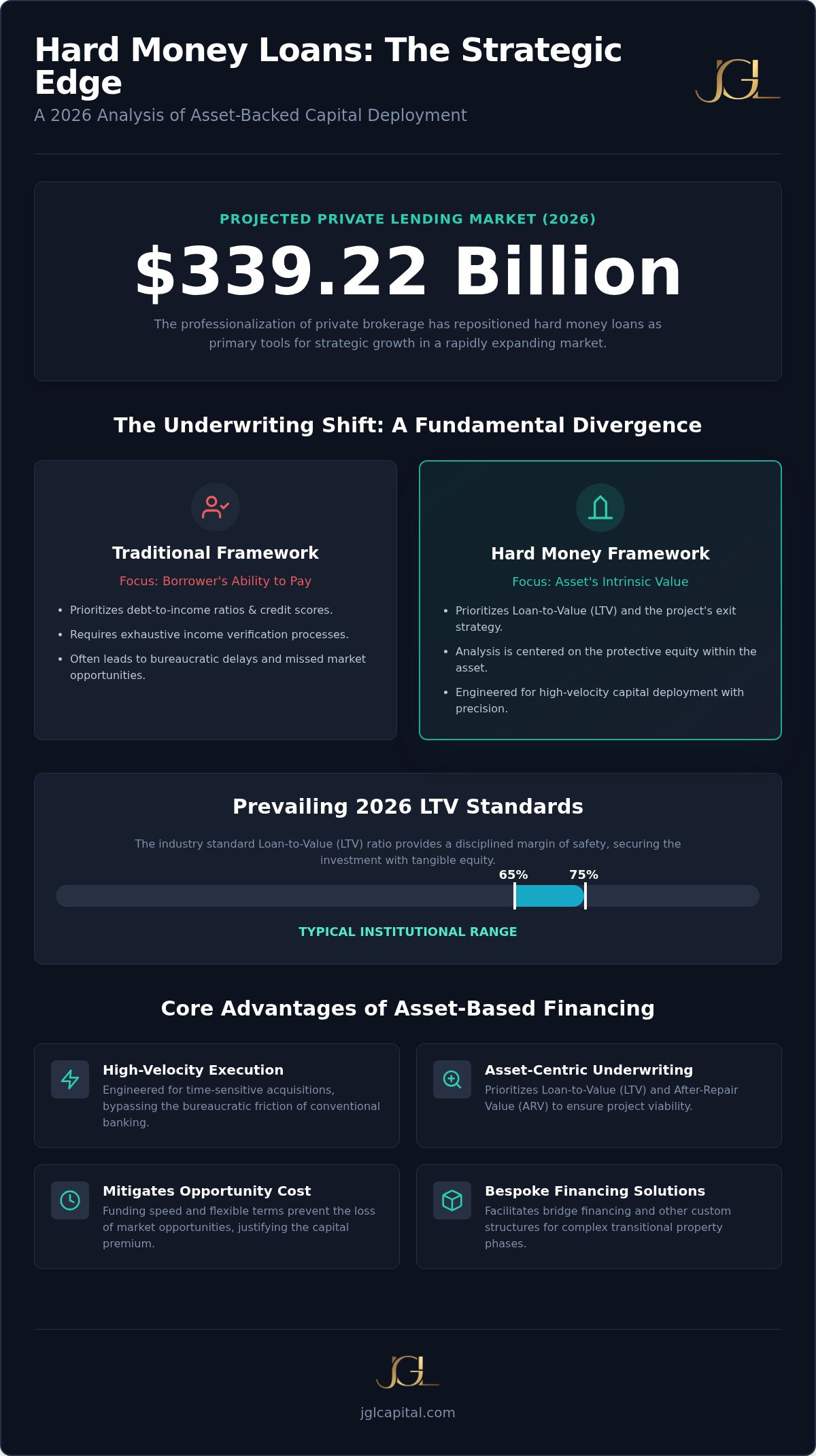
This article offers a comprehensive analysis of the strategic role of hard money within a disciplined capital allocation framework, illustrating how investors can achieve superior outcomes through asset-based lending. We’ll explore the evolution of private capital markets, examine the prevailing 2026 LTV standards which currently range between 65% and 75%, and discuss the methodologies for aligning with a capital partner who values long-term stability and analytical rigor. As the private lending market is projected to reach $339.22 billion this year, understanding these sophisticated financial tools is essential for any developer seeking to maintain a competitive advantage in a high-stakes environment.
Key Takeaways
- Recognize hard money loans as sophisticated, high-velocity instruments specifically engineered for institutional-grade, asset-backed capital deployment.
- Master the analytical framework of asset-based underwriting by prioritizing Loan-to-Value and After-Repair Value metrics to ensure the underlying viability of complex projects.
- Evaluate the cost of private capital through a disciplined return-on-investment lens, acknowledging how funding speed and flexible terms can mitigate the risk of missed market opportunities.
- Identify the strategic deployment of bridge financing and other bespoke lending solutions within a diversified real estate portfolio to facilitate transitional property phases.
- Understand the critical importance of aligning with a seasoned capital partner who possesses the intellectual rigor and industry expertise required to navigate large-scale commercial transactions.
Defining Hard Money as a Strategic Financial Instrument
Within the fiscal climate of 2026, characterized by volatile interest rate environments and shifting regulatory frameworks, the Hard money loan has transcended its historical reputation as a lender of last resort. It’s now understood as a precision instrument within the broader spectrum of asset-based lending, specifically engineered to provide liquidity secured by the intrinsic value of real property. While consumer-level private money often relies on informal networks, institutional-grade hard money loans are underpinned by rigorous underwriting standards and significant intellectual capital, ensuring that every deployment is grounded in a disciplined assessment of project viability. This distinction is critical for developers who require a partner capable of executing complex, multi-million dollar transactions without the administrative friction typically associated with conventional banking institutions.
The Evolution of Private Capital in Real Estate
The transition from distressed lending to opportunistic financing marks a significant maturation in how sophisticated developers approach capital allocation. Historically, hard money loans were viewed as emergency measures for troubled assets; however, the professionalization of the private brokerage space has repositioned them as tools for strategic growth. Today’s investors utilize this capital to preserve momentum in competitive markets where speed of execution is the primary determinant of success. This shift toward institutional rigor ensures that every deployment is grounded in a disciplined assessment of project viability, allowing for the creation of lasting value through deliberate, asset-backed strategies in a private lending market projected to reach $339.22 billion in 2026.
This methodology of identifying and revitalizing high-potential assets is mirrored in the Canadian resource sector; for example, Golden Pursuit Resources Ltd focuses on the reactivation of high-grade gold mining districts through disciplined exploration.
Hard Money vs. Traditional Mortgages: A Theoretical Framework
The fundamental divergence between traditional institutional lending and hard money lies in the underlying underwriting philosophy. Conventional banks operate within a framework focused on the borrower’s “ability to pay,” which necessitates exhaustive credit reviews and income verification processes that frequently lead to missed opportunities. The distinction is fundamental. Asset-based lending prioritizes “asset viability,” focusing on the property’s potential and the developer’s track record of performance. This contrast is best understood through their divergent priorities regarding risk mitigation:
- Traditional Framework: Prioritizes debt-to-income ratios and historical credit performance to gauge the likelihood of repayment through personal liability.
- Hard Money Framework: Prioritizes the loan-to-value ratio and the project’s projected exit strategy, ensuring the investment is secured by tangible equity and future worth.
The Analytical Framework of Asset-Based Underwriting
The underwriting of institutional-grade hard money loans requires a fundamental shift in perspective from the borrower’s personal balance sheet to the project’s intrinsic worth. While traditional financial institutions often remain preoccupied with historical debt-to-income ratios, sophisticated asset-based lenders prioritize the protective equity within the transaction. In 2026, the industry standard for loan-to-value (LTV) ratios typically ranges between 65% and 75%, providing a disciplined margin of safety for both the lender and the investor. Personal financial history remains a relevant data point, yet it’s secondary to the strategic viability of the asset and its projected performance within its specific market sub-sector.
Loan-to-Value (LTV) and After-Repair-Value (ARV) Dynamics
LTV serves as the primary foundational metric, representing the ratio of the requested capital to the property’s current appraised value. For complex, value-add commercial projects or $10M+ developments, the After-Repair-Value (ARV) becomes the critical benchmark for capital allocation. This forward-looking metric estimates the property’s worth upon completion of a specific renovation or construction phase, allowing lenders to structure capital draws that align with the increasing value of the asset. Because these ratios determine the borrower’s required equity stake, which in 2026 generally necessitates a down payment of 25% to 35%, they ensure a rigorous alignment of objectives between the developer and the capital partner.
The Underwriting Process: From Submission to Funding
Efficiency defines the institutional private lending space. The administrative tasks involved in evaluating property risk are intensive yet streamlined, requiring a synthesis of market data and asset-specific performance metrics. Professional appraisals and third-party feasibility studies are essential to validate the project’s assumptions and ensure the collateral’s durability. It’s also vital to consider the Legal aspects of hard money lending, as compliance with state-level regulations and federal mandates remains paramount for institutional integrity. Developers seeking to navigate these complexities often find that a private money broker provides the necessary bridge between institutional capital and project execution.
A robust exit strategy is the cornerstone of the lender’s risk assessment. Whether the intention is to transition into long-term permanent financing or to execute a strategic sale, the path to repayment must be clearly defined and analytically sound. This focus on the “end game” allows for greater flexibility during the loan term, as the lender’s security is rooted in the asset’s eventual worth rather than the borrower’s monthly liquidity. By prioritizing the project’s strategic viability, hard money loans offer a level of responsiveness that traditional banking models cannot replicate, with approvals often occurring in as few as 3 to 5 days.
Hard Money vs. Traditional Institutional Lending: A Comparative Analysis
The decision to utilize hard money loans rather than traditional bank debt isn’t merely a matter of interest rate comparison; it’s a strategic choice regarding capital velocity and certainty of execution. Traditional banking institutions operate within a framework of administrative inertia, often requiring 45 to 60 days to navigate the committees and compliance reviews necessary for a commercial closing. In a high-stakes real estate market, this delay represents a significant opportunity cost. Sophisticated developers recognize that the ability to close a transaction in as few as 3 to 5 days often allows them to secure assets at a discount, effectively offsetting the higher cost of private capital through immediate equity gains.
Evaluating the Total Cost of Capital
Analytical rigor requires a thorough examination of the components that constitute the total cost of capital. As of August 2026, typical interest rates for these instruments range from 9.5% to 12.5%, while origination fees, or points, generally fluctuate between 1.5 and 3 points of the total loan amount. While these figures represent a premium over conventional institutional lending, the structure of the debt is often more favorable for transitional assets. Most hard money agreements utilize interest-only repayment schedules with a terminal balloon payment, a configuration that preserves operational cash flow during the critical phases of renovation or stabilization. This bespoke approach to debt service allows for a more efficient allocation of resources toward property improvements rather than immediate principal reduction.
Speed as a Competitive Advantage in 2026
The contemporary real estate environment rewards agility. In 2026, the digital and private lending market is projected to reach $339.22 billion, reflecting a broad institutional shift toward high-velocity capital deployment. When a developer identifies an undervalued multi-family complex or a time-sensitive commercial opportunity, the 60-day approval cycle of a traditional bank is a liability. Hard money loans serve as a precision tool for agile investors, enabling them to win competitive bids by offering a closing timeline that mirrors a cash transaction. This speed isn’t merely a convenience; it’s a structural advantage that allows for the capture of market anomalies before they’re corrected by slower, more bureaucratic capital sources. By aligning with a disciplined private partner, developers can execute on complex deals with a level of confidence that traditional financing cannot sustain.
Ultimately, the comparison between private and traditional lending hinges on the specific objectives of the capital allocation. For long-term, stabilized assets, the low-cost, slow-moving nature of a bank may be appropriate. However, for acquisitions requiring immediate action, value-add renovations, or bridge financing during transitional periods, the flexibility and responsiveness of the private market remain unmatched. This strategic alliance between developer and private lender creates a synergy that prioritizes the preservation and creation of value over the fulfillment of rigid, standardized banking checklists.
Strategic Implementation: When to Deploy Hard Money Capital
The deployment of hard money loans within an institutional portfolio is a deliberate act of capital management, reserved for scenarios where the preservation of opportunity outweighs the immediate interest expense. While traditional debt is suitable for long-term holds of stabilized assets, private capital serves as a high-velocity solution for transitional periods or complex acquisitions. Sophisticated developers often utilize these instruments for new construction loans, where the ability to fund draws based on project milestones is critical to maintaining momentum. This strategic application ensures that equity isn’t unnecessarily sidelined by the slow administrative pace of conventional banking committees.
Fix and Flip and Value-Add Strategies
Within the broader spectrum of real estate investing, the acquisition of distressed or underperforming assets requires a capital partner capable of funding both the purchase and the subsequent renovation budget. This dual-funding capability is essential for executing value-add strategies where the property’s eventual worth is significantly higher than its entry price. Investors navigating competitive regional markets often look to specialized frameworks, such as those detailed in our analysis of fix and flip loans florida, to understand how local market dynamics influence asset-based underwriting. By securing capital that recognizes the After-Repair Value (ARV), developers can maximize their leverage and increase their total return on equity.
Commercial and Multi-Family Bridge Scenarios
For large-scale acquisitions, understanding what is a bridge loan is fundamental to managing the transition between purchase and permanent financing. These scenarios often involve stabilized assets that require temporary liquidity to facilitate a quick closing or to navigate a brief period of vacancy before re-stabilization. Institutional partners frequently deploy hard money loans to secure multi-family complexes or industrial properties where time is the primary constraint. This capability is particularly relevant for commercial real estate loans exceeding $10 million, where the complexity of the deal demands a partner with deep intellectual capital and a disciplined approach to risk.
If you’re ready to align with a capital partner that understands the nuances of high-stakes asset management, contact JGL Capital today to discuss your next strategic acquisition.
Aligning Objectives with JGL Capital: Bespoke Private Money Solutions
Selecting a capital partner is a decision of significant consequence, particularly when the stakes involve institutional-grade assets and complex development cycles. JGL Capital functions not merely as a facilitator of transactions but as a strategic ally dedicated to the disciplined stewardship of capital. With over 30 years of industry expertise, the firm has cultivated a reputation for analytical rigor that transcends the transactional nature of the broader market. This longevity provides a foundation of stability for partners seeking hard money loans for high-value acquisitions, ensuring that every deal is underwritten with a focus on property value and long-term project viability. Our firm acts as a quiet expert, relying on established history and intellectual capital to navigate the intricacies of the 2026 real estate landscape.
The JGL Capital Advantage: Expertise and Discretion
JGL Capital specializes in $10 million+ loans, a threshold that requires a sophisticated understanding of resource management and performance metrics. This institutional focus allows the firm to provide individual solutions that are often overlooked by more rigid, volume-driven lenders. By maintaining national service coverage across the United States, the firm serves as a discreet partner for high-net-worth stakeholders and professional developers who require both reach and localized market insight. The commitment to a collaborative relationship ensures that every strategy is clearly defined and every claim is qualified, reinforcing the brand’s position as a leader in the creation and preservation of worth. We value integrity above all else, focusing on building lasting legacies through careful, deliberate action.
Initiating a Strategic Alliance
The transition from initial inquiry to capital deployment is a methodical process designed to respect the time and objectives of professional developers. Unlike the bureaucratic friction of traditional banking, the firm’s streamlined approach to hard money loans prioritizes transparency and intellectual capital. Every transaction begins with a thorough analysis of the asset’s intrinsic value, moving from high-level mission statements to specific operational strengths without the delays of traditional committees. This deliberate pace reflects a firm that values precision over speed, ensuring that the alignment of objectives is absolute before capital is committed. It’s a persuasive rhythm that builds a case for the firm’s competence through a methodical presentation of principles and philosophies.
Professional developers and institutional investors are invited to consult with JGL Capital to explore how bespoke private money solutions can facilitate their next large-scale acquisition. By framing our activities as a form of high-level strategic alliance rather than simple service provision, the firm continues to carve out a distinct identity as a collaborative and deeply invested ally. We encourage you to reach out to our team to discuss your next project and experience the stability and expertise that defines our approach to private capital.
Advancing Institutional Objectives through Disciplined Capital Allocation
The transition toward private, asset-backed finance represents a fundamental evolution in how sophisticated developers manage liquidity and risk. By prioritizing the intrinsic value of the collateral and the project’s strategic viability, investors can bypass the administrative friction of traditional banking to secure time-sensitive opportunities that might otherwise be lost to bureaucratic delay. These hard money loans serve as a cornerstone for high-velocity portfolios, offering a level of responsiveness that’s essential in a market where speed of execution defines success. Success in this environment requires more than just capital; it demands a partner who possesses the intellectual rigor to underwrite complex, large-scale transactions with precision.
With over thirty years of industry expertise, JGL Capital remains a disciplined steward for high-net-worth stakeholders and institutional partners. Our firm maintains a specialized focus on capital allocations exceeding $10 million, providing a national reach that’s grounded in stability and discretion. We invite you to Secure Institutional Capital for Your Next Asset-Backed Project with JGL Capital. By aligning your strategic objectives with our seasoned expertise, you can ensure the continued creation and preservation of worth in your real estate endeavors. We look forward to facilitating your next milestone.
Frequently Asked Questions
What is the typical interest rate for hard money loans in 2026?
Typical interest rates for the 2026 fiscal year range from 9.5% to 12.5%, with some specific transactions exceeding 12% based on asset complexity. These rates are influenced by the Federal Funds Rate and the specific risk profile of the underlying real property. While this capital carries a premium, it’s a calculated expense within a broader return-on-investment framework.
How do hard money lenders calculate the Loan-to-Value (LTV) ratio?
The LTV ratio is determined by dividing the requested loan amount by the current appraised value of the property securing the transaction. In 2026, institutional standards typically require a disciplined LTV of 65% to 75%, ensuring sufficient protective equity for all stakeholders. This calculation serves as the primary metric for risk mitigation in asset-based underwriting.
Can hard money loans be used for new construction projects?
Yes, these instruments are specifically engineered to facilitate new construction projects that require high-velocity capital and milestone-based draw schedules. Developers utilize this financing to maintain project momentum when traditional banking timelines would otherwise cause operational delays. The focus remains on the project’s eventual value rather than the borrower’s immediate liquidity.
What are the primary differences between hard money and bridge loans?
Hard money describes the asset-based underwriting philosophy, while bridge loans refer to the strategic application of capital for transitional property phases. In practice, hard money loans often function as bridge financing, providing the necessary liquidity to navigate the period between acquisition and long-term stabilization. Both terms signify a commitment to speed and asset viability over rigid credit requirements.
What documentation is required to secure an institutional hard money loan?
Underwriting focuses on property-specific data, requiring professional appraisals, feasibility studies, and a clearly articulated exit strategy. While personal financial history is reviewed, it remains secondary to the project’s strategic viability and the quality of the underlying collateral. This streamlined documentation process is what allows for the rapid execution of large-scale transactions.
How fast can a hard money loan be funded for a commercial property?
Institutional capital can be deployed in as few as 3 to 5 days, provided the essential due diligence and property valuations are in place. This speed offers a significant advantage over the 30 to 45 days required for conventional mortgages. Agile investors rely on this rapid funding cycle to secure assets in highly competitive market environments.
Are hard money loans available for multi-family real estate investments?
Yes, specialized multi-family loans are a foundational component of the private capital market, particularly for acquisitions exceeding $10 million. These loans are designed to facilitate the purchase or renovation of large-scale residential complexes that require flexible terms. This capital allows for the creation of value through deliberate, asset-backed strategies.
Why do sophisticated investors choose hard money over traditional bank financing?
Sophisticated investors utilize hard money loans to eliminate the opportunity cost associated with bureaucratic banking delays. The ability to execute a transaction with the speed of a cash offer provides a structural advantage that traditional financing cannot replicate. This choice reflects a disciplined approach to capital allocation where certainty of execution is the priority.