

The assumption that capital agility must be sacrificed for institutional security is a fallacy that frequently constrains the growth of modern real estate portfolios, especially when traditional lending institutions remain mired in exhaustive debt-to-income verifications. You’ve likely felt the frustration of watching a lucrative deal dissolve because a conventional bank’s appraisal timeline failed to match the velocity of the market. This strategic guide explores how asset-based lending for real estate serves as a sophisticated mechanism for unlocking liquidity by focusing on the after-repair value of an asset rather than the personal credit history of the borrower.
By prioritizing the fundamental worth of the development, you can secure the rapid, flexible financing necessary for complex, high-stakes projects with minimal personal financial disclosure. We’ll analyze the methodologies for accelerating capital deployment and the disciplined approach required to leverage property value as a primary driver of institutional growth. This transition from credit-dependent borrowing to asset-centric strategy ensures that your capital remains as dynamic as the opportunities you pursue.
Key Takeaways
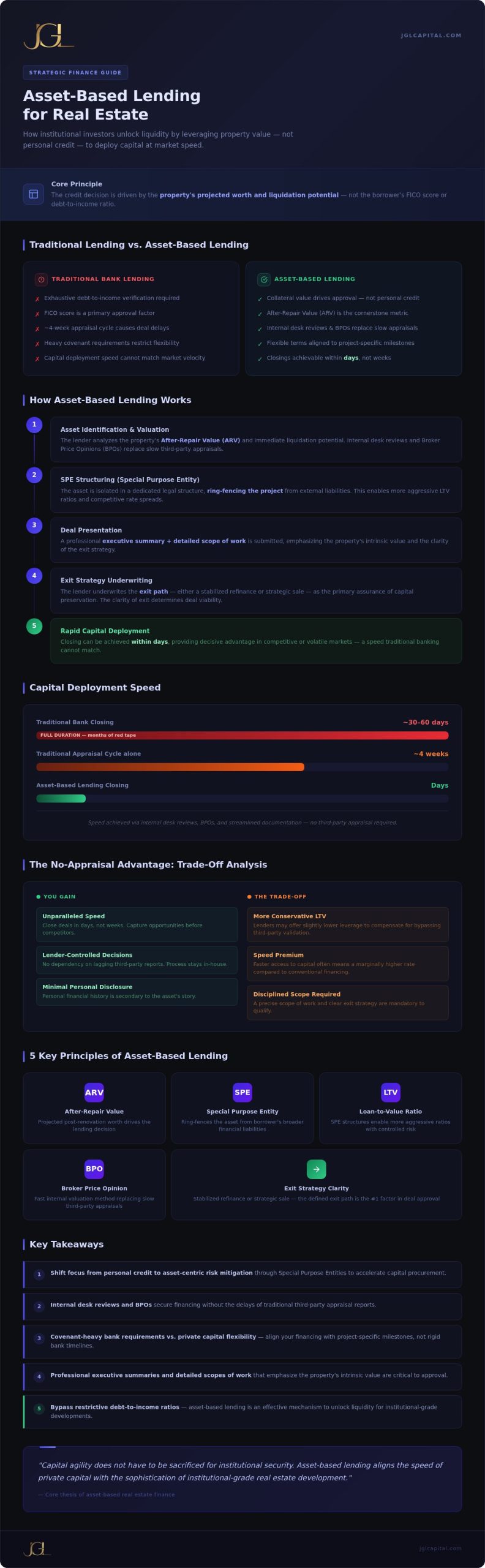
- Shift focus from personal credit to asset-centric risk mitigation through Special Purpose Entities to accelerate capital procurement.
- Utilize internal desk reviews and streamlined valuations to secure financing without the delays of traditional third-party appraisal reports.
- Compare covenant-heavy bank requirements against the flexibility of private capital to align your financing with project-specific milestones.
- Refine your deal presentation with professional executive summaries and detailed scopes of work that emphasize the property’s intrinsic value.
- Leverage asset-based lending for real estate to bypass restrictive debt-to-income ratios; it’s an effective way to unlock liquidity for institutional-grade developments.
The Mechanics of Asset-Based Lending for Real Estate
The architecture of modern institutional finance has undergone a definitive transition toward structures that prioritize the intrinsic value of the underlying collateral over the personal financial history of the sponsor. In this framework, asset-based lending for real estate functions as a mechanism of risk mitigation where the property’s projected worth and its eventual liquidation potential form the cornerstone of the credit decision. This shift necessitates a rigorous analysis of the asset’s lifecycle, moving away from the restrictive debt-to-income metrics that often characterize traditional retail banking. This methodology distinguishes between the immediate liquidation value of “hard” assets and the stabilized cash-flow potential of commercial properties, allowing for the delivery of highly customized, individual solutions that align with the specific needs of the project.
Central to these institutional-grade transactions is the utilization of a Special Purpose Entity, or SPE, which serves to isolate the real estate asset from the broader financial liabilities of the borrower. By ring-fencing the project within a dedicated legal structure, lenders can ensure that the security interest remains unencumbered by external litigation or unrelated financial distress. This structural discipline allows for more aggressive loan-to-value ratios and competitive interest rate spreads, as the risk is strictly confined to the performance of the specific development or acquisition. When collateral liquidity is high, the resulting interest rate spreads often reflect the stability of the asset rather than the perceived risk of the individual borrower.
Priority of Collateral Over Credit
While traditional lenders may obsess over a sponsor’s FICO score or personal liquidity, the private capital markets recognize that property-level equity is the most reliable form of security. In high-stakes environments, the borrower’s personal credit history becomes a secondary consideration to the strength of the asset’s “story” and its eventual marketability. Underwriting rigor focuses on the exit strategy, whether through a stabilized refinance or a strategic sale, as the primary assurance of capital preservation. It’s the clarity of this exit path that determines the viability of the deal, ensuring that every claim is qualified and every strategy is clearly defined from the outset.
Capital Velocity in Competitive Markets
Speed is frequently the most valuable currency in high-stakes real estate development. Because the documentation requirements are streamlined to focus on the asset’s valuation and the scope of work, these structures enable closings within days, providing a distinct advantage in volatile or highly competitive markets. Asset-based lending serves as a sophisticated strategic tool that prioritizes the intrinsic value of real estate collateral to facilitate the rapid deployment of institutional capital. This agility is achieved through a rejection of bureaucratic red tape in favor of analytical precision and a deep understanding of market-specific asset liquidity. By focusing on the generation of worth through the asset itself, developers can move with a level of decisiveness that traditional banking simply cannot accommodate.
Evaluating Risk Without Red Tape: The No-Appraisal Advantage
In the high-velocity environment of 2026, the reliance on traditional third-party appraisals often represents a critical point of failure for sophisticated developers. A real estate investment loan with no appraisal is no longer a theoretical concept; it’s a practical necessity for those operating in volatile markets. By bypassing the standard four-week valuation cycle, asset-based lending for real estate allows for a more agile response to emerging opportunities. This model utilizes internal desk reviews and Broker Price Opinions (BPOs) to establish a baseline of value, ensuring that the decision-making process remains within the lender’s direct control. It prioritizes the immediate deployment of capital over the bureaucratic safety of a lagging third-party report.
While this methodology offers unparalleled speed, it typically involves a calculated trade-off regarding the Loan-to-Value (LTV) ratio. Institutional lenders may offer slightly more conservative leverage in exchange for the total elimination of red tape. This discipline protects both the capital steward and the borrower from the risks associated with inflated valuations. It’s a strategic choice. Developers must decide if the premium on speed outweighs the marginal benefit of higher leverage. In most high-stakes scenarios, the ability to close a deal within days provides a competitive advantage that far exceeds the cost of additional equity. The focus remains on the preservation of value through precise, data-driven action.
The Internal Valuation Process
Institutional deal desks now leverage proprietary data sets and real-time local market comparables to conduct rapid, rigorous valuations. These internal reviews mitigate the risk of market cooling during the term of the loan, as they’re based on current transaction velocity rather than lagging historical reports. The deal desk meticulously verifies developer-provided pro formas to ensure every strategic objective is grounded in analytical reality. A “no appraisal” loan relies on the lender’s intellectual capital and market data to provide a foundation for secure financing. This approach ensures that capital is deployed based on the asset’s current trajectory rather than its past performance.
When to Forego the Traditional Appraisal
There are specific scenarios where the cost of a traditional appraisal report is dwarfed by the potential lost opportunity. Time-sensitive auctions and distressed property acquisitions require a level of decisiveness that standard banking cannot provide. A thorough cost-benefit analysis often reveals that the speed of execution is far more critical than the marginal savings of a slightly higher LTV. For those managing high-stakes portfolios, engaging a private money broker who understands these nuances is essential for maintaining a competitive edge. This allows for the generation of worth through the acquisition of undervalued assets that would otherwise be lost to more agile competitors.
Asset-Based vs. Traditional Financing: A Strategic Comparison
Traditional banking institutions often impose a rigid, covenant-heavy framework that prioritizes the lender’s protection at the expense of the borrower’s operational agility. In contrast, asset-based lending for real estate utilizes a covenant-light structure that allows sophisticated developers to execute complex strategies without the constant interference of a retail bank’s risk management department. While a bank might focus on restrictive global cash-flow requirements, an asset-centric approach centers on the Debt Service Coverage Ratio (DSCR) of the specific property. This shift ensures that the project’s intrinsic ability to service debt remains the primary metric of eligibility, which is particularly vital in value-add scenarios where traditional appetites for risk are nonexistent.
The distinction between long-term legacy building and short-term tactical deployment is fundamental to capital stack positioning. Traditional mortgages are often designed for stabilized assets held for decades, yet they lack the flexibility required for the transitional phases of a property’s lifecycle. Private capital structures provide the necessary bridge to move an asset from acquisition through renovation to stabilization. By prioritizing the after-repair value (ARV) and the specific milestones of a development plan, these loans offer a level of customization that aligns perfectly with a disciplined investor’s objectives. It’s about finding the right tool for the specific phase of growth.
The Cost of Capital vs. The Cost of Inaction
Institutional investors recognize that the nominal interest rate is only one component of the total cost of capital. When analyzing the project’s return on investment (ROI), the certainty of execution often carries a weight far greater than a marginal difference in basis points. A bank’s delay can be more expensive than a private lender’s spread, especially when lost opportunities or expired purchase contracts are considered. Bridge financing provides the essential liquidity to seize these moments, serving as a tactical tool that preserves the long-term integrity of a developer’s portfolio. Execution matters more than perfection.
Strategic Alignment of Objectives
A sophisticated lender acts not as a mere transactional vendor but as a strategic ally deeply invested in the project’s success. This relationship allows for the creation of individual solutions that match the precise lifecycle of the development, from initial land acquisition to final disposition. For instance, new construction loans represent a primary example of asset-aligned funding where the draw schedule and terms are meticulously calibrated to the builder’s specific operational needs. By framing these activities as a high-level strategic alliance, asset-based lending for real estate ensures that both parties are committed to the generation of long-term worth. This alignment of interests is the hallmark of a disciplined steward of capital.
Navigating the Application: How to Present an Asset-Backed Deal
The successful procurement of asset-based lending for real estate depends significantly on the sponsor’s ability to synthesize a property’s narrative into a coherent, professional executive summary. This document must go beyond simple descriptions; it should articulate the asset’s intrinsic potential and the specific market conditions that justify the capital request. A meticulously detailed Scope of Work (SOW) is equally vital for projects involving rehabilitation or ground-up development. By presenting a clear, line-item budget and a realistic timeline, you demonstrate the disciplined approach required for high-stakes management. This level of transparency instills confidence in the lender’s deal desk, ensuring that the strategic objectives of both parties remain perfectly aligned from the initial review.
Transparency regarding the exit strategy is the cornerstone of any institutional-grade asset-backed deal. Whether the intended path is a stabilized refinance, a strategic sale, or a rapid lease-up, the lender must see a defined route toward capital preservation. Organizing property-level documentation for rapid underwriting review is not merely an administrative task; it is a signal of operational excellence. When leases, tax records, and title history are presented in a structured format, it allows for the analytical rigor necessary to move a deal toward closing without the delays typical of less sophisticated lending environments. This methodical presentation builds a case for your competence through a logical flow of information.
The Essential Document Checklist
While the asset serves as the primary security, a developer’s track record remains a significant factor in the risk assessment process. History provides a context for the current project, illustrating a consistent ability to generate worth through careful, deliberate action. Financial pro formas must project stabilized value with analytical rigor, utilizing current market data rather than speculative trends. These documents should include:
- Comprehensive property-specific records, including current leases and historical tax data.
- A detailed summary of the sponsor’s past performance in similar asset classes.
- Rigorous financial projections that account for various market scenarios.
Optimizing the Capital Request
Determining the ideal Loan-to-Value (LTV) ratio requires a balance between project safety and the desire for leverage. Institutional investors often find that a slightly more conservative request facilitates a smoother underwriting process and more favorable terms. Communicating timeline requirements clearly to your private money broker ensures that the capital deployment matches the velocity of your acquisition schedule. For those operating in specific regional markets, you may consult our guide on hard money lenders in Florida for insights into national private capital standards. If you are ready to move forward with a high-stakes development, you can partner with a seasoned private money broker to begin the process of strategic alliance.
JGL Capital: Bespoke Asset-Based Solutions for Institutional Investors
JGL Capital serves as a disciplined steward within the real estate capital markets, leveraging over 30 years of institutional expertise to facilitate the most demanding transactions. Our firm specializes in the procurement of capital for projects exceeding $10 million, ensuring that each partnership is grounded in rigorous analytical standards. We deliver asset-based lending for real estate across a national footprint, with a focused emphasis on the specific requirements of new construction, multi-family developments, and commercial assets. This depth of experience allows us to project a confidence that’s rooted in stability rather than marketing hyperbole, providing a sense of security to high-net-worth stakeholders and sophisticated partners.
A Disciplined Approach to Value Creation
Our approach to value creation is defined by a commitment to highly customized, individual solutions that address the nuances of complex deal structures. As a seasoned private money broker, we bridge the essential gap between institutional-grade opportunities and the specialized private capital they require. We reject the transactional mindset of generic competitors. Instead, we frame our activities as high-level strategic alliances. This focus on building lasting legacies ensures that every project we support contributes to the long-term preservation of worth. You can gain deeper insight into our philosophy and strategic objectives by reviewing our real estate investing overview.
Securing Your Next High-Stakes Project
Securing capital for high-stakes projects shouldn’t be impeded by the bureaucratic friction typical of traditional mortgage institutions. JGL Capital eliminates these barriers by focusing on the intrinsic value of the asset and the integrity of the developer’s vision. Our underwriting process remains steady and measured, mirroring a patient approach to long-term objectives while maintaining the velocity required for competitive market acquisitions. We provide a sense of security through expert underwriting that qualifies every claim and defines every strategy with precision. By choosing to secure asset-based lending for real estate through a quiet expert, you align your project with a partner that values intellectual capital over aggressive self-promotion. We invite you to Consult with the deal desk at JGL Capital to discuss how our strategic brokerage services can facilitate your next $10M+ development.
Advancing Institutional Growth Through Strategic Capital Allocation
The transition toward a more agile, asset-centric financing model is essential for developers seeking to maintain a competitive advantage in the volatile 2026 market. By prioritizing the intrinsic value of collateral and utilizing sophisticated structures like Special Purpose Entities, you ensure that your capital remains as dynamic as the opportunities you identify. This strategic guide has detailed the mechanics of bypassing traditional bureaucratic delays through internal desk reviews and the importance of presenting a clear, data-driven narrative for every development. Asset-based lending for real estate represents more than a source of liquidity; it’s a form of high-level strategic alliance that aligns your project’s lifecycle with a disciplined approach to value preservation.
JGL Capital brings over 30 years of industry expertise to every transaction, specializing in $10M+ institutional-grade loans with a national reach that ensures precision across diverse markets. We invite you to Secure Strategic Capital for Your Next Asset-Backed Project and experience the stability of a seasoned partner. Your vision for long-term growth deserves the support of a steward committed to analytical rigor and the creation of lasting worth. It’s time to build your legacy with a partner that values precision as much as you do.
Frequently Asked Questions
What is the typical interest rate for asset-based lending in real estate?
Interest rates for asset-based lending for real estate are determined by the risk profile of the underlying collateral and the projected liquidity of the exit strategy. These rates typically reflect a premium over traditional bank financing to account for the superior speed and flexibility of capital deployment. While specific figures fluctuate based on market benchmarks, institutional lenders calibrate their pricing to align with the strategic value provided to the developer, ensuring that the cost of capital remains secondary to the certainty of execution.
Can I get a real estate investment loan with no appraisal in 2026?
It’s possible to secure financing without a traditional third-party appraisal by utilizing internal deal desk reviews or Broker Price Opinions (BPOs). This methodology relies on real-time market data and proprietary valuation models to establish the asset’s worth with analytical rigor. Such a “no appraisal” approach is particularly effective for sophisticated partners who require rapid execution in competitive or time-sensitive acquisition environments where traditional timelines would be prohibitive.
How does asset-based lending differ from hard money loans?
Asset-based lending for real estate serves as a broader institutional category that encompasses various private capital structures, whereas hard money is often a specific subset focused on short-term, high-interest bridge scenarios. While both prioritize collateral over credit, institutional asset-based solutions typically offer more sophisticated terms for $10M+ developments. These solutions focus on long-term value creation and collaborative relationships rather than purely transactional, short-term lending.
What property types qualify for asset-backed real estate loans?
Qualifying assets include multi-family residential complexes, new construction projects, land acquisitions, and various commercial properties. The primary requirement is that the asset possesses intrinsic value and a clear, documented path to stabilization or liquidation. Institutional brokers prioritize properties that demonstrate strong market demand and the potential for significant worth generation through disciplined management and strategic development.
Is a personal guarantee required for an asset-based loan?
Many institutional asset-based structures are designed as non-recourse or limited-recourse loans, especially when the asset is isolated within a Special Purpose Entity (SPE). This structure limits the lender’s recovery to the property itself, protecting the sponsor’s personal balance sheet from the liabilities of the specific project. However, standard carve-outs for specific acts are typically included to ensure that the borrower maintains the highest level of professional responsibility throughout the loan term.
How fast can an asset-based real estate loan close?
What is the maximum Loan-to-Value (LTV) for asset-based financing?
Maximum LTV ratios generally range from 65% to 80% depending on the asset class and the specific risk profile of the development. For new construction or value-add projects, lenders may also consider the Loan-to-Cost (LTC) or the projected After Repair Value (ARV) to determine the appropriate leverage. These metrics ensure that the capital stack is properly balanced to protect the interests of all sophisticated stakeholders while providing necessary liquidity.
Does asset-based lending require income verification or tax returns?
Asset-centric underwriting significantly reduces the need for personal income verification or the submission of extensive tax returns. The lender’s analytical rigor is focused on the property’s cash flow potential, its Debt Service Coverage Ratio (DSCR), and the overall strength of the collateral. This shift allows developers with complex financial structures or significant non-liquid assets to access capital without the constraints of traditional debt-to-income requirements.