

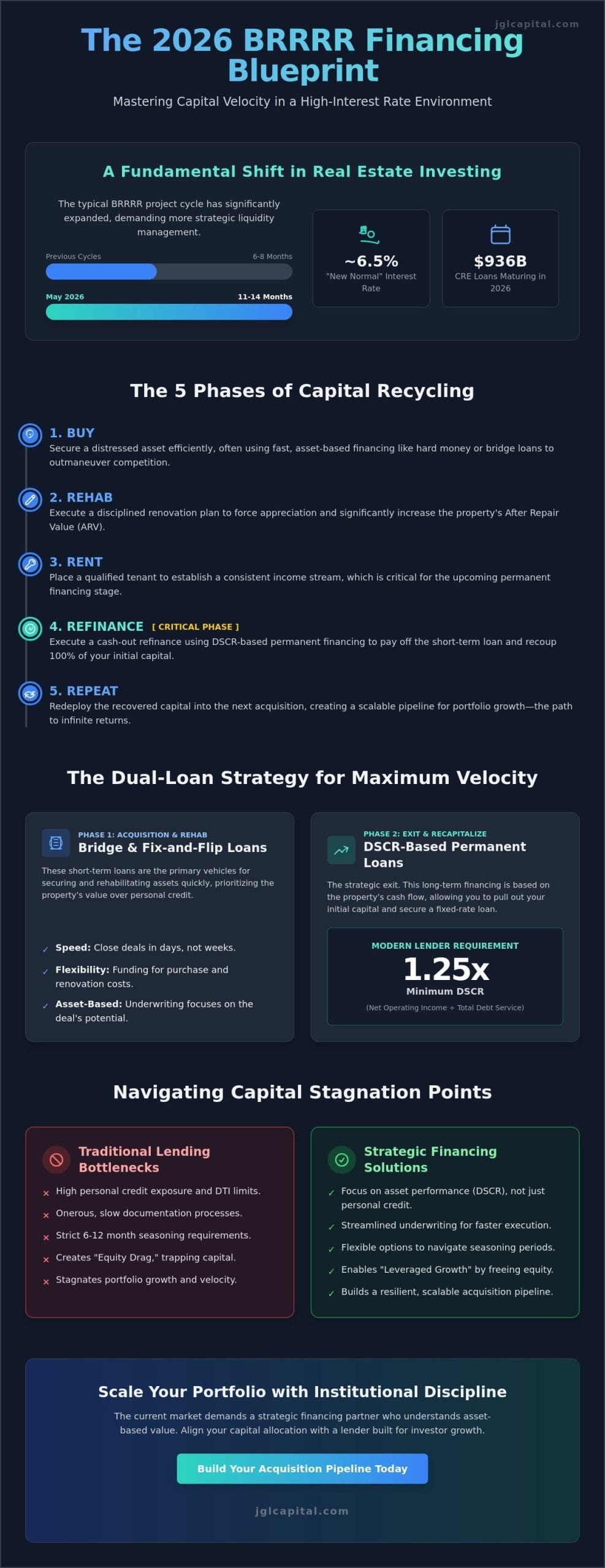
Did you know that in May 2026, the typical cycle for a successful BRRRR project has expanded to between 11 and 14 months; a duration that nearly doubles the timelines observed in previous market cycles? This significant deceleration of capital velocity represents a fundamental shift in the real estate landscape, where liquidity management poses a direct challenge to portfolio scalability. To maintain institutional momentum, sophisticated investors must move beyond transactional thinking and master the complex BRRRR method financing options currently available in this higher interest rate environment. You likely understand that traditional seasoning requirements and onerous documentation can lead to capital stagnation, effectively locking your liquidity in a single asset for far too long.
This guide provides the analytical framework necessary to navigate these constraints and achieve the strategic objective of infinite returns. You’ll learn how to leverage bridge loans and fix and flip loans to secure assets, followed by disciplined transitions into DSCR-based permanent financing that prioritizes property performance over personal credit exposure. We’ll examine the precise methodologies required to recoup 100% of your initial investment while managing the tighter 1.25x debt service coverage ratios demanded by modern lenders. By the end of this analysis, you’ll possess the blueprint to build a resilient acquisition pipeline that functions with professional precision and preserves the integrity of your long-term wealth strategy.
Key Takeaways
- Align capital allocation strategies with long-term wealth preservation to ensure consistent liquidity across the investment lifecycle.
- Evaluate the most sophisticated BRRRR method financing options, such as bridge loans and fix and flip loans, to secure and rehabilitate distressed assets efficiently.
- Master the Debt Service Coverage Ratio (DSCR) metrics required to successfully execute cash-out refinances in a higher interest rate environment.
- Implement proactive measures to manage seasoning requirements and LTV constraints to prevent capital stagnation and maintain a steady acquisition pipeline.
- Establish strategic alliances that prioritize asset-based performance over personal credit to scale your portfolio with institutional discipline.
The Mechanics of Capital Velocity: Why Financing Defines the BRRRR Strategy
The BRRRR method is frequently mischaracterized as a mere tactical renovation sequence, yet for the institutional-grade investor, it serves as a rigorous capital allocation framework. This strategy prioritizes the preservation and rapid redeployment of liquidity, a concept known as capital velocity. In the current economic landscape of 2026, where interest rates have stabilized at a “new normal” of approximately 6.5%, the ability to recycle equity efficiently has become the primary differentiator between stagnant portfolios and scalable enterprises. Because the real estate investing environment now demands more disciplined underwriting, the specific BRRRR method financing options an investor selects will fundamentally dictate the project’s internal rate of return. A failure to align the financing structure with the asset’s lifecycle often results in capital stagnation, where equity is trapped by restrictive terms or lengthy seasoning requirements.
In 2026, the premium on liquidity has never been higher. With an estimated $936 billion in commercial real estate loans projected to mature this year, the lending environment is characterized by heightened caution and stricter adherence to fundamental metrics. Investors who treat financing as a secondary consideration often find their capital velocity curtailed by inaccurate appraisals or rigid bank documentation. Successful execution requires a strategic alliance with a lender that understands the nuances of asset-based value, ensuring that the transition from acquisition to refinance is a calculated progression rather than a series of disjointed transactions.
The Lifecycle of an Asset-Based Investment
Mapping the transition from acquisition to permanent financing requires a seamless coordination between short-term debt and long-term wealth preservation. Investors often encounter significant friction during the “Refinance” stage, particularly as seasoning requirements from government-sponsored enterprises often mandate a six to twelve-month holding period. In 2026, a full BRRRR cycle typically spans 11 to 14 months, making the choice of BRRRR method financing options critical for managing carrying costs. Intellectual capital involves identifying these stagnation points early and selecting financial vehicles that provide the flexibility to exit the short-term phase as soon as the asset’s value is stabilized. Friction points such as onerous documentation or delayed appraisal timelines can extend this cycle, eroding the project’s overall profitability.
Equity Drag vs. Leveraged Growth
Traditional credit-based lending often imposes an “equity drag” on a portfolio, as personal debt-to-income ratios and exhaustive documentation requirements create bottlenecks that prevent rapid scaling. Asset-based underwriting offers a strategic advantage by focusing on the property’s intrinsic value and income-generating potential rather than the borrower’s personal credit profile. This approach minimizes personal credit exposure and allows for a more scalable acquisition pipeline. Capital velocity in real estate investing is the rate at which an investor can recycle their initial equity through a complete acquisition and refinancing cycle to facilitate subsequent acquisitions. By prioritizing leveraged growth through asset-based metrics, investors can overcome the limitations of traditional banking and achieve a level of portfolio expansion that remains resilient despite market volatility.
Primary Acquisition Vehicles: Hard Money and Bridge Financing
The strategic utility of hard money lenders is most evident during the acquisition of distressed assets where traditional timelines prove prohibitive. In the competitive environment of 2026, the ability to secure financing within a three to five-day window allows sophisticated investors to capture opportunities that would otherwise be lost to capital stagnation. These short-term instruments provide the necessary liquidity to execute the “Buy” phase of the BRRRR method, even when the property’s current condition fails to meet institutional standards for permanent financing. While interest rates for these loans currently fluctuate between 9.5% and 12.5%, the cost of capital is often secondary to the speed of execution and the preservation of the acquisition pipeline.
Bridge loans facilitate a deliberate transition through the “Rehab” phase, providing terms that typically range from 6 to 36 months. These vehicles are designed to cover the gap between acquisition and stabilization, allowing the investor to focus on value creation. A critical component of this phase is the After-Repair Value (ARV), which serves as the primary metric for determining loan proceeds. Most lenders in 2026 cap their exposure at 65% to 80% of the ARV, a benchmark that requires rigorous underwriting and conservative projections. Managing these BRRRR method financing options effectively ensures that you don’t over-leverage the asset before it reaches its full income-generating potential.
Asset-Based Underwriting vs. Personal Credit
Sophisticated investors prioritize property value over personal tax returns to maintain maximum scalability and minimize personal credit exposure. This asset-based approach allows for a more streamlined approval process, focusing on the deal’s intrinsic merits rather than the borrower’s debt-to-income ratio. By utilizing fix and flip loans, you can secure properties based on their projected worth, effectively bypassing the documentation bottlenecks common in traditional banking. Engaging a partner with deep-seated expertise in bridge loans can help ensure that your capital structure remains resilient during these initial phases.
Structuring the Rehab Budget and Draw Schedules
The discipline of the draw schedule is paramount to ensuring that project milestones align with capital release. In 2026, renovation cost volatility necessitates a meticulous approach to contingency planning, often requiring a buffer for unforeseen overruns. A well-structured draw schedule maintains the alignment of objectives between the lender and the developer, ensuring that capital is deployed only as value is added to the asset. This methodical approach prevents the “equity drag” discussed previously and ensures that the project remains on track for a successful transition to the “Rent” and “Refinance” stages of the BRRRR method financing options lifecycle.
Executing the Exit Strategy: Permanent Financing and Cash-Out Refinance
The transition from the “Rehab” phase to the “Refinance” phase represents a critical pivot from capital deployment to the preservation of long-term value. While bridge financing facilitates the initial value-add, the enduring viability of your investment depends on securing permanent debt that reflects the asset’s stabilized performance. In 2026, the selection of BRRRR method financing options must be guided by a thorough analysis of the prevailing interest rate environment, which currently sees national average 30-year fixed refinance APRs at approximately 6.78%. This environment necessitates a more conservative approach to Loan-to-Value (LTV) extraction, as higher debt service costs directly impact the amount of equity that can be safely withdrawn without compromising the property’s net cash flow. Conventional mortgages often come with rigid seasoning requirements and debt-to-income caps that can hinder the speed of capital recycling; in contrast, portfolio loans offer more flexibility in terms of loan count and underwriting criteria, allowing for a more customized approach to your capital structure.
A strategic comparison between institutional lending products reveals that the interest rate environment in 2026 has placed a premium on debt serviceability. Investors must weigh the benefits of lower-rate conventional products against the administrative ease and scalability of asset-based portfolio loans. When evaluating BRRRR method financing options, it’s essential to recognize that the final LTV extraction will be capped between 75% and 80% for most investment properties. This limit ensures that the property retains a sufficient equity cushion to withstand potential market volatility in the latter half of 2026, while still providing the liquidity needed to fund subsequent acquisitions.
The DSCR Loan: The Professional Investor’s Exit Vehicle
DSCR loans have emerged as the primary vehicle for sophisticated investors because they prioritize the property’s gross rental income over the borrower’s personal debt-to-income ratio. To secure the most competitive rates in 2026, lenders typically require a minimum Debt Service Coverage Ratio of 1.20x to 1.25x, ensuring the asset generates sufficient revenue to cover all debt obligations with a disciplined margin of safety. Calculating the optimal DSCR involves a rigorous assessment of all operating expenses and potential vacancies to ensure long-term sustainability. Non-recourse options further enhance portfolio management by limiting the investor’s personal liability, an essential feature for those seeking to build large-scale acquisitions without increasing personal credit exposure.
Optimizing the Cash-Out Refinance
Maximizing the cash-out refinance requires a meticulous focus on the final appraisal, where every dollar of increased net operating income translates into significant equity gains. Investors should prepare a comprehensive “rehab book” for the appraiser to document the specific improvements and high-grade materials used during the renovation phase. Understanding what is a bridge loan and how it functions allows investors to maintain project momentum by filling the critical gap between the completion of the rehab and the closing of permanent debt. Successfully recouping 100% of the initial investment enables the “Repeat” phase, providing the liquidity necessary to fund the next acquisition in the pipeline and maintain consistent capital velocity.
Navigating Regulatory and Market Constraints: Seasoning and LTV
The execution of a successful capital recycling strategy requires more than just operational proficiency; it demands a sophisticated understanding of the regulatory and market constraints that govern liquidity. The seasoning period, often viewed as a mandatory phase of capital stagnation, represents the duration a lender requires an investor to hold a property before the appraised value can be used for a cash-out refinance. In 2026, while government-sponsored entities like Fannie Mae maintain a six-month requirement, the broader market often imposes holds of up to twelve months. For the strategic architect, these months are not merely a waiting period but a phase that must be actively managed to prevent the erosion of internal rates of return. As the lending environment tightens, particularly with $936 billion in commercial real estate loans maturing this year, the outlook for LTV constraints suggests that lenders will remain exceptionally conservative in their valuations.
Mitigating the risk of an appraisal gap during the refinance phase is essential for maintaining the integrity of the BRRRR lifecycle. An appraisal gap occurs when the final valuation falls short of the projected After-Repair Value (ARV), a scenario that has become increasingly common as market volatility returns in the latter half of 2026. A disciplined steward manages this risk by maintaining conservative debt-to-equity ratios and ensuring that every capital improvement is documented with institutional precision. By selecting the right BRRRR method financing options, investors can align their debt structures with realistic market expectations, ensuring that the transition to permanent financing remains seamless even when market conditions fluctuate.
Seasoning Period Strategies
Sophisticated investors must distinguish between title seasoning, which tracks the length of ownership, and loan seasoning, which refers to the duration the current debt has been in place. To circumvent the traditional six-to-twelve-month stagnation, many professionals utilize short-term bridge extensions that provide the necessary time to satisfy institutional requirements without triggering a liquidity crisis. Another advanced tactic involves the strategic use of delayed financing exceptions, which can allow for a faster recoupment of capital if the initial acquisition was made with cash. Understanding these nuances is vital for those who wish to master the various BRRRR method financing options available in a high-stakes environment. To navigate these complex regulatory hurdles with a partner who values long-term growth, you may wish to consult with an asset-based lending specialist.
Managing the LTV/ARV Matrix
The relationship between purchase price, rehab cost, and final ARV forms the mathematical foundation of the BRRRR method. In the 2026 lending landscape, a 75% LTV on the ARV is widely considered the “Golden Ratio” for recouping 100% of the initial capital investment while maintaining a sustainable equity cushion. This benchmark requires that the total acquisition and renovation costs do not exceed 75% of the property’s stabilized value. Risk mitigation in volatile markets necessitates a “return to fundamentals,” where investors prioritize high-demand assets and conservative underwriting. By adhering to these disciplined metrics, you ensure that your portfolio remains resilient against declining valuations and that your capital remains mobile for the next strategic acquisition.
Scaling the Portfolio: JGL Capital as Your Strategic Financing Partner
Transitioning from a single successful project to a scalable enterprise requires more than just capital; it necessitates a strategic alliance with a firm that understands the complexities of the capital lifecycle. JGL Capital operates as a disciplined steward, leveraging over 30 years of institutional expertise to inform every decision regarding capital allocation and risk management. For the professional investor, the value of this partnership lies in the shift from transactional interactions to a collaborative relationship that prioritizes the alignment of long-term objectives. By integrating a deep understanding of the BRRRR method financing options into a broader portfolio strategy, JGL Capital ensures that your liquidity remains mobile and your acquisition pipeline remains robust, even as market volatility returns in late 2026.
Our commitment to the creation and preservation of worth is reflected in our diverse range of products, which are meticulously designed to meet the needs of high-net-worth stakeholders. Whether you are seeking multi-family loans for stabilized assets or new construction loans for ground-up development, our approach remains rooted in analytical rigor and timeless business principles. We recognize that each project represents a building block in a larger legacy, requiring a serious and disciplined approach to debt structuring that minimizes personal credit exposure while maximizing capital velocity. This focus on fundamentals ensures that your portfolio remains resilient against the tighter lending standards and maturing commercial debt cycles currently defining the 2026 landscape.
Beyond Simple Brokerage: Tailored Capital Solutions
Customized loan structures are the engine of the “Repeat” phase, providing the flexibility needed to exit short-term debt and redeploy equity into new opportunities. Asset-backed underwriting allows for a level of efficiency that traditional credit-based lending cannot match, particularly in a fast-moving market where speed of execution is a competitive advantage. By focusing on property performance and intrinsic value, we help you manage your debt-to-equity ratios with the precision required to sustain long-term growth. This deliberate approach to capital management ensures that your portfolio isn’t just growing, but is built on a foundation of stability and integrity. It’s this commitment to customized, individual solutions that distinguishes a strategic alliance from a simple service provision.
Next Steps for the Sophisticated Investor
Securing fast funding in 2026 requires a level of professional processing and underwriting that leaves little room for ambiguity. As you prepare your portfolio for its next capital injection, ensuring that your documentation and property metrics are institutional-grade will facilitate a smoother transition through the refinance stage. We invite you to consult with the experts at JGL Capital to discuss your strategic objectives and explore how our tailored solutions can support your next acquisition. Establishing a collaborative relationship now will ensure that you are positioned to capitalize on the $936 billion in maturing commercial debt and other emerging opportunities in the coming year. Let us act as your invested ally in the generation of worth and the preservation of your investment legacy.
Mastering the Lifecycle of Institutional-Grade Capital
Executing a successful capital recycling strategy in 2026 requires a transition from transactional thinking toward a holistic lifecycle management of your assets. You’ve seen how capital velocity depends on the precise alignment of acquisition debt with long-term stabilized financing. By prioritizing asset-based underwriting and navigating seasoning constraints with analytical rigor, you preserve the liquidity necessary for a scalable pipeline. Selecting the appropriate BRRRR method financing options remains the most critical decision in maintaining the momentum of your wealth preservation strategy and ensuring your portfolio isn’t hindered by traditional lending bottlenecks.
Securing a partner who values disciplined stewardship is paramount as you navigate the complexities of the current market. JGL Capital offers national reach and institutional-grade capital solutions, backed by over 30 years of industry expertise and a commitment to property-value-focused underwriting. We invite you to partner with JGL Capital for your high-stakes BRRRR financing strategy to ensure your portfolio remains resilient and adaptable. Your commitment to these timeless principles of value creation will provide the foundation for a lasting legacy. We look forward to supporting your continued growth and strategic success.
Frequently Asked Questions
Is the BRRRR method still viable with 2026 interest rates?
The BRRRR method remains a viable strategy in 2026, though it demands a more rigorous adherence to financial fundamentals than in previous years. With interest rates stabilizing around 6.5%, the margin for error has narrowed, requiring investors to focus on assets with significant value-add potential. Successful execution now hinges on conservative underwriting and the selection of appropriate BRRRR method financing options that prioritize cash flow over speculative appreciation.
Can I use a bridge loan for the initial acquisition in a BRRRR deal?
Bridge loans serve as an effective instrument for the initial acquisition and stabilization phases of a BRRRR project. These vehicles provide the necessary liquidity to secure distressed assets and fund renovations when traditional permanent financing is unavailable due to property condition. By utilizing a bridge loan, you can maintain project momentum and ensure a seamless transition into the “Rent” phase once the asset’s value is fully realized.
How much of my own capital is typically required for a BRRRR financing package?
Most institutional lenders require an initial capital contribution ranging from 20% to 35% of the total project costs, depending on the investor’s track record and the asset’s risk profile. While the goal of the BRRRR method is to recoup 100% of this investment through a cash-out refinance, you must be prepared to cover the gap between the purchase price and the loan proceeds. This initial liquidity ensures that the project remains sufficiently capitalized during the critical “Rehab” phase.
What is the difference between a hard money loan and a DSCR loan for BRRRR?
Hard money loans are short-term, asset-based instruments designed for the acquisition and renovation phases, whereas DSCR loans are long-term vehicles used for the final refinance. Hard money focuses on the property’s potential After-Repair Value (ARV) to facilitate rapid execution. In contrast, DSCR loans prioritize the property’s actual rental income to ensure that the debt service is sustainable over a 30-year term.
How long is the typical seasoning period before I can perform a cash-out refinance?
The typical seasoning period required by most lenders in 2026 ranges from 6 to 12 months before a cash-out refinance can be executed. While some DSCR products may offer shorter windows of 3 to 6 months, traditional government-sponsored guidelines often mandate a minimum six-month holding period. Planning for this duration is essential to avoid capital stagnation and to ensure that your BRRRR method financing options align with your overall portfolio timeline.
What happens if the property appraises for less than the ARV during the refinance?
If a property appraises for less than the projected ARV, it results in an “appraisal gap” that limits the amount of equity you can extract during the refinance. In such scenarios, you may be unable to recoup your entire initial investment, leaving a portion of your capital trapped in the asset. To mitigate this risk, it’s vital to use conservative valuation metrics and maintain a disciplined approach to renovation costs from the project’s inception.
Can the BRRRR method be applied to multi-family or commercial properties?
The BRRRR framework is highly effective when applied to multi-family and commercial properties, where the scale of the investment can lead to significant equity gains. Commercial real estate loans and multi-family loans are structured to support these larger acquisitions, focusing on the Net Operating Income (NOI) as the primary driver of value. Scaling this method into larger assets allows for more efficient capital redeployment and the creation of substantial long-term wealth.
How does JGL Capital accelerate the financing process for experienced investors?
JGL Capital accelerates the financing process by utilizing a disciplined, asset-based underwriting model that prioritizes property value over exhaustive personal documentation. Our institutional-grade processing and 30 years of expertise allow us to provide rapid funding for bridge loans and fix and flip loans. This streamlined approach ensures that experienced investors can capture competitive opportunities and maintain a high rate of capital velocity.