

The pursuit of institutional-scale growth is rarely hindered by a lack of capital or opportunity, but rather by the structural fragility of the organization itself. As commercial investment volume is projected to reach $562 billion by the end of 2026, the gap between ambitious individuals and established firms continues to widen. You’ve likely recognized that operational bottlenecks in deal flow and inconsistent property management performance are not merely inconveniences; they’re systemic risks that threaten your long-term legacy. Successfully building a real estate investment team requires a fundamental shift from a transactional mindset to one of strategic stewardship.
Mastering the architectural principles of assembling a sophisticated team allows you to maximize capital velocity and optimize asset performance with surgical precision. This article provides a methodical blueprint for transforming your operations into a disciplined, institutional-grade engine designed for the preservation and creation of worth. We’ll explore how to structure your internal hierarchy to secure reliable capital for time-sensitive acquisitions while navigating the complexities of the 2026 tax landscape, ensuring your organization remains resilient in an evolving market.
Key Takeaways
- Understand the evolution from individual transactional effort to a strategic alliance where every member functions as a disciplined steward of capital.
- Discover the architectural requirements for building a real estate investment team by identifying high-performance pillars like strategic brokers and professional asset managers.
- Learn to apply analytical rigor when vetting partners to ensure that fee structures and operational philosophies align with your long-term objectives.
- Develop institutional-grade systems and Standard Operating Procedures that facilitate rapid deal evaluation and maximize capital velocity.
- Recognize the importance of integrating a sophisticated capital partner early in the acquisition process to secure reliable financing for complex property types.
The Philosophy of the Strategic Alliance: Why Individual Effort Limits Scale
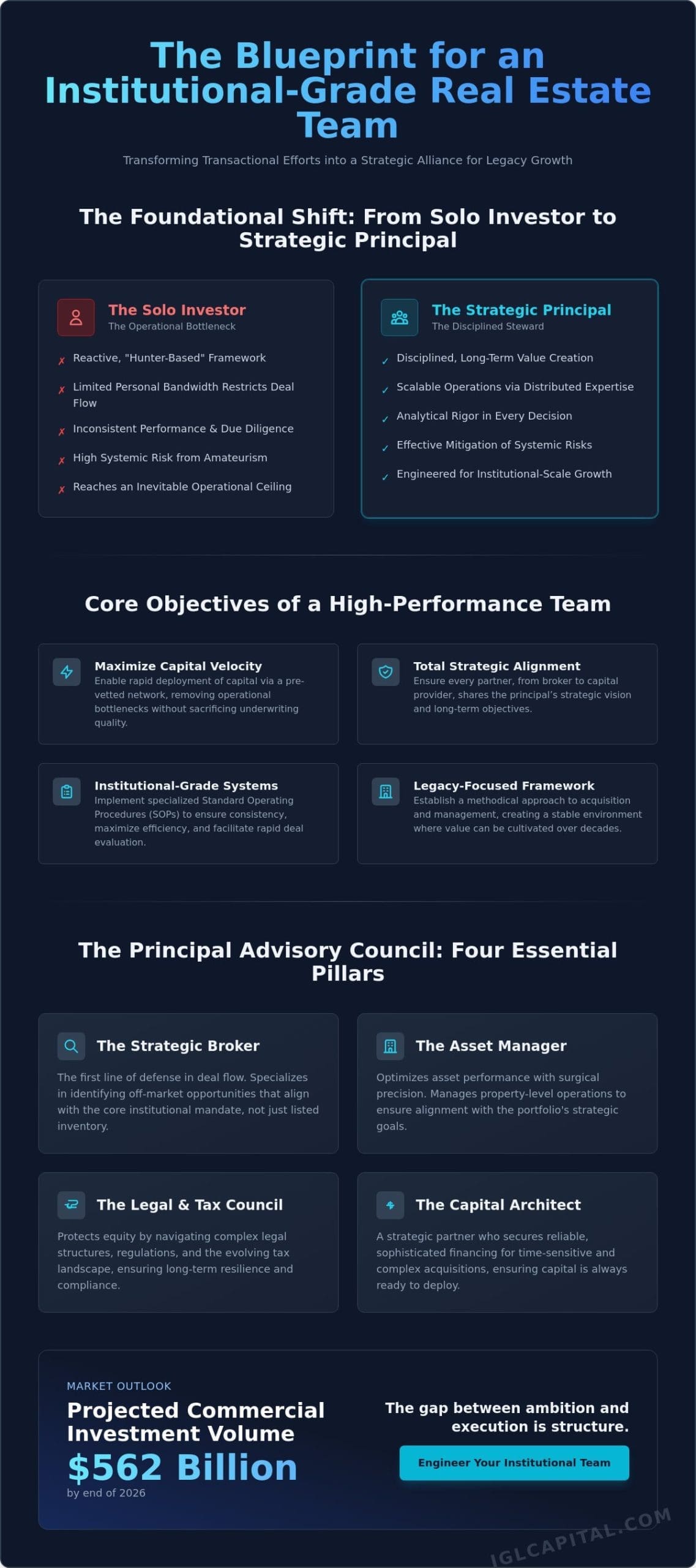
The transition from a transactional solo investor to a strategic portfolio principal represents a profound shift in the management of capital. While the individual investor often operates within a reactive, hunter-based framework, the principal functions as a disciplined steward who values the long-term preservation and generation of worth. Building a real estate investment team is the essential mechanism that facilitates this transition, allowing for the articulation of a core philosophy that transcends personal limitations. By engineering a team architecture grounded in analytical rigor, an organization can effectively mitigate systemic risks that would otherwise compromise the integrity of the portfolio.
The Limitations of the Solo Investor Model
Core Objectives of a High-Performance Team
A high-performance team is defined by the total alignment of objectives, ensuring that every partner, from the broker to the capital provider, shares the principal’s strategic vision. This alignment is maintained through the implementation of specialized Standard Operating Procedures (SOPs) that maximize resource efficiency and ensure consistency across diverse assets. Understanding real estate investing fundamentals from an institutional perspective allows the team to establish a legacy-focused framework for property acquisition. This methodical approach ensures that every project is evaluated with the same level of disciplined scrutiny, regardless of the acquisition’s speed or scale. By prioritizing these core objectives, the organization creates a stable environment where value can be cultivated over decades.
Capital velocity is the lifeblood of a growing portfolio, yet it’s frequently stifled by operational bottlenecks. A pre-vetted network of professional allies removes these obstructions, allowing for the rapid deployment of capital without sacrificing the quality of the underwriting. This sophisticated alliance transforms the act of investment into a form of high-level strategic stewardship. Every member of the team acts as a guardian of the principal’s capital, ensuring that every decision is backed by deep-seated expertise and analytical precision. Building a real estate investment team isn’t just about hiring help; it’s about engineering a machine for sustainable wealth generation.
The Principal Advisory Council: Identifying Essential Team Pillars
Building a real estate investment team requires the assembly of a Principal Advisory Council, a collective of experts who function with the same disciplined focus as an institutional board. This council is not merely a list of service providers; it’s a strategic alliance designed to protect equity and optimize performance across diverse asset classes. The foundation of this council rests upon four essential pillars: the Strategic Broker, the Asset Manager, the Legal and Tax Council, and the Capital Architect. Each member must be vetted for their ability to operate within high-stakes environments where analytical rigor is the standard.
The Strategic Broker is the first line of defense in deal flow. Unlike retail agents who focus on listed inventory, the strategic broker specializes in identifying off-market opportunities that align with institutional mandates. When building a real estate investment team, it’s vital to select partners who possess a deep understanding of real estate investing fundamentals and have established networks for national deal flow. These individuals act as scouts, filtering out noise to present only those assets that meet the principal’s specific risk-adjusted return profiles.
Operational success depends on the transition from simple property management to professional asset management. While traditional managers focus on rent collection, specialist management teams take a holistic view of the property’s lifecycle, focusing on Net Operating Income (NOI) optimization and long-term value creation. This distinction is critical for maintaining performance across a growing portfolio. Furthermore, the Legal and Tax Council serves as the critical safeguard for the organization’s equity. In the 2026 landscape, characterized by the permanent provisions of the One Big Beautiful Bill Act, sophisticated entity structuring is required to maximize the 23% Qualified Business Income deduction. This pillar ensures that the firm’s growth isn’t undermined by regulatory shifts or tax inefficiencies.
The Strategic Broker and Deal Finder
Identifying an investor-friendly broker involves evaluating their historical performance in securing distressed or off-market assets. Their value lies in their ability to navigate complex negotiations and provide localized market intelligence that isn’t available through public databases. A broker who understands the principal’s long-term objectives can serve as a vital extension of the firm’s internal research capabilities, providing a steady stream of viable opportunities without the clutter of retail listings.
Operational Execution: Contractors and Property Managers
Executing a value-add strategy requires standardizing the rehab process, particularly when utilizing fix and flip loans florida or similar short-term capital. General contractors must be held to institutional standards, ensuring that timelines are met with precision. This is especially true for developers relying on new construction loans, where delays can significantly impact capital velocity. Partnering with a Capital Architect who provides bridge loans or other customized financing solutions ensures that the team remains agile. Engaging a seasoned ally like JGL Capital ensures that the capital architecture remains as disciplined as the rest of the council.
Vetting and Alignment: Engineering a Disciplined Partner Network
Vetting is an exercise in analytical rigor that extends far beyond the examination of a curriculum vitae. When building a real estate investment team, the principal must look past superficial accolades to identify a history of disciplined action. It requires a methodical evaluation of how potential partners navigate market volatility and preserve equity under duress. The objective is to engineer a network of allies who operate not as independent vendors, but as an integrated extension of the firm’s strategic vision. This process ensures that every member of the council is prepared for the gravity of institutional management.
The “Alignment of Worth” test serves as the cornerstone of this selection process. It’s a critical assessment of whether a partner’s financial incentives are inextricably linked to the performance of the asset. Fee structures should be designed to reward the generation of long-term value rather than simple transactional volume. By ensuring that every member of the alliance has a vested interest in the outcome, the principal mitigates the risk of divergent objectives. This disciplined approach is essential for anyone building a real estate investment team capable of sustaining worth across multiple market cycles.
A common concern among principals is the perceived loss of control when delegating critical functions. However, control in a sophisticated environment is maintained through the establishment of rigorous institutional standards and transparent communication protocols. It’s not a surrender of authority, but an elevation of it. By defining clear boundaries and expectations, the principal can manage a vast portfolio without becoming entangled in granular operational details. This allows for the focus to remain on high-level strategic stewardship and capital allocation, rather than basic property oversight.
Quantifying Professional Competence
Evaluating competence requires the use of specific Key Performance Indicators (KPIs) tailored to the asset class in question. A track record in multi-family housing doesn’t necessarily translate to success in land development or complex commercial repositioning. Principals should verify asset-specific experience by analyzing past performance metrics and conducting thorough reference checks with other institutional-grade stakeholders. Reliability in volatile markets is best gauged by observing how a professional managed assets during periods of economic contraction or regulatory shifts.
Building the Strategic Alliance Agreement
The foundation of a successful partnership is a clearly articulated Strategic Alliance Agreement. This document must define roles, responsibilities, and decision-making hierarchies with absolute precision to leave no room for ambiguity. Every partner must be intimately familiar with the stringent requirements of commercial real estate loans, as financing often dictates the operational timeline and reporting standards. Establishing a culture of accountability through standardized reporting ensures that all activities remain aligned with the firm’s core mission and the preservation of capital.
Operational Systems: Scaling Through Institutional Rigor
The integration of the capital partner early in the acquisition lifecycle is a hallmark of a sophisticated operation. Rather than treating financing as a final, transactional hurdle, the principal should involve the capital architect during the initial underwriting phase. This collaborative approach ensures that the acquisition strategy is fully aligned with the available leverage and debt structures. It also facilitates the steady flow of capital required to maintain team momentum, particularly when navigating time-sensitive opportunities that demand immediate action. It’s a method that prioritizes precision over speed, ensuring every move is calculated.
The Acquisition and Underwriting Workflow
A streamlined pipeline from deal discovery to loan closing is essential for maximizing capital velocity. This workflow is empowered by a deep understanding of what is a bridge loan, as transitional capital often provides the agility needed to secure assets before permanent financing is arranged. By standardizing the due diligence process, the team can eliminate analysis paralysis and act with the confidence that every decision is backed by verified data. This systematic approach ensures that the underwriting remains objective, regardless of market sentiment or external pressures.
Financial Synchronization and Reporting
Maintaining a constant dialogue with the capital architect is vital for the health of the portfolio. This synchronization is particularly critical for managing cash flow and draw schedules in complex new construction projects, where precision is paramount. Institutional-grade reporting requirements for asset-backed financing and multi-family projects serve as a form of internal audit, ensuring that performance remains on track. To facilitate this level of operational excellence, developers should partner with a firm that values long-term stewardship. You can secure institutional-grade financing to support your team’s expansion and ensure your projects remain on schedule.
The Capital Architect: Integrating Private Financing as a Strategic Partner
The process of building a real estate investment team culminates in the selection of a Capital Architect who recognizes that financing is a strategic lever rather than a static operational cost. Asset-based lending serves as the primary engine for high-velocity portfolios because it prioritizes the inherent value and performance potential of the real estate over the narrow constraints of traditional credit underwriting. This property-centric philosophy allows the principal to execute on complex acquisitions that would otherwise be stalled by the bureaucratic inertia of institutional banks. By integrating a capital partner who possesses a deep-seated understanding of market fundamentals, the organization gains a sophisticated advisor capable of facilitating rapid, institutional-scale growth.
JGL Capital represents the archetype of this strategic ally, offering over 30 years of industry expertise in capital allocation for national developers and sophisticated investors. Unlike transactional lenders who focus on volume, a seasoned Capital Architect provides the stability and intellectual capital required to navigate shifting regulatory landscapes and economic cycles. This longevity ensures that the financing strategy remains as disciplined as the firm’s internal operational standards. It is an alliance grounded in the mutual objective of generating long-term worth through the meticulous selection and development of high-performing assets across the commercial and residential sectors.
Leveraging Private Capital for Competitive Advantage
In highly competitive markets, speed is often the determining factor in securing high-yield opportunities before they reach the broader retail market. Utilizing hard money lenders florida or specialized national brokers provides a distinct advantage over competitors who remain tethered to the prolonged timelines of traditional depository institutions. Bridge financing plays a critical role in this process; it offers the transitional capital needed to secure commercial assets while the broader Advisory Council finalizes the long-term asset management strategy. This agility is particularly vital for developers managing a diverse mix of new construction and multi-family projects across multiple jurisdictions.
A Commitment to Collaborative Growth
The final stage of building a real estate investment team is the full synchronization of the capital architect’s underwriting process with the firm’s acquisition workflow. JGL Capital’s streamlined, asset-backed approach is designed to complement the analytical rigor of sophisticated principals, ensuring that capital is available exactly when the deal flow demands it. This collaborative growth model ensures that every loan is structured to support the team’s overarching objectives and the preservation of equity. To integrate a partner who values stewardship as much as performance, you should Contact JGL Capital LLC to discuss how a strategic capital alliance can support your organization’s long-term legacy.
Engineering a Legacy of Sustainable Portfolio Expansion
The transition from a transactional solo investor to a strategic portfolio principal is achieved through the meticulous assembly of a Principal Advisory Council. By building a real estate investment team, you establish a resilient framework capable of navigating regulatory shifts and market volatility with institutional precision. This disciplined approach ensures that your organization prioritizes the preservation of capital while maximizing the velocity of your acquisitions through standardized operational systems and aligned objectives.
Realizing this level of scale requires a capital partner who functions as a dedicated steward of your vision rather than a mere vendor. JGL Capital brings over 30 years of industry expertise to your alliance, offering national reach and specialized financing solutions including bridge, fix-and-flip, and new construction loans. Our asset-backed lending philosophy is designed to align with your long-term objectives, providing the stability and speed necessary for high-stakes management. Secure the capital your team needs with JGL Capital LLC to fortify your operational engine and accelerate your path toward a lasting legacy. Your commitment to strategic stewardship is the definitive first step toward enduring success.
Frequently Asked Questions
What are the first three roles I should hire when building a real estate investment team?
The three foundational roles to secure are the Strategic Broker, the Asset Manager, and the Capital Architect. These specific pillars provide the necessary infrastructure for identifying off-market opportunities, optimizing property performance, and securing transitional financing. By prioritizing these roles when building a real estate investment team, the principal creates a stable environment where capital can be deployed with both speed and analytical precision.
How do I find a real estate agent who actually understands investment metrics?
Identifying a broker with institutional fluency requires vetting for a track record in off-market acquisitions and a deep understanding of Net Operating Income (NOI) optimization. You should avoid retail agents who focus on residential listings and instead seek professionals who serve sophisticated portfolio principals. A qualified broker must be able to articulate how a specific asset aligns with your risk-adjusted return profiles through rigorous metric analysis.
Is it better to hire in-house employees or work with independent contractors?
Utilizing independent contractors is generally more efficient during the initial stages of portfolio expansion because it provides access to specialized expertise without the overhead of internal staff. This model allows the organization to remain agile and scale its operations in alignment with current deal flow. As the firm reaches a critical mass of assets, transitioning core strategic functions to in-house employees may become necessary to maintain total alignment of objectives.
How does a private money lender differ from a traditional bank in a team setting?
A private money lender functions as a strategic ally who prioritizes the performance of the asset over the borrower’s personal credit profile. While traditional banks operate with rigid, time-consuming underwriting processes, a private partner provides the agility necessary for a sophisticated organization. This speed allows the team to secure time-sensitive commercial assets that traditional institutions might overlook due to bureaucratic constraints and conservative lending mandates.
What is the most common mistake investors make when assembling their professional network?
The most frequent error is selecting professional partners based on low transactional fees rather than the total alignment of long-term objectives. This transactional approach often results in divergent incentives that can compromise the integrity of the investment over time. A disciplined principal understands that the generation of worth depends on a network of allies who are incentivized to act as stewards of the capital rather than simple service providers.
How can I ensure my property manager is acting as a steward of my investment?
Ensuring a property manager acts as a steward is achieved through the implementation of performance-based fee structures and standardized reporting protocols. These mechanisms incentivize the manager to focus on NOI growth and asset preservation rather than simple rent collection. Regular audits and transparent communication ensure that the manager’s operational decisions remain consistent with the firm’s overarching strategic vision and its commitment to long-term value.
What role does a bridge loan play in a team’s acquisition strategy?
A bridge loan serves as the vital transitional capital that allows a team to secure an asset quickly before permanent financing is arranged. This tool is essential for maintaining capital velocity and ensuring that the organization can act on time-sensitive opportunities in competitive markets. By providing immediate liquidity, bridge financing empowers the Advisory Council to execute repositioning strategies or stabilization efforts with the confidence that the capital structure is secure.
Can I build a national real estate team without being physically present in every market?
National expansion is entirely feasible through the establishment of localized Strategic Advisory Councils and the use of sophisticated oversight technology. By partnering with pre-vetted local experts who share the firm’s disciplined philosophy, the principal can manage a diverse portfolio without the requirement of physical presence. This model relies on rigorous reporting and institutional standards to ensure that every asset, regardless of location, contributes to the generation of worth.