

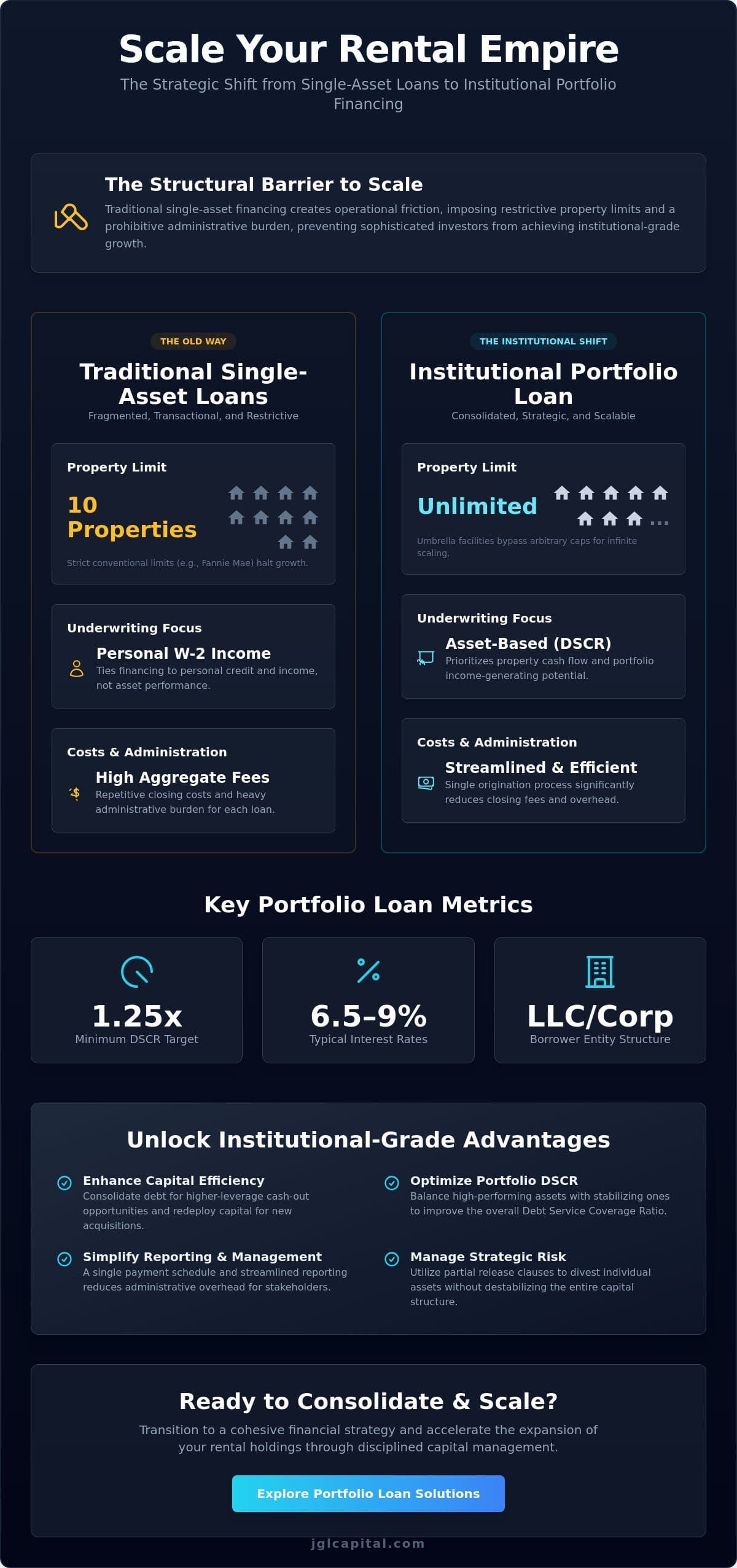
The traditional method of financing rental assets on an individual basis often functions as the primary structural barrier preventing a sophisticated investor from achieving institutional-grade scale. You likely understand the operational friction inherent in managing disparate lending relationships and the prohibitive administrative burden of fragmented payment schedules, particularly as conventional institutions enforce strict limitations on the total number of financed properties. Transitioning to a portfolio loan for multiple rental properties represents a fundamental shift from transactional management to a cohesive financial strategy. This institutional facility enables the consolidation of existing debt into a single, streamlined capital structure, effectively optimizing your capital allocation while mitigating the high aggregate closing costs typically associated with individual refinances.
You’ll discover how these sophisticated instruments improve the Debt Service Coverage Ratio at the portfolio level and simplify reporting requirements for high-net-worth stakeholders. This analysis details the strategic advantages of portfolio consolidation, providing a roadmap for those seeking to accelerate the expansion of their rental holdings through disciplined, analytical capital management. We will examine the specific mechanics of these facilities, which often offer interest rates ranging from 6.5% to 9%, and how they align with the objectives of long-term wealth preservation.
Key Takeaways
- Transition from fragmented, single-asset lending to institutional-grade umbrella facilities that bypass the restrictive property limits of traditional financing.
- Enhance capital efficiency by consolidating debt into a single origination process, significantly reducing aggregate closing fees and administrative overhead.
- Optimize the Debt Service Coverage Ratio (DSCR) across your entire holdings by balancing high-performing assets with stable, long-term investments.
- Understand the rigorous analytical standards and valuation protocols required to secure a portfolio loan for multiple rental properties.
- Manage strategic risk through the effective use of partial release clauses, ensuring the flexibility to divest individual assets without destabilizing the broader capital structure.
The Mechanics of Portfolio Loans for Multiple Rental Properties
Establishing a portfolio loan for multiple rental properties requires a departure from the retail lending mindset that characterizes early-stage residential investment. This transition from single-asset financing to institutional-grade umbrella coverage represents a maturation of the investor’s capital strategy, moving away from the restrictive caps often imposed by conventional lenders. While agencies like Fannie Mae typically limit a single borrower to ten financed properties, a portfolio facility removes these arbitrary barriers, allowing for virtually unlimited scaling. Unlike traditional mortgages that treat each property as an isolated risk, these asset-backed private capital solutions view the collective holdings as a holistic enterprise, providing a level of stability that individual properties often cannot sustain on their own.
Central to this structure is the concept of cross-collateralization, which serves as the foundational mechanism for mitigating lender risk while maximizing borrower leverage. By tying multiple properties together, the lender gains a diversified collateral base, which often results in more favorable terms than those found in the retail market. This approach recognizes that while one property may experience a temporary vacancy, the aggregate cash flow of the portfolio remains resilient. It’s a disciplined method of resource management that treats the entire collection of assets as a singular, income-producing entity rather than a series of disconnected liabilities.
Understanding Cross-Collateralization and Blanket Liens
The technical execution of this strategy relies on the deployment of a Blanket mortgage, which provides the lender with a comprehensive claim across the entire asset pool. This holistic security model ensures that the equity in high-performing properties can effectively support the leverage on newer or stabilizing acquisitions. A blanket lien is a legal instrument covering multiple parcels of real estate under one debt obligation. By utilizing this instrument, investors can avoid the repetitive documentation and fragmented closing costs that define the conventional refinance process, creating a more streamlined path to liquidity and long-term capital preservation.
The Shift from Personal Credit to Asset-Based Underwriting
In the contemporary 2026 lending environment, institutional facilities prioritize the income-generating potential of the real estate over the borrower’s personal W-2 income. This asset-based approach focuses heavily on the Debt Service Coverage Ratio (DSCR), with many lenders seeking a minimum ratio of 1.25x for multifamily assets to ensure robust cash flow. It’s a shift that favors professional investors who operate through structured entities. Because these loans are viewed as commercial transactions, they’re typically issued to LLCs, corporations, or trusts rather than individual owners. This alignment of objectives ensures that the financing structure reflects the professional nature of the investment, allowing for a clearer separation between personal liability and corporate growth.
The Economics of Consolidation: Analyzing ROI and Capital Efficiency
Consolidating debt through a portfolio loan for multiple rental properties serves as a catalyst for enhanced capital efficiency, transforming a collection of individual liabilities into a unified investment vehicle. This strategic shift allows sophisticated investors to move beyond the limitations of single-asset financing, where equity often remains trapped in fragmented structures. By leveraging the aggregate value of the portfolio, you can access higher-leverage cash-out refinancing opportunities that would be unattainable under traditional underwriting. These funds can then be redeployed into new acquisitions, accelerating the scaling of your holdings without the friction of multiple separate applications.
The true power of this model lies in its ability to optimize the Debt Service Coverage Ratio (DSCR) at a global level. In the current 2026 lending climate, where lenders typically require a minimum DSCR of 1.25x for multifamily assets, a portfolio facility provides a significant tactical advantage. High-performing assets with robust cash flows can effectively subsidize lower-yielding properties that may be in a stabilization phase. This balancing act ensures that the entire facility maintains institutional compliance, unlocking capital that would otherwise be restricted by the performance of a single underperforming unit.
Portfolio-Level DSCR: A Strategic Advantage
Calculating a “Global DSCR” allows for a more nuanced assessment of risk and performance. While a single property might fluctuate due to localized market conditions, the collective performance of the portfolio remains steady. Integrating interest-only payment structures further enhances this strategy by maximizing monthly liquidity. This liquidity is essential for maintaining the disciplined stewardship of your assets and ensuring that capital is always positioned for its highest and best use. Effective portfolio loan risk management requires this level of analytical rigor to protect value across various market cycles.
Transactional Cost Mitigation
From a purely transactional perspective, the mitigation of redundant costs is substantial. When managing ten individual properties, an investor faces ten separate appraisal fees, ten legal reviews, and ten sets of title insurance premiums. A consolidated facility eliminates this duplication, concentrating these expenses into a single origination event. This streamlined approach doesn’t just reduce immediate closing costs; it simplifies the long-term administrative burden of debt service to a single monthly remittance. For those managing complex holdings, utilizing structured rental property loans through a single facility ensures that every dollar of capital is working toward the generation of worth rather than being consumed by administrative friction.
Underwriting Standards for Institutional Portfolio Facilities
Accessing a portfolio loan for multiple rental properties requires a transition toward institutional due diligence, where the focus moves from personal solvency to the verifiable performance of the underlying assets. Institutional capital providers typically establish minimum entry thresholds, often requiring a pool of at least five properties or a total facility size that justifies the analytical overhead of the origination process. This rigorous evaluation involves a forensic review of rent rolls and historical operating statements to ensure that the projected cash flow is grounded in market reality rather than speculative growth. Unlike the binary approval process of retail banking, institutional underwriting is a nuanced assessment of risk, where the alignment of the investor’s strategy and the quality of the collateral determines the final terms.
In high-stakes financing, the distinction between recourse and non-recourse debt becomes a critical strategic consideration for the preservation of value. While recourse loans may offer slightly more aggressive pricing, non-recourse options provide a layer of asset protection by limiting the lender’s recovery to the collateral itself. This preference is common among sophisticated partners focused on building lasting legacies. Underwriters also scrutinize the liquidity of the borrower, frequently requiring at least six months of mortgage payments in cash reserves to ensure the portfolio can withstand temporary market volatility or unexpected capital expenditures.
Documentation and Entity Requirements
The application process demands a high level of organizational transparency, beginning with the Schedule of Real Estate Owned (SREO). This document serves as the central ledger for the underwriting team, detailing the acquisition dates, current valuations, and debt structures of all holdings. Because these facilities are commercial in nature, lenders require clean operating agreements and comprehensive organizational charts for any LLC or trust involved. Professional management experience is also a significant factor; underwriters often show greater confidence in portfolios managed by third-party firms or dedicated internal teams with a documented history of maintaining low vacancy rates and efficient expense ratios.
Property Type and Geographical Diversification
Institutional facilities offer the flexibility to include a diverse mix of assets, including single-family rentals, 2-4 unit properties, and larger multi-family buildings. This geographical and structural spread can actually lower the risk profile in the eyes of a lender. While a concentration in a single market might expose the facility to localized economic downturns, a diversified portfolio across various states can secure more competitive interest rates. Lenders typically enforce a minimum valuation threshold per door to maintain the institutional quality of the pool, ensuring that every asset contributes meaningfully to the collective worth of the facility. Credit requirements remain disciplined, with minimum scores typically residing in the mid-600s, though a score of 700 or higher often unlocks the most favorable capital structures.
Strategic Risk Management: Navigating Cross-Collateralization
While the consolidation of debt offers undeniable administrative advantages, the primary objection from cautious investors often centers on the perceived risk of cross-collateralization. The concern is that the underperformance of a single asset might destabilize the entire facility, potentially triggering technical defaults or restrictive covenants across the broader pool. This perspective, however, fails to account for the institutional-grade safeguards built into modern financing structures. A portfolio loan for multiple rental properties is designed with these contingencies in mind, utilizing the collective strength of the diversified holdings to absorb localized shocks that might otherwise devastate a single-asset mortgage.
Managing this risk requires a disciplined approach to oversight and a clear understanding of the legal mechanisms that govern the facility. By treating the portfolio as a singular economic unit, you can leverage the surplus cash flow from stabilized properties to support those undergoing renovation or tenant transitions. This structural resilience is a hallmark of professional resource management, ensuring that the alignment of objectives between the borrower and the lender remains intact even during periods of market volatility.
Asset Liquidity and Partial Release Clauses
A sophisticated facility must maintain liquidity, allowing for the strategic disposition of assets without the necessity of refinancing the entire pool. This is achieved through the inclusion of partial release clauses, which specify a predetermined “release price” for each property, typically calculated as 110% to 120% of its allocated loan balance. By paying down this specific portion of the principal, an investor can remove the lien from a single parcel while the remaining debt continues under the original terms. It’s essential, however, to ensure that the remaining assets continue to meet the facility’s LTV and DSCR covenants after the sale, a process that requires meticulous forensic accounting and proactive communication with your capital partner.
The Disciplined Steward Approach to Debt
Adopting the persona of a disciplined steward means viewing these financial instruments as tools for long-term wealth preservation rather than speculative instruments. Maintaining substantial cash reserves, often equivalent to six months of global debt service, is not merely a lender requirement; it’s a core philosophy for those focused on the generation of lasting worth. A portfolio loan requires a holistic view of risk where the strength of the collective outweighs the volatility of the individual. This balanced approach allows for the steady expansion of your holdings while protecting the core integrity of your capital structure. For those prepared to implement this level of strategic oversight, exploring institutional rental property loans from JGL Capital LLC provides the necessary framework for sustainable growth.
Implementation: Integrating Portfolio Loans into Your Growth Strategy
The final phase of a sophisticated capital strategy involves a transition from theoretical analysis to the methodical execution of debt consolidation. Integrating a portfolio loan for multiple rental properties into your growth model requires a comprehensive audit of your current capital stack to identify where equity is stagnant or where fragmented debt terms are obstructing operational efficiency. This implementation process isn’t merely an administrative task; it’s a strategic realignment that bridges the gap between the emerging investor and the institutional player. By identifying assets with high equity positions or those burdened by restrictive retail banking covenants, you can unlock the liquidity necessary to fund your next phase of expansion.
Successfully navigating this transition requires a step-by-step approach that begins with the forensic verification of your portfolio’s collective performance. You’ll need to aggregate your historical operating statements and rent rolls into a unified reporting format that reflects the analytical rigor expected by institutional capital providers. This level of preparation ensures that the transition from disparate mortgages to a unified facility is seamless, minimizing the friction that often accompanies large-scale refinancing. It’s a disciplined path toward achieving a more resilient and scalable financial architecture.
The Role of the Strategic Broker
Selecting a partner who understands the nuances of private capital and institutional brokerage is paramount to the success of your consolidation. JGL Capital LLC leverages thirty years of expertise to source the most competitive institutional capital, focusing on the alignment of objectives between the investor and the lender. A strategic partner prioritizes the income-generating potential of your properties over personal financial history, recognizing that professional real estate management is a business enterprise rather than a personal liability. This expertise allows for the customization of loan terms that specifically support your long-term strategic objectives, ensuring that your capital structure remains a catalyst for growth rather than a constraint.
Scaling Through Strategic Refinancing
A unified portfolio structure provides the ideal framework for implementing the “BRRRR” (Buy, Rehab, Rent, Refinance, Repeat) method at an institutional scale. Instead of refinancing individual assets, you can utilize the consolidated equity across your holdings to extract capital for new construction or multi-family acquisitions. This method allows for the continuous recycling of capital into higher-yielding opportunities, effectively accelerating your ability to build a lasting legacy. As your portfolio matures, the transition into larger asset classes becomes the logical next step in your evolution. You may explore our guide on Commercial Real Estate Loans to understand how to allocate this extracted capital into more complex property types. To begin this transition, Consult with the experts at JGL Capital LLC to optimize your rental portfolio financing.
Scaling Your Vision Through Institutional Capital Alignment
The transition to a sophisticated capital structure marks the defining moment when an investor moves beyond transactional management and into the realm of institutional-grade enterprise. By consolidating fragmented debt into a singular facility, you effectively eliminate the administrative friction that inhibits growth while optimizing your global Debt Service Coverage Ratio across the entire pool. Implementing a portfolio loan for multiple rental properties represents the final step in transforming a collection of individual assets into a cohesive, income-generating legacy. This strategic realignment ensures that your capital allocation remains disciplined, allowing you to focus on the long-term generation of worth rather than the complexities of managing disparate lending relationships.
With over 30 years of industry expertise, JGL Capital LLC provides the specialized asset-based underwriting and access to nationwide institutional capital networks required to navigate today’s high-stakes market. Our commitment to stability and analytical rigor ensures that your strategic objectives are always prioritized in every customized solution we deliver. It’s time to move beyond the limitations of traditional finance and embrace a partnership grounded in timeless principles and proven performance. Secure Strategic Capital for Your Portfolio via JGL Capital LLC and establish a capital foundation that supports your vision for decades to come.
Frequently Asked Questions
What is the minimum number of properties required for a portfolio loan?
Institutional lenders typically require a minimum of five residential units to justify the analytical and administrative overhead of a portfolio loan for multiple rental properties. Some facilities may instead establish a minimum aggregate loan amount, often starting at $500,000, to ensure the pool of assets aligns with institutional capital requirements. This threshold ensures that the facility achieves the necessary scale to provide meaningful debt consolidation and capital efficiency benefits.
How does a portfolio loan differ from a traditional commercial blanket mortgage?
A portfolio loan refers to a debt instrument held on the lender’s own balance sheet rather than being sold into the secondary market, while a commercial blanket mortgage specifically describes the legal lien structure covering multiple properties. In professional practice, these terms are often used interchangeably within private capital markets. Both facilities utilize cross-collateralization to unify disparate assets under a single, cohesive debt obligation, although institutional portfolio loans often offer more sophisticated partial release clauses.
Can I include different property types, such as SFRs and multi-family units, in one loan?
You can integrate a diverse mix of asset classes, including single-family rentals (SFR), 2-4 unit properties, and larger multi-family buildings, into a single unified facility. Institutional lenders value the risk mitigation provided by structural and geographical diversification across the United States. This flexibility allows for the comprehensive consolidation of your entire real estate enterprise regardless of the individual building configurations within the holdings.
Is personal income verification required for a portfolio rental loan?
Personal income verification, such as W-2 documentation or debt-to-income (DTI) analysis, is typically not required for asset-based portfolio loans. The underwriting process prioritizes the property’s income-generating potential and the Debt Service Coverage Ratio (DSCR) over the borrower’s individual earnings. This approach allows professional investors to qualify based on the performance of their holdings rather than their personal financial history, aligning the debt with the business entity.
What happens if I want to sell one of the properties in the portfolio?
Selling an individual asset within the pool is managed through a partial release clause, which allows for the disposition of a property without the necessity of refinancing the entire facility. This mechanism typically requires a release price payment, often set at 110% to 120% of the property’s allocated loan balance. It ensures the remaining portfolio maintains its required Loan-to-Value and DSCR covenants while providing the investor with necessary exit flexibility for capital recycling.
Are portfolio loans typically recourse or non-recourse?
Portfolio facilities are available in both recourse and non-recourse structures, with the choice often depending on the total loan size and the borrower’s specific risk management strategy. Non-recourse options are highly favored by high-net-worth stakeholders as they limit the lender’s recovery to the collateral itself, effectively protecting personal assets from liability. Recourse debt may offer slightly more aggressive interest rates but requires a personal guarantee for the full debt obligation of the portfolio.
How is the DSCR calculated for a portfolio of multiple rental properties?
The Debt Service Coverage Ratio for a portfolio loan for multiple rental properties is calculated as a “Global DSCR,” which aggregates the Net Operating Income (NOI) of all properties and divides it by the total annual debt service. This holistic calculation allows high-performing assets to compensate for properties that may be in a stabilization phase or experiencing temporary vacancies. Lenders in the 2026 market typically seek a minimum Global DSCR of 1.25x for stabilized institutional portfolios.
What are the typical LTV limits for a rental portfolio refinance?
Typical Loan-to-Value (LTV) limits for a rental portfolio refinance generally range from 75% to 80% of the aggregate appraised value of the properties. These limits ensure that the facility remains well-collateralized while providing the investor with significant equity extraction for future strategic acquisitions. Underwriting standards remain disciplined; therefore, the highest LTV ratios are often reserved for portfolios with a documented history of strong performance and professional management oversight.