

While traditional financial institutions increasingly retreat into rigid, credit-centric silos, the most agile real estate portfolios in 2026 are scaled through the strategic deployment of private credit and a clear understanding of hard money loan requirements. You’ve likely experienced the frustration of watching a time-sensitive acquisition dissolve because a conventional lender’s underwriting cycle couldn’t match the speed of the market. It’s clear that the primary hurdle for sophisticated investors isn’t a lack of opportunity, but rather the onerous and often opaque nature of standard banking protocols.
This analysis offers a comprehensive breakdown of asset-backed benchmarks, reframing private capital as a high-performance tool for disciplined asset management rather than a mere subprime fallback. We’ll explore the critical parameters of loan-to-value ratios, the significance of property-specific performance metrics, and the precise documentation needed to establish a stable partnership with a private capital steward. By prioritizing the intrinsic value of the asset over personal credit history, you’ll gain a clear roadmap to securing the expedited financing required to execute complex, high-stakes real estate strategies with absolute confidence.
Key Takeaways
- Understand the fundamental transition from traditional credit-dependent underwriting to collateral-centric valuation models that prioritize property potential and asset quality.
- Master the technical frameworks of private credit, including LTV and ARV, to navigate modern hard money loan requirements with institutional precision.
- Evaluate the critical trade-off between the cost of capital and the speed of execution to successfully secure time-sensitive acquisitions in a competitive market.
- Identify the essential criteria for selecting stable, national-scale capital partners who offer certainty of execution and a disciplined approach to value preservation.
- Learn to align strategic investment objectives with bespoke financing solutions designed to facilitate long-term growth through professional asset management.
The Evolution of Hard Money Lending: Defining Private Capital in 2026
In the current 2026 fiscal environment, sophisticated real estate investors increasingly view private capital as a high-performance tool for capital allocation rather than a subprime alternative. A hard money loan serves as a short-term, asset-backed bridge, facilitating either a transition to permanent financing or a strategic divestment of the asset. Unlike traditional banking, which remains tethered to borrower-centric metrics, the evolution of private credit has shifted the focus toward collateral-based valuation. This transition allows for a more precise alignment of capital with property potential, ensuring that the intrinsic worth of the real estate remains the primary driver of the transaction.
Maintaining liquidity is paramount for institutional-grade investors who prioritize the preservation of value across diverse portfolios. By adhering to specific hard money loan requirements, these stakeholders can ensure high capital velocity, allowing them to capture market inefficiencies that traditional funding cycles would otherwise miss. This disciplined approach to resource management defines the role of private credit in the current real estate landscape, where speed and certainty of execution are often more valuable than the marginal cost of capital.
The Mechanism of Asset-Backed Financing
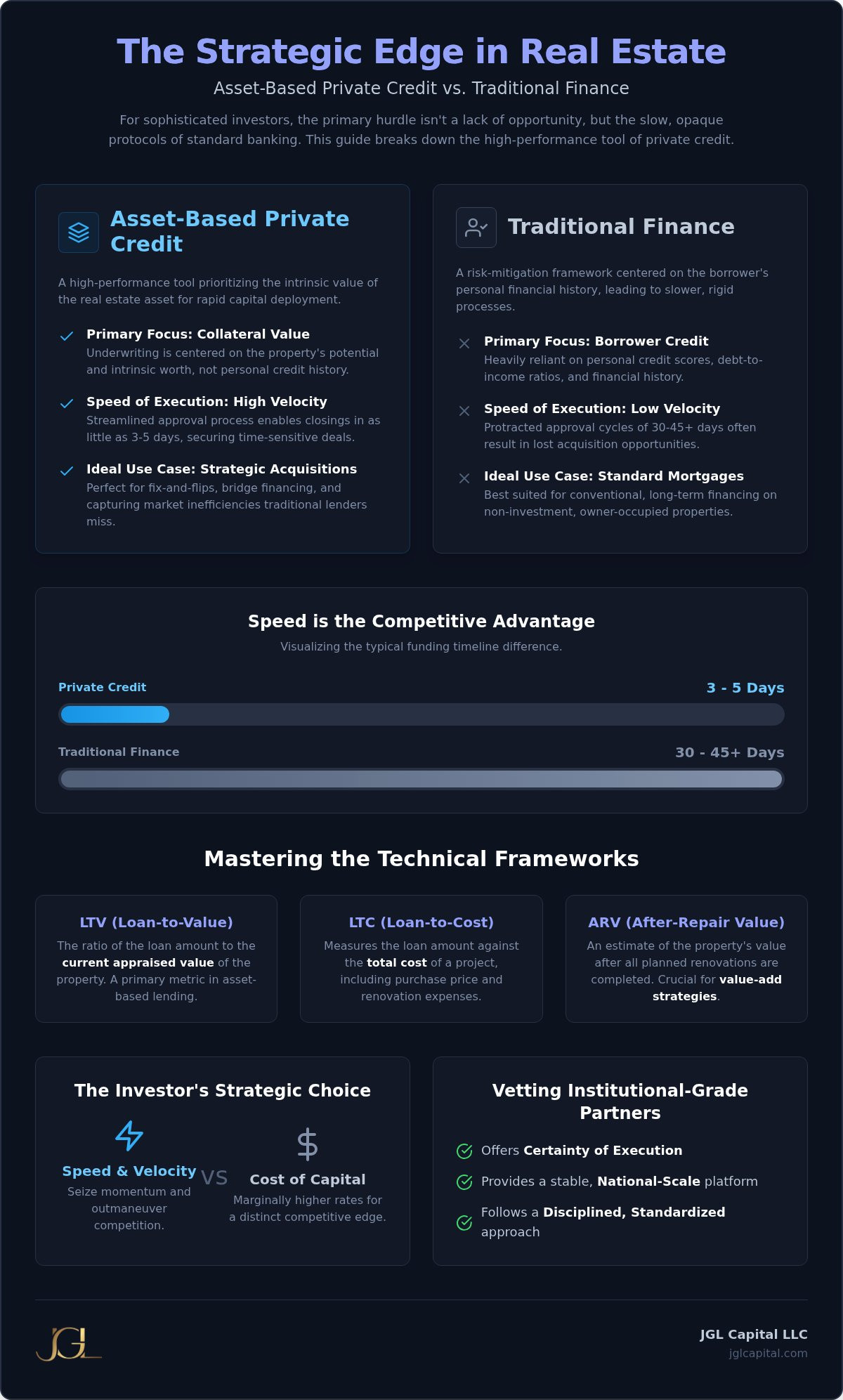
The underlying property value acts as the primary security for the debt, mitigating risk through tangible asset quality rather than the borrower’s personal financial history. This structure enables a streamlined approval process, often completing in as little as three to five days. Such efficiency stands in stark contrast to the month-long bureaucratic delays common in traditional institutions. A robust exit strategy remains a cornerstone of these agreements, ensuring that both the lender and the borrower have a clearly defined path toward the fulfillment of their strategic objectives.
Hard Money vs. Private Money: Nuances in the National Market
Distinguishing between institutional-grade private credit and individual hard money sources is essential for sophisticated partners seeking stability. While individual lenders might offer flexibility, institutional partners provide a national scope and a standardized set of protocols that mirror the rigor of traditional finance without its inherent friction. These loans are specifically designed for non-owner-occupied investment projects, operating within a regulatory framework that prioritizes commercial utility and performance metrics. The movement toward standardized institutional-grade private credit ensures that hard money loan requirements remain predictable and transparent for high-net-worth stakeholders, fostering a collaborative environment grounded in analytical rigor.
The Strategic Dichotomy: Asset-Based Lending vs. Traditional Institutional Finance
The decision to utilize private credit over traditional institutional finance represents a fundamental strategic choice between capital preservation and capital velocity. While conventional banks operate within a framework of risk mitigation centered on the borrower’s personal financial history, private capital prioritizes the intrinsic and future potential of the real estate asset. This shift in focus is a defining characteristic of hard money in real estate investing, where the rigor of property analysis replaces the bureaucratic inertia of traditional debt-to-income audits.
Within this framework, hard money loan requirements are designed to facilitate rapid decision-making, allowing investors to secure high-value opportunities that would otherwise be lost during a protracted bank approval cycle. The trade-off is clear; while the cost of capital may be higher than a standard mortgage, the speed of execution provides a distinct competitive advantage in national markets. It’s a choice that reflects a commitment to seizing momentum rather than succumbing to the friction of traditional underwriting.
Speed as a Competitive Advantage
Institutional private lenders typically operate on a five-to-ten-day funding cycle, a timeline that traditional institutions simply can’t match. This expedited liquidity transforms a developer’s offer into a cash-equivalent position, significantly strengthening their negotiating power with sellers in competitive environments. By bypassing the rigid income verification and DTI constraints that define traditional lending, sophisticated investors can maintain a high pace of acquisition. Those seeking a disciplined partner for rapid funding find that these streamlined protocols are essential for maintaining market relevance.
Flexibility in Complex Real Estate Scenarios
Traditional banks often refuse to fund distressed assets or projects requiring significant stabilization, viewing them as outside their regulatory risk appetite. Conversely, private credit is uniquely structured to handle these complexities, offering commercial real estate loans that accommodate rapid transitional periods. This flexibility extends to the ability to cross-collateralize multiple properties within a single portfolio, allowing for increased leverage without the need for additional liquid reserves. Such strategic maneuvers are central to modern hard money loan requirements, enabling investors to navigate distressed acquisitions and value-add projects with a level of precision that rigid bank guidelines cannot support.
Technical Frameworks of Private Credit: Understanding LTV, LTC, and ARV
Analyzing the technical architecture of a private loan requires a deep understanding of the metrics that define risk and capital allocation. The primary hard money loan requirements center on three fundamental ratios: Loan-to-Value (LTV), Loan-to-Cost (LTC), and After-Repair Value (ARV). Each serves a specific function in the underwriting process. They ensure the capital deployed remains protected by a sufficient equity buffer. While traditional lenders focus on debt-coverage ratios, private credit stewards prioritize these asset-based benchmarks to gauge the safety of the principal.
For renovation or value-add projects, the ARV is the most critical metric. Lenders determine this value by analyzing comparable properties that have already undergone similar improvements. This analysis is combined with a rigorous review of the borrower’s proposed scope of work. It’s not a speculative figure. It’s a calculated projection of the property’s market worth upon completion of the strategic plan. This forward-looking valuation allows for higher funding amounts than what the property’s current distressed state would justify.
Leverage Ratios and Capital Requirements
LTV typically caps at 70% to 75% of the current appraised value, though high-performance investors may secure up to 80% for stabilized assets. This requirement ensures the borrower maintains “skin in the game”, a principle that aligns the interests of the capital partner with the project’s success. Private credit maintains these caps to preserve the integrity of the asset-backed model. Experienced developers with a proven history of successful exits can often negotiate these thresholds. They use their intellectual capital as a form of secondary security.
The Financial Structure of a Hard Money Deal
Interest-only payments are the standard in private lending. This allows investors to maximize cash flow during the transitional period. This structure is particularly vital in new construction loans, where the focus is on the eventual sale or refinance rather than immediate amortization. LTC measures the loan amount against the total cost of the project, providing an accurate reflection of risk in ground-up developments. Origination fees, commonly referred to as points, are paid at closing and influence the overall cost of capital. Navigating hard money lending regulations is equally important, as institutional-grade lenders must adhere to specific licensing and disclosure standards. Understanding these hard money loan requirements ensures that the financial structure of the deal remains transparent and predictable.
Methodology for Vetting Institutional-Grade Private Money Partners
Selecting a capital partner requires a methodology rooted in the evaluation of institutional stability and long-term alignment. While many transactional vendors prioritize volume, a disciplined steward of private credit focuses on the preservation of value and the successful realization of the investor’s vision. For those navigating modern hard money loan requirements, the primary objective should be identifying a partner with a national scope and an established history of performance. This level of institutional rigor ensures that the capital remains stable even during periods of market volatility, providing a secure foundation for high-stakes real estate management.
Investors often fall into the trap of pursuing the lowest possible interest rate, only to find that the lender lacks the capacity to fund at the critical moment of acquisition. Certainty of execution is the true metric of a lender’s worth. A partner with over 30 years of industry expertise possesses the intellectual capital to manage complex underwriting scenarios that would stifle less experienced organizations. This depth of history ensures that the capital is not only available but also deployed with a precision that reflects a deep understanding of market cycles. It’s the difference between a simple service provider and a collaborative ally invested in your long-term growth.
Assessing Credibility and Stability
Institutional-grade partners demonstrate their stability through a transparent track record in funding multi-family and commercial projects across diverse jurisdictions. Vetting must include a rigorous review of the term sheet to ensure the absence of ambiguous junk fees that erode project margins. A stable partner also provides the assurance of follow-on funding, allowing for the seamless execution of subsequent project phases without the friction of re-establishing a new capital relationship. This continuity is essential for developers who value the creation of lasting legacies through careful, deliberate action.
The Role of a Specialized Broker
A specialized broker acts as a strategic ally, navigating a vast network of capital sources to secure the optimal bridge loan structure for transitional assets. This role goes beyond simple facilitation; it involves a consultative approach to aligning debt structures with the investor’s long-term objectives. By understanding the nuances of hard money loan requirements across national markets, an experienced broker provides a layer of protection and strategic insight that transactional lenders cannot replicate. Investors seeking to build worth through disciplined capital allocation should consult with a seasoned private money advisor at JGL Capital LLC to ensure their financing strategy is as robust as their acquisition targets.
JGL Capital LLC: Bespoke Financing and Strategic Loan Origination
JGL Capital LLC operates as a disciplined steward within the private credit landscape, providing the institutional-grade expertise required for high-stakes real estate management. Unlike transactional entities that prioritize volume over value, our firm functions as a strategic ally, focusing on the generation of long-term worth through meticulous capital allocation. By aligning our objectives with those of sophisticated investors, we offer a stable platform for complex acquisitions, ranging from specialized fix-and-flip projects to large-scale multi-family and new construction developments. Our commitment extends beyond simple lending; we strive to build lasting legacies by providing the reliable capital necessary for visionary projects to reach fruition.
Understanding the nuances of hard money loan requirements is only the first step. Executing a financing strategy requires a partner who values precision and integrity above all else. JGL Capital LLC provides this stability, ensuring that every strategic objective is met with a customized solution that reflects the unique requirements of the asset and the investor. Our approach is grounded in analytical rigor, rejecting speculative trends in favor of timeless principles that have defined our firm’s thirty-year history in the national market. We recognize that the ability to navigate hard money loan requirements with institutional speed is a prerequisite for any high-performance real estate portfolio.
A Disciplined Approach to Asset-Based Lending
The firm’s methodology prioritizes the intrinsic value of the property and the overall viability of the project over the restrictive personal credit metrics favored by traditional banks. This focus on the asset allows for a streamlined alternative to conventional financing, effectively minimizing bureaucratic delays that often result in missed opportunities. With over thirty years of experience as industry veterans, the team at JGL Capital LLC possesses the intellectual capital to navigate intricate underwriting challenges with a level of sophistication that ensures certainty of execution. We don’t just provide capital; we provide the strategic framework for its optimal deployment, ensuring that every bridge or construction loan is structured for success.
Securing Your Next Acquisition
We invite sophisticated partners to explore our suite of customized financing solutions, tailored for both residential and commercial assets across the nation. Whether you’re managing a transitional bridge phase or a ground-up development, our team provides the rapid term sheets necessary to maintain momentum in time-sensitive environments. This efficiency doesn’t come at the cost of precision. Every deal undergoes a thorough analysis to ensure it aligns with our standards of disciplined management and value preservation. Engage with the strategic experts at JGL Capital LLC for your next capital requirement.
Mastering Capital Velocity in the Modern Real Estate Landscape
The transition from traditional, credit-dependent financing to an asset-centric model is a hallmark of sophisticated real estate management. By prioritizing property performance and technical metrics like LTV and ARV, investors bypass the friction of conventional banking to capture time-sensitive opportunities. Navigating modern hard money loan requirements with a disciplined partner ensures that your capital remains stable and your execution remains certain across national commercial and residential markets.
Success in high-stakes acquisition doesn’t just require a source of funds; it demands a strategic alliance with a steward who understands the gravity of long-term value preservation. With over 30 years of industry expertise and a dedicated asset-backed funding focus, JGL Capital LLC provides the intellectual capital and national reach necessary to scale your portfolio with absolute confidence. We invite you to Secure Institutional-Grade Funding with JGL Capital LLC and establish a relationship grounded in analytical rigor and professional integrity. Your next strategic acquisition deserves the stability of a seasoned expert.
Frequently Asked Questions
What is a hard money loan and how does it differ from a traditional mortgage?
A hard money loan is a short-term, collateralized debt instrument secured by real estate, differing from traditional mortgages by prioritizing asset value over borrower creditworthiness. While banks focus on personal debt-to-income ratios, private capital stewards evaluate the property’s intrinsic worth and the viability of the investor’s exit strategy. This distinction allows for the rapid funding of transitional assets that don’t satisfy conventional institutional standards.
How much do hard money loan lenders typically charge in interest and fees?
Interest rates for these instruments generally range from 10% to 18%, reflecting the increased risk and speed of private capital allocation. Borrowers should also anticipate origination fees, commonly referred to as points, which typically range from 1% to 3% of the total loan amount. These costs are a function of the loan-to-value ratio and the specific complexity of the underlying real estate project.
Can I get a hard money loan with a low credit score or no income verification?
You can secure financing with a lower credit score or minimal income verification because the primary underwriting criterion is the property’s value. While a score of 700 or higher often results in more favorable terms, many lenders prioritize the after-repair value and the borrower’s equity position. This asset-based focus is a core component of modern hard money loan requirements, designed to facilitate opportunity capture for disciplined investors.
What are the typical terms and repayment structures for hard money loans in 2026?
Repayment structures are typically characterized by interest-only payments over a term of six months to three years, concluding with a final balloon payment. This framework is designed to maximize cash flow during the project’s development or stabilization phase. It’s a strategic bridge that allows for the eventual transition to long-term financing or the total divestment of the asset upon completion of the investment plan.
How much of a down payment is required for an asset-backed private loan?
Lenders typically require a down payment ranging from 25% to 40% of the property’s purchase price or appraised value. This equity requirement ensures that the borrower maintains a significant stake in the project’s success, aligning the interests of the investor with those of the capital partner. For highly experienced developers with a proven history of successful exits, some institutional-grade lenders might offer more aggressive leverage options.
What happens if I cannot repay a hard money loan within the short term?
Failure to repay the principal within the agreed term may lead to foreclosure proceedings, as the property itself serves as the primary security for the debt. In some instances, a lender may offer a term extension in exchange for additional fees if the project’s progress demonstrates continued viability. It’s essential to maintain transparent communication with your capital steward to navigate unforeseen delays in the exit strategy.
Is hard money lending regulated on a national level for investment properties?
Hard money lending is subject to a complex framework of state and federal regulations, though non-owner-occupied investment loans are exempt from many consumer protection laws. These regulations primarily focus on licensing requirements and disclosure standards to ensure transparency in private credit markets. Understanding these hard money loan requirements and legal benchmarks is essential for maintaining institutional stability and protecting the interests of all stakeholders.
How quickly can a hard money lender fund a commercial real estate deal?
A primary advantage of private credit is the ability to fund a commercial real estate deal in as little as three to five days. This expedited cycle is possible because the underwriting process focuses on collateral quality rather than the exhaustive personal audits required by traditional banks. This speed is a critical factor for investors who need to execute time-sensitive acquisitions in competitive national markets.