

In the institutional real estate market of 2026, the traditional distinction between capital and opportunity has effectively dissolved. Liquidity is no longer merely a tool for execution; it has become the primary determinant of competitive advantage in an era defined by compressed acquisition windows. Most professional investors have experienced the frustration of a viable transaction collapsing because of the rigid, bureaucratic delays inherent in conventional banking. When a high-stakes deal requires immediate action, the absence of a reliable mechanism for funding for time-sensitive real estate deals doesn’t just represent a missed acquisition, it represents a failure of strategic positioning.
You’ve likely found that inflexible underwriting and a lack of transparency in private markets often complicate what should be a straightforward deployment of capital. This article provides a sophisticated analysis of how disciplined investors secure asset-backed funding within days rather than months. We’ll explore the transition toward certainty in execution and how aligning with a seasoned, strategic partner who acts as a disciplined steward of capital allows you to navigate complex acquisitions without the typical friction of traditional finance. By the end of this discussion, you’ll understand the precise methodologies required to preserve value through rapid, deliberate capital deployment.
Key Takeaways
- Understand how rapid liquidity serves as a tactical instrument to negotiate more favorable purchase terms and secure a competitive advantage in compressed acquisition windows.
- Learn how transitioning to asset-centric risk assessments prioritizes property value over personal credit metrics, effectively minimizing administrative delays and traditional banking friction.
- Evaluate specific mechanisms for funding for time-sensitive real estate deals, such as bridge loans and new construction financing, to execute complex acquisitions with absolute certainty.
- Identify the methodical framework required to prepare property documentation and establish transparent communication channels for an accelerated underwriting review cycle.
- Recognize the strategic value of aligning with a disciplined steward of capital that possesses over thirty years of expertise in navigating the intricacies of high-stakes commercial transactions.
The Strategic Role of Speed in Modern Capital Allocation
In the high-stakes environment of institutional real estate, the dimension of speed has evolved from a secondary operational metric into a primary tactical instrument for value preservation. Professional investors recognize that the ability to secure funding for time-sensitive real estate deals is the cornerstone of a sophisticated acquisition strategy, particularly as the market dynamics of 2026 demand unprecedented agility. Rapid liquidity does more than facilitate a transaction; it serves as a powerful lever during the negotiation of purchase terms, often providing the necessary leverage to secure assets at a valuation that reflects the seller’s need for transactional certainty. In a landscape where acquisition windows are increasingly compressed, the capacity for immediate capital deployment is the defining characteristic of a market leader.
The Opportunity Cost of Delayed Financing
Defining Transitional Capital in 2026
Defining transitional capital in 2026 requires an understanding of the core philosophies that prioritize asset integrity over individual credit metrics. Sophisticated stewards of capital focus on the intrinsic value of the real estate, recognizing that asset-backed security provides the most reliable foundation for high-value transactions. Bridge financing functions as a critical mechanism in this regard, offering the temporary liquidity needed to stabilize an asset before transitioning to long-term debt structures. By utilizing funding for time-sensitive real estate deals, investors can maintain their momentum in competitive markets, ensuring that every strategic objective is met with precision and analytical rigor. This approach reflects a commitment to timeless principles of value creation, where the alignment of interests between the borrower and the capital provider facilitates the preservation of long-term wealth.
Asset-Backed Underwriting: A Disciplined Alternative to Conventional Lending
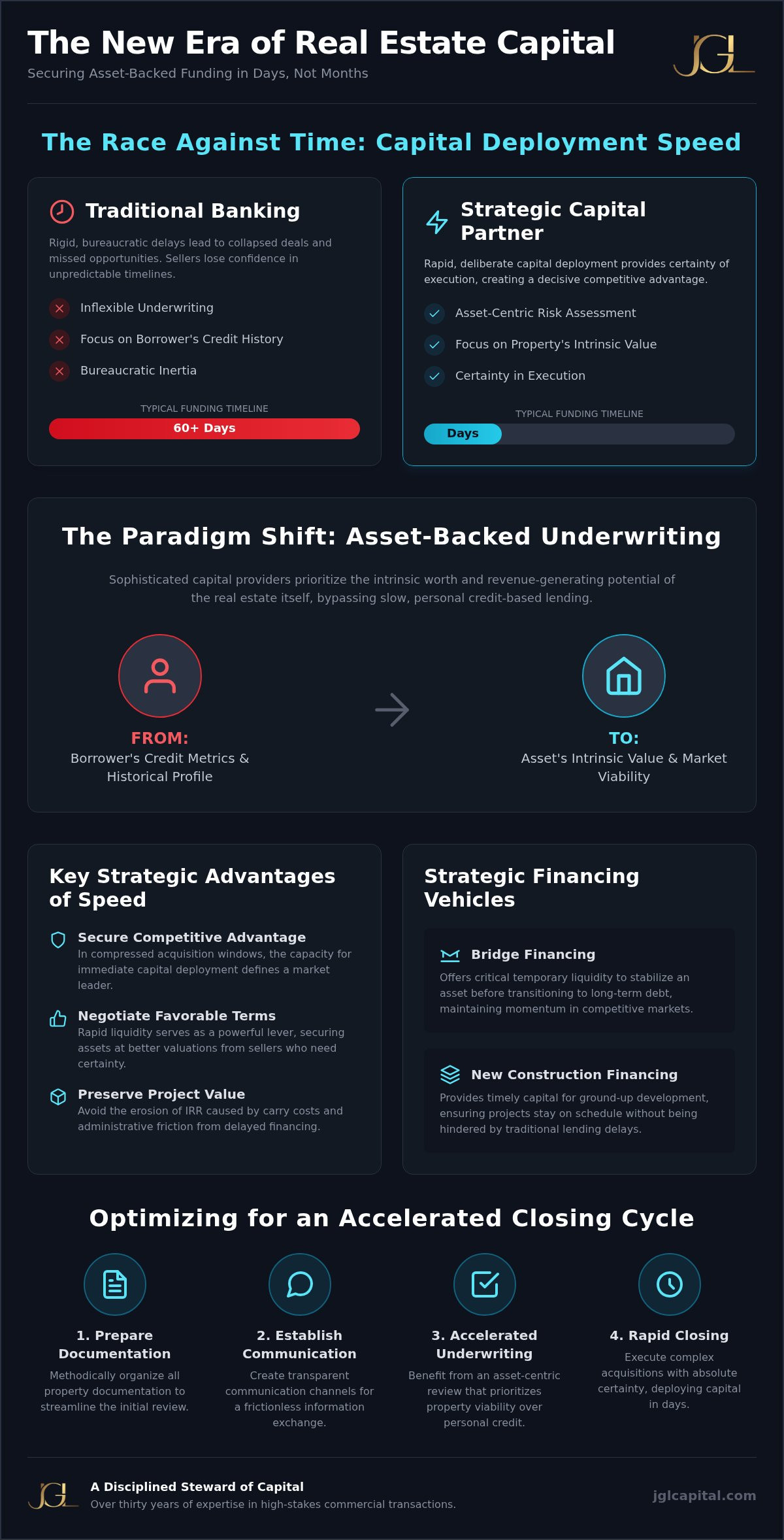
The transition toward asset-centric risk assessment represents a fundamental departure from the traditional banking model. While conventional institutions remain tethered to the borrower’s historical financial profile, sophisticated capital providers prioritize the intrinsic worth and revenue-generating potential of the real estate itself. This shift is essential for securing funding for time-sensitive real estate deals, as it bypasses the exhaustive and often redundant personal income verification processes that frequently stall institutional closures. By focusing on the property as the primary security, investors can execute high-value acquisitions with a level of certainty that personal credit-based lending simply cannot facilitate. This approach requires a high degree of analytical rigor, ensuring that every complex commercial asset is evaluated through a lens of long-term stability and market viability.
Prioritizing Property Value Over Credit Scores
The strategic potential of a project should always supersede the historical credit metrics of the borrower. In the context of 2026, the methodology for determining loan-to-value (LTV) ratios has become increasingly sophisticated, incorporating predictive analytics and real-time market data to ensure the preservation of capital. Professional hard money lenders structure these arrangements by meticulously calculating the current and stabilized value of the asset, allowing for a more accurate reflection of the risk-reward profile. This disciplined focus on the underlying collateral enables a streamlined deployment of resources, ensuring that the alignment of objectives remains centered on the asset’s performance. For those navigating high-stakes environments, establishing a strategic alliance with a seasoned broker provides the necessary intellectual capital to bridge the gap between opportunity and execution.
Streamlining the Evaluation Process
Internal review protocols are specifically designed to eliminate the administrative friction that typically characterizes the mortgage industry. By leveraging deep-seated expertise and local market knowledge, a capital partner can conduct rapid property valuations that are both precise and authoritative. This efficiency is particularly vital for national lending operations where understanding regional nuances is the key to accurate underwriting. The process is not a rejection of diligence but a refocusing of it; every claim is qualified and every strategy is defined by the asset’s tangible metrics. Asset-backed lending serves as a sophisticated mechanism for immediate liquidity that operates independently of conventional lending constraints.
Strategic Financing Vehicles for Immediate Execution
The selection of a specific financing vehicle is a strategic decision that must align with the investor’s broader mandate for value creation and asset preservation. For those seeking funding for time-sensitive real estate deals, the choice between bridge loans and fix-and-flip funding is not merely a matter of interest rates, but a calculation of how each instrument serves the project’s lifecycle. While fix-and-flip structures are tailored for rapid renovation and divestment, commercial real estate loans provide the necessary stability for larger, more complex holdings. This strategic deployment of capital ensures that the investor maintains liquidity without compromising the long-term integrity of their portfolio. Each vehicle serves as a specialized tool within a disciplined investment framework, designed to mitigate risk while maximizing the certainty of execution.
Bridge Financing vs. Private Money
Distinguishing between transitional real estate capital and permanent financing is essential for maintaining a balanced balance sheet. Bridge loans are ideally deployed when an immediate property acquisition is required to preempt a competitive bidding process, providing a temporary solution until long-term debt can be secured. In a professional context, these arrangements are defined by transparent fee structures, including points and origination costs that reflect the risk-adjusted return required by the capital steward. This transparency fosters a collaborative relationship between the borrower and the broker, ensuring that all parties are aligned regarding the cost of capital and the timeline for repayment. It’s a method that values clarity over speculative trends.
New Construction and Multi-Family Strategies
Large-scale developers facing tight deadlines require a highly customized approach to new construction loans. These projects often demand a level of sophistication that exceeds the capacity of local banks, particularly when the loan amount surpasses the $10M+ threshold. For multi-family investors, the ability to secure rapid closing is frequently the factor that determines whether a portfolio can expand into high-value urban markets or remain stagnant. Navigating these requirements demands a partner with over thirty years of expertise, capable of underwriting complex developments with the precision required to preserve investor worth. By leveraging specialized funding for time-sensitive real estate deals, developers can focus on the physical execution of the project while maintaining absolute confidence in their capital stack.
Optimizing the Underwriting Process for Rapid Closing
The efficiency of capital deployment is contingent upon the structural integrity of the borrower’s initial submission. A methodical framework for documentation doesn’t just speed up the process; it builds institutional trust between the investor and the capital provider. Professional investors seeking funding for time-sensitive real estate deals must recognize that transparent communication is the primary catalyst for accelerating the review cycle. By eliminating ambiguity in the initial disclosure, you allow the underwriter to focus on the technical merits of the asset rather than seeking clarification on basic operational details. This disciplined approach ensures that capital is deployed with the precision required to meet competitive acquisition windows.
Essential Documentation for High-Stakes Funding
To facilitate a rapid asset-backed evaluation, the submission package must be comprehensive and meticulously organized. A disciplined steward of capital requires specific documentation to validate the strategic potential of the acquisition and ensure the preservation of value. The following items are typically required for an institutional-grade review:
- Executed purchase and sale agreements with clearly defined closing dates.
- A detailed scope of work for any value-add, renovation, or construction components.
- Preliminary title reports and existing property appraisals if available.
- A clearly articulated exit strategy that outlines the transition to permanent financing or divestment.
Presenting a complex commercial project for rapid approval requires more than just raw data. It demands a narrative that aligns with the lender’s risk mitigation philosophies and demonstrates a thorough understanding of the local market. When you submit your project for review, ensure that the financial modeling reflects realistic market conditions. This level of preparation signals to the broker that the project is managed with the analytical rigor necessary for a high-value strategic alliance.
Accelerating the Timeline Through Strategic Alliance
Engaging with a private money broker early in the acquisition window transforms the relationship from a transactional service into a collaborative alliance. This partnership begins with a thorough initial inquiry where the broker assesses the deal’s alignment with specific capital sources. Following this, the review moves through an internal underwriting phase where property value remains the focal point, culminating in a final settlement at closing. This structured progression ensures that every claim is qualified and every operational strength is leveraged to meet the necessary deadlines. In 2026, the industry standard for rapid private funding requires that capital deployment occurs within five to seven business days when documentation is submitted with precision.
JGL Capital: A Strategic Ally in Real Estate Transactions
JGL Capital LLC serves as more than a source of liquidity; it functions as a discreet partner for sophisticated investors who prioritize the long-term preservation of value. In a market where speed is often misconstrued as a lack of diligence, our firm maintains a commitment to analytical rigor and disciplined capital allocation. We understand that the generation of worth isn’t a transactional event but a cumulative process of building lasting legacies. By providing reliable funding for time-sensitive real estate deals, we enable our partners to execute complex strategies with the certainty that only an established history of performance can provide. This approach ensures that every strategic objective is met with a level of precision that transcends speculative trends and short-term market noise.
The Advantage of Seasoned Expertise
Engaging with a Disciplined Steward
The philosophy that defines our organization is one of integrity and long-term growth. We don’t view our activities as simple service provision. Instead, we frame them as a form of high-level strategic alliance where our objectives are meticulously aligned with those of our high-net-worth stakeholders. This commitment to responsibility distinguishes us from transactional competitors who may prioritize volume over value. As a quiet expert, JGL Capital relies on intellectual capital and a history of successful deployments to instill confidence in our partners. If you’re preparing for an upcoming acquisition that requires funding for time-sensitive real estate deals, we invite you to explore our customized financing solutions. Initiating a strategic alliance begins with a deliberate conversation about your long-term objectives and how our asset-backed focus can serve as the foundation for your next legacy.
Advancing Your Strategic Acquisition Mandate in 2026
The capacity to deploy capital with precision remains the ultimate differentiator for the professional investor navigating the competitive windows of 2026. By prioritizing the intrinsic value of the asset and maintaining a disciplined approach to documentation, you effectively eliminate the administrative friction that characterizes traditional banking. Securing reliable funding for time-sensitive real estate deals isn’t a matter of chance; it’s the result of a deliberate alliance with a partner who understands the gravity of high-stakes management. Our firm’s established history provides the stability required to transform complex opportunities into realized value without the delays inherent in conventional underwriting.
With over thirty years of industry expertise and a specialization in $10M+ asset-backed loans, we offer the national reach and intellectual capital necessary to support your most ambitious commercial objectives across the United States. We invite you to Secure Your Strategic Capital Alliance with JGL Capital to ensure your next acquisition is met with absolute certainty of execution. The preservation of your investment legacy begins with a partner who values analytical rigor as much as you do.
Frequently Asked Questions
How quickly can funding be secured for a time-sensitive real estate deal?
Capital deployment typically occurs within five to seven business days once a comprehensive documentation package is submitted. This efficiency is achieved by prioritizing asset-backed underwriting over the exhaustive personal income verification processes that frequently cause delays in traditional institutional lending environments.
What are the primary requirements for asset-backed financing in 2026?
The primary requirements center on the intrinsic value of the property and a clearly articulated exit strategy. Underwriters focus on current and stabilized valuations, requiring executed purchase contracts and a detailed scope of work to ensure the preservation of capital throughout the project lifecycle.
Can bridge loans be utilized for large-scale commercial acquisitions?
Bridge loans serve as an ideal mechanism for large-scale commercial acquisitions that demand immediate liquidity to preempt competitive bidding. These transitional instruments provide the necessary capital to secure and stabilize high-value assets before the investor transitions to a more permanent debt structure.
What distinguishes a private money broker from a traditional retail lender?
A private money broker operates as a strategic ally, providing access to specialized capital pools that prioritize property value over the borrower’s historical financial profile. This flexibility is essential for securing funding for time-sensitive real estate deals where conventional banking syntax and bureaucratic inertia would otherwise result in missed opportunities.
Are there specific property types that qualify for rapid funding solutions?
Multi-family complexes, new construction projects, and commercial real estate assets are the primary property types that qualify for these rapid funding mechanisms. Land acquisitions and fix-and-flip projects also remain viable candidates, provided the underlying collateral demonstrates sufficient strategic potential and market viability.
How does JGL Capital approach the underwriting of $10M+ transactions?
JGL Capital utilizes a disciplined framework grounded in analytical rigor to evaluate transactions exceeding the $10M+ threshold. We focus on property-specific performance metrics and regional market dynamics, ensuring that every high-value deployment aligns with the long-term objectives of our sophisticated partners and high-net-worth stakeholders.
What fees are typically associated with sourcing private capital for real estate?
Fees associated with private capital typically include origination points and administrative costs that reflect the risk-adjusted return required for rapid execution. These costs are transparently defined within the initial strategic alliance, ensuring that the cost of capital is clearly understood before any definitive action is taken.
Is a personal credit score a limiting factor in asset-based lending?
Personal credit scores are not the primary determinant in asset-based lending because the property itself serves as the principal security for the loan. While a credit review is often part of the background diligence, it doesn’t possess the same restrictive weight found in the borrower-centric models of traditional retail banks.