

The traditional reliance on personal balance sheets for high-value acquisitions has become an archaic constraint that stifles institutional growth in an increasingly competitive market. For the sophisticated investor, securing financing for a single-tenant net lease property in 2026 requires a departure from conventional banking rigidities in favor of disciplined, asset-backed strategies. You likely recognize that the current landscape of onerous underwriting requirements and protracted closing timelines often jeopardizes the acquisition of specialized, high-quality assets. These systemic inefficiencies frequently prevent the timely execution of transactions that demand both precision and substantial capital.
This guide provides a rigorous analysis of private capital and asset-backed lending frameworks designed to navigate these complexities with the gravity they deserve. We offer a comprehensive institutional roadmap for leveraging tenant credit and intrinsic property value to achieve superior outcomes, including higher loan-to-value ratios and accelerated closing schedules. By shifting the focus away from personal income and toward the fundamental strength of the lease and the underlying real estate, we examine how sophisticated partners can secure the necessary capital for transactions exceeding the ten million dollar threshold without the typical delays of traditional institutions.
Key Takeaways
- Understand the mechanics of Credit Tenant Lease (CTL) structures and how they leverage single-occupant obligations to ensure reliable debt service.
- Learn how modern asset-backed underwriting prioritizes intrinsic real estate value and tenant credit ratings to secure competitive financing for a single-tenant net lease property.
- Discover the strategic advantages of utilizing bridge loans and new construction financing to facilitate rapid acquisitions and build-to-suit developments in the STNL sector.
- Identify institutional benchmarks for lease stability, including the critical importance of investment-grade credit ratings and a minimum ten-year remaining lease term.
- Explore the benefits of engaging with seasoned private capital partners to navigate high-stakes transactions exceeding ten million dollars where traditional banking appetite remains limited.
The Fundamentals of Single-Tenant Net Lease (STNL) Financing Mechanisms
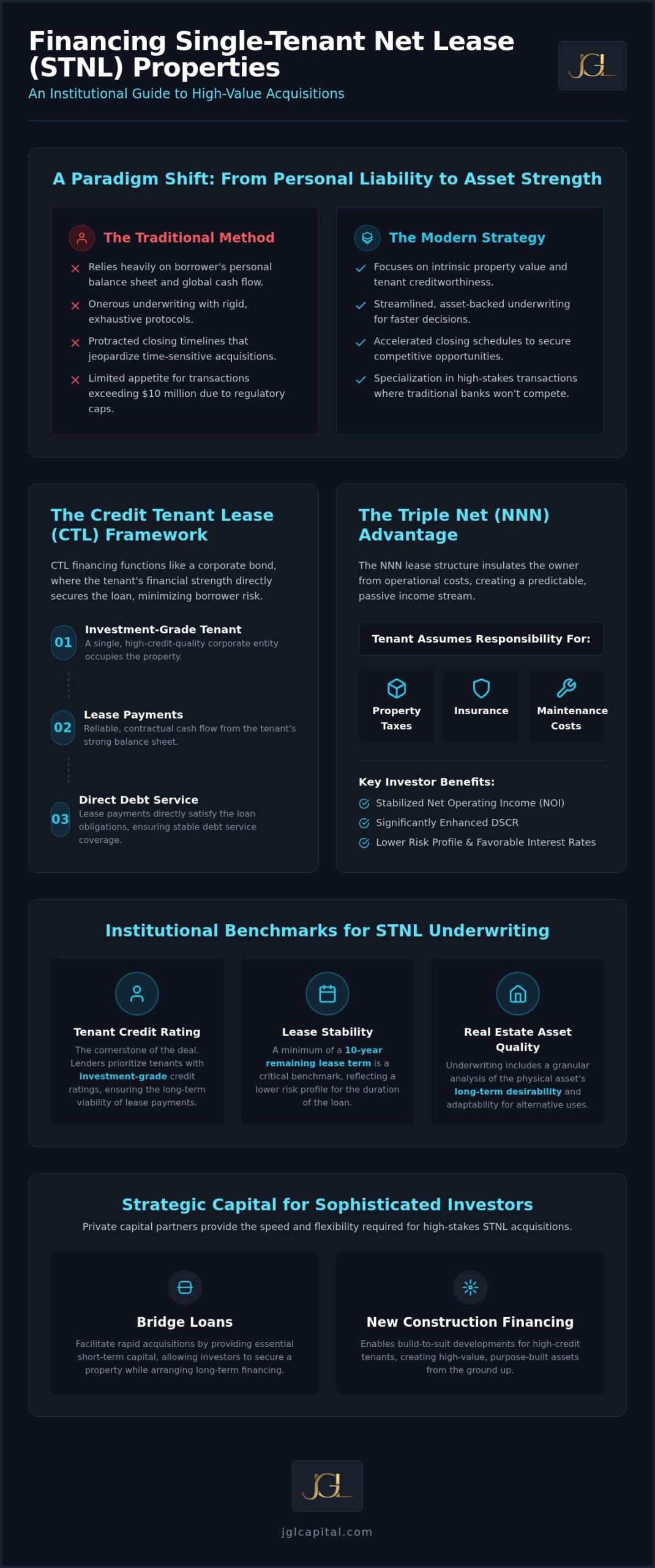
STNL financing operates on a principle of structural transparency where the real estate asset is inextricably linked to the creditworthiness of a single corporate entity. Unlike multi-tenant assets that require intensive management, a single-tenant net lease property functions as a passive, bond-like instrument. The investor’s primary objective is the preservation of capital through predictable, long-term cash flow. When seeking financing for a single-tenant net lease property, lenders prioritize the Credit Tenant Lease (CTL) framework. This structure ensures that debt service is directly satisfied by the lease payments of a high-credit-quality tenant, effectively shifting the underwriting focus from the borrower’s personal income to the tenant’s balance sheet. It’s a disciplined approach to wealth preservation that relies on the strength of the contract rather than daily operational oversight.
The Triple Net (NNN) Advantage
The inherent stability of these assets stems from the Triple Net (NNN) agreement, which dictates that the tenant assumes responsibility for property taxes, insurance, and all maintenance costs. Understanding The Fundamentals of a Net Lease is essential for recognizing how this structure mitigates landlord risk. By insulating the owner from operating expense fluctuations, NNN leases provide a stabilized net operating income. This predictability significantly enhances the Debt Service Coverage Ratio (DSCR), as the cash flow remains unencumbered by the rising costs of utilities or structural repairs. Lenders recognize this reduced volatility. They often offer more favorable interest rate spreads when the lease term extends beyond a ten-year horizon, reflecting a lower risk profile for the duration of the loan.
Institutional vs. Private Capital Sources
The 2026 financial landscape has seen a clear divergence between traditional institutional lenders and private capital providers. Traditional banks often impose rigid underwriting protocols that include personal recourse and exhaustive audits of a borrower’s global cash flow. These constraints lead to protracted closing timelines that are incompatible with the rapid pace of modern acquisitions. Sophisticated investors increasingly turn to private money brokers who specialize in high-stakes transactions. These sources emphasize asset-backed lending, prioritizing the intrinsic value of the property and the strength of the corporate guarantee over the borrower’s personal liquidity. This flexibility allows for the execution of complex projects where traditional bank appetite is often limited by regulatory caps or narrow risk thresholds. It’s a shift toward a more sophisticated form of capital allocation that values speed and precision.
The Shift Toward Asset-Backed Underwriting in Net Lease Markets
Modern underwriting paradigms in the 2026 market have shifted decisively toward the intrinsic worth of the real estate and the credit profile of the occupant. This is a critical evolution. While traditional institutions often remain mired in exhaustive personal income verification, sophisticated lenders prioritize the property’s capacity to generate value independently of the borrower’s personal financial history. It’s a more disciplined approach to risk. This methodology recognizes that the ultimate hedge against market volatility, characterized by the 10-Year Treasury settling near 4.38% in early 2026, lies in the asset’s fundamental viability and the strength of the corporate guarantee. Securing financing for a single-tenant net lease property under these terms allows for a more streamlined capital allocation process, focusing on the durability of the lease rather than the individual investor’s liquidity.
Evaluating the Real Estate Asset
Strategic underwriting necessitates a granular analysis of the physical asset, specifically focusing on its residual value should the current tenant vacate. Lenders must evaluate the location’s long-term desirability and the building’s adaptability for alternative uses. Generic property types often command more favorable terms due to their ease of re-leasing, whereas specialized assets require a deeper dive into market demand. This rigorous approach is a cornerstone of broader commercial real estate loans, where the objective is to align capital with assets that possess enduring market relevance. It’s about ensuring that the real estate itself provides a secondary layer of security beyond the initial tenant commitment.
Bypassing Traditional Credit Hurdles
The role of the private money broker has become increasingly vital for sourcing capital in non-conforming deals that fall outside the narrow parameters of traditional retail banking. By emphasizing Credit Tenant Loan (CTL) Financing, lenders can structure transactions based on the project’s potential and the tenant’s financial fortitude. This shift from a borrower-centric model to a deal-centric model permits high-net-worth stakeholders to execute on significant opportunities without the friction of personal balance sheet audits. Investors seeking to preserve agility in a competitive environment often find that a strategic capital partner can provide the necessary discretion and analytical rigor to close complex transactions with speed. It allows for the preservation of value through careful, deliberate action.
Structural Variations: Bridge Loans and New Construction for STNL
The execution of high-stakes acquisitions in the 2026 net lease market demands a sophisticated approach to capital structuring that extends beyond simple term loans. Investors frequently encounter off-market opportunities where the window for execution is exceptionally narrow, often measured in days rather than months. In these scenarios, the speed and certainty of private capital provide a distinct competitive advantage over traditional institutional lenders. Securing financing for a single-tenant net lease property in this environment requires a nuanced understanding of transitional capital. By utilizing flexible structural variations, such as bridge and construction financing, stakeholders can capture value that would otherwise be lost to more agile competitors; to support the technical design of these high-value builds, you can visit GMatrix-7 for specialized engineering software modules.
Strategic Bridge Financing
Bridge capital serves as a critical intermediary tool for closing the temporal gap between an immediate acquisition and the finalization of long-term institutional take-out debt. This transitional funding is particularly vital when a property requires immediate liquidity for tenant improvements or when an investor seeks to stabilize a recently vacated asset before seeking permanent financing. For a deeper analysis of these mechanisms, investors should consult our strategic guide to bridge loans. With bridge loan interest rates approximately at 9.00% as of August 2026, the cost of capital is balanced by the strategic agility it provides. This allows for the seamless management of liquidity during lease renewals or structural repositioning, ensuring that the asset remains attractive for eventual long-term debt placement at more favorable interest rate spreads.
New Construction for Credit Tenants
Build-to-suit developments for national retailers and medical providers represent a specialized segment of the market where risk mitigation is paramount. Utilizing new construction loans allows developers to align their financing with the specific requirements of investment-grade tenants. These projects often exceed the ten million dollar threshold, requiring a partner capable of funding complex, high-value developments nationwide. Construction risk is significantly reduced through the execution of pre-lease agreements, which provide a guaranteed revenue stream upon completion. Modern construction-to-permanent financing models further streamline this process. They allow for an efficient transition from the build phase to the stabilized lease-up period, effectively eliminating the friction of multiple closings and ensuring that the long-term capital structure is secured from the project’s inception. This disciplined approach to development ensures that the resulting asset meets the rigorous standards of institutional portfolios.
Due Diligence: Assessing Tenant Credit and Lease Stability
Due diligence in the 2026 market requires an analytical rigor that transcends simple checklist approvals. Lenders now scrutinize a tenant’s financial statements with the same intensity as a corporate bond offering, reflecting the asset’s role as a bond-like instrument. This meticulous approach is essential when securing financing for a single-tenant net lease property, as the lease’s strength dictates the loan’s viability. Beyond basic balance sheet health, institutional underwriters prioritize S&P or Moody’s credit ratings to establish a baseline for risk. A disciplined steward of capital recognizes that the underlying value of the transaction isn’t merely the physical real estate; it’s the certainty of the revenue stream. It’s a rigorous process that demands a deep understanding of corporate finance and legal structures.
The Tenant Credit Hierarchy
The hierarchy of tenant credit directly influences the interest rate spreads and loan-to-value (LTV) ratios available to investors. In early 2026, investment-grade tenants with ratings from AA to BBB- typically secure 10-year fixed non-recourse CMBS loans with rates between 5.75% and 7.25%. Conversely, sub-investment-grade or unrated franchisees often face a risk premium, with rates ranging from 7.25% to 9.25%. This spread reflects the heightened volatility associated with smaller entities. Sophisticated lenders also distinguish between corporate guarantees and subsidiary-only leases. A guarantee from a parent corporation provides a robust layer of security that a localized subsidiary cannot match. For transactions exceeding the ten million dollar threshold, identifying these nuances is critical for maintaining the integrity of the investment. Sophisticated stakeholders should engage with a seasoned private money broker to navigate these credit complexities and ensure their capital allocation remains secure.
Lease Structure Analysis
A granular examination of the lease agreement is the secondary pillar of institutional due diligence. The ten-year remaining lease term remains the institutional gold standard, providing the stability necessary for long-term debt placement. Underwriters specifically look for “hell or high water” clauses in absolute NNN agreements, which mandate rent payment regardless of any unforeseen property issues. Any termination options or “kick-out” clauses that allow a tenant to vacate early can severely threaten financing options. Furthermore, the sustainability of the current rent relative to market rates must be evaluated. If the contract rent significantly exceeds market averages, the risk of default or a failed renewal increases. Lenders also analyze rent escalation clauses. These provisions are vital for protecting the long-term cap rate, which averaged 6.80% in early 2026, against the erosive effects of inflation. Ensuring the lease is fully assignable is equally important, as it preserves the future resale and refinancing value of the asset.
Strategic Capital Allocation with JGL Capital
JGL Capital operates as a disciplined steward for sophisticated investors who require precision in high-stakes commercial transactions. When traditional banking institutions retreat due to regulatory constraints or a lack of appetite for specialized assets, we provide the necessary intellectual capital to bridge the gap. Securing financing for a single-tenant net lease property in excess of ten million dollars demands more than a simple credit check; it requires a deep understanding of asset-backed mechanics and corporate lease structures. Our approach is grounded in over thirty years of industry expertise, ensuring that every transaction is underwritten with an emphasis on the generation of worth and the preservation of long-term value. We recognize that in the 2026 market, success is defined by the ability to align capital with high-quality assets through analytical rigor rather than speculation.
The Brokerage Advantage in STNL
The role of a private money broker is essential for navigating the complexities of national-scale developments where speed is a non-negotiable requirement. By maintaining extensive relationships across a diverse range of private capital sources, JGL Capital ensures that complex commercial projects receive the funding they require without the protracted delays inherent in traditional underwriting. This access allows us to prioritize the intrinsic value of the real estate and the strength of the tenant guarantee, facilitating rapid funding for properties that may not conform to rigid bank protocols. Our national service area ensures that sophisticated partners can execute on opportunities across the United States with the confidence that their capital partner possesses the reach and resources to support their objectives. It’s a streamlined process designed to eliminate friction and maximize the certainty of execution.
Partnering for Long-Term Growth
We believe that high-level strategic alliances are superior to simple transactional lending. This philosophy drives our commitment to providing customized financial solutions that are meticulously aligned with the individual objectives of our stakeholders. By focusing on the alignment of interests and the delivery of highly individual solutions, we distinguish ourselves as a collaborative ally rather than a mere service provider. This disciplined approach ensures that every acquisition contributes to a lasting legacy of value creation. We reject the fleeting trends of the industry in favor of timeless principles that emphasize integrity and long-term growth. We invite you to Align your investment objectives with JGL Capital and experience the stability and expertise that have defined our three decades of industry leadership. By framing our activities as a form of high-level strategic alliance, we ensure that your capital is managed with the gravity and precision that high-stakes real estate management demands.
Advancing Strategic Objectives in the 2026 STNL Market
The evolution of the net lease landscape in 2026 demands a departure from traditional, friction-heavy lending models in favor of disciplined, asset-centric strategies. Successful capital allocation now relies upon a rigorous synthesis of real estate intrinsic value and the contractual strength of the credit tenant. By prioritizing these fundamentals over the rigid constraints of personal income verification, sophisticated investors can maintain the agility necessary to capture high-value opportunities. Securing financing for a single-tenant net lease property requires a partner capable of navigating these complexities with analytical precision and a commitment to the preservation of wealth. It’s a shift toward a more sophisticated form of capital management that values the long-term integrity of the asset above all else.
JGL Capital stands as a seasoned steward, offering over 30 years of strategic industry expertise to facilitate complex transactions. As a national asset-backed private money brokerage specializing in $10M+ loan amounts, we provide the stability and intellectual capital required for high-stakes management. We invite you to Secure Strategic Capital for Your STNL Acquisition with JGL Capital. By aligning your long-term vision with our disciplined underwriting, you ensure that your portfolio remains resilient and positioned for sustained growth in a competitive environment. We look forward to building a lasting legacy of value through our collaborative alliance.
Frequently Asked Questions
What is the typical LTV for single-tenant net lease financing in 2026?
Maximum loan-to-value (LTV) ratios typically reach 75% for acquisitions and refinances involving investment-grade national credit tenants. In the current 2026 market, sub-investment-grade or unrated tenants generally command more conservative LTVs, often ranging from 55% to 65%. Bridge financing options for transitional properties or short-term needs are generally capped at 70% LTV, reflecting a disciplined approach to risk for assets in transition.
How does tenant credit rating affect the interest rates on a NNN property loan?
Tenant credit quality serves as the primary driver for interest rate pricing in the net lease sector. Investment-grade tenants rated BBB- or better can secure 10-year fixed-rate financing between 5.75% and 7.25% as of mid-2026. Conversely, sub-investment-grade and franchisee-guaranteed properties often see rates between 7.25% and 9.25%. This spread represents the risk premium that lenders require for lower-tier credit profiles and franchisee-backed obligations.
Can I secure financing for an STNL property with a short lease term?
Securing financing for a single-tenant net lease property with a short remaining lease term is achievable through transitional capital or bridge loans. While institutional gold standards prefer a minimum of ten years, flexible private capital sources can provide the necessary liquidity to facilitate an acquisition while the owner negotiates a lease extension. These structures prioritize the property’s residual value and the probability of a successful renewal over the immediate lease duration.
What is the difference between a CTL loan and a traditional commercial mortgage?
A Credit Tenant Lease (CTL) loan is a highly specialized asset-backed structure where the underwriting focus is almost entirely on the tenant’s investment-grade credit rating rather than the property’s physical characteristics. Traditional commercial mortgages evaluate the property’s market-based net operating income and appraisal value. CTL financing often allows for higher leverage and more favorable terms because the lease payments are viewed as corporate debt obligations rather than simple real estate rent.
How fast can a private money broker close an STNL financing deal?
Private money brokers can often facilitate a closing within three to four weeks, significantly outperforming the sixty to ninety-day timelines common in traditional banking institutions. This speed is the result of streamlined underwriting processes that prioritize asset value and tenant credit over exhaustive personal financial audits. Such efficiency is critical for sophisticated investors competing for high-demand assets where certainty of execution remains a primary competitive requirement.
Does JGL Capital provide financing for build-to-suit STNL projects?
JGL Capital specializes in providing new construction loans for build-to-suit projects occupied by national retailers and medical providers. We facilitate the transition from construction to permanent financing, ensuring that developers have access to steady capital throughout the build cycle. Our specialization in $10M+ developments allows us to support large-scale projects that require a sophisticated, national-wide lending partner with a disciplined approach to capital management.
What are the minimum loan amounts for institutional-grade net lease properties?
Institutional-grade net lease financing typically targets loan amounts exceeding $10 million to align with the scale and quality of corporate-backed assets. While smaller loans exist in the retail market, sophisticated private capital sources focus on larger transactions that demand rigorous analytical underwriting and customized structural solutions. This threshold ensures that the transaction receives the necessary level of institutional attention required for long-term value preservation.
Is personal recourse required for $10M+ single-tenant financing?
Personal recourse is frequently waived in $10M+ single-tenant financing for stabilized assets occupied by investment-grade tenants. Non-recourse structures are a hallmark of institutional-grade CMBS and private capital lending, where the loan is secured solely by the property and the lease guarantee. This arrangement protects the borrower’s personal balance sheet, provided that the asset maintains its performance and the tenant’s credit remains intact throughout the duration of the loan term.