

Traditional real estate financing often treats the hard money loan underwriting process as a bureaucratic hurdle, yet for the sophisticated developer, the true value of a private capital partner lies in the ability to transform complex risk assessment into a competitive advantage. You likely find that standard lending institutions move with a glacial pace that fails to account for the intrinsic value of high-stakes assets, particularly when specialized projects like large-scale new construction are involved. This institutional friction often results in missed opportunities and misaligned incentives between the borrower and the source of capital.
This article provides an institutional-grade analysis of how private lenders evaluate risk and asset value to facilitate rapid real estate capital deployment, shifting the focus from opaque checklists to a strategic framework designed for long-term value creation. By understanding how a disciplined steward evaluates asset potential, you can navigate the path to approval with greater clarity. We’ll examine the specific metrics that define asset-first valuation and the phases of rigorous due diligence that allow for the execution of complex, high-value transactions exceeding 10 million dollars while leveraging the lender’s intellectual capital and execution speed.
Key Takeaways
- Recognize how the prioritization of intrinsic asset value over conventional credit metrics serves as the foundational philosophy for sophisticated risk mitigation.
- Master the sequential stages of the hard money loan underwriting process to anticipate the analytical requirements of a high-level strategic alliance.
- Evaluate the specific criteria used to assess the viability of complex new construction and multi-family projects exceeding 10 million dollars.
- Understand the significance of borrower execution and strategic alignment in securing the rapid deployment of private capital for large-scale acquisitions.
- Identify the critical attributes of a disciplined capital steward that ensure the preservation of value and the creation of lasting strategic legacies.
The Philosophy of Asset-Based Risk Mitigation
The hard money loan underwriting process represents a sophisticated departure from the standardized credit assessments found in retail banking, functioning instead as a specialized evaluation of collateral-driven risk. Rather than fixating on the historical credit profiles of the borrower, this methodology prioritizes the intrinsic value of the underlying real estate. This strategic focus ensures that capital allocation remains grounded in the tangible worth of the project, creating a disciplined framework for both the preservation of capital and its rapid deployment into high-growth opportunities. A disciplined steward recognizes that true risk mitigation involves more than just a checklist; it requires a deep understanding of market cycles and property-specific potential. When the lender’s capital is synchronized with the investor’s overarching strategy, the underwriting process evolves from a transactional requirement into a collaborative alliance that seeks to maximize the generation of worth across the entire lifecycle of the investment.
Traditional vs. Private Underwriting Methodologies
Institutional banking entities typically rely on automated, rigid standards established by government-sponsored enterprises, which often fail to account for the nuances of complex real estate portfolios. These conventional frameworks are designed for high-volume, low-variability transactions, making them ill-suited for the dynamic requirements of institutional-grade development or distressed asset repositioning. Private money underwriting utilizes a bespoke approach that evaluates the specific merits and strategic objectives of each unique asset. By bypassing the bureaucratic delays and exhaustive documentation requirements inherent in traditional financing, private capital provides a strategic advantage where execution speed is a critical determinant of acquisition success. This agility allows sophisticated developers to secure prime opportunities before competitors can navigate the labyrinthine approval structures of a traditional bank.
The Primacy of the Collateral Asset
Determining the fundamental worth of the real estate serves as the primary source of security in every private capital transaction. This asset-centric focus provides significant flexibility for investors who may possess non-traditional financial profiles, complex liquidity structures, or a high concentration of wealth in non-liquid holdings that would otherwise trigger rejection from conventional lenders. Asset-backed underwriting is a precision-based evaluation of tangible property value. By focusing on the viability of commercial real estate loans and the potential for substantial value creation, the underwriting process facilitates the acquisition of premier assets without the constraints of personal debt-to-income ratios. This methodology ensures that the focus remains on the property’s ability to generate returns, which is the ultimate benchmark of a successful capital allocation strategy.
Strategic Evaluation of Property Value and Potential
The hard money loan underwriting process demands a high degree of analytical rigor to ensure that capital is deployed into assets with verifiable potential. This evaluation isn’t merely a survey of current market conditions but a forward-looking assessment of a project’s viability under varying economic scenarios. When a lender evaluates high-value commercial real estate loans, they must scrutinize location analytics and market-specific economic drivers, such as population growth trends and local regulatory environments. These variables directly influence the terminal value of the asset and its ability to service debt. By conducting thorough property-level due diligence, a strategic partner mitigates execution risk and ensures that the investment’s trajectory aligns with the broader goals of capital preservation.
After-Repair Value (ARV) and Loan-to-Cost (LTC) Metrics
Calculating the After-Repair Value (ARV) serves as the cornerstone for specialized financing structures, particularly for fix and flip loans in Florida. This metric requires a precise estimation of a property’s worth following the completion of planned renovations, necessitating a deep understanding of local comparable sales and buyer demand. In contrast, Loan-to-Cost (LTC) metrics are frequently utilized in the capitalization of large-scale developments to measure the loan amount against the total project cost. Balancing capital protection with the need to maximize investor leverage requires a nuanced approach that only a seasoned steward can provide. For developers managing complex portfolios, aligning with an expert institutional partner ensures that these ratios are optimized for both safety and growth.
Underwriting for New Construction and Multi-Family Assets
The underwriting requirements for new construction loans and multi-family assets are significantly more complex than standard residential bridge financing. For multi-family projects, the focus shifts to income-producing potential, necessitating a rigorous analysis of occupancy rates, capitalization (cap) rates, and Net Operating Income (NOI). Lenders must verify construction budgets and timeline feasibility to ensure that the project doesn’t face liquidity constraints before completion. This level of scrutiny is essential for projects exceeding 10 million dollars, where the margin for error is slim and the need for precision is absolute. Verifying the developer’s ability to manage these costs is a critical component of the hard money loan underwriting process, ensuring that the project remains viable from inception to stabilization.
Assessing the Borrower: Execution and Strategic Alignment
Experience as a Risk Mitigant
A proven history of successful project completions often serves as a more powerful risk mitigant than traditional credit metrics. When developers demonstrate specialized expertise in niche sectors, such as industrial repositioning or institutional-grade multi-family assets, this track record provides a layer of security that offsets concerns regarding non-traditional financial profiles. Institutional lenders value these long-term collaborative relationships because they’re built on a foundation of mutual trust and proven performance. By focusing on the developer’s history of delivering worth in high-stakes environments, the underwriting process becomes a forward-looking evaluation of professional competence rather than a backward-looking audit of personal debt. This shift in perspective allows for the funding of projects that traditional banks would likely reject due to rigid, automated standards; similarly, developers can explore Surety Bond Brokerage and Underwriting to overcome credit-related hurdles in project bonding.
Transparency and the Alignment of Interests
Strategic alignment requires a high degree of transparency regarding the borrower’s long-term objectives and the specific milestones of the project. Clear documentation of these goals allows the lender to identify potential conflicts early, ensuring that both parties are moving along a unified path toward a successful resolution. This collaborative approach distinguishes the firm as a strategic ally rather than a transactional service provider. Borrower assessment in hard money is an evaluation of execution capability rather than mere creditworthiness. When interests are fully aligned, the resulting alliance fosters an environment where capital can be deployed with confidence, knowing that the principals possess both the integrity and the operational discipline required to protect the integrity of the investment.
The Lifecycle of the Hard Money Underwriting Process
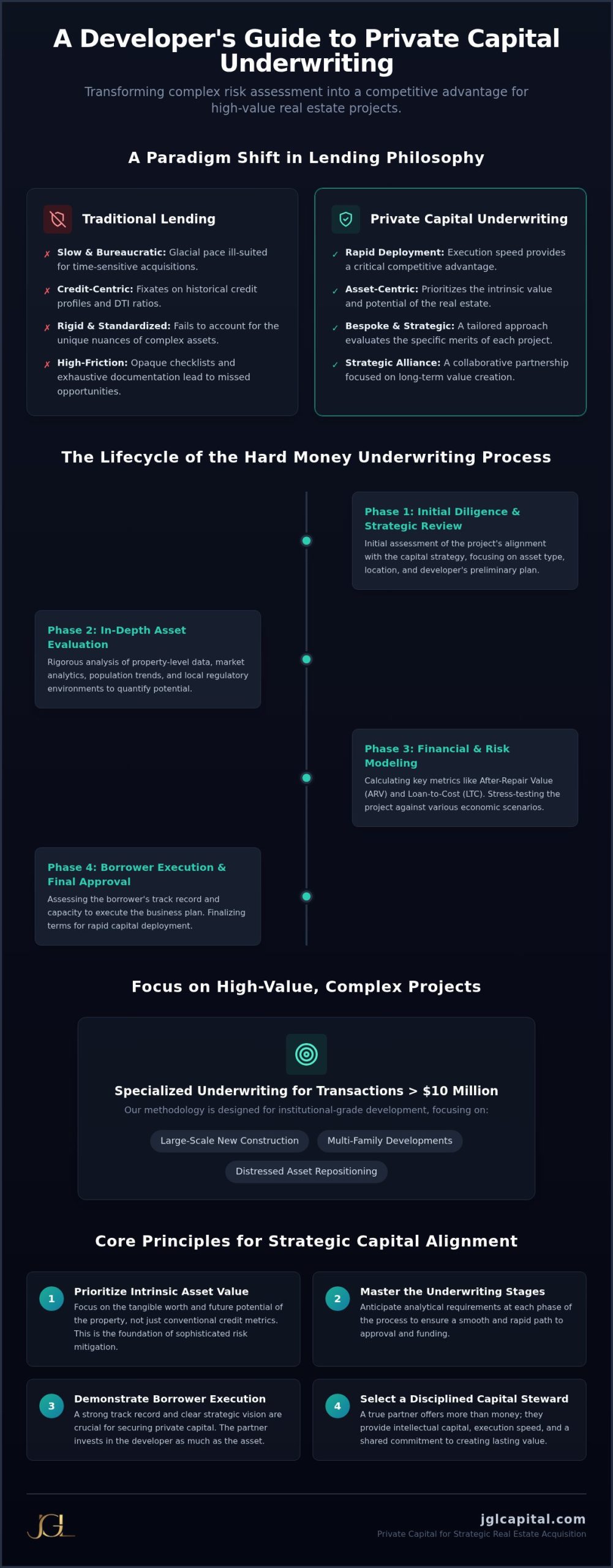
The lifecycle of the hard money loan underwriting process is characterized by a methodical progression designed to ensure the integrity of capital allocation while maintaining the agility required for high-stakes acquisitions. It begins with Phase I, the Initial Strategic Review, where the lender evaluates the core merits of the proposal and issues a preliminary term sheet to establish the framework of the alliance. Phase II involves comprehensive due diligence, incorporating third-party reports such as appraisals and environmental assessments to verify the asset’s condition and market standing. In Phase III, a formal Underwriting Committee conducts a final review to issue a binding commitment. The cycle concludes with Phase IV, the precise execution of legal documentation and closing, where the alignment of interests is codified into a final agreement. This structured approach ensures that every transaction is grounded in analytical rigor and professional discipline.
The Expedited Timeline of Private Capital
Streamlined internal review processes allow for funding in days, a stark contrast to the months-long timelines often associated with traditional banking institutions. Dedicated loan processors play a pivotal role in maintaining the momentum of the transaction; they ensure that every document is accounted for without sacrificing the analytical rigor that defines an institutional approach. This speed is a strategic advantage for developers who must act quickly to secure premier assets in competitive markets. Balancing rapid execution with thoroughness is the hallmark of a disciplined capital steward. When you’re ready to move forward with a partner who values your time, you can initiate a strategic review of your project to accelerate your capital deployment.
Documentation Requirements for Sophisticated Investors
Preparing a comprehensive Investor Package is essential for a seamless underwriting experience and serves as a testament to the developer’s professional discipline. This package should include executed purchase contracts, detailed scopes of work, and corporate entity documentation that clarifies the structure of the borrowing principal. Verification of title insurance and property insurance serves as the final safeguard, providing the necessary security for the investment before the final deployment of funds. Professional developers who maintain meticulous records find that this transparency significantly accelerates the path to funding. Clear communication regarding these requirements ensures that the underwriting team can focus on the merits of the deal rather than administrative delays.
- Executed Purchase Contracts: Establishing the baseline for the acquisition and its terms.
- Detailed Scope of Work: Providing a roadmap for value creation and project completion.
- Entity Documentation: Ensuring the legal structure of the borrower is transparent and compliant.
- Third-Party Reports: Validating the physical and environmental integrity of the collateral asset.
Selecting a Strategic Partner for Capital Deployment
The selection of a capital partner is a critical component of a developer’s strategic legacy, as the stability of the funding source directly impacts the long-term viability of high-stakes projects. Partnering with an institution that possesses over thirty years of industry capital provides a level of security that transactional, volume-driven lenders simply cannot replicate. During volatile market cycles, the presence of a disciplined steward ensures that capital remains available even when conventional credit markets experience sudden contractions. JGL Capital facilitates the generation of worth by providing highly customized financial solutions that are meticulously tailored to the unique requirements of complex, high-value assets. This commitment to stability allows partners to pursue ambitious objectives with the confidence that their capital source is grounded in analytical rigor and a rejection of speculative trends.
The Advantage of Intellectual Capital
Leveraging a lender’s deep-seated expertise allows developers to refine their project strategies through a lens of institutional-grade risk assessment. This intellectual capital is particularly valuable when navigating the hard money loan underwriting process for assets exceeding 10 million dollars, where specialized knowledge is required to accurately evaluate risk and asset potential. By combining a national scope with localized market insights, a sophisticated partner helps position your portfolio for sustainable growth and value preservation. This collaborative relationship transforms the lending process into a strategic alliance that prioritizes the alignment of objectives over simple transaction volume. Such a partnership ensures that every capital allocation serves as a building block for a lasting professional legacy.
Initiating the Partnership
The process for submitting high-value loan scenarios is designed to be both efficient and professional, reflecting the gravity of the high-stakes management involved. A discreet inquiry allows for an immediate review of project merits, moving quickly from the initial point of contact to a preliminary assessment of strategic alignment. This methodical approach ensures that every partnership begins with a clear understanding of core philosophies and a mutual commitment to excellence in execution. It’s through this steady and measured communication rhythm that trust is established between sophisticated stakeholders. Engage with the strategic expertise of JGL Capital for your next high-value acquisition.
Advancing Your Strategic Capital Allocation
Mastering the hard money loan underwriting process allows sophisticated developers to transcend the limitations of traditional banking and secure the rapid deployment of capital for complex assets. This framework ensures that every allocation is grounded in the intrinsic value of the property and the proven execution history of the principals involved. By prioritizing analytical rigor and strategic alignment, you transform a transactional necessity into a collaborative alliance that preserves long-term value. It’s a disciplined approach that values the generation of worth above all else, ensuring that your capital partner is as invested in the project’s success as you are.
With over thirty years of strategic lending expertise and a specialization in complex capital allocations exceeding 10 million dollars, JGL Capital provides the institutional stability and national reach required to navigate diverse market cycles. Our commitment to disciplined stewardship ensures that your objectives are synchronized with our capital deployment strategies. Secure your real estate legacy with institutional-grade capital from JGL Capital. We look forward to supporting your vision for sustained growth and the creation of lasting worth through careful, deliberate action.
Frequently Asked Questions
What are the primary factors considered during the hard money underwriting process?
The primary factors considered include the intrinsic value of the collateral asset, the developer’s historical execution capability, and the feasibility of the proposed exit strategy. By focusing on these core pillars, the lender ensures that the capital deployment is synchronized with the project’s long-term strategic objectives. This methodology prioritizes the generation of worth and the preservation of capital through a rigorous, asset-first evaluation of risk that traditional institutions often overlook.
How long does the underwriting process typically take for a private money loan?
The hard money loan underwriting process is characterized by its efficiency, often moving from the initial strategic review to a final commitment within a few business days. This compressed timeline serves as a strategic advantage for sophisticated developers who must act decisively to secure premier assets, bypassing the bureaucratic delays inherent in conventional banking. Maintaining this pace requires a disciplined approach that balances execution speed with the analytical rigor necessary for high-value capital allocation.
Is a formal appraisal required for hard money underwriting on commercial assets?
Formal third-party appraisals are standard requirements for high-value commercial assets to ensure an objective validation of the property’s current and future market worth. These reports provide the necessary data to mitigate risk and confirm that the loan amount aligns with the asset’s terminal value. Alongside environmental assessments and title reports, appraisals form the foundation of the comprehensive due diligence phase for institutional-grade projects exceeding 10 million dollars.
Why do hard money lenders focus on property value rather than credit scores?
Lenders prioritize property value because the real estate serves as the primary security for the capital deployment, ensuring that the investment is protected by a tangible asset. This philosophy allows for greater flexibility when working with developers who possess non-traditional financial profiles or complex liquidity structures. By focusing on the property’s income-producing potential and market viability, the lender can facilitate growth that traditional credit-based institutions don’t have the capacity to support.
What documentation is necessary to initiate the hard money underwriting phase?
Initiating the underwriting phase requires clear documentation, including executed purchase contracts, a detailed scope of work, and comprehensive corporate entity records. These documents allow the lender to conduct a thorough analysis of the transaction’s structure and the borrower’s strategic intent. Providing a complete Investor Package from the outset accelerates the timeline, ensuring that the analytical review proceeds without the administrative delays often found in transactional lending environments.
Can a hard money loan be underwritten for a new construction project with no existing structure?
A hard money loan underwriting process can indeed be applied to new construction projects where no structure currently exists, provided the underlying land value and project feasibility are verifiable. These specialized loans focus on the developer’s capacity to manage construction budgets and adhere to strict completion timelines. This asset-backed approach is essential for high-value developments, where the margin for error is slim and precision in the allocation of private capital is paramount.
What is the difference between Loan-to-Value (LTV) and Loan-to-Cost (LTC) in underwriting?
Loan-to-Value (LTV) represents the ratio of the loan amount to the property’s appraised worth, while Loan-to-Cost (LTC) compares the loan to the total project expenditure. Understanding the distinction between these metrics is critical for optimizing investor leverage while maintaining appropriate levels of capital protection. Sophisticated underwriting utilizes both ratios to ensure that the capitalization structure remains stable throughout the entire lifecycle of the development project, from acquisition to stabilization.
How does the lender evaluate the borrower’s exit strategy during the review?
The lender evaluates the exit strategy by analyzing the feasibility of the borrower’s plan to either refinance the asset or execute a strategic sale. This review considers market-specific economic drivers, such as cap rates and occupancy trends, to ensure that the terminal value supports a full return of capital. A transparent and well-documented exit strategy is a critical indicator of project success and serves as the primary roadmap for a successful and collaborative strategic alliance.