

The preservation of equity in high-stakes real estate development is not merely a function of market timing, but rather a result of the structural integrity of one’s capital stack. Sophisticated investors understand that while private capital offers unparalleled agility, it also introduces complexities that can erode margins or threaten asset control if not managed with analytical rigor. You likely recognize that high interest rates and aggressive foreclosure clauses represent significant risks in the current 2026 lending environment. This guide provides an institutional-grade framework for how to protect yourself when using hard money by implementing disciplined vetting processes and sophisticated agreement structures. We will examine the methodologies required to secure a predictable financing partner and ensure total transparency in fee structures. By the conclusion of this analysis, you will possess a comprehensive strategy for mitigating risk and maintaining control over your most valuable assets through precise, professional capital management. This disciplined approach ensures that every transaction is grounded in stability and long-term value preservation rather than speculative haste.
Key Takeaways
- Understand the strategic deployment of private capital as transitional liquidity, prioritizing institutional agility and execution speed over the pursuit of the lowest nominal interest rates in the 2026 market.
- Master the structural nuances of loan documentation, specifically the integration of interest reserves and clearly defined exit strategies, to learn exactly how to protect yourself when using hard money.
- Implement a rigorous due diligence protocol to verify a lender’s historical performance and proof of funds, ensuring that the source of capital is as stable as the asset itself.
- Utilize a disciplined checklist to audit fee schedules and verify that Loan-to-Value calculations are based on conservative, realistic appraisal metrics rather than speculative projections.
- Leverage the strategic guidance of a seasoned partner to navigate the complexities of $10M+ commercial real estate loans through a model that prioritizes long-term asset preservation.
The Strategic Role of Private Capital in 2026 Real Estate
In the sophisticated landscape of 2026 real estate, the utilization of a Hard money loan has evolved from a peripheral financing option into a primary instrument for strategic transitional capital. Professional developers and high-net-worth stakeholders prioritize the institutional agility and execution speed of these asset-backed structures, recognizing that the ability to secure a multi-family or new construction site often outweighs the marginal cost of capital. While traditional banking institutions remain constrained by rigid regulatory frameworks, the private sector has matured into a disciplined source of liquidity, offering a level of responsiveness that is essential for capital-intensive developments. This shift requires a nuanced understanding of how to protect yourself when using hard money, specifically regarding the identification of liquidity traps and the mitigation of aggressive default clauses that can jeopardize asset control.
Investors must remain vigilant against several critical risk factors that often characterize less reputable lending sources:
- Opaque fee structures that erode project margins through hidden administrative costs.
- Aggressive default triggers designed to facilitate predatory foreclosure rather than project completion.
- Inadequate liquidity reserves that create mid-project funding gaps during critical construction phases.
Asset-Backed vs. Credit-Based Lending
The fundamental distinction in private capital lies in its focus on the intrinsic value of the collateral rather than the personal credit history of the borrower. This asset-centric evaluation allows for greater flexibility in structuring complex transactions, particularly those exceeding $10 million. A critical component of this framework is the After-Repair Value (ARV), which serves as the primary metric for determining the safety margin of a project. When engaging in high-leverage deals, investors must ensure that the appraisal process is both conservative and grounded in current 2026 performance data. Maintaining a robust equity position relative to the ARV is a primary method for preserving asset control during periods of market volatility.
The Institutional Shift in Private Lending
The 2026 market has seen a significant professionalization of the private lending space, characterized by the emergence of seasoned brokers who act as disciplined gatekeepers. These experts provide strategic guidance that distinguishes institutional-grade capital from speculative sources. Distinguishing between a predatory lender and a professional bridge lender requires a rigorous audit of the organization’s history and proof of funds. Because market volatility necessitates more robust exit planning, sophisticated partners now integrate comprehensive contingency strategies into their initial loan structures. This evolution ensures that capital serves as a bridge to long-term value creation. Understanding these distinctions is essential for any investor seeking to master how to protect yourself when using hard money while maintaining a competitive advantage in a fast-moving environment.
Structuring Agreements for Maximum Asset Protection
The structural composition of a private capital agreement is the primary determinant of long-term asset security. Beyond the nominal interest rate, the meticulous definition of exit strategies within the loan documentation serves as a critical safeguard. Investors must ensure that multiple repayment paths are clearly articulated, whether through a permanent refinance or the strategic sale of the asset. Incorporating interest reserves into the loan structure is another essential tactic to maintain debt service during intensive construction phases. This ensures that capital remains available for operational requirements without the immediate pressure of monthly interest payments. Negotiating flexible extension options is equally vital in the 2026 market. These provisions offer a necessary buffer against unforeseen project delays, preserving the investor’s equity position. While prepayment penalties are common, they must be balanced against the need for liquidity. A disciplined approach to these variables is fundamental when considering how to protect yourself when using hard money.
The Anatomy of a Secure Loan Commitment
A secure commitment requires transparency in every clause. Sophisticated partners conduct a thorough Bridge Loan vs. Traditional Mortgage comparison to align their financing with the specific lifecycle of the project. It’s vital to review default interest rates and “bad boy” guaranties, which trigger personal liability only in cases of fraud or intentional misconduct. Transparency in points and origination fees prevents surprises at the closing table, ensuring that the net proceeds match the initial projections. Sophisticated investors don’t just plan for success; they document the contingencies required to sustain it.
Mitigating the Risk of Default
Preserving equity requires proactive default mitigation strategies. One such mechanism is the “Cure Period,” which grants the borrower a specific timeframe to rectify a missed payment before foreclosure proceedings commence. This provision is a cornerstone of how to protect yourself when using hard money. Additionally, investors should be wary of cross-collateralization clauses that link multiple assets to a single loan. This structure can create a domino effect where a delay on one project jeopardizes an entire portfolio. For high-stakes transactions exceeding $10 million, the strategic use of non-recourse debt can further insulate personal wealth from project-specific risks. Aligning with a partner who provides strategic guidance in loan structuring ensures that these protections aren’t just theoretical but operational. This level of analytical rigor is what distinguishes a successful capital alliance from a mere transaction.
Lender Due Diligence: Vetting the Source of Capital
Vetting the capital source is as vital as vetting the asset itself. In the 2026 lending environment, the pursuit of the lowest possible interest rate often leads to a sacrifice in execution reliability. For complex developments, cheap capital can be the most expensive if the lender fails to fund draws or lacks the liquidity to close on schedule. Evaluating a lender’s “Proof of Funds” isn’t merely a formality; it’s a necessary step in verifying their operational capacity. This is a fundamental aspect of how to protect yourself when using hard money, as it ensures the financing partner is a stable entity capable of supporting the project’s lifecycle. Analytical rigor during the selection phase prevents the catastrophic failure of a capital stack mid-construction.
Sophisticated investors must remain alert to “Loan-to-Own” strategies. These predatory models prioritize the acquisition of the collateral over the repayment of the debt. You can spot these in term sheets through excessively aggressive default triggers or unreasonably short cure periods. A disciplined review of the fine print reveals whether a lender is an ally in your success or a competitor for your equity. Leveraging a broker’s network provides access to pre-vetted, institutional-grade lenders who value long-term relationships over short-term asset seizures.
Verifying Lender Capacity and Reliability
Professional developers should inquire specifically about the internal underwriting timeline and the mechanics of the draw process. Delays in funding construction draws can halt progress and inflate carry costs. Checking references from peers who have completed similar high-stakes projects provides invaluable qualitative data. JGL Capital applies over 30 years of institutional pattern recognition to vet these sources, ensuring that only the most reliable capital enters the transaction. This level of scrutiny is essential to maintaining the integrity of your project’s financial foundation.
The Advantage of the Broker-First Model
Adopting a broker-first model establishes a fiduciary-style buffer between the borrower and the source of capital. This strategic alliance allows investors to access highly specialized programs, such as institutional-grade New Construction Loans, through a managed and vetted network. A broker’s role is to ensure that the lender’s objectives align with the developer’s long-term goals. By securing multiple capital paths for a single project, a broker provides the redundancy needed to navigate market shifts. This collaborative approach is a sophisticated method for how to protect yourself when using hard money, transforming a simple loan into a strategic partnership grounded in mutual success.
The Definitive Hard Money Protection Checklist
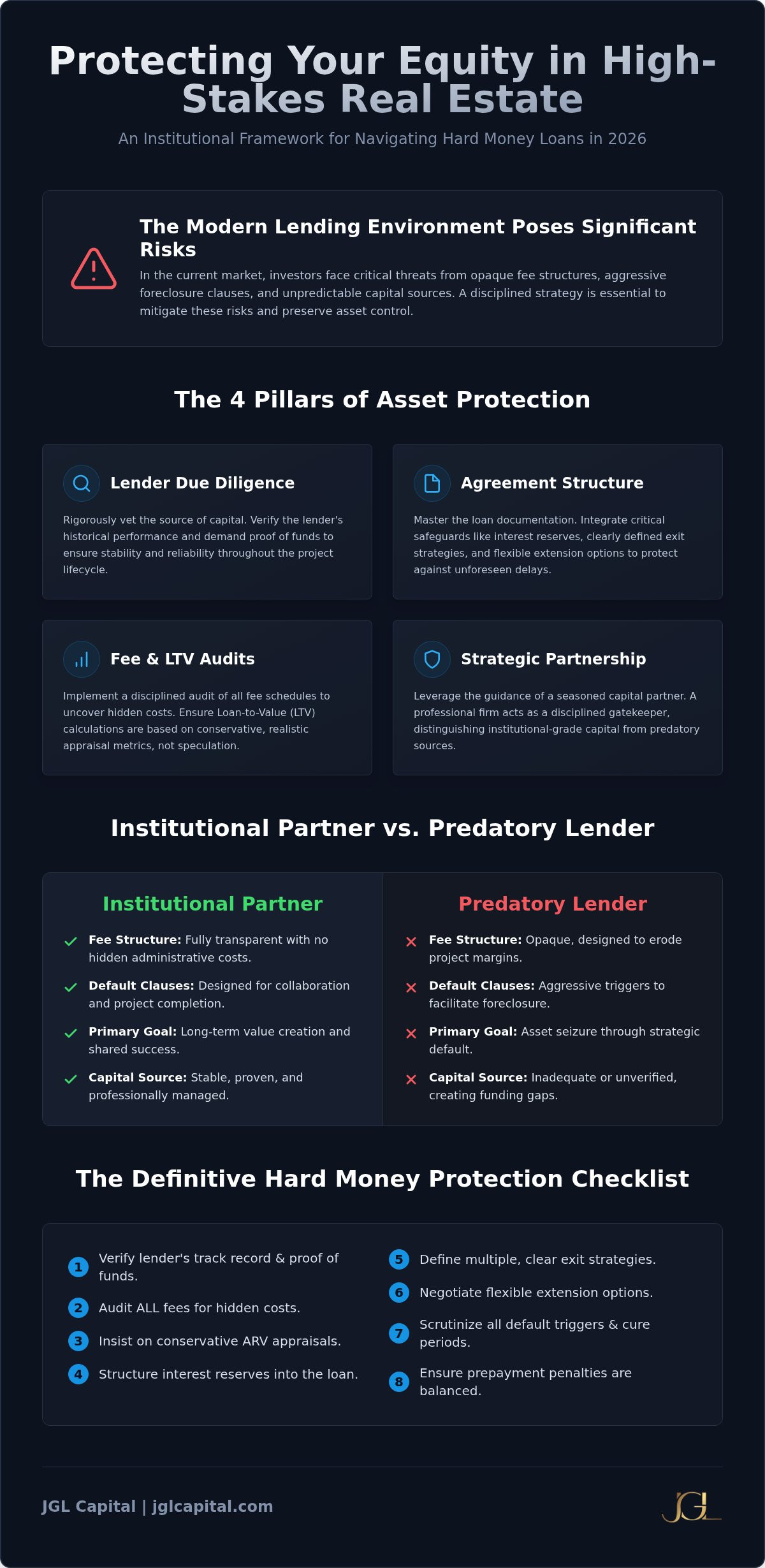
Executing a high-stakes real estate transaction requires a final, technical verification of all lending parameters. This checklist serves as the operational standard for how to protect yourself when using hard money by ensuring that every variable is aligned with project success. A disciplined investor never assumes that a term sheet is final until it has undergone a rigorous analytical audit. This process begins with the verification of Loan-to-Value (LTV) and After-Repair Value (ARV) calculations. Appraisals must be conservative and grounded in actual 2026 market data rather than optimistic projections. Overestimating the ARV creates a false sense of security and erodes the actual equity cushion available during market fluctuations.
- Audit the Fee Schedule: Request a comprehensive breakdown of all points and administrative costs to identify potential fees that negatively impact your internal rate of return.
- Confirm the Draw Schedule: The release of funds must be synchronized with specific construction milestones to prevent liquidity gaps that could halt site progress.
- Review Default Clauses: You must understand the precise triggers for foreclosure and the associated penalty costs, ensuring they are based on objective performance metrics.
- Finalize the Exit Strategy: A documented plan for either a permanent refinance or a strategic asset sale must be established well before the balloon payment becomes due.
Technical Audit of the Term Sheet
Investors must scrutinize the term sheet for “automatic default” triggers that grant lenders excessive leverage over the asset. It’s a standard institutional practice to ensure that interest is calculated solely on the disbursed balance rather than the total loan commitment, particularly in construction scenarios. This distinction significantly reduces the effective cost of capital. An Interest Reserve serves as a dedicated capital allocation within the loan structure to cover debt service obligations, thereby insulating the project’s operational cash flow from the burden of monthly interest payments. This mechanism is a primary tool for maintaining project stability during the stabilization phase. Understanding these technicalities is central to how to protect yourself when using hard money.
Operational Safeguards for Project Execution
Operational security extends beyond the loan documents. Establishing a collaborative relationship with a reputable title company and specialized legal counsel provides an additional layer of fiduciary oversight. A disciplined project budget must always include a 10-15% contingency reserve to absorb the inevitable cost overruns associated with large-scale developments. Referencing the Hard Money Lenders in Florida guide provides essential context on regional standards for capital allocation and asset-backed structures. If you’re ready to secure institutional-grade financing for your next project, you can consult with the experts at JGL Capital to ensure your deal is structured for maximum protection.
Aligning with JGL Capital for Disciplined Execution
The selection of a financing partner represents the most critical decision in the lifecycle of a high-stakes development project. JGL Capital LLC functions as a disciplined steward of private capital, providing strategic guidance that transcends the limitations of traditional loan origination. Our institutional framework is built upon more than 30 years of industry expertise, allowing us to navigate the complexities of Commercial Real Estate Loans with analytical precision. We maintain a steadfast commitment to transparency, ensuring that borrower and lender objectives are perfectly aligned before capital is deployed. This collaborative framework is the ultimate answer to how to protect yourself when using hard money; it shifts the focus from a purely transactional interaction to a long-term strategic alliance grounded in the preservation of value. Engaging a partner who understands the gravity of high-stakes management ensures that your capital stack remains resilient throughout the 2026 market cycle.
Customized Solutions for Serious Investors
Institutional real estate requires financing that is as unique as the asset itself. We tailor our bridge and construction programs to match specific project timelines, ensuring that liquidity is available exactly when it’s required. The transition from the initial application to strategic funding is a methodical process characterized by rigorous underwriting and clear communication. This disciplined approach is why JGL Capital LLC remains the preferred choice for sophisticated stakeholders seeking Fix and Flip Loans and other transitional capital structures. We prioritize the structural integrity of the deal, ensuring that every term serves the long-term viability of the project.
Securing Your Next Opportunity
Preparing a project for institutional-grade funding requires a comprehensive analysis of both property value and sponsor capacity. During our initial consultation, we conduct a deep-seated evaluation of the asset’s intrinsic worth and the developer’s execution strategy. This level of scrutiny is a primary mechanism for how to protect yourself when using hard money, as it identifies potential risks before they manifest in the capital stack. To prepare for a successful application, investors should provide detailed 2026 pro formas and clear exit documentation that reflects current market realities. When you’re ready to elevate your capital strategy, you should partner with JGL Capital LLC for your next high-value project. Our team provides the stability and expertise required to turn complex opportunities into enduring legacies of worth.
Mastering the Architecture of Private Capital
The successful deployment of private capital in 2026 is predicated on an unwavering commitment to analytical rigor and the meticulous alignment of structural safeguards. By internalizing the institutional methodologies examined in this guide, specifically the implementation of conservative LTV metrics and the verification of lender liquidity, you position your portfolio for sustained growth and asset security. Mastering how to protect yourself when using hard money ensures that your capital stack remains a tool for acceleration; it’s a strategic necessity for any investor managing high-value assets. With over 30 years of combined industry expertise, JGL Capital acts as a disciplined partner for national developers, specializing in the complex requirements of institutional-grade $10M+ loans. We encourage you to Secure Strategic Capital for Your Next Deal with JGL Capital and experience the stability of a truly professional capital alliance. Your projects represent the future of the built environment, and they deserve a financing structure that reflects that level of excellence.
Common Questions Regarding Private Capital Protection
Is hard money safe for first-time real estate investors?
Private capital is a safe and effective instrument for first-time investors when it is utilized as a strategic transitional tool rather than a last resort. Success depends on the investor’s ability to implement a disciplined exit strategy and secure a vetted capital source. Aligning with a seasoned broker helps mitigate the inherent risks of asset-backed lending by providing the institutional oversight that less experienced developers may lack.
What is the most common mistake when using a hard money lender?
The most frequent error is underestimating the total cost of carry and the realistic timeline required for project stabilization. Investors often fail to account for how high interest rates in 2026 can erode net margins if project milestones are delayed. This oversight underscores the necessity of learning how to protect yourself when using hard money by conducting a rigorous sensitivity analysis of your project’s pro forma before closing.
How do I know if a hard money lender is predatory or legitimate?
Legitimate institutional lenders maintain total transparency in their fee structures and possess a verifiable history of successful closings on complex, multi-million dollar projects. Predatory entities often utilize “loan-to-own” strategies, which you can identify through aggressive default triggers and unreasonably short cure periods in the term sheet. Verifying a lender’s proof of funds and institutional reputation is a critical step in ensuring the safety of your collateral.
Can I negotiate the terms of a hard money loan agreement?
Sophisticated investors can and should negotiate key structural elements such as extension options, prepayment penalties, and the duration of interest reserves. While interest rates are often dictated by the 2026 market environment, the legal and operational clauses within the documentation are frequently subject to refinement. A professional broker acts as a strategic ally to ensure these terms align with the sponsor’s long-term objectives and asset protection goals.
What happens if I cannot pay back the hard money loan on time?
Failure to repay within the agreed term typically triggers default interest rates and potential foreclosure proceedings as defined in the loan documentation. However, proactive communication and the pre-negotiated existence of extension options can provide a necessary buffer for unforeseen project delays. Maintaining a clearly defined and documented exit strategy is the most effective way to prevent asset seizure during the final phase of the loan term.
Does a hard money loan affect my personal credit score?
Institutional hard money loans are primarily asset-backed and typically do not require personal credit reporting unless a default occurs under a specific recourse guaranty. Because these loans are usually structured for legal entities rather than individuals, they won’t appear on a personal credit profile during the standard term. This allows sophisticated developers to maintain their personal borrowing capacity while managing large-scale commercial acquisitions exceeding $10 million.
What is an interest reserve, and why do I need one for my loan?
An interest reserve is a portion of the loan proceeds held by the lender to cover monthly debt service payments during the construction phase. This mechanism is vital because it ensures that project cash flow isn’t strained by interest obligations before the asset becomes income-producing. It serves as a fundamental operational safeguard for maintaining project stability and is a core component of how to protect yourself when using hard money.
How much equity do I need to protect myself in a hard money deal?
A standard institutional benchmark for equity protection is 20% to 35% of the total project cost, depending on the specific asset class and risk profile. Maintaining a conservative Loan-to-Value ratio is a primary method for preserving your interests against market volatility. This equity cushion provides the necessary resilience to absorb cost overruns and ensures the sponsor remains the primary beneficiary of the asset’s long-term value creation.