

The prevailing assumption that personal liquidity remains the primary driver for development capital is a strategic fallacy that will limit institutional growth through 2026. It’s widely understood that the 60-day underwriting delays and rigid debt-to-income requirements of traditional banks often stifle the momentum of high-stakes projects. This guide delivers a sophisticated framework for navigating new construction loan requirements for investors; it focuses on asset-based underwriting where the intrinsic value of the project dictates the terms of engagement.
We’ll provide a precise checklist of institutional-grade criteria and illustrate how a disciplined capital partner can streamline your draw processes to ensure continuous operational efficiency. By shifting the focus toward project-level metrics and strategic oversight, you can transcend the limitations of conventional lending. This article outlines the essential requirements for securing sophisticated capital and provides a roadmap for scaling your portfolio across national markets with confidence and precision.
Key Takeaways
- Understand the strategic transition from traditional credit-based lending to a sophisticated asset-centric model that prioritizes the intrinsic value of the development.
- Master the institutional metrics of After-Repair Value (ARV) and Loan-to-Cost (LTC) benchmarks that dictate capital allocation in modern underwriting.
- Identify the essential new construction loan requirements for investors by constructing a rigorous documentation framework comprising architectural specifications and site plans.
- Learn to optimize project liquidity through the strategic management of construction draw schedules and the mechanics of interest-only periods during the build phase.
- Discover how to leverage bespoke financing solutions and institutional-grade expertise to secure capital for complex, large-scale investment projects.
Understanding the Architecture of New Construction Financing for Investors
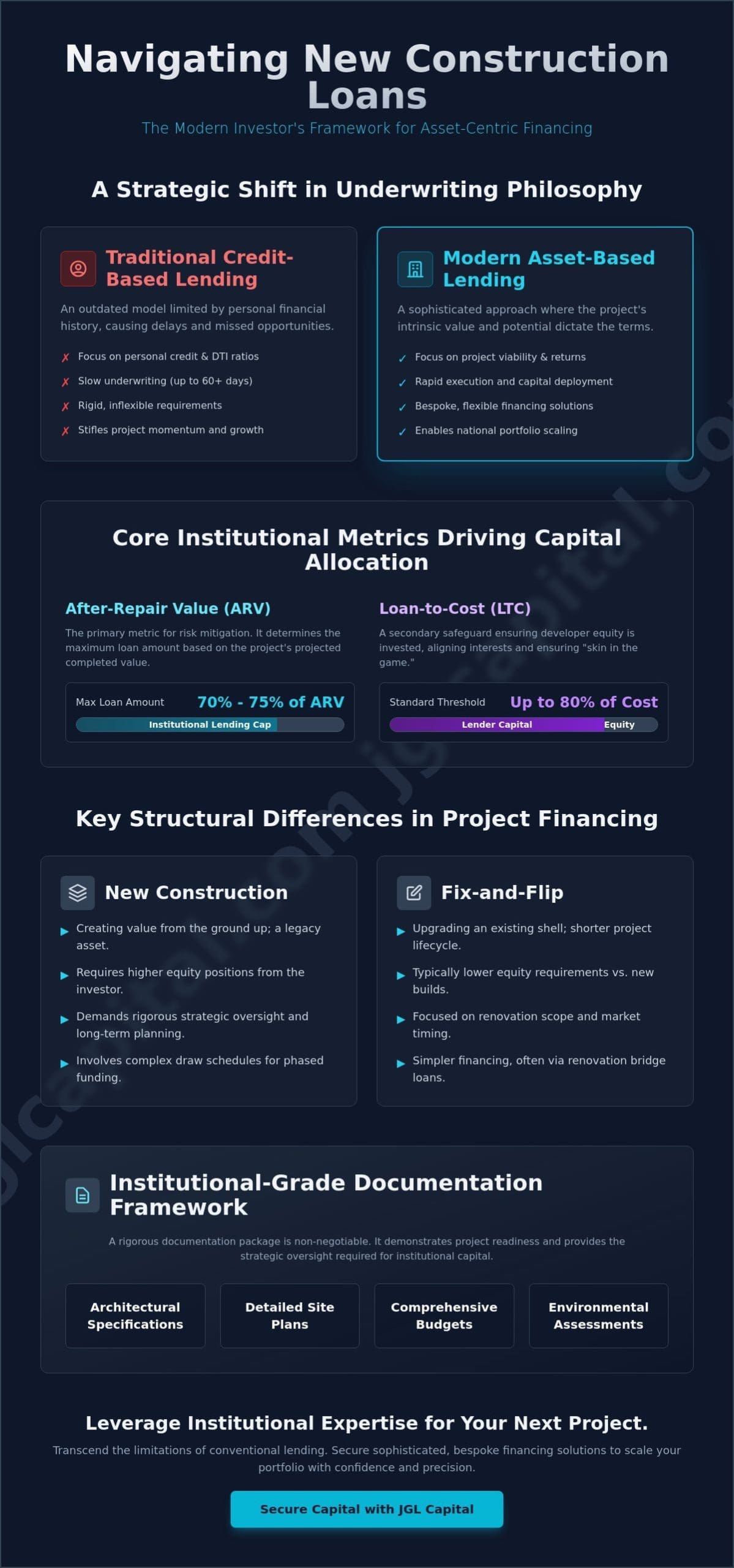
The new construction loan represents a sophisticated, asset-backed instrument designed to facilitate the lifecycle of a development project from site acquisition through vertical completion. In the current 2026 economic climate, the industry’s moved toward asset-centric underwriting, a strategic shift that prioritizes the intrinsic value of the real property and its projected revenue. This methodology contrasts with traditional credit-based lending which often relies too heavily on a borrower’s personal history. By focusing on the underlying asset, lenders ensure that new construction loan requirements for investors remain rooted in the project’s viability and risk-adjusted returns.
Investors must distinguish between residential investment builds and multi-family development financing. While both require rigorous capital allocation, multi-family projects involve more complex debt stacks and longer stabilization periods. Professional developers utilize these specialized loans as a form of understanding the architecture of project finance, where the debt’s serviced by the project’s future cash flows rather than the developer’s existing balance sheet. This disciplined approach to wealth creation ensures that each development stands as a self-sustaining financial entity.
The Role of Private Capital in 2026 Real Estate Development
Private capital’s become the cornerstone of ground-up development in 2026. Speed of execution’s vital in national markets where inventory remains constrained. Private money brokers facilitate transitional capital, bridging the gap between land acquisition and permanent financing. This institutional-grade support relies on 30 years of industry expertise to navigate complex deal structures. It’s a level of strategic oversight that traditional banks rarely match, providing developers with the agility needed to capture market opportunities before they dissipate.
New Construction vs. Fix-and-Flip: Key Structural Differences
Understanding the distinction between vertical construction and renovation-based bridge loans is essential for portfolio optimization. Ground-up status significantly impacts loan-to-cost (LTC) ratios, often requiring higher equity positions than a standard flip. While a fix-and-flip focuses on cosmetic or structural upgrades to an existing shell, new construction demands a more rigorous strategic oversight. The new construction loan requirements for investors for these builds include detailed site plans, environmental assessments, and comprehensive budget breakdowns. It isn’t just about a simple renovation; it’s about creating a legacy from the soil up. This process requires a steady, measured flow of information and a commitment to long-term value creation.
Institutional Underwriting: Core Requirements and Capital Allocation
Capital allocation in the current market demands a rigorous assessment of a project’s intrinsic value and terminal potential, moving beyond simple credit checks to a holistic evaluation of the asset’s lifecycle. Institutional lenders prioritize the After-Repair Value (ARV) as the primary metric for risk mitigation, as it dictates the maximum loan amount, typically capped at 70% to 75% of the projected value. When evaluating new construction loan requirements for investors, the emphasis shifts from historical personal income to the precise execution and feasibility of the proposed development.
Loan-to-Cost (LTC) benchmarks serve as a secondary safeguard, ensuring that the developer maintains significant equity within the capital stack. For national investment projects, an LTC of 80% represents a standard threshold, though this may tighten based on regional market volatility or asset class risk profiles. This requirement for “skin in the game” ensures that the developer’s interests remain aligned with the lender’s capital preservation goals. Lenders utilize the OCC’s Commercial Real Estate Lending Handbook to establish these rigorous documentation and risk management frameworks. This institutional oversight ensures that every dollar deployed is backed by a verifiable budget, a realistic timeline, and a clear path to stabilization.
Asset-Based Underwriting vs. Traditional Credit Scoring
Asset-based lending functions as a sophisticated mechanism that prioritizes project feasibility and collateral value over individual W-2 income verification. While personal credit remains a component of the holistic review, the property’s potential and the developer’s historical performance carry more weight in the final underwriting decision. It’s a method that rewards the strategic oversight of an established portfolio rather than simple tax returns. Asset-based lending serves as a strategic tool for capital preservation and growth by aligning loan structures with the actual revenue-generating potential of the real estate asset.
Financial Benchmarks for Professional Developers
Maintaining liquidity is essential for managing the unforeseen variables inherent in ground-up development, such as sudden shifts in material costs or labor availability. Lenders typically require developers to demonstrate specific financial thresholds to ensure project stability and optimize risk-adjusted returns:
- Minimum liquidity reserves covering at least 10% of the total project cost.
- Interest reserves sufficient to carry the debt throughout the anticipated construction and lease-up periods.
- A debt service coverage ratio (DSCR) of at least 1.25x for the terminal exit strategy.
This capital provides a buffer against market fluctuations; meanwhile, the DSCR ensures that the completed asset can comfortably transition into permanent financing once stabilized. Meeting these specific new construction loan requirements for investors requires a disciplined approach to financial reporting and project management. For those seeking to optimize their capital stack, a bespoke lending strategy can provide the necessary flexibility to scale operations effectively.
The Investor’s Documentation Framework: Plans, Specs, and Vetting
The assembly of a comprehensive underwriting package is a prerequisite for institutional capital allocation. Lenders don’t merely review documents; they analyze the strategic alignment of the project’s components. An effective “Executive Summary” functions as a roadmap for the lender, detailing the investment thesis and the specific milestones for value creation. Meeting the new construction loan requirements for investors in 2026 requires an analytical rigor that exceeds historical norms. This documentation provides the necessary transparency to secure competitive pricing and favorable leverage ratios. It’s the primary instrument used to instill confidence in the firm’s ability to manage high-stakes financial commitments.
Technical Project Documentation
Institutional lenders require that all municipal approvals and building permits are secured before the loan closing. This ensures that the project is “shovel-ready,” which significantly reduces the risk of regulatory delays that can erode returns. Detailed “Plans and Specs” are essential because they form the basis for the project’s after-repair value (ARV). Without granular architectural drawings, an appraiser cannot accurately project the future worth of the asset. For a more comprehensive analysis of project planning and lifecycle management, developers can reference this New Construction Loans: A Strategic Guide for Real Estate Developers (2026). A line-itemized budget, or Pro Forma, serves as the financial backbone of the application. It must include a contingency reserve, typically set at 10% of hard costs, to absorb unforeseen inflationary pressures or supply chain disruptions.
Builder and Contractor Approval Standards
The vetting of the general contractor is often as intensive as the financial review of the borrower. Lenders evaluate the builder’s resume, specifically looking for at least three successful ground-up completions within the previous 36 months. This historical performance serves as a proxy for future execution and risk mitigation. This Forbes guide to commercial real estate loans highlights how underwriting standards prioritize the experience of the development team to mitigate construction risk. Verification of professional liability, general liability, and builder’s risk insurance is a mandatory step in the due diligence process. A seasoned builder is a prerequisite for investors seeking high-leverage financing. Their technical expertise ensures that the project adheres to the timeline, which is vital for maintaining the projected debt service coverage ratio. Adhering to these new construction loan requirements for investors positions the project as a disciplined and stable investment opportunity for institutional partners.
Navigating the Draw Schedule and Project Liquidity
Effective capital management distinguishes a successful development from a stalled asset. Liquidity is the lifeblood of vertical development. This reality dictates that sophisticated sponsors must master the mechanics of the draw schedule to ensure project continuity. Compliance with new construction loan requirements for investors involves more than just initial approval; it requires rigorous ongoing documentation to release capital at every milestone. Institutional lenders prioritize the alignment of interests through verified completion, ensuring that the value of the collateral remains ahead of the disbursed debt.
The Draw Process: A Step-by-Step Guide
The draw process demands precision to prevent bottlenecks that can derail a construction timeline. Most institutional frameworks follow a standardized four-step cycle:
- Step 1: Submission of the draw request. The borrower submits a formal request detailing the specific budget line items completed during the period, supported by invoices and receipts.
- Step 2: Independent third-party inspection. A lender-appointed inspector visits the site within 48 to 72 hours to verify that the work claimed in the draw request matches the physical progress on the ground.
- Step 3: Title update and lien waiver verification. The title company performs a date-down endorsement to ensure no new liens have been filed. Collected lien waivers from subcontractors protect the equity position of both the investor and the lender.
- Step 4: Rapid disbursement of funds. Once the inspection and title search are cleared, funds are wired to the borrower, typically within 24 to 48 hours, to maintain project momentum and pay trade partners.
Liquidity Management and Interest Reserves
Interest reserves are structured to support developer cash flow by capitalizing the monthly debt service into the loan balance. This mechanism allows the sponsor to focus on execution rather than monthly out-of-pocket interest payments. However, the impact of 2026 market volatility on construction cost contingencies cannot be ignored. Current projections from the 2026 Construction Cost Index suggest a 4.5% year-over-year increase in specialized labor costs, making a 10% to 15% hard cost contingency reserve essential for capital preservation.
The final draw serves as the bridge to the next phase of the investment lifecycle. This disbursement occurs only after the issuance of a Certificate of Occupancy and the filing of a final unconditional lien waiver. At this juncture, the sponsor must execute a seamless transition to permanent financing or a strategic property sale. Success depends on maintaining a disciplined steward’s mindset throughout the build. For investors seeking to optimize their capital allocation and secure bespoke financing solutions, the team at JGL Capital provides the strategic oversight necessary to navigate these complex liquidity requirements.
Securing Bespoke Financing with JGL Capital
JGL Capital leverages thirty years of institutional expertise to facilitate complex construction transactions that demand more than traditional banking institutions can provide. The firm’s national reach combined with a specialized focus ensures that sophisticated developers receive the level of strategic oversight necessary for large-scale projects. By prioritizing risk-adjusted returns and rigorous capital preservation, the organization serves as a disciplined steward for residential, multi-family, and commercial builds. It’s this commitment to analytical rigor that allows the firm to navigate the shifting landscape of 2026 with confidence.
The firm specializes in creating customized loan structures that address the unique demands of diverse asset classes. Whether a project involves a high-density residential development or a sprawling commercial complex, the capital allocation process remains rooted in timeless financial principles. Every deal benefits from a deep-seated understanding of market cycles and portfolio optimization. This institutional approach ensures that the capital provided isn’t just a loan; it’s a strategic tool designed for long-term value creation and the preservation of equity.
Tailored Solutions for National Developers
Success in the current market requires a partnership-based approach where private money lending transcends simple transactions. JGL Capital designs loan terms that mirror the project’s specific exit strategy, whether that involves a stabilization phase or a rapid disposition. For those focused on the Southeast, reviewing our insights on Hard Money Lenders in Florida provides a deeper understanding of the private capital landscape. This level of customization ensures that new construction loan requirements for investors don’t become a bottleneck but rather a framework for professional growth.
The firm’s ability to offer bespoke solutions is a direct result of its selective intake process. By focusing on a limited number of high-conviction projects, the team provides a level of attention that larger, more bureaucratic lenders cannot replicate. This exclusivity fosters a sense of security for partners who value discretion and precision. The alignment of interests between the lender and the developer remains the cornerstone of every successful build.
Initiating the Underwriting Process
The path to capital allocation begins with a streamlined application process designed for high-stakes, asset-backed construction loans. JGL Capital’s underwriting team conducts a rigorous initial project review to determine the feasibility and strategic alignment of the proposal. Within a condensed timeframe, the firm issues a comprehensive term sheet that outlines the leverage, interest rates, and draw schedules. This commitment to precision over speed ensures that every detail aligns with the borrower’s long-term legacy and the new construction loan requirements for investors active in the 2026 market.
- Initial project intake and feasibility assessment.
- Issuance of a detailed term sheet within 48 to 72 hours of review.
- Collaborative due diligence focusing on asset quality and exit viability.
- Final capital deployment structured for phased construction draws.
To begin the process of securing your next project’s future, consult with our strategic advisors to secure your new construction capital and refine your project’s financial structure. The firm stands ready to act as your quiet expert and strategic ally in the pursuit of institutional-grade real estate development.
Mastering the 2026 Development Landscape
Navigating the complexities of large-scale development requires more than just vision. It demands a sophisticated understanding of how institutional underwriting and project liquidity intersect. Success hinges on a meticulous documentation framework where every plan and specification undergoes rigorous vetting to ensure capital remains secure throughout the project lifecycle. Meeting the specific new construction loan requirements for investors is the essential step in transforming an architectural concept into a high-performing asset. As we approach the 2026 fiscal year, the alignment of interests between the developer and the capital provider becomes the primary driver of long-term value creation.
JGL Capital offers over 30 years of industry expertise to help you scale your portfolio with confidence. Our national lending capabilities provide professional investors with the stability of institutional capital, while our streamlined asset-based underwriting ensures that project timelines aren’t compromised by inefficient approval processes. We’re committed to providing the strategic oversight and bespoke financing solutions that turn ambitious developments into enduring legacies. Secure your next development with a bespoke new construction loan from JGL Capital. Your vision deserves a partner with the analytical rigor to see it through to completion.
Frequently Asked Questions
Can I get a new construction loan for an investment property with a low credit score?
Securing capital with a credit score below 660 is difficult because institutional lenders prioritize risk-adjusted returns and borrower reliability. While some private entities consider scores as low as 620, these arrangements often necessitate a 10% increase in equity participation to offset perceived volatility. Investors should focus on maintaining a 720 score to access the most favorable capital allocation strategies and lower interest rates.
What is the typical down payment requirement for a private construction loan in 2026?
Investors should anticipate a down payment ranging from 20% to 25% of the total project cost in the 2026 fiscal cycle. This equity requirement ensures a disciplined alignment of interests between the steward of capital and the developer. Industry data from the Mortgage Bankers Association indicates that 85% of private construction originations require at least 15% liquidity to secure a firm commitment.
How do draw schedules work for ground-up construction projects?
Draw schedules operate through a series of milestone-based disbursements that align with the physical progression of the asset. A standard schedule includes 5 to 7 specific stages, such as site preparation and interior finishing, where an inspector verifies the work before funds are released. Adhering to these new construction loan requirements for investors ensures that capital remains protected throughout the lifecycle of the project.
Is a licensed general contractor required for investor construction loans?
A licensed general contractor is almost universally mandatory to ensure the strategic oversight and structural integrity of the project. Institutional frameworks typically require the contractor to provide a portfolio of at least 3 completed projects of similar scale within the last 60 months. This requirement mitigates the risk of project abandonment and ensures that the execution meets rigorous professional standards and local building codes.
What is the difference between Loan-to-Cost (LTC) and Loan-to-Value (LTV)?
Loan-to-Cost (LTC) measures the percentage of the total project budget covered by the loan, while Loan-to-Value (LTV) calculates the loan amount against the projected market value upon completion. Most institutional lenders cap LTC at 80% and LTV at 75% to maintain a secure margin of safety. Understanding these metrics is essential for optimizing your capital structure and ensuring the long-term growth of your real estate portfolio.
Can I use a new construction loan for a multi-family property?
Investors can certainly utilize these specialized financing vehicles for multi-family assets, particularly those ranging from 5 to 50 units. These projects often require more complex new construction loan requirements for investors, including detailed feasibility studies and 3-year pro-forma statements. Strategic allocation into multi-family housing remains a cornerstone of disciplined wealth preservation in high-demand urban corridors where housing inventory remains low.
What happens if my construction costs exceed the original budget?
If construction costs exceed the original budget, the borrower is responsible for covering the deficiency through a pre-funded contingency reserve. Industry standards dictate a reserve of 10% for new builds and 15% for complex renovations to manage unforeseen inflationary pressures. Without this capital cushion, a project risks stagnation, which can severely impair the overall risk-adjusted return and the viability of the investment.
How long does it take to close on a private money construction loan?
Closing on a private money construction loan typically requires 14 to 21 business days, providing a significant speed advantage over traditional banking institutions. This accelerated timeline allows for the rapid deployment of capital in competitive markets where site acquisition is time-sensitive. The efficiency of this process is predicated on the borrower having a complete project package, including architectural plans and a detailed line-item budget.