

The conventional reliance on institutional depository banks for ground-up development has increasingly become a strategic bottleneck for the modern real estate developer. While these traditional entities often prioritize personal debt-to-income ratios and rigid credit thresholds, sophisticated investors recognize that construction loans for investment properties should be evaluated through the lens of asset-backed potential and projected yield. You’ve likely experienced the frustration of seeing a prime development opportunity compromised by the administrative inertia of a bank that values personal income verification over the fundamental merits of the project itself. It’s a common struggle in a landscape where speed and precision are the primary determinants of value creation.
This comprehensive guide provides a disciplined analysis of how private capital serves as a superior vehicle for executing complex development projects with the agility that current market conditions demand. We’ll examine the strategic shift toward asset-centric borrowing, the seamless transition from construction phases to long-term rental financing, and the implications of the 21st Century ROAD to Housing Act on your capital allocation strategy. By the conclusion of this analysis, you’ll understand how to establish a reliable capital partnership that facilitates the preservation and growth of your investment portfolio through multiple project cycles.
Key Takeaways
- Analyze the strategic transition toward ground-up development as a response to the 2026 low-inventory landscape, utilizing private capital to circumvent traditional market constraints.
- Master the structural nuances of construction loans for investment properties, where the focus shifts from personal borrower history to asset-backed metrics like Loan-to-Cost (LTC) and Loan-to-Value (LTV).
- Contrast the agility of institutional-grade private capital with the inherent friction of traditional financing to secure a significant competitive advantage in rapid project execution.
- Refine operational oversight by aligning capital disbursements with rigorous draw schedules and inspection protocols that ensure transparency throughout the project lifecycle.
- Establish a framework for selecting a sophisticated capital partner that combines a robust national presence with the precise local market intelligence required for successful development.
The Strategic Landscape: Why Investors Prioritize New Construction in 2026
The current fiscal environment of 2026 represents a definitive rebalancing within the real estate sector. While the aggressive interest rate fluctuations observed in previous years have stabilized, the persistent scarcity of existing inventory has fundamentally altered the risk-to-reward calculus for sophisticated stakeholders. Investors are increasingly recognizing that the acquisition of distressed or underperforming assets no longer yields the same alpha as it once did. Instead, the strategic allocation of capital toward ground-up development has emerged as the primary mechanism for value creation. Utilizing construction loans for investment properties allows developers to circumvent the competitive friction of the retail market while simultaneously ensuring that the finished asset meets the rigorous energy-efficiency standards demanded by 2026 tenants.
Inventory Dynamics and the Case for Ground-Up Development
The case for new construction is bolstered by a market that systematically favors the developer over the traditional buyer. Retail buyers face a landscape of elevated prices and limited choice, whereas the developer maintains control over the supply side of the equation. By leveraging modern construction technology, such as real-time budget tracking and digital draw management, investors can maintain tighter control over their project margins. High-growth sectors, particularly those involving multi-family projects and accessory dwelling units (ADUs), are benefiting from recent legislative shifts like the 21st Century ROAD to Housing Act. This legislation has streamlined environmental reviews and expanded the utility of federal funding, making ground-up projects more feasible in markets previously considered cost-prohibitive due to regulatory hurdles.
The Evolution of Private Capital in Real Estate Development
The shift toward private capital represents a broader evolution in the philosophy of business financing within the development sphere. Sophisticated investors are distancing themselves from traditional depository institutions, which often remain mired in bureaucratic delays and rigid, income-based underwriting that ignores the intrinsic value of the project. Private capital partners offer a level of agility that is essential for securing prime development sites in a fast-moving environment. This is not merely a transactional relationship; it’s a strategic alliance where the lender prioritizes the potential of the project and the expertise of the sponsor over simple credit scores. In an era where a return to ultra-low interest rates is not anticipated, the ability to execute with precision and speed is the ultimate competitive advantage.
Sustainable growth in 2026 is predicated on the preservation of value through the entire asset lifecycle. Modern builds offer a lower total cost of ownership, as energy-efficient systems reduce operational expenses and enhance the long-term viability of the rental income stream. When an investor secures construction loans for investment properties, they aren’t just financing a build; they’re manufacturing an asset that’s purpose-built for the demands of a modern workforce. This foresight ensures that the property remains competitive against aging inventory, providing a hedge against future market volatility and ensuring a more favorable transition to permanent financing once the construction phase concludes.
Structural Framework: Mechanics of Asset-Backed Construction Loans
The structural integrity of a development project isn’t limited to its physical foundation; it extends into the financial architecture that supports its execution. Asset-backed construction loans for investment properties function on the premise that the project’s intrinsic worth serves as the primary security for the capital allocation. This methodology represents a definitive departure from traditional underwriting, which often remains tethered to personal income history and debt-to-income ratios. By shifting the focus to the projected performance and the tangible value of the asset, private lenders enable developers to capitalize on opportunities that’d otherwise be stifled by institutional red tape.
Key Financial Metrics: LTC vs. LTV
Understanding how construction loans work requires a precise grasp of two fundamental metrics: Loan-to-Cost (LTC) and Loan-to-Value (LTV). LTC measures the percentage of the total project budget, including land acquisition and vertical construction, that the lender is willing to finance. In contrast, LTV represents the ratio of the loan amount relative to the “as-completed” market value of the property. For the sophisticated investor, maximizing LTC is often the preferred strategy for portfolio scaling, as it preserves liquidity and allows for the simultaneous management of multiple projects across different markets.
The Asset-Based Underwriting Philosophy
Securing a partner that provides strategic capital solutions is essential for investors who demand a lender capable of interpreting complex pro forma projections with analytical precision. In 2026, where market rebalancing necessitates a focus on “clean” deals, the alignment between the sponsor’s vision and the lender’s underwriting philosophy is paramount. It’s this collaborative alliance that ensures the capital remains a catalyst for value creation rather than a source of administrative friction, allowing for the execution of ground-up projects with the speed that today’s inventory-starved market requires.
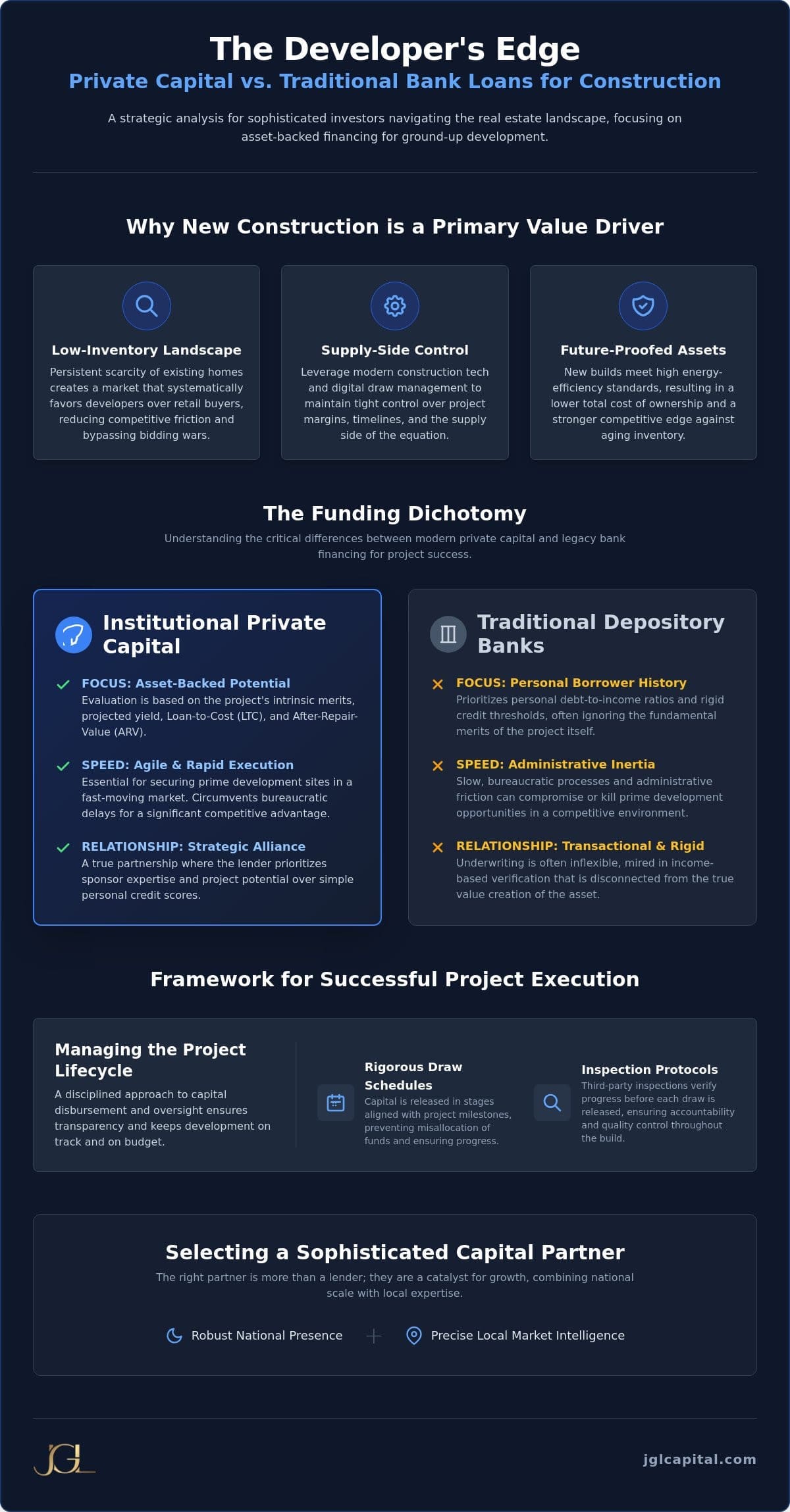
Strategic Comparison: Private Capital vs. Traditional Institutional Financing
Selecting a financial vehicle for ground-up development requires a nuanced understanding of the divergence between traditional depository institutions and specialized private capital providers. While many investors reflexively seek the lower nominal interest rates associated with commercial banks, this preference often ignores the systemic friction inherent in institutional bureaucracy. In the rebalancing market of 2026, the delta between a bank rate of 6.5% and a private capital rate of 10% is frequently offset by the agility required to secure and execute a project. Sophisticated stakeholders recognize that construction loans for investment properties are not merely debt instruments but are strategic components of a broader capital allocation plan where velocity and certainty of execution are the primary benchmarks of success.
Velocity of Capital as a Competitive Advantage
The administrative inertia typical of traditional banks often results in closing timelines that extend into months, a duration that can prove fatal for time-sensitive development opportunities. Private capital partners operate with a streamlined approval process that prioritizes the merits of the project over the exhaustive personal income verification required by institutional lenders. In 2026, where prime development sites are highly contested, the ability to close a loan in a matter of days rather than months provides a decisive advantage. This speed allows developers to lock in material costs and labor contracts with greater precision, mitigating the risks associated with the moderate inflation still present in the construction sector.
Navigating Complexity: LLCs and Multi-Entity Structures
Sophisticated investors rarely hold assets in their personal names, opting instead for complex multi-entity structures such as LLCs or specialized trusts to manage liability and facilitate tax efficiency. Traditional lenders often struggle with these arrangements, frequently reverting to a one-size-fits-all credit scoring model that fails to account for the strategic alignment of the sponsor’s portfolio. Private lenders excel in this environment by offering customized solutions that respect the integrity of the investor’s legal and fiscal framework. By focusing on the asset’s pro forma and the sponsor’s track record, private capital facilitates the use of construction loans for investment properties for high-net-worth stakeholders who require a more discreet and analytically rigorous partnership.
The true cost of capital is never limited to the interest rate alone; it must include the opportunity cost of delayed starts and the administrative burden of rigid compliance hurdles. When a project is sidelined by a bank’s committee-led decision-making process, the resulting loss in potential rental yield can far exceed the higher origination fees associated with private money. A disciplined approach to value preservation dictates that the certainty of a capital partner who understands the nuances of new construction is worth the premium. This transition from a transactional mindset to a strategic alliance ensures that the developer remains positioned to capitalize on the inventory gap that continues to define the 2026 real estate landscape.
Operational Excellence: Managing the Draw Schedule and Project Lifecycle
The operational success of a ground-up development is fundamentally tied to the precision of its capital disbursement. For those utilizing construction loans for investment properties, the draw schedule represents a critical roadmap that dictates the cadence of project funding. It’s a structured mechanism designed to ensure that the deployment of capital remains in perfect alignment with the physical evolution of the asset. By adhering to a disciplined draw schedule, developers can maintain the liquidity necessary to satisfy labor contracts and material suppliers without compromising the project’s overall fiscal stability. This phase of the project lifecycle demands a high degree of analytical rigor and a commitment to transparent communication between all stakeholders.
Mastering the Draw Request Process
A professional draw request process is characterized by transparency and meticulous documentation. Developers must provide a comprehensive package that includes a draw request form, corresponding invoices, and executed lien waivers for all subcontractors involved in the current phase. This level of detail allows for precise line-item tracking, ensuring that funds are allocated exactly as outlined in the initial pro forma. The role of the third-party inspector is central to this process, as they provide an objective verification of the work completed. This rigorous validation serves to protect the interests of both the sponsor and the capital partner, fostering a relationship built on accountability rather than speculation. It’s a far cry from the disorganized experiences common in less formal lending environments.
Risk Mitigation and Stewardship
Maintaining project solvency requires a strategic approach to the interest reserve and the allocation of hard and soft costs. The interest reserve functions as a vital buffer, allowing the developer to manage debt service without depleting the operational capital required for construction. In the rebalancing market of 2026, it’s essential to account for the potential of minor delays by establishing a robust contingency fund within the project budget. This proactive stance on risk mitigation is further enhanced by the use of digital draw management technology, which provides real-time visibility into the budget’s performance. Such tools allow for the early identification of cost overruns, enabling the sponsor to make informed adjustments before the project’s long-term value is compromised.
Establishing a partnership with a lender that understands the nuances of the construction lifecycle is paramount for the preservation of project worth. Sophisticated investors don’t just look for capital; they look for a disciplined steward of that capital who can provide the stability needed for complex builds. If you’re prepared to execute your next development with this level of precision, you can leverage institutional-grade construction capital to ensure your project remains on a steady path toward completion and long-term yield generation.
Collaborative Alliances: Selecting a Private Capital Partner for Ground-Up Development
The final phase of any strategic capital allocation involves the selection of a partner whose institutional expertise aligns with the developer’s long-term vision. For those utilizing construction loans for investment properties, the choice of lender is a decision that impacts the entire project lifecycle, from the initial site clearing to the final stabilization. A sophisticated partner must possess more than just capital; they require a deep-seated understanding of the construction process and a national footprint that’s balanced by acute local market awareness. This dual perspective ensures that the lender can provide the stability needed to navigate the complexities of the 2026 rebalancing market, where precise execution remains the only path to superior yield.
The Exit Strategy: Transitioning to Long-Term Holds
A disciplined approach to development necessitates a clear and viable exit strategy established well before the first draw request. Transitioning from a high-leverage construction phase to a stable, long-term hold requires a capital partner capable of facilitating a seamless migration to permanent financing. By leveraging rental property loans, investors can lock in post-construction stability and protect the equity created during the build. This transition often hinges on satisfying Debt Service Coverage Ratio (DSCR) requirements, which measure the property’s ability to cover its debt obligations through its generated income. Utilizing a single-source capital partner for both the construction and permanent phases reduces administrative friction and ensures that the strategic objectives of the project remain consistent throughout its duration.
The JGL Capital LLC Advantage
JGL Capital LLC represents the pinnacle of disciplined real estate stewardship, bringing over 30 years of industry expertise to every capital allocation. We prioritize the delivery of highly customized, individual solutions that address the unique requirements of high-net-worth stakeholders rather than offering generic, transactional services. Our commitment to analytical rigor ensures that every project is evaluated on its own merit, allowing for the execution of complex builds that traditional banks often overlook. By framing our relationships as a form of high-level strategic alliance, we provide the intellectual capital and fiscal support necessary to build lasting legacies in the modern market. If you’re seeking to fortify your 2026 development pipeline with a partner that values integrity and long-term growth, we invite you to inquire about our New Construction Loan programs today to begin a collaborative journey toward value creation.
Navigating the Future of Strategic Real Estate Development
The evolution of the 2026 real estate market demands a departure from traditional, friction-heavy financing toward a model of disciplined capital allocation. By prioritizing asset-backed metrics over personal income history, investors can unlock the agility required to execute ground-up projects in an inventory-constrained landscape. We’ve explored how a rigorous focus on draw schedules and the strategic transition to post-construction rental financing ensures the preservation of project worth. Utilizing construction loans for investment properties within this framework allows for the manufacturing of value that acquisition alone cannot provide.
JGL Capital LLC brings over 30 years of industry expertise to this collaborative process, offering a national reach and a streamlined approach to private capital allocation. Our methodology remains rooted in the fundamental value of the property, providing the stability and precision that high-stakes management requires. It’s time to align your development pipeline with a partner that values long-term stewardship and analytical rigor. We invite you to Secure Your Strategic Construction Capital with JGL Capital LLC and begin building your lasting legacy. Your vision for 2026 and beyond deserves a foundation of certainty and expertise.
Frequently Asked Questions
Can I get a construction loan for an investment property without a primary residence?
Yes, it is entirely possible to secure financing for a new build without owning a primary residence. Private lenders prioritize the projected performance and intrinsic value of the subject property rather than the borrower’s personal housing status. This asset-centric approach allows developers to allocate capital based on project feasibility, provided the sponsor demonstrates sufficient liquidity and a credible development track record. The focus remains on the generation of worth through the specific project at hand.
What is the typical down payment required for a private money construction loan?
Most private capital allocations require a down payment ranging from 20% to 30% of the total project cost. This requirement ensures that the sponsor maintains a meaningful equity position in the development, aligning the interests of the developer with those of the capital partner. Specific leverage thresholds are determined by the Loan-to-Cost (LTC) and Loan-to-Value (LTV) metrics established during the analytical underwriting phase. Maintaining this equity buffer is a fundamental principle of risk management for sophisticated builds.
How does a ground-up construction loan differ from a fix and flip loan?
A ground-up construction loan is designed for the vertical development of a new structure on vacant or cleared land, whereas a fix and flip loan facilitates the acquisition and renovation of existing improvements. Ground-up projects involve more complex draw schedules and rigorous inspections to validate progress from the foundation upward. These construction loans for investment properties require a more comprehensive pro forma analysis to account for the longer lifecycle and higher complexity of new builds in the 2026 market.
Are interest-only payments available during the construction phase?
Yes, interest-only payments are the standard structural preference during the construction phase of a project. This arrangement preserves the developer’s liquidity by requiring payments only on the capital that has been disbursed through the draw process. By minimizing debt service obligations during the non-income-producing period of the build, sponsors can maintain a more robust operational contingency fund. This steady approach to capital management ensures that resources remain focused on the physical execution of the project.
Do I need a general contractor to qualify for investment construction financing?
What documents are required to initiate the underwriting for a new build?
Initiating the underwriting process requires a comprehensive documentation package, including detailed architectural plans, a line-item construction budget, and a formal pro forma projection. Sponsors must also provide a track record of previous projects, the general contractor’s resume, and the legal entity documents for the borrowing LLC or Trust. This level of detail allows the capital partner to conduct a disciplined analysis of the project’s long-term value preservation. It ensures that every strategy is clearly defined before the allocation of capital begins.
Can I use a bridge loan for the initial land acquisition before construction?
Yes, a bridge loan is a highly effective strategic tool for securing a prime development site before the full construction financing is finalized. This allows the developer to close on the land acquisition with speed, ensuring the site is not lost to competitors during the entitlement or permitting phase. Once the project is ready for vertical development, the bridge loan is typically refinanced into the comprehensive construction facility. This method provides the agility needed to capitalize on time-sensitive opportunities in a low-inventory environment.
How does the lender determine the After Repair Value (ARV) for a new build?
The After Repair Value, or as-completed value, is determined through a rigorous appraisal process that evaluates the architectural plans against current market comparables. The appraiser considers the projected rental yields and the quality of the proposed finishes to establish a credible market valuation for the finished asset. This forward-looking metric is essential for determining the appropriate leverage for construction loans for investment properties. It provides a foundation of analytical rigor that guides the entire capital allocation strategy.