

Scaling a real estate portfolio requires a fundamental shift from individual asset management to a sophisticated framework of operational liquidity. Understanding how to get a second fix and flip loan is less about replicating your initial success and more about demonstrating the institutional capacity to manage concurrent obligations. While your first deal relied heavily on the underlying asset, secondary financing demands a rigorous evaluation of your operational track record and capital reserves. This transition marks the point where an investor moves from simple project execution to disciplined portfolio stewardship.
You’ve likely realized that capital constraints become more pronounced as you transition from a single project to a multi-asset portfolio. It’s a common challenge where increased scrutiny on liquidity can hinder your momentum. This article outlines the analytical framework and procedural requirements necessary to secure secondary funding for your investment trajectory. We’ll explore how your professional experience translates into more favorable loan terms and the specific benchmarks required to satisfy a capital partner’s scrutiny. By the end, you’ll possess a clear roadmap for managing multiple asset-backed obligations while maintaining the stability required for long-term wealth preservation.
Key Takeaways
- Transitioning to a diversified portfolio requires moving beyond asset-based trust toward a comprehensive demonstration of operational capacity and institutional discipline.
- Understand the procedural requirements of how to get a second fix and flip loan, specifically focusing on the elevation of liquidity thresholds and the verification of prior unit completions.
- Analyze the strategic implications of simultaneous versus consecutive project funding to determine the most efficient method for the preservation and deployment of capital.
- Develop an institutional-grade investment summary that includes detailed construction budgets and timelines to facilitate the rigorous underwriting process required for secondary financing.
- Align your long-term growth objectives with a capital partner that values property viability and established track records over traditional credit metrics.
Navigating the Transition to Multi-Project Real Estate Financing
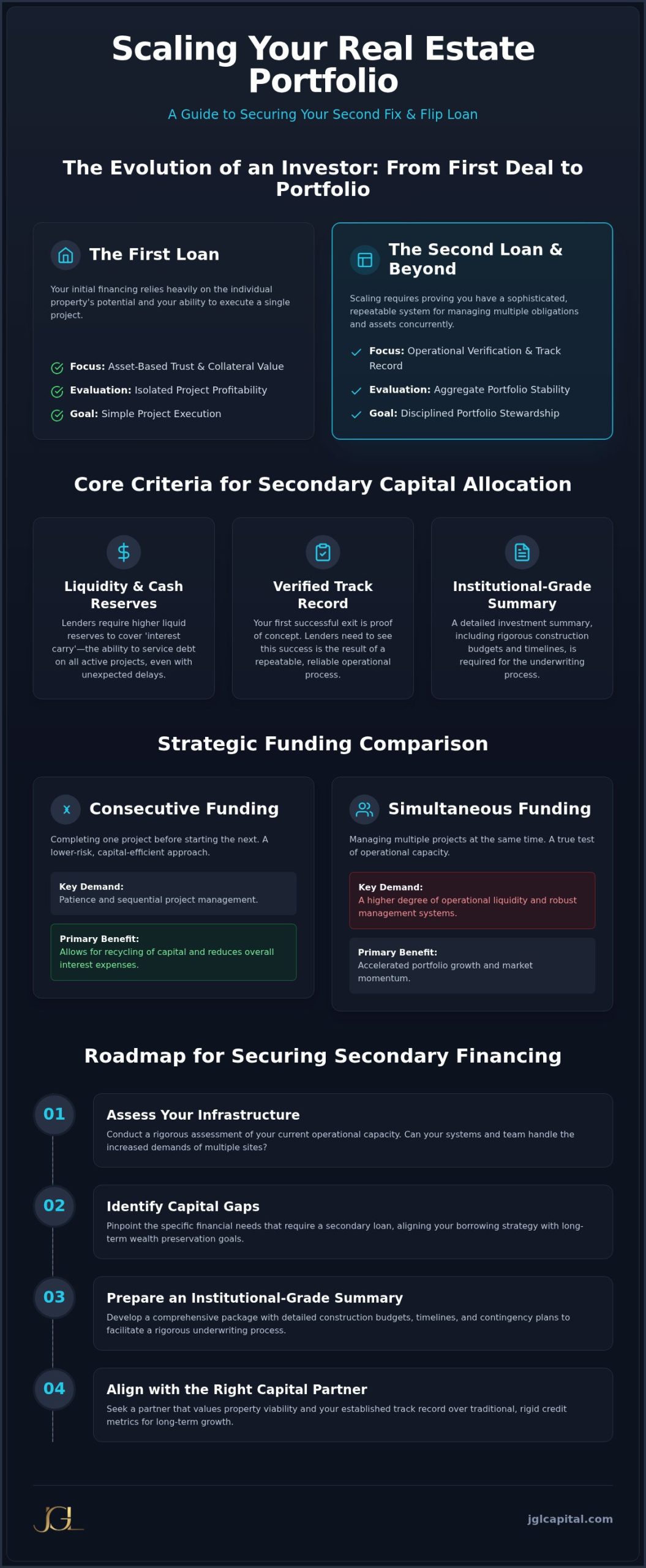
The strategic evolution from a single-asset focus to a diversified project portfolio represents a significant inflection point in an investor’s professional trajectory. Lenders do not merely view the second application as a repetition of the first; instead, it’s perceived as a critical milestone that tests the scalability of your operational model. When you’re analyzing how to get a second fix and flip loan, you must understand that the focus shifts from the isolated profitability of a single property to the aggregate stability of your entire enterprise. This transition requires a disciplined approach to capital allocation and a fundamental understanding of the institutional perspective on risk mitigation for repeat borrowers.
There’s a vital distinction between consecutive project funding and concurrent project management that dictates your financing strategy. Consecutive funding allows for the recycling of capital and a reduction of interest expenses, whereas concurrent management demands a higher degree of operational liquidity. Institutional partners evaluate the second loan as a stress test of your capacity to oversee multiple construction timelines without compromising the integrity of either project. Your ability to articulate this strategy clearly is what separates a transactional borrower from a sophisticated partner.
The Shift from Asset-Based Trust to Operational Verification
While the initial acquisition often relies heavily on the inherent value of the collateral, the second engagement requires a more robust demonstration of your internal systems. Your first successful exit serves as primary evidence of strategic competence, yet it’s the consistency of your execution that establishes true credibility within private capital circles. Institutional underwriters seek to verify that your success wasn’t an anomaly, but rather the result of repeatable processes that can withstand the complexity of managing two active construction sites. This shift in scrutiny means your track record becomes a quantifiable metric of your reliability as a steward of capital.
Defining Your Scaling Objectives for 2026
As you define your scaling objectives for 2026, it’s imperative to conduct a rigorous assessment of your current infrastructure to ensure it can support the increased demands of multiple sites. Identifying the specific capital gaps that necessitate a secondary private money injection is a fundamental step in aligning your borrowing strategy with long-term wealth preservation goals. This disciplined approach ensures that your expansion is supported by analytical rigor rather than speculative momentum. To successfully secure additional funding, you must demonstrate how this second project integrates into a broader vision of portfolio growth. Understanding how to get a second fix and flip loan is ultimately about proving that your enterprise can manage the increased scrutiny on liquidity and operational capacity that comes with institutional-grade scaling.
Evaluating the Core Criteria for Secondary Capital Allocation
The transition from a primary investment to a multi-asset portfolio necessitates a significant elevation in the criteria used for capital allocation. Understanding how to get a second fix and flip loan involves recognizing that lenders now prioritize your aggregate liquidity over the speculative value of the individual property. It’s a rigorous process. While your first deal may have been approved based on the strength of the collateral, the second requires a comprehensive evaluation of your enterprise’s operational capacity. This shift ensures that the addition of a new note does not jeopardize the stability of your existing obligations. Underwriters look for a disciplined approach to risk management that transcends simple project execution.
Liquidity and Cash Reserves: The Safety Margin
When holding multiple active notes, the requirement for liquid capital increases proportionally to the total debt service. Lenders specifically analyze your ‘interest carry’ capacity, which is the ability to maintain monthly payments on all simultaneous obligations even if a project timeline extends beyond the original projection. It’s common for institutional partners to require a higher percentage of liquid reserves for a second project to mitigate the risk of systemic cash flow interruptions. Documenting this proof of funds requires a meticulous presentation of various investment accounts, ensuring that your capital remains accessible for unforeseen construction contingencies. Engaging with a private money broker who understands these nuances can facilitate the alignment of your operational goals with the necessary capital structures.
The Institutional Importance of the Track Record
Your previous performance is the most reliable predictor of future success in the eyes of a capital partner. A ‘HUD-1’ or ‘Closing Disclosure’ from your initial flip acts as your strongest credential, providing empirical evidence of your ability to manage a project from acquisition to exit. Lenders typically categorize investors into specific tiers based on their volume of completed units:
- Emerging: Investors with one to two successful exits, often subject to more conservative leverage.
- Professional: Those with three to ten completed units who qualify for more favorable interest rates.
- High-Volume: Entities managing ten or more assets annually with access to institutional-grade credit lines.
The efficiency of your previous project timelines directly impacts the terms of your secondary financing. If your first project was completed within the projected window, it signals a high level of management depth. Conversely, significant delays on prior projects may lead to more stringent oversight or higher interest carry requirements. Underwriters also apply a more conservative multiplier to the After Repair Value (ARV) when concurrent projects are involved. This ensures that market fluctuations don’t compromise the integrity of the entire portfolio, reinforcing the need for a seasoned approach to asset valuation.
Strategic Comparison: Simultaneous vs. Consecutive Project Funding
Choosing between simultaneous and consecutive project funding is a decision that requires a rigorous assessment of your firm’s operational capacity and the prevailing market conditions. When you’re determining how to get a second fix and flip loan, you must weigh the potential for increased yield against the heightened risk of managing two active construction sites. Simultaneous funding allows an organization to capture market opportunities in high-demand environments where waiting for a project exit might result in losing a prime asset to a competitor. However, this path demands a sophisticated management infrastructure to oversee overlapping timelines and financial obligations without compromising quality.
Consulting with a private money broker is often the most prudent step to determine the optimal capital structure for your specific situation. These professionals provide the analytical rigor necessary to ensure that your chosen path aligns with your long-term wealth preservation goals. They act as strategic intermediaries, aligning your current liquidity with the most appropriate institutional capital sources.
Simultaneous Funding: Maximizing Market Momentum
Executing multiple projects concurrently necessitates a dedicated project management team or a highly reliable general contractor capable of handling the logistical complexities. Managing the draw schedule becomes significantly more intricate when multiple sites require funding disbursements at once, as any delay in one project’s inspection could potentially impact the liquidity available for the other. Many sophisticated investors utilize bridge loans to secure a second property while their primary project is currently in escrow. This strategy provides the transitional capital needed to maintain acquisition momentum without waiting for the final liquidation of the initial asset, allowing for a more aggressive expansion strategy.
Consecutive Funding: A Disciplined Approach to Scaling
For many investors, a consecutive approach offers a more disciplined path to scaling that prioritizes the reduction of interest expenses and the recycling of capital. By leveraging the profit from a completed project, you can significantly reduce the Loan-to-Cost (LTC) ratio on your subsequent acquisition, which often results in more favorable borrowing terms. A successful exit from your first project serves as a powerful proof point, improving your leverage and overall credibility for the next allocation of capital. This method minimizes the carrying cost burden by focusing your operational attention on one execution at a time, ensuring that each project receives the meticulous oversight required to maximize its after-repair value. Understanding how to get a second fix and flip loan through a sequential model allows for a steady, cumulative growth of your portfolio while maintaining a conservative risk profile.
The Procedural Framework for Securing Your Second Loan
The procedural framework for securing secondary financing is an exercise in meticulous documentation and analytical precision. When you’re assessing how to get a second fix and flip loan, the application package must evolve from a basic property overview into an institutional-grade investment summary. This summary serves as the primary instrument through which a capital partner evaluates your operational maturity. It’s not enough to simply present a profitable deal; you must demonstrate a disciplined methodology that accounts for every variable in the construction lifecycle. Mastering how to get a second fix and flip loan is ultimately a test of your firm’s administrative discipline and its ability to present a compelling case for capital stewardship.
Initiating this formal process through a specialized private money broker ensures that your proposal is positioned for maximum alignment with institutional underwriting standards. This collaborative relationship allows you to refine your presentation, ensuring that every strategic objective is clearly articulated and every risk is properly mitigated before it reaches the underwriter’s desk.
Step 1: Documentation of Previous Performance
Your first successful exit is no longer just a memory; it’s a quantifiable data point that serves as your most persuasive credential. You must compile a comprehensive dossier of previous performance that includes professional before-and-after photography alongside final accounting statements. Providing empirical evidence of budget adherence and timeline management proves that your execution is rooted in sound real estate investing fundamentals. Lenders scrutinize these records to ensure that your previous success was the result of systemic oversight rather than favorable market volatility.
Step 2: Detailed Project Analysis for the New Asset
Securing a second allocation requires a rigorous After Repair Value (ARV) analysis based on current 2026 market comparables. You should draft a line-item construction budget that includes specific allowances for potential contingencies, reflecting a seasoned understanding of material and labor fluctuations. A firm exit strategy is equally vital to the underwriting process. Whether you intend to liquidate through a retail sale or transition the asset into a long-term rental property loan, your underwriters need to see a clearly defined path to capital redemption that accounts for various market scenarios.
Step 3: Verification of Financial Capacity
The final phase involves a transparent verification of your financial capacity to sustain multiple concurrent obligations without compromising your operational integrity. You’ll need to submit updated bank statements that clearly show liquid reserves dedicated to interest carry for the duration of the project. As you review the current hard money lenders landscape, it’s evident that the most competitive terms are reserved for those who present a clean, verified financial profile. Finalizing this structure with a dedicated broker allows you to optimize your leverage while maintaining a conservative risk posture.
To begin your transition from individual projects to a scaled portfolio, you can apply with JGL Capital to secure the specialized brokerage services required for sophisticated capital allocation.
Aligning with JGL Capital for Sophisticated Portfolio Expansion
Partnering with a brokerage that possesses over thirty years of industry expertise offers a definitive advantage in the pursuit of institutional-grade financing. JGL Capital operates as a disciplined steward of capital, prioritizing the intrinsic viability of the real estate asset and the demonstrated track record of the investor over traditional, often restrictive credit metrics. This philosophy ensures that sophisticated investors, who may face capital constraints while scaling, are evaluated on their operational merits and strategic execution. When considering how to get a second fix and flip loan, the alignment of your strategic objectives with a seasoned capital partner is the most critical factor in achieving sustainable portfolio growth. It’s a disciplined approach to value creation.
Accessing a diverse range of private capital sources allows for a level of flexibility that traditional banking institutions simply cannot replicate. JGL Capital serves as a quiet expert, utilizing its established history and intellectual capital to facilitate sophisticated capital allocation for fix-and-flip, new construction, and bridge loans. By focusing on property value and investor experience, we provide a streamlined alternative to conventional lending that values the preservation of your momentum. This commitment to timeless principles and a rejection of speculative trends solidifies our position as a knowledgeable entity capable of supporting high-stakes real estate development.
Customized Capital Solutions for Repeat Borrowers
Tailoring loan terms to match the specific cash flow requirements of an expanding portfolio is essential for maintaining liquidity across multiple construction sites. JGL Capital facilitates a streamlined underwriting process that’s specifically designed for fast, asset-backed funding, allowing you to secure secondary properties with the precision required in competitive markets. By leveraging our deep expertise in fix and flip loans, you can optimize your leverage and ensure that each project is supported by a capital structure that enhances your overall performance metrics. We prioritize the generation of worth through highly customized, individual solutions for every borrower.
A Collaborative Partnership for Long-Term Growth
Moving beyond the limitations of transactional lending, JGL Capital fosters a high-level strategic alliance that serves as the foundation for long-term wealth creation. Our national reach supports your expansion into new markets across the United States, providing a stable source of private capital that adapts to your evolving needs. This collaborative relationship transforms the borrowing process into an investment in your professional legacy, where your history of successful project management translates into more favorable terms. Understanding how to get a second fix and flip loan is ultimately about identifying a partner that values integrity and long-term stability as much as you do. Initiating your next acquisition with the confidence of a professional capital partner allows you to focus on the meticulous execution required to maximize your portfolio’s potential.
Advancing Your Institutional Real Estate Strategy
Transitioning from a single-asset focus to a diversified portfolio is a testament to an investor’s operational maturity and strategic foresight. Success in this phase depends on your ability to present a rigorous analytical framework that satisfies the elevated scrutiny of institutional capital partners. By prioritizing liquidity, documenting a consistent track record of execution, and selecting an optimal funding timeline, you establish the foundation for sustainable growth. Mastering how to get a second fix and flip loan is ultimately about evolving from a project-level mindset to one of disciplined portfolio stewardship.
Achieving this level of scale requires a partner that understands the nuances of high-stakes management. You can secure your secondary fix and flip funding through JGL Capital’s expert brokerage services. We provide national coverage for sophisticated investors across the United States. This allows you to leverage over 30 years of strategic real estate financing expertise. It’s time to align your objectives with a firm that values integrity and long-term value preservation. Your next project represents more than just a transaction; it’s the next chapter in your professional legacy.
Frequently Asked Questions
Can I have two fix and flip loans at the same time?
Yes, investors can maintain multiple concurrent obligations provided they demonstrate the operational capacity to manage overlapping construction timelines. When researching how to get a second fix and flip loan, you’ll find that lenders prioritize your liquidity and management depth. This ensures that the addition of a secondary asset does not compromise the stability of your existing portfolio or jeopardize the completion of your initial project.
Does getting a second fix and flip loan require a higher credit score?
A higher credit score is typically not a prerequisite for secondary financing because private money brokers prioritize asset quality and investor experience. While traditional institutions rely on personal credit metrics, sophisticated capital partners focus on your ability to execute a profitable exit. Your demonstrated track record of project completion serves as a more reliable indicator of risk mitigation than a personal credit profile alone.
How much liquid cash do I need to hold for a second fix and flip loan?
You must maintain sufficient liquid reserves to cover the down payment, closing costs, and interest carry for all active obligations. Lenders generally require a higher percentage of liquid capital for a second project to ensure you can sustain concurrent monthly payments even if timelines extend. This safety margin protects your enterprise from systemic cash flow interruptions during the construction phase of multiple properties.
Will my interest rate decrease on my second fix and flip loan?
Interest rates often decrease as an investor transitions into higher experience tiers through successful project completions. A documented history of budget adherence and timely exits allows you to qualify for more favorable terms on your subsequent allocations. Lenders view your established track record as a quantifiable reduction in risk, which justifies a lower cost of capital for your second fix and flip loan.
Can I use the profit from my first flip as a down payment for the second?
Profit from an initial project can be utilized as a down payment for a second acquisition once the first asset has been liquidated. This strategy allows for the efficient recycling of capital and can significantly reduce your Loan-to-Cost (LTC) ratio on the new asset. Using realized gains demonstrates a disciplined approach to wealth creation and reinforces your position as a sophisticated steward of investment capital.
What documents are required to prove my experience as a house flipper?
Proving your experience requires a comprehensive dossier including ‘HUD-1’ or ‘Closing Disclosure’ statements from previous transactions. You should also provide professional before-and-after photography along with detailed accounting records that show adherence to original construction budgets. These documents provide empirical evidence of your strategic competence and are vital for securing institutional-grade capital for your expanding real estate portfolio.
How does the lender calculate the ARV for my second project?
Lenders calculate the After Repair Value (ARV) through a rigorous analysis of current market comparables, often applying a more conservative multiplier for multi-project portfolios. This analytical approach ensures that your leverage remains sustainable despite potential market fluctuations. Underwriters scrutinize these values to protect the integrity of the collateral and ensure that your exit strategy remains viable under various economic conditions.
What happens if my first project hasn’t sold yet when I apply for a second loan?
If your first project remains active, the lender will perform a stress test on your total operational liquidity to ensure you can carry both notes. You’ll need to provide evidence of sufficient reserves to cover the monthly debt service for both projects until the initial asset is sold. This requirement ensures that your expansion is supported by analytical rigor rather than speculative momentum.