

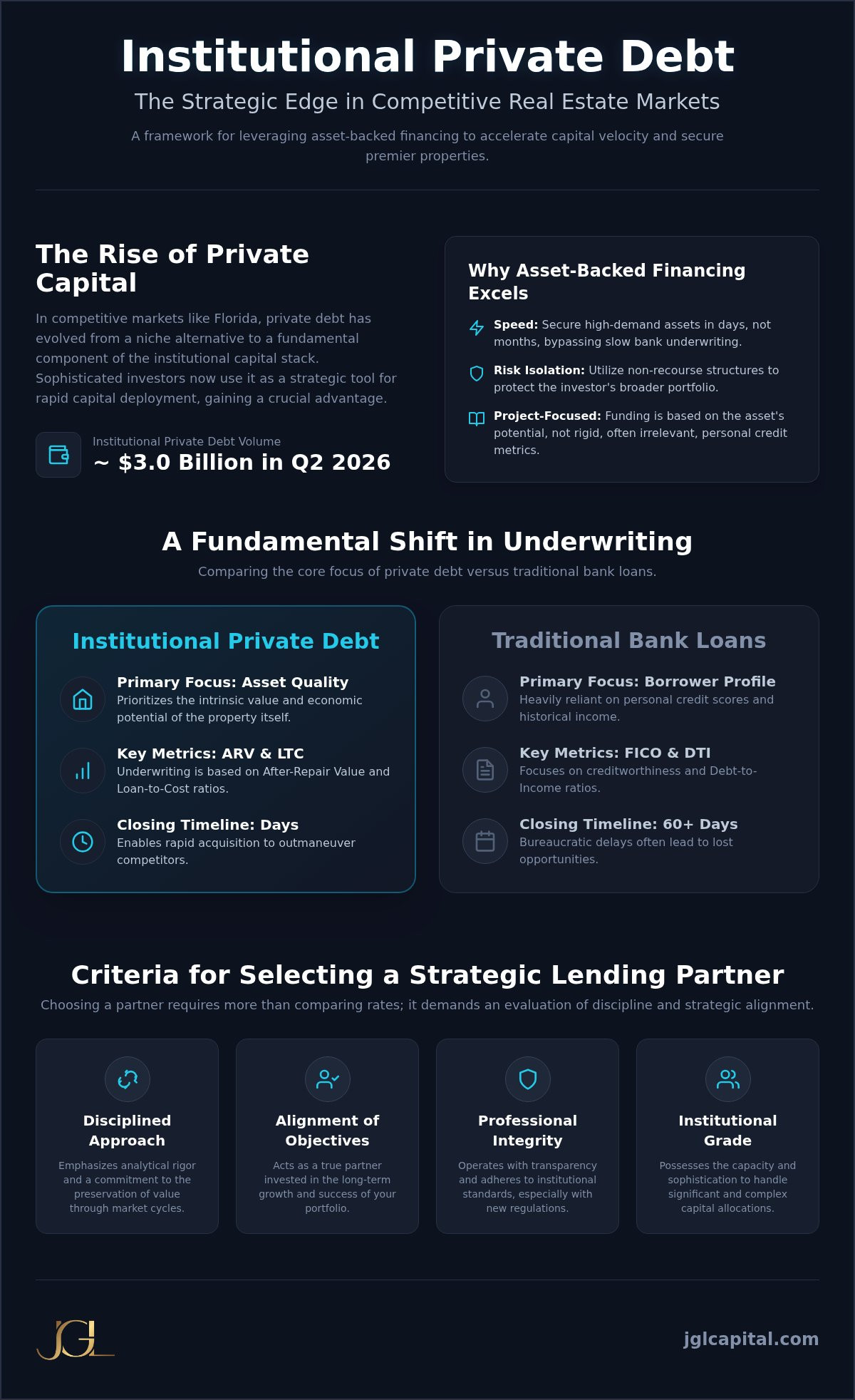
The pursuit of superior risk-adjusted returns in the real estate sector requires more than just capital; it necessitates a disciplined approach to leverage that prioritizes asset quality over traditional borrower constraints. As institutional volume in the private debt space reached approximately $3.0 billion in the second quarter of 2026, it’s evident that sophisticated investors are increasingly bypassing the inherent delays of traditional bank underwriting. Engaging with professional florida hard money brokers has transitioned from a tactical necessity to a strategic advantage for those managing high-stakes portfolios across the nation. You’re likely aware that the efficiency of your capital stack often determines the ultimate success of a multi-family or new construction project. This article provides a comprehensive framework for leveraging institutional-grade private debt to accelerate capital velocity and secure premier assets in competitive markets nationwide. We’ll explore the nuances of asset-backed funding, the impact of recent FinCEN reporting regulations, and the methodology for selecting a strategic partner who values long-term growth and professional integrity.
Key Takeaways
- Analyze the strategic deployment of institutional-grade private debt to maintain capital velocity within the competitive Florida real estate landscape.
- Discover how seasoned florida hard money brokers utilize property intrinsic value to circumvent the structural inefficiencies of traditional bank underwriting.
- Master the technical nuances of asset-backed underwriting, focusing on the optimization of After-Repair Value (ARV) and Loan-to-Cost (LTC) metrics for complex developments.
- Develop a sophisticated framework for capital stack allocation that balances the immediate cost of capital against the long-term opportunity cost of delayed acquisition.
- Establish rigorous criteria for selecting a strategic lending partner who demonstrates a disciplined approach to value preservation and alignment of objectives.
Florida Hard Money Lenders: Private Capital in 2026
A Hard money loan is defined as a short-term, asset-backed debt instrument issued by private entities or specialized investment firms rather than traditional depository institutions. In the 2026 fiscal year, this form of capital has transitioned from a niche alternative into a fundamental component of the institutional capital stack. Florida’s real estate environment remains characterized by intense competition and acute land scarcity, particularly within the South Florida tri-county area and the I-4 corridor. Such conditions necessitate rapid capital deployment. Sophisticated investors utilize private debt not as a last resort, but as strategic transitional capital to secure high-demand assets before traditional bank underwriting can even initiate its preliminary review. This evolution reflects a disciplined approach to capital velocity, where the ability to close in a matter of days serves as a primary competitive advantage.
The fundamental metric in this space is the intrinsic value of the underlying collateral. While commercial banks focus extensively on borrower credit scores and historical personal income, florida hard money brokers prioritize the property’s current and future valuation. This shift allows for the funding of complex projects based on analytical rigor and property potential rather than rigid, often irrelevant, credit requirements. It’s an approach that respects the gravity of high-stakes management and the necessity of securing assets that possess genuine worth.
The Evolution of Private Lending in the Florida Market
The private debt market in Florida has achieved a level of maturity that mirrors traditional fixed-income sectors. Regulatory transparency, bolstered by the federal reporting requirements effective March 1, 2026, has institutionalized the reporting of beneficial ownership. This environment attracts significant capital from pension funds and family offices seeking stable, asset-backed returns. There’s a clear distinction between small-scale, localized lenders and institutional-grade florida hard money brokers who provide the sophisticated syntax and strategic alignment required for significant capital allocations. These professional entities act as disciplined stewards, ensuring that every claim is qualified and every strategy is clearly defined through market cycles.
Why Asset-Backed Financing Outperforms Traditional Mortgages
Traditional banking bureaucracies often lack the agility required for modern real estate investing strategies that demand immediate action. While a conventional mortgage might require sixty days for approval, private asset-backed structures can be finalized with remarkable speed. Professional hard money debt frequently utilizes non-recourse or limited-recourse structures. This effectively isolates risk to the specific asset, protecting the investor’s broader portfolio. Such structures are vital for stakeholders who value the preservation of value while pursuing aggressive growth in new construction or multi-family sectors.
The Mechanics of Asset-Backed Lending: Institutional Standards and Underwriting
Institutional private lending operates on a foundation of analytical rigor that distinguishes it from the more transactional approach of retail finance. While traditional lenders remain tethered to the personal credit history of the individual, professional florida hard money brokers prioritize the intrinsic value and economic potential of the real estate asset. This methodology centers on two critical metrics: After-Repair Value (ARV) and Loan-to-Cost (LTC) ratios. By evaluating these figures with precision, lenders determine the project’s viability and the necessary capital cushion required to withstand market fluctuations. Understanding How Hard Money Works within this professional framework allows investors to align their financing needs with the specific risk profile of their asset.
The underwriting for new construction loans involves a meticulous review of site plans, permits, and budget projections. A primary component of this process is the establishment of a disciplined draw schedule. These schedules ensure that capital is released in phases as specific construction milestones are achieved, thereby preserving the lender’s position and ensuring the project remains capitalized through completion. A professional broker acts as a strategic intermediary, sourcing capital from diverse private pools to match the unique requirements of high-value developments. This expertise is particularly valuable when structuring complex multi-family acquisitions where project feasibility and borrower experience carry more weight than a personal FICO score. If you require a partner to navigate these technical requirements, consult with a strategic capital advisor to review your project’s merits.
Valuation Methodologies for Professional Investors
Standard appraisals often fail to capture the nuances of a high-stakes development. Institutional lenders instead rely on investment-focused feasibility studies that analyze market absorption rates and competitive positioning. This is especially true for multi-family and commercial assets where the future income stream is the primary security. Transparency in the points and fees structure at closing is a non-negotiable standard. It ensures that all stakeholders have a clear understanding of the cost of capital before the transaction is finalized, avoiding the ambiguity often found with smaller lenders.
Risk Mitigation and Capital Preservation
Strategic lenders protect their capital through senior lien status, providing a clear priority of repayment. To further mitigate risk, professional underwriting often requires the establishment of interest reserves and escrow accounts for taxes and insurance. These mechanisms ensure that the project remains financially stable during the transitional phase. The administrative tasks involved in professional underwriting are exhaustive. They require precise document preparation and a thorough review of title and environmental reports to ensure a secure and disciplined allocation of capital.
Evaluating the Capital Stack: Hard Money vs. Traditional Institutional Debt
Strategic capital allocation requires a rigorous comparison between the nominal interest rate and the total economic impact of project delays. While traditional institutional debt offers a lower cost of capital, its rigid underwriting often results in missed acquisitions and stalled construction timelines. Sophisticated investors recognize that the premium paid for private debt is frequently offset by the preservation of project momentum. By utilizing florida hard money brokers, developers can secure non-stabilized assets that fall outside the narrow risk parameters of conventional banking. This flexibility is essential for high-value acquisitions where the property’s intrinsic worth hasn’t yet been realized through stabilization or renovation. Adherence to rigorous Asset-Backed Lending Standards ensures that this capital remains a disciplined tool for value creation rather than a speculative risk.
The impact of capital velocity on the overall internal rate of return (IRR) can’t be overstated. When a project is funded quickly, the entire development cycle is compressed, allowing for an earlier exit or refinancing. This acceleration often yields a higher net present value than a project burdened by the administrative inertia of a traditional bank. It’s a matter of choosing the right tool for a specific phase of the investment lifecycle.
The True Cost of Capital Velocity
Capital velocity is defined as the measurement of how quickly an investor can deploy, recover, and redeploy capital across a sequence of projects to maximize annual compounded returns.
Shorter closing cycles empower investors to submit aggressive, non-contingent bids that are often prioritized by sellers in the competitive Florida landscape. There’s also a significant trade-off to consider regarding equity dilution. While private debt carries a higher interest expense, it allows the sponsor to retain a larger ownership stake by avoiding the need for high-cost equity partners who demand permanent participation in the project’s upside. It’s often more cost-effective to pay a higher interest rate for twelve months than to surrender twenty percent of the project’s terminal value.
Transitional Financing for Multi-Family and Commercial Assets
Transitional financing serves as a vital bridge for multi-family and commercial assets during the critical lease-up phase. A bridge loan provides the necessary liquidity to reach stabilized occupancy levels, at which point the asset becomes eligible for permanent Agency or DSCR financing. This strategic progression maximizes the long-term value of the investment while maintaining flexibility during the development cycle. JGL Capital LLC excels in orchestrating these transitions, acting as a seasoned broker to align specific project risks with the most appropriate private capital sources. The firm’s role as a disciplined steward ensures that the transition from transitional debt to long-term financing is executed with precision and strategic foresight.
Criteria for Selecting a Strategic Private Lending Partner in Florida
Selecting a lending partner for high-stakes capital management requires a level of scrutiny that extends far beyond mere interest rate comparisons. Within the intricate Florida market, the distinction between transactional lenders and seasoned florida hard money brokers is defined by a firm’s historical performance through diverse market cycles. A disciplined steward of capital provides more than just immediate liquidity; they offer a stable foundation for the preservation and creation of value. When evaluating a potential ally, investors must verify the firm’s industry tenure and their specific expertise within the targeted asset class. This verification is particularly critical when managing fix and flip loans in Florida, where the inherent complexity of renovation budgets and specific market timing demands a partner who understands local regulatory and economic nuances. Professionalism is mirrored in the firm’s communication. A preference for precise industry-specific language and transparent syntax signals a commitment to timeless principles over speculative trends.
Due Diligence on the Lending Entity
A stable lending entity projects the persona of a quiet expert, relying on deep-seated intellectual capital rather than aggressive marketing hyperbole. Investors should prioritize florida hard money brokers with significant industry tenure, as a history spanning over 30 years provides superior market access and a proven ability to navigate institutional volatility. Verification of a firm’s national reach and established institutional relationships is essential to ensure they can scale alongside a sophisticated portfolio. Predatory lenders often mask rigid requirements with superficial promises, whereas a strategic partner provides the analytical rigor necessary for high-value capital allocations. It’s vital to identify firms that prioritize the project’s intrinsic worth over the borrower’s personal financial history.
Alignment of Strategic Objectives
The alignment of objectives serves as the linguistic signature of a genuine strategic alliance. This synchronization is most visible in the draw process, where the lender’s disbursement timeline must mirror the project’s construction phases with absolute precision. A failure to align these elements can lead to significant delays in the development cycle, compromising the ultimate internal rate of return. Sophisticated partners require customized, individual solutions that respect the unique profile of each asset rather than generic products. This approach ensures that every claim is qualified and every strategy is clearly defined. To ensure your capital management strategy is supported by this level of professional expertise, engage JGL Capital LLC for strategic private money broker services. By establishing a relationship with a partner who values long-term growth and integrity, you secure a legacy of success in the Florida market.
JGL Capital LLC: Bespoke Transitional Financing and Strategic Alliances
As established throughout this guide, the Florida landscape in 2026 demands a level of precision that traditional institutions struggle to provide. JGL Capital LLC operates as a disciplined steward of capital, specializing in the asset-backed financing structures necessary for large-scale development. By emphasizing property intrinsic value over individual credit history, the firm removes the friction common in high-stakes capital allocation. This specialization in New Construction, Multi-Family, and Bridge Loans ensures that sophisticated partners receive the technical expertise required for their specific asset class. Leveraging a 30-year legacy of industry expertise, JGL Capital LLC provides the stability and institutional rigor necessary to navigate volatile market cycles with confidence.
Our Approach to Capital Allocation
The underwriting process at JGL Capital LLC is guided by a methodical presentation of strategic principles rather than transactional volume. We function as a seasoned ally for investors focused on building lasting legacies, moving beyond simple service provision to form high-level strategic alliances. This personality is defined by a sense of exclusivity and a focus on deliberate, careful action. We invite sophisticated stakeholders to initiate a dialogue regarding their next project, ensuring that every claim is qualified and every objective is aligned for long-term growth. By framing our activities as a form of high-level strategic alliance, we carve out a distinct identity as a collaborative and deeply invested partner.
Securing Your 2026 Florida Investment
Navigating the complexities of the current market requires financing that is both fast and reliable. JGL Capital LLC maintains the national reach and institutional capital necessary to fund diverse residential and commercial projects without the bureaucratic delays of traditional banking. Our ability to provide customized, individual solutions allows for a seamless transition from acquisition to stabilization. To secure a professional assessment of your capital needs, engage JGL Capital LLC today. Partnering with professional florida hard money brokers who prioritize analytical rigor over marketing hyperbole is the most secure path to optimizing your 2026 capital stack and ensuring the generation of worth for your portfolio.
Orchestrating Strategic Capital Allocation in the 2026 Florida Market
The 2026 Florida real estate sector demands a disciplined approach to capital stack management, where the speed of execution and asset-based valuation serve as the primary drivers of worth. We’ve explored how institutional-grade private debt functions as a precision instrument, allowing investors to bypass traditional bureaucratic delays while focusing on the intrinsic value of high-stakes developments. Selecting a partner among the various florida hard money brokers requires a commitment to analytical rigor and a rejection of speculative trends. JGL Capital LLC offers over 30 years of industry leadership, providing a national reach and deep-seated expertise in complex New Construction and Multi-Family financing. By prioritizing property value over credit history, we ensure that your capital velocity remains optimized throughout the development lifecycle. We invite you to Initiate a Strategic Consultation with JGL Capital LLC to review your upcoming project requirements. Your pursuit of a lasting legacy and value preservation is supported by our seasoned expertise and disciplined stewardship. We look forward to aligning our strategic objectives with your vision for growth.
Frequently Asked Questions
What are the primary requirements for securing a hard money loan in Florida in 2026?
The primary requirements for securing private capital in 2026 focus on the property’s intrinsic value and a clearly defined exit strategy. Investors must provide comprehensive documentation regarding the asset’s potential, alongside compliance with the federal FinCEN reporting requirements that became effective on March 1, 2026. While traditional lenders demand exhaustive personal financial history, professional private debt providers prioritize the project’s feasibility and the sponsor’s experience in managing similar high-stakes developments.
How do hard money lenders evaluate property value for new construction projects?
Lenders evaluate new construction through a disciplined analysis of After-Repair Value (ARV) and Loan-to-Cost (LTC) ratios. Rather than relying on standard residential appraisals, they utilize investment-focused feasibility studies to project future market absorption and income potential. This analytical rigor ensures that the capital allocation is supported by the project’s economic reality, allowing for the release of funds through a structured draw schedule as construction milestones are achieved.
Can an investor use a bridge loan for a multi-family property acquisition?
Yes, a bridge loan is a strategic instrument frequently utilized to secure multi-family assets during the acquisition and transitional phases. This form of financing provides the necessary liquidity to purchase a non-stabilized property, allowing the investor to implement value-add strategies before transitioning to long-term Agency or DSCR financing. It’s an essential tool for maintaining capital velocity in Florida’s competitive multi-family sector.
What is the typical duration of a private money real estate loan?
The typical duration of a private money real estate loan ranges from six to twenty-four months, reflecting its role as transitional capital. These short-term debt structures are designed to facilitate specific project phases, such as acquisition, renovation, or construction, rather than serving as permanent financing. This limited duration allows sophisticated stakeholders to execute their business plans and either sell the asset or refinance into a lower-cost, long-term debt instrument.
How does hard money financing differ from a traditional commercial bank loan?
Hard money financing differs from traditional commercial loans by prioritizing the asset’s collateral value over the borrower’s personal creditworthiness. While traditional banks are characterized by bureaucratic delays and rigid underwriting, professional florida hard money brokers offer rapid capital deployment and customized debt structures. This flexibility allows investors to secure distressed or high-demand assets that don’t meet the narrow criteria of deposit-taking institutions.
Is personal credit a factor when applying for asset-backed financing?
Personal credit is generally a secondary consideration in the underwriting of asset-backed financing. The primary focus remains on the property’s current and future valuation, alongside the investor’s historical performance in managing similar asset classes. This approach allows for the funding of lucrative projects that may be overlooked by traditional institutions due to technical credit constraints, focusing instead on the generation of worth.
What are points and how are they structured in hard money transactions?
Points represent origination fees calculated as a percentage of the total loan amount, which are typically paid to the lender at the time of closing. In professional private debt transactions, these fees are clearly disclosed and structured to ensure the alignment of objectives between the lender and the borrower. They serve as part of the total cost of capital, which must be weighed against the opportunity cost of project delays.
Why should a professional developer choose a private money broker over a direct lender?
A professional developer should choose a broker to gain access to a broader spectrum of capital sources and highly individual solutions tailored to complex project risks. Seasoned florida hard money brokers act as strategic intermediaries, utilizing institutional relationships to source the most efficient debt for a specific asset. This brokerage expertise ensures that the developer isn’t limited to a single lender’s rigid criteria, providing superior market access and more reliable execution.